Vint Cerf's "Internet ca 1977", an Incorrect Title on an Illogical Network Diagram: Disagreements | Network, Not Protocol
The sketch that Vinton G. Cerf titled "Internet ca 1977" is not "Internet ca 1977"; it is "Internetworking via heterogeneous methodologies within a DoD wide area intranet, 1977", and its two dotted TCP/IP routes are an illogical application of TCP to an intranet, so the sketch is wrong in its title and wrong in its TCP, and it is not the Internet.
Preamble: The sketch fails on two counts: its title claims the Internet for a wide area intranet of the Department of Defense, as section 3.0 documents, and its two dotted TCP/IP routes run outside every network and around every gateway, where TCP never runs, as section 2.0 documents. This page examines the signed blue-ink sketch that Vinton G. Cerf titled "Internet ca 1977", mark by mark, against the design, equipment, and operating records of the three-network test of November 22, 1977, and it records the disagreements of Mark Nichols with the sketch's dotted TCP/IP strokes, with its title, and with the credit the sketch claims, gives the sketch its corrected title, "Internetworking via heterogeneous methodologies within a DoD wide area intranet, 1977", and names the teams that the records credit with designing, building, and operating the networks, gateways, radios, and host programs of the test. This page exists to stop the misinformation that the sketch and its title carry. The date on which Vinton G. Cerf drew the sheet is unknown, and the words "ca 1977" date only the arrangement that the sketch depicts. The definitions governing every term on this page are those of The Governing Definitions and Controlling Facts of Telecommunications Internetworking. This page is Disagreement 62 in the standing index of the series, Disagreements of Published Claims | Network, Not Protocol, and a finding on this page is cited by that number followed by the finding's locus, as Disagreement 62, 1.1.
Opinion Rules: You are visiting my record, and I am the subject matter expert on it. If you are a subject matter expert too, I want to hear from you: bring your document and I will answer it on the record. If you are not, you are welcome here to read and to learn. The documented-challenge terms of marknichols.com and the condition on opinion are stated at F40 of The Governing Definitions and Controlling Facts of Telecommunications Internetworking, and they govern this page.
Conditional on the Governing Definitions: Every finding on this page is conditional on the Governing Definitions D1 through D13 of marknichols.com, which are reproduced in full in the Definitions Addendum at the bottom of this page.
0.0 This page examines the “Internet ca 1977” sketch of Vinton G. Cerf in deposition form, fixes the terms on which the examination depends, and maps the sections in which each disagreement is documented.
0.1 This page is written in deposition form: its sections and paragraphs are numbered for citation, and any claim on it can be cited, challenged, or defended by its locus, which is the page’s slug, section number, paragraph number, and sentence ordinal.
0.2 The Internet, with a capital I, is the network of networks that the public can join, with an address and autonomous system registry lineage from the InterNIC to the American Registry for Internet Numbers (ARIN), in which people can buy access from competing providers and networks can interconnect by agreement with a willing network, with no central owner approving admission, as D1 of The Governing Definitions and Controlling Facts of Telecommunications Internetworking defines it.
0.3 An intranet is a network whose owner controls who may join, and the size, the geography, and the choice of protocol of an intranet do not change who controls its admission, as D2 of The Governing Definitions and Controlling Facts of Telecommunications Internetworking defines it.
0.4 Internetworking joins separate networks through gateways so that traffic from one network can reach a host on another, and the joining of restricted intranets creates a restricted internetwork, which marknichols.com calls an internet with a lowercase i, as D3 of The Governing Definitions and Controlling Facts of Telecommunications Internetworking defines it.
0.5 The sketch examined on this page is a signed drawing in blue ink that Vinton G. Cerf titled “Internet ca 1977”, which shows three networks that he wrote as PRNET, Arpanet, and SATNET, three boxes marked G, three boxes marked H, and the letters TCP/IP written twice beside dotted strokes, under a legend that reads “H=host” and “G=gateway”, and the sketch is reproduced as Exhibit 9.1 in section 9.0. The date on which Vinton G. Cerf drew the sheet is unknown, and the words “ca 1977” date only the arrangement that the sketch depicts.
0.6 The operating record against which this page reads the sketch is the Progress Report on Packet Radio Experimental Network of February 1978, written at SRI by R. C. Kunzelman, V. D. Cone, K. S. Klemba, J. E. Mathis, J. L. McClurg, and D. L. Nielson, whose operating figure traces the packets of the three-network test of November 22, 1977 and is reproduced at printed page 5 of the account by Don Nielson that sections 2.0 and 5.0 cite. The title and date of the account by Don Nielson are unknown on this page.
0.7 Section 1.0 transcribes every mark on the sketch, section 2.0 shows why the dotted TCP/IP strokes are illogical as a packet route, section 3.0 tests the title "Internet ca 1977" against D1, D2, and D3 and states the corrected title, section 4.0 names the teams that the records credit with the working pieces of the 1977 test, section 5.0 follows the documented packet path of November 22, 1977, section 6.0 assigns the credits for the design, the specification, and the implementation of the protocol, section 7.0 records the dated judgments of Mark Nichols, section 8.0 states the documented-challenge terms, and section 9.0 holds the exhibits.
1.0 Vinton G. Cerf drew the marks that this section transcribes, each as it appears on the copy of the sketch reproduced at Exhibit 9.1, so that every disagreement on this page can be cited to the mark it concerns.
1.1 This section transcribes the copy of the sketch that marknichols.com holds at https://marknichols.com/wp-content/uploads/2026/10/vc.internet.1977.jpg, an image 2000 pixels wide and 1415 pixels high, and it reads the marks from the top of the sheet to the bottom, with each mark’s words reproduced as Vinton G. Cerf wrote them.
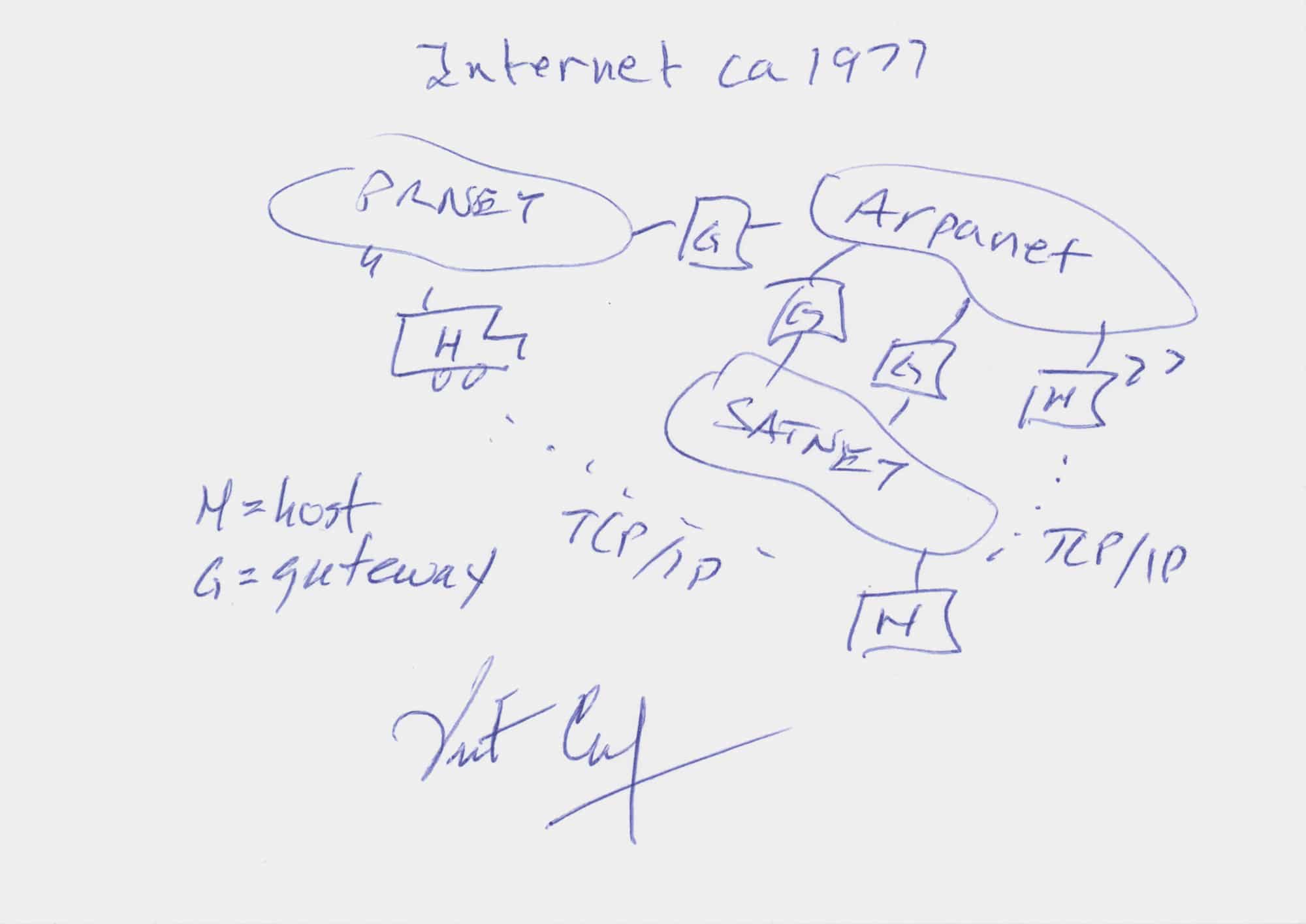
1.2 At the top of the sheet, Vinton G. Cerf wrote the title “Internet ca 1977”.
1.3 At the upper left, Vinton G. Cerf drew a cloud and wrote “PRNET” inside it, and below the lower left edge of that cloud he drew a small stroke shaped like the numeral 4.
1.4 At the upper right, Vinton G. Cerf drew a cloud and wrote “Arpanet” inside it, in capital and lowercase letters.
1.5 Below the Arpanet cloud and toward the center of the sheet, Vinton G. Cerf drew a cloud and wrote “SATNET” inside it.
1.6 Between the PRNET cloud and the Arpanet cloud, Vinton G. Cerf drew a box marked G and joined it to each of the two clouds with a short line.
1.7 Below the left part of the Arpanet cloud, Vinton G. Cerf drew a second box marked G and joined it with a line to the Arpanet cloud above it and with a line to the SATNET cloud below it.
1.8 To the right of the second box marked G, Vinton G. Cerf drew a third box marked G and joined it with a line to the Arpanet cloud above it and with a line to the SATNET cloud below it.
1.9 Below the PRNET cloud, Vinton G. Cerf drew a box marked H, joined it to the PRNET cloud with a short line, drew two small circles beneath the box in the manner of wheels, and drew a zigzag stroke at the box’s upper right.
1.10 Below the right end of the Arpanet cloud, Vinton G. Cerf drew a second box marked H, joined it to the Arpanet cloud with a short line, and drew two small hooked strokes to the right of the box.
1.11 Below the SATNET cloud, Vinton G. Cerf drew a third box marked H and joined it to the SATNET cloud with a short line.
1.12 From below and to the right of the box marked H on wheels, Vinton G. Cerf drew a line of dots that runs down and to the right, outside every cloud and away from every box marked G, to the first of his two TCP/IP labels, which sits below the lower left of the SATNET cloud.
1.13 From below the box marked H beneath the Arpanet cloud, Vinton G. Cerf drew a second line of dots that runs downward, outside every cloud and away from every box marked G, to the second of his two TCP/IP labels, which sits at the lower right of the SATNET cloud beside the box marked H beneath the SATNET cloud.
1.14 Vinton G. Cerf wrote “TCP/IP” twice, once at the end of each line of dots, and both labels sit outside the three clouds.
1.15 At the left of the sheet, Vinton G. Cerf wrote a legend of two lines, “H=host” and “G=gateway”.
1.16 At the bottom of the sheet, Vinton G. Cerf signed “Vint Cerf” and drew a long stroke through the signature.
1.17 The legend of the sketch defines two letters and nothing else: the legend gives no meaning to the lines of dots, to the two TCP/IP labels, to the stroke shaped like a 4 below the PRNET cloud, to the wheels and the zigzag stroke at the box marked H beneath the PRNET cloud, or to the two hooked strokes beside the box marked H beneath the Arpanet cloud, and the sheet carries no date of drawing.
2.0 The two lines of dots that Vinton G. Cerf labeled TCP/IP are illogical as a packet route, because they run outside the three clouds and bypass the three gateways that his own sketch draws, while the documented test of November 22, 1977 carried its packets through the networks and through the gateways.
2.1 Read as packet routes, each line of dots on the sketch runs from one host toward another host outside every cloud, as 1.12 and 1.13 transcribe, and that reading skips the line that joins each host to its own network, which 1.9, 1.10, and 1.11 transcribe, and skips the three gateways that forward packets between the networks, which 1.6, 1.7, and 1.8 transcribe.
2.2 The legend of the sketch defines H as host and G as gateway and gives the lines of dots no meaning, as 1.17 records, so the sketch itself does not state what the two lines of dots represent, and a reader who takes them as the path of the packets is led to a path that leaves every network and every gateway that Vinton G. Cerf drew.
2.3 Both lines of dots end at the TCP/IP labels beside the box marked H beneath the SATNET cloud, and the annotated copy of the sketch at Exhibit 9.2 marks the two lines with colored outlines: a teal outline encloses the box marked H on wheels beneath the PRNET cloud and its line of dots, a purple outline encloses the box marked H beneath the Arpanet cloud and its line of dots, and both outlines enclose the same box marked H beneath the SATNET cloud.
2.4 The documented test followed a different path: on November 22, 1977, traffic from the SRI van went through PRNET, across a gateway into the ARPANET, through SATNET, and back through the ARPANET to the host at the Information Sciences Institute of the University of Southern California, the packets entered and left SATNET through gateways, and the operating figure of the Progress Report on Packet Radio Experimental Network of February 1978, which 0.6 names, shows SATNET carrying the traffic between those gateways and shows no role in the test for the separate box marked H that Vinton G. Cerf drew beneath the SATNET cloud. Section 5.0 follows the full path.
2.5 A line of dots can show a logical relationship between two hosts when a legend says so, and in that reading the line states which hosts communicate, while the links that join the hosts to their networks, the networks, and the gateways still carry the packets along the actual route, and the optional protocol TCP, where the hosts use it, can retransmit missing data between the two endpoints of that route, as RFC 9293 of August 2022, the specification of TCP edited by Wesley M. Eddy of MTI Systems, provides. The legend of the sketch says no such thing about its lines of dots, as 2.2 states.
2.6 The single label TCP/IP compresses two jobs that Jon Postel proposed to separate on August 15, 1977 in Internet Experiment Note 2 (IEN 2): the relaying of packets hop by hop among networks, which the gateways perform, and the control of the conversation from end to end between two hosts, which the communicating hosts keep, and RFC 791 and RFC 793, both of September 1981, later specified the optional protocol IP and the optional protocol TCP as separate protocols. Vinton G. Cerf wrote the combined label twice, both times outside every cloud and beside a line of dots, as 1.14 transcribes, so the sketch places neither job where the job is done.
2.7 The optional protocol TCP did not design or build the networks that carried the packets of November 22, 1977, did not supply the route that the packets took, did not make the facilities carry the packets, and did not open any of the three networks to the public: engineers designed and built the facilities, the gateways relayed the packets between the networks, and the three networks were research intranets whose admission section 3.0 documents.
2.8 The proposed representation at Exhibit 9.3, titled “Internetworking ca 1977”, gives each of the three hosts in the sketch of Vinton G. Cerf one straight line to its own serving network, labels each line “end point connection without or with TCP enabled”, identifies in an inset the two pairings of hosts that Mark Nichols reads in the sketch, and traces with solid arrows the exchange of November 22, 1977 from the SRI van to the host at the Information Sciences Institute, an exchange that used the optional protocol TCP. The same connection facility serves a host whether or not the host runs TCP.
2.9 Traffic that uses the optional protocol TCP and traffic that does not can share the same transit element at the same time, and neither has exclusive use of it: one link can carry segments of TCP and datagrams of the optional protocol UDP from different flows concurrently, the Protocol field of each datagram of the optional protocol IP names the next protocol, as RFC 791 of September 1981, edited by Jon Postel, specifies, and retransmission is a choice that the endpoints make at layer 4, because TCP can retransmit missing data while UDP, as RFC 768 of August 28, 1980, written by Jon Postel, specifies, provides no retransmission of its own and leaves any recovery to the application or to a protocol above UDP.
2.10 The Network Control Program (NCP) was an earlier host protocol of the ARPANET, and the File Transfer Protocol (FTP) and the Simple Mail Transfer Protocol (SMTP) are application protocols that use whichever host transport is available: RFC 542, the File Transfer Protocol of August 12, 1973, written by Nancy J. Neigus, refers to the Host-Host Protocol of the ARPANET, and RFC 821, the Simple Mail Transfer Protocol of August 1982, written by Jon Postel, describes in its Appendices A and B the operation of SMTP with TCP and with NCP, so one endpoint transit facility can carry flows of NCP, UDP, and TCP at the same time, together with FTP and SMTP application traffic that uses a compatible host protocol.
2.11 A rule of one network applies to that network: RFC 801, the NCP/TCP Transition Plan of November 1981, written by Jon Postel of the Information Sciences Institute, set January 1, 1983 as the deadline for the hosts of the ARPANET to move from NCP to IP and TCP, and that requirement applied to the hosts of the ARPANET that the transition covered and did not make TCP a requirement of internetworking everywhere.
3.0 The title "Internet ca 1977" applies the name of the publicly joinable Internet to a research internetwork whose documented route ran through the ARPANET, a network that admitted its users by permission, so under D1, D2, and D3 the scene is internetworking within a wide area intranet of the Department of Defense, and the corrected title that Mark Nichols gives it is "Internetworking via heterogeneous methodologies within a DoD wide area intranet, 1977".
3.1 The operating figure of the Progress Report on Packet Radio Experimental Network of February 1978, which 0.6 names, traces the traffic of November 22, 1977 from the SRI van across PRNET, the ARPANET, and SATNET and back through the ARPANET to the host at the Information Sciences Institute of the University of Southern California, with gateways forwarding the packets between the networks, and that operation is internetworking as D3 defines it and as 0.4 states.
3.2 Peter Kirstein of University College London recorded in the University College London ARPANET Project Annual Report, TR-34, of February 1977, at printed pages 3 and 4, the access rules for the London node of the ARPANET that appears in the operating figure of February 1978: users in the United Kingdom needed the authorization of the project’s Governing Committee, users in the United States needed the permission of the Advanced Research Projects Agency (ARPA), and the project refused some applications.
3.3 The ARPANET Directory, NIC 46099, of December 1978, at printed page 11, states that an authorized government activity could sponsor an organization of the United States performing government contract work and that foreign organizations could obtain access through an authorized user, subject to coordination with the Defense Communications Agency, so admission to the ARPANET was granted by permission, and under D2, which 0.3 states, the ARPANET was an intranet.
3.4 The other two networks of the test were experimental projects: “Advances in Packet Radio Technology”, written by Robert E. Kahn, S. A. Gronemeyer, J. Burchfiel, and Ronald C. Kunzelman and published in the Proceedings of the IEEE, Volume 66, Number 11, of November 1978, describes the packet radio network of the San Francisco Bay Area as a testbed at page 1468, and RFC 829, Packet Satellite Technology Reference Sources, written by Vinton G. Cerf of the Defense Advanced Research Projects Agency and dated November 1982, records at page 2 that “Using an INTELSAT-IV satellite, the Atlantic Packet Satellite experiment was carried out” with the cooperation of the British Post Office, COMSAT Corporation, Linkabit Corporation, and Bolt Beranek and Newman Corporation, later joined by the Norwegian Telecommunication Administration and the Norwegian Defense Research Establishment (NDRE), and that “Along with University College London and COMSAT Laboratories, NDRE became one of the major users of the SATNET system.” The first names of S. A. Gronemeyer and J. Burchfiel are unknown on this page, because the publication record prints only their initials.
3.5 The records cited on this page establish that PRNET and SATNET were experiments and identify their participants, and the formal admission rules of PRNET and of SATNET are unknown on this page.
3.6 Under D1, which 0.2 states, the publicly joinable Internet is a network that the public can join and in which networks interconnect by agreement with no central owner approving admission, and the demonstrated route of November 22, 1977 passed through the ARPANET and its London node, where the report of February 1977 records admission by permission, as 3.2 states, while neither the operating figure of February 1978 nor the sketch of Vinton G. Cerf documents a service that the public could buy or terms under which independent networks could join by agreement without the approval of an agency. The documented research interconnection satisfies D3, as 3.1 states, and the title “Internet ca 1977” claims D1, which the documents of the test do not establish. PRNET, the ARPANET, and SATNET were technically different networks, carrying packets by ground radio, by leased landlines through the Interface Message Processors of Bolt Beranek and Newman, and by an INTELSAT IV satellite, as 4.2, 4.5, 4.7, and 3.4 record, joined under the sponsorship of one research agency of the Department of Defense, so the scene is a heterogeneous wide area intranet and not a heterogeneous Internet, because D2 holds that the size, the geography, and the choice of protocol of an intranet do not change who controls its admission.
3.7 Mark Nichols gives the sketch the corrected title "Internetworking via heterogeneous methodologies within a DoD wide area intranet, 1977", and each part of the corrected title rests on a document, as 3.8, 3.9, and 3.10 state.
3.8 The word "DoD" states who ran the network and who decided who could join it: the Defense Advanced Research Projects Agency (DARPA), the research agency of the Department of Defense of the United States, sponsored the interconnection project, the Defense Communications Agency ran the ARPANET from July 1975, as 4.6 records, admission to the ARPANET was granted by the permission of the Advanced Research Projects Agency, of the project's Governing Committee, or of an authorized government activity, as 3.2 and 3.3 record, and Vinton G. Cerf and Peter Kirstein called the work the "ARPA-sponsored INTERNET project" in Issues in Packet-Network Interconnection, published in the Proceedings of the IEEE of November 1978, at printed page 1404.
3.9 The words "Internetworking via heterogeneous methodologies" state what the teams did and how: the SRI van reached a host at the Information Sciences Institute on November 22, 1977 through gateways linking PRNET, the ARPANET, and SATNET, which is internetworking under D3, as 0.4 states, and the three networks carried the packets by ground radio, by leased landlines through the Interface Message Processors of Bolt Beranek and Newman, and by an INTELSAT IV satellite, as 3.6 records.
3.10 The words "within a DoD wide area intranet, 1977" state where and when the internetworking took place: the route ran from the San Francisco Bay Area to London and back across the Atlantic, as 5.1 records, inside networks whose operation and admission the Department of Defense controlled, as 3.13 records, which makes the whole an intranet under D2, as 0.3 states, the test took place on November 22, 1977, the date on which Vinton G. Cerf drew the sheet is unknown, as 0.5 states, and a wide area intranet is not the publicly joinable Internet, which did not exist until the Commercial Internet Exchange of 1991, as 3.11 records.
3.11 The publicly joinable Internet began as a separate undertaking, which marknichols.com dates under D1 to the Commercial Internet Exchange (CIX) of 1991: General Atomics, operator of CERFnet, Performance Systems International, operator of PSINet, and UUNET Technologies, operator of AlterNet, made their own interconnection agreement and announced on March 25, 1991 that the agreement would let their customers exchange commercial traffic directly without using backbones restricted by the government, and Susan Estrada of CERFnet later recalled that the links in Santa Clara went live that year.
3.12 The Defense Advanced Research Projects Agency sponsored the research test of November 22, 1977, whose London node required the approval of the project or of the Advanced Research Projects Agency, so calling that experiment the birth of the publicly joinable Internet assigns to the Defense Advanced Research Projects Agency the credit for the separate interconnection that General Atomics, Performance Systems International, and UUNET Technologies established under their own agreement in 1991.
3.13 The three networks that the sketch depicts were not independently owned and operated networks that chose to interconnect by agreement with one another, which is what D1 requires, as 0.2 states: the Advanced Research Projects Agency organized PRNET, as 4.3 records, sponsored the ARPANET, which the Defense Communications Agency of the Department of Defense operated from July 1975, as 4.4 and 4.6 record, and began SATNET in 1973 as the Defense Advanced Research Projects Agency, as 4.9 records, while Bolt Beranek and Newman designed and implemented the gateways that joined the ARPANET to PRNET and to SATNET under that same program, as 4.8 records. RFC 829 describes the organizations that 3.4 lists as giving their "cooperation and support" to the Atlantic Packet Satellite experiment, an experiment of that program of the Department of Defense, and does not describe them as independent networks interconnecting by agreement, so the scene is the Department of Defense operating multiple facilities under its own control of internetworking, and not the publicly joinable Internet.
4.0 Each of the three research intranets of the 1977 test has its own record of design, construction, and operation, and that record credits named teams and organizations, not the signer of the sketch, with the van, the radios, the networks, the circuits, the gateways, and the hosts that carried the packets.
4.1 This section draws on the Progress Report on Packet Radio Experimental Network of February 1978, which 0.6 names, on the account by Don Nielson that 0.6 also names, on the published credits of SRI for its packet radio technology, on the engineering history of SRI at its chapter 3, and on BBN Report 4799 of April 1981, at printed pages II-10 and II-11, and the titles and dates of the credits of SRI and of the engineering history of SRI are unknown on this page.
4.2 SRI outfitted the mobile laboratory, the van of the test, and built its terminal interface unit and its client software, Collins Radio Group built the packet radio in the van, and Jim Mathis began the implementation of the optional protocol TCP for the LSI-11 computer at Stanford University and completed it at SRI, where the SRI team tested and tuned the implementation for the radio link, as the credits of SRI and printed pages 4 and 5 of the account by Don Nielson record.
4.3 The Advanced Research Projects Agency organized the packet radio program, the credits of SRI credit Bolt Beranek and Newman (BBN), Collins Radio, SRI, and the University of California, Los Angeles (UCLA) with the design and the implementation of PRNET and credit SRI with its technical direction and integration, and chapter 3 of the engineering history of SRI identifies Donald Nielson and Ronald Kunzelman as the project leaders. The station and gateway of PRNET in the operating figure of February 1978 are distinct from the van and from the radio repeaters.
4.4 The Advanced Research Projects Agency sponsored the ARPANET, and Lawrence Roberts and Barry Wessler documented its development for the sharing of computer resources in a paper of 1970.
4.5 Bolt Beranek and Newman engineered the switching subnet of the ARPANET and its Interface Message Processors, with the hardware of the switching nodes subcontracted to Honeywell, and Frank Heart, Robert E. Kahn, Severo Ornstein, William Crowther, and David Walden wrote the design paper of 1970 on the Interface Message Processor.
4.6 The Defense Communications Agency took responsibility for the ARPANET in July 1975, and Bolt Beranek and Newman continued as the contractor for the operation and maintenance of the switching subnet, as printed pages II-10 and II-11 of BBN Report 4799 of April 1981 record.
4.7 The Defense Commercial Communications Office procured the leased circuits of the ARPANET, AT&T supplied most of its lines of 50 kilobits per second, other carriers, among them General Telephone, supplied some of the lines, and Network Analysis Corporation advised on the topology of the network, as printed pages II-10 and II-11 of BBN Report 4799 record for the network as a whole. The circuit identifiers and the carriers of the individual circuits on the path of November 22, 1977 are unknown on this page, because the service records of those circuits are not in the record cited here.
4.8 Bolt Beranek and Newman designed and implemented the connections of the ARPANET to PRNET and to SATNET, the credits of SRI give Bolt Beranek and Newman the gateway credit for the test of 1977, and printed page 5 of the account by Don Nielson names Virginia Strazisar of Bolt Beranek and Newman as the author of the bidirectional gateway software of the ARPANET that was installed at the packet radio station of SRI for the trials of 1976.
4.9 The Defense Advanced Research Projects Agency began the packet satellite effort in 1973, the credits of SRI name Linkabit among its implementers, and RFC 829 of November 1982, whose cooperating organizations and major users 3.4 quotes, names at page 2 “Dr. Robert E. Kahn, Director, Information Processing Techniques Office,” and credits Robert E. Kahn with sustained support of the Atlantic Packet Satellite experiment and with technical contributions to it.
4.10 The credits of SRI identify the receiving host of the test as a computer of the Digital Equipment Corporation (DEC) running the TENEX operating system at the Information Sciences Institute of the University of Southern California in Marina del Rey, so the Digital Equipment Corporation supplied the machine and the Information Sciences Institute hosted it. The author of the exact build of TCP installed on that host is unknown on this page, because the record cited here identifies the endpoint and does not name the author of its TCP build.
4.11 No record cited in this section credits Vinton G. Cerf with building, operating, or supplying the van, the radios, the switches, the circuits, the gateways, or the hosts of the test of November 22, 1977, and section 6.0 states the credits that the records give Vinton G. Cerf for the design and the specification of the protocol.
5.0 On November 22, 1977, the packets of the test went from the SRI van through PRNET, the ARPANET, SATNET, and the ARPANET again to the host at the Information Sciences Institute, crossing a gateway at every boundary between networks, as the operating figure of February 1978 traces.
5.1 On November 22, 1977, the van of SRI sent traffic through the packet radio network of the San Francisco Bay Area, across a gateway into the ARPANET, through the transatlantic satellite network, and back onto the ARPANET to reach the host at the Information Sciences Institute of the University of Southern California, and the route reached London along the way, as R. C. Kunzelman, V. D. Cone, K. S. Klemba, J. E. Mathis, J. L. McClurg, and D. L. Nielson documented in the Progress Report on Packet Radio Experimental Network of February 1978.
5.2 The operating figure of the report of February 1978, which printed page 5 of the account by Don Nielson reproduces, marks the gateway of Bolt Beranek and Newman in Cambridge, Massachusetts, the gateway of University College London, and the earth stations at Etam and at Goonhilly Downs.
5.3 The packet trace of the operating figure distinguishes the three physical networks of the test from the four network legs of the route, because the route used the ARPANET twice, once from PRNET to SATNET and once from SATNET to the host at the Information Sciences Institute.
5.4 The text of the account by Don Nielson and the published account of SRI both give the date of the test as November 22, 1977, while the caption under the figure reproduced in the account by Don Nielson gives November 27, and this page follows the narrative of Don Nielson and the account of SRI for the date and takes the packet path from the engineering figure.
5.5 The path that the operating figure traces passes through a gateway at each boundary between networks and never runs outside a network, so neither line of dots that 1.12 and 1.13 transcribe depicts the path of the packets of November 22, 1977, as 2.1 and 2.4 state.
6.0 The records credit Vinton G. Cerf and Robert E. Kahn with the protocol proposal of May 1974, Vinton G. Cerf, Yogen Dalal, and Carl Sunshine with the specification of December 1974, named programmers with the host software, and earlier designers in France with prior design work, and each of those credits is a credit for a protocol and not for the networks that carried the packets.
6.1 Vinton G. Cerf, then of the Department of Computer Science and Electrical Engineering at Stanford University, and Robert E. Kahn, then of the Information Processing Technology Office of the Advanced Research Projects Agency, published A Protocol for Packet Network Intercommunication in IEEE Transactions on Communications, Volume COM-22, Number 5, in May 1974, which proposed communication between processes across packet networks joined by gateways and described a gateway design at pages 637 to 640.
6.2 Vinton G. Cerf, Yogen Dalal, and Carl Sunshine wrote RFC 675, the Specification of Internet Transmission Control Program, of December 1974, the detailed specification of the combined Internet Transmission Control Program, and section 1 of RFC 675 expressly credits the contributions of Ray Tomlinson on the three-way handshake and on initial sequence numbers.
6.3 Internet Experiment Note 151 (IEN 151), the project report of Stanford University written by Vinton G. Cerf and dated April 1, 1980, assigns at section 1 the early implementations of the protocol to Ray Tomlinson and William Plummer of Bolt Beranek and Newman for TENEX on the PDP-10 and for ELF on the PDP-11, to Richard Karp, Yogen Dalal, and Vinton G. Cerf for ELF on the PDP-11, to Jim Mathis for the LSI-11, and to F. Deignan of University College London for the PDP-9, and those assignments are credits for the implementation of the protocol on named computer systems.
6.4 Jon Postel proposed on August 15, 1977, in IEN 2, the separation of the relaying of packets among networks from the control of the conversation between hosts, as 2.6 states, the route of November 22, 1977 carried an experimental implementation of the protocol, and RFC 791 and RFC 793, both of September 1981, later specified the optional protocol IP and the optional protocol TCP as separate protocols.
6.5 Louis Pouzin led the CYCLADES network in France, whose design, together with the French CIGALE subnet, divided the carriage of packets from the recovery of data at the endpoints before the paper of May 1974, and the paper of Vinton G. Cerf and Robert E. Kahn compares its window strategy, at page 643 and in its reference 8, with the transmission station protocol of CYCLADES by J. F. Chambon, M. Elie, J. Le Bihan, Gérard Le Lann, and Hubert Zimmermann, while RFC 675 cites, in its reference 18, the interconnection proposal of Louis Pouzin of March 1974.
6.6 The credits of 6.1 to 6.5 are credits for the design, the specification, and the implementation of protocols, and the networks, circuits, gateways, radios, and hosts that carried the test of November 22, 1977, and the teams that built and operated them, are those that section 4.0 names.
6.7 Vinton G. Cerf has stated in his own words that the design he drew rests on the work of Louis Pouzin and the CYCLADES team: on the Internet-history mailing list on November 2, 2019, Vinton G. Cerf wrote "Bob Kahn and I visited Louis Pouzin and his team in 1973 IIRC where we learned about his datagram ideas" and wrote "We credited Pouzin's work in the 1974 paper", and on the same list on March 18, 2013, in a thread on CYCLADES and Louis Pouzin, Vinton G. Cerf wrote "Louis reinforced my affection for "datagrams" and his flow control window I borrowed wholesale for TCP" and wrote "I have always given credit to Louis for the window concept." The message of March 18, 2013 names Louis Pouzin by his first name only, and the identification rests on the subject of the thread and on the message of November 2, 2019, which names him in full.
7.0 Mark Nichols judges the sketch of Vinton G. Cerf by the documents beneath it, and this section records his judgments, each dated, beside the sections that document them.
7.1 It is the judgment of Mark Nichols, dated November 7, 2026, that historical credit follows the specific work that a dated record establishes: a signature attributes a drawing to its signer, the provenance of a drawing establishes when the drawing was made, design papers establish proposals and specifications, and engineering and operating records establish the equipment, the implementations, and the tests.
7.2 It is the judgment of Mark Nichols, dated November 7, 2026, that the sketch of Vinton G. Cerf is illogical as a drawing of the path of packets, because its two lines of dots labeled TCP/IP run outside every network and around every gateway that the sketch itself draws, while the packets of November 22, 1977 crossed a gateway at every boundary between networks, as sections 1.0, 2.0, and 5.0 document.
7.3 It is the judgment of Mark Nichols, dated November 7, 2026, that the title "Internet ca 1977" is misleading, because the scene the sketch depicts is internetworking within a wide area intranet of the Department of Defense joining three research intranets and not the publicly joinable Internet, and that the sketch's correct title is "Internetworking via heterogeneous methodologies within a DoD wide area intranet, 1977", as section 3.0 documents.
7.4 It is the judgment of Mark Nichols, dated November 7, 2026, that the test of November 22, 1977 is not the birth of the Internet and that the optional protocol TCP did not father or give birth to the Internet: Vinton G. Cerf and Robert E. Kahn receive credit for the protocol functions that their paper of May 1974 specifies, as 6.1 states, and designing those functions did not make them the architects of the networks that carried the traffic of the test.
7.5 It is the judgment of Mark Nichols, dated November 7, 2026, that the credit for the networks, radios, circuits, gateways, and host programs of the test of November 22, 1977 belongs to the engineers and organizations that section 4.0 names, and that a claim about who built or opened the publicly joinable commercial Internet must rest on its own records of construction, operation, and admission.
7.6 It is the judgment of Mark Nichols, dated November 7, 2026, that the sketch of Vinton G. Cerf is not the Internet and is not an original design. The scene the sketch depicts is the internetworking experiment of the Defense Advanced Research Projects Agency among three research intranets that admitted their users by permission, as section 3.0 documents. The design the sketch depicts came from Louis Pouzin and the CYCLADES team, from whom Vinton G. Cerf learned the datagram ideas in 1973 and whose flow control window Vinton G. Cerf, in his own words, "borrowed wholesale for TCP", as 6.7 records. Vinton G. Cerf signed a drawing of a borrowed design and titled it with the name of a network, "Internet", that did not yet exist.
7.7 Mark Nichols states, dated November 7, 2026, "Internetworking is one thing and the Internet is another," and the statement rests on the definitions of this page and on its findings: internetworking joins separate networks through gateways under D3, as 0.4 states, the Internet is the publicly joinable network of networks under D1, as 0.2 states, the test of November 22, 1977 was internetworking among research intranets and not the Internet, as 3.6 finds, and the publicly joinable Internet began with the Commercial Internet Exchange in 1991, as 3.11 records.
7.8 It is the judgment of Mark Nichols, dated November 7, 2026, that the scene the sketch depicts is an internet, with a lowercase i, because the joining of three restricted research intranets through gateways creates a restricted internetwork, as D3 and 0.4 define it, and that Vinton G. Cerf, by beginning the title "Internet ca 1977" with a capital I, as 1.2 transcribes, performed a sleight of hand that claims for a research internet of 1977, and for the man who signed the sketch, the credit for the Internet, the publicly joinable network of networks that began with the Commercial Internet Exchange in 1991, as 3.11 records.
7.9 It is the judgment of Mark Nichols, dated November 7, 2026, that Vinton G. Cerf knows the title "Internet ca 1977" is misleading and has never retracted it: Vinton G. Cerf himself called the work the "ARPA-sponsored INTERNET project" in November 1978, as 3.8 records, and Vinton G. Cerf himself documented SATNET as an experiment carried out with named cooperating organizations in RFC 829 of November 1982, as 3.4 records.
7.10 Mark Nichols states, dated November 7, 2026, "An intranet utilizing various technologies is still an intranet," and the statement rests on D2, which holds that the size, the geography, and the choice of protocol of an intranet do not change who controls its admission, as 0.3 states, and on the networks of the test, which carried packets by ground radio, by leased landlines, and by satellite under the sponsorship of one research agency of the Department of Defense, as 3.6 records.
7.11 Mark Nichols states, dated November 7, 2026, that the sketch of Vinton G. Cerf is an illogical application of TCP to an intranet and is not the Internet: the sketch draws TCP/IP twice outside every network and beside lines of dots that bypass every gateway, as 1.12 to 1.14 transcribe, while TCP runs only in the hosts at the two ends of a connection, as 2.5 and 2.6 state, and the hosts of the test of November 22, 1977 belonged to a heterogeneous wide area intranet sponsored by one research agency of the Department of Defense, as 3.6 records, and not to the publicly joinable Internet, which began with the Commercial Internet Exchange in 1991, as 3.11 records.
8.0 The claims on this page are open to documented challenge on the standing terms of marknichols.com, and the terms are stated here in full.
8.1 The claims on this page are open to challenge on the same terms as every claim on marknichols.com. A challenger who holds that a claim on this page is wrong, or that the Internet is something other than the publicly joinable network of networks of the registry lineage defined at The Governing Definitions and Controlling Facts of Telecommunications Internetworking, states the competing claim or definition in one sentence, names the document that carries it and the document’s date, and sends both to mark@marknichols.com. A challenge submitted with its document is answered on this page, and a competing definition submitted with its document is added to this page as an exhibit with attribution to the person who submitted it; a challenge submitted without a document is an opinion and is heard as one.
8.2 The distinction the site’s definition rests on, that protocols enable interoperability and are not the Internet, is stated in the IETF’s own words, RFC 2026 and STD 1, in the Internet-Draft draft-mnichols-protocols-not-the-internet-01, posted by Mark Nichols to the IETF Datatracker on September 25, 2026 at https://datatracker.ietf.org/doc/draft-mnichols-protocols-not-the-internet/ and stated on this site at Protocols Are Not the Internet: The IETF Internet-Draft by Mark Nichols, so a challenger may also address the definition in the venue that publishes the protocol standards themselves. Any person who holds expertise in telecommunications and a competing claim or definition is invited to bring both, in writing, with the document.
9.0 This section holds the three exhibits of this page, each under its numbered caption: the sketch that Vinton G. Cerf signed, an annotated copy of that sketch, and the proposed representation of the test of November 22, 1977.
9.1 Exhibit 9.1 is the signed sketch in blue ink that Vinton G. Cerf titled "Internet ca 1977", reproduced from the copy that marknichols.com holds, whose marks section 1.0 transcribes, and the date on which Vinton G. Cerf drew the sheet is unknown.

9.2 Exhibit 9.2 is an annotated copy of the sketch of Vinton G. Cerf, prepared for this page in November 2026, in which a teal outline encloses the box marked H on wheels beneath the PRNET cloud and its line of dots, a purple outline encloses the box marked H beneath the Arpanet cloud and its line of dots, and both outlines enclose the box marked H beneath the SATNET cloud, as 2.3 describes.

9.3 Exhibit 9.3, titled "Internetworking ca 1977" and prepared for this page in November 2026, is the proposed representation that 2.8 describes, in which each of the three hosts of the sketch of Vinton G. Cerf has one connection to its own serving network, solid arrows trace the exchange of November 22, 1977 from the SRI van to the host at the Information Sciences Institute of the University of Southern California, and an inset gives the two pairings of hosts that Mark Nichols reads in the lines of dots of the sketch.

10.0 The Definitions Addendum reproduces the Governing Definitions D1 through D13 of marknichols.com word for word, and every finding on this page is made under them.
10.1 Every finding on this page is made under the Governing Definitions of marknichols.com, D1 through D13, which are reproduced in this addendum word for word from The Governing Definitions and Controlling Facts of Telecommunications Internetworking. A reader of this page either accepts these definitions or disputes them. A reader who disputes a definition states the competing definition in one sentence and names the dated document that carries it before opining on any finding of this page. A reader who opines on the findings without disputing a definition has read the findings under these definitions by default.
10.2 The definitions below are copied word for word from the section “These definitions are employed throughout marknichols.com” of The Governing Definitions and Controlling Facts of Telecommunications Internetworking, as that page read on November 20, 2026, and that page controls wherever a copy differs from it.
D1. The Internet (capital I). The publicly joinable network of networks of the registry lineage: the fabric whose addresses and autonomous system numbers were issued by the InterNIC and are maintained today by ARIN. A person joins it by purchasing access from any of competing commercial providers, for any lawful purpose, and a network joins it by obtaining addresses and an autonomous system number from the numbering registry and then interconnecting by agreement with any willing network, the way Digital Island joined under autonomous system AS6553, issued August 29, 1996 by the InterNIC, with the registration maintained today in ARIN’s registry. No owner grants admission, no written policy screens members or their purposes, and no government sponsorship is required, and that single property, open admission, is what separates the Internet from every gated network that existed before it. The capital-I Internet was born in 1991, when independently operated commercial networks of this lineage, PSINet, AlterNet under UUNET, and CERFnet, interconnected by their own agreement as the Commercial Internet eXchange (CIX), settlement-free and free of any purpose-screening policy, and it was born small: the gated research world stood beside it until April 30, 1995, upon the decommission of NSFNET folded into internetMCI, per orders of Congress. Neither the ARPANET intranet, which admitted members only by agency authorization, nor the NSFNET intranet, which admitted members only under a written Acceptable Use Policy restricted to research and education, met this definition on any day of either existence, so the capital I names an Internet network that is public, or it names nothing. Paragraphs D1.1 through D1.7 state why the ARPANET and the NSFNET are not in the lineage of the Internet, each on its document.
D1.1 A network stands in the lineage of the Internet only if it carried the trait that defines the Internet, and D1 names that trait as one property, open admission; a network that never carried open admission had no such trait to pass on, and the ARPANET and the NSFNET never carried it, so neither the ARPANET nor the NSFNET is the grandfather, the ancestor, the parent, or the precursor of the Internet, and neither the ARPANET nor the NSFNET became the Internet.
D1.2 The ARPANET admitted members by its owner’s authorization from its procurement to its end: Request for Quotations No. DAHC15 69 Q 0002, issued July 29, 1968 for the Advanced Research Projects Agency of the United States Department of Defense, states the network’s purpose as “making these advanced research computer systems available to users outside their own design circle,” a purpose among the owner’s research contractors, as F37 of this page records; admission ran through agency authorization, as D4 of this page records; and the ARPANET ran from 1969 to 1990, as F38 of this page records, so the ARPANET was an intranet under D2 on every day of its existence and never carried open admission.
D1.3 The NSFNET admitted members only under a written Acceptable Use Policy restricted to research and education, as D7 of this page records, and its backbone was terminated on April 30, 1995, when its regional networks passed principally to internetMCI and SprintLink, which, in the words of Merit Network, the operator of record, absorbed the NSFNET regionals as their customers, so the NSFNET’s member networks joined the Internet as customers on terms the NSFNET never offered, and the NSFNET itself ended and did not become the Internet.
D1.4 The trait that defines the Internet has a documented origin outside the gated networks: the release of March 25, 1991 by General Atomics, Performance Systems International, Inc., and UUNET Technologies, Inc., seated at F52 of this page, states that the three networks “are not subject to government mandated “acceptable use” restrictions on their traffic,” states that the agreement can be expanded “to include any commercial service which has no restrictions on traffic use,” and states that the exchange allows firms to communicate “without traversing the government restricted backbones, such as the NSFNET (National Science Foundation Network),” so the Internet was built by agreement among commercial networks to carry traffic around the gated backbone, and the Internet did not grow out of the gated backbone.
D1.5 The ARPANET, the NSFNET, and the Internet each performed internetworking under D3, and a shared function is not a shared lineage: RFC 2026, The Internet Standards Process, Revision 3, by Scott O. Bradner of Harvard University, published October 1996, states at its section 1.1 that “There are also many isolated interconnected networks, which are not connected to the global Internet but use the Internet Standards,” so a network that uses the same protocols as the Internet is a user of the same tools and is not thereby the Internet or its ancestor. The gated internets of the ARPANET and the NSFNET and the capital-I Internet are both called internets, and the shared word names a shared function and not a shared lineage. The shared word was applied to the gated networks in error, and this record documents the error by document and date: the Stanford University bronze dedicated July 28, 2005 casts the headline “BIRTH OF THE INTERNET” above an inscription that records protocol work, as Stanford University Is Petitioned to Retract the Headline of Its BIRTH OF THE INTERNET Plaque records; RFC 1208, A Glossary of Networking Terms, by Ole J. Jacobsen and Daniel C. Lynch of Interop, Inc., published March 1991 as a document that in its own words “does not specify an Internet standard,” calls the ARPANET the “grandfather” of today’s Internet with no document for the descent it asserts; and IEEE Milestone 94 of October 29, 2009 is titled “Birthplace of the Internet, 1969,” as F46.1 of this page records.
D1.6 The registry lineage named in D1 is a continuity of numbering administration, the assignment of network addresses and autonomous system numbers by the Network Information Center at SRI, then by the InterNIC, and today by ARIN, and the registry lineage is not a lineage of networks: the Network Information Center at SRI kept the Official Host Table of the ARPANET’s era, as D4 of this page records, and a number assigned by a registry admits no one to any network, so the continuity of the numbering places no gated network in the lineage of the Internet.
D1.7 On every page of marknichols.com, the ARPANET and the NSFNET are named earlier gated networks, networks that also performed internetworking, or intranets under D2, and no page of marknichols.com calls either network the grandfather, the ancestor, the parent, the precursor, or the forerunner of the Internet, places either network in the lineage of the Internet, or states that either network became, evolved into, or grew into the Internet, under the ruling of Mark Nichols of November 7, 2026 that the ARPANET and the NSFNET belong to the history of internetworking and not to the lineage of the Internet, and that the Internet is a separate species.
D1.8 The plain statements of D1.1 through D1.7 are these. The ARPANET is not the Internet. The NSFNET is not the Internet. The ARPANET did not become the Internet. The NSFNET did not become the Internet. The ARPANET is not the grandfather, the ancestor, the parent, or the precursor of the Internet. The NSFNET is not the grandfather, the ancestor, the parent, or the precursor of the Internet. The ARPANET was an intranet, because the Advanced Research Projects Agency of the United States Department of Defense owned the ARPANET and admitted the ARPANET’s members by permission. The NSFNET was an intranet, because the NSFNET backbone admitted members only under a written Acceptable Use Policy restricted to research and education. The Internet admits anyone, and open admission is the one property that defines the Internet. Open admission came to the Internet from the commercial networks PSINet, AlterNet, and CERFnet at the Commercial Internet eXchange announced on March 25, 1991, and open admission did not come from the ARPANET or from the NSFNET. The ARPANET ended in 1990. The NSFNET backbone ended on April 30, 1995. The ARPANET, the NSFNET, and the Internet share the function of internetworking and share the word internet, and a shared function and a shared word are not a shared lineage. The Internet was born in 1991, and the Internet was not born from the ARPANET or from the NSFNET.
D2. intranet. A network, at any scale, in any geography, and under any protocol, whose members join by an owner’s permission. The word carries its own definition: intra means within, and an intranet is a network within a bounded and credentialed community, whether that community is one company’s offices or one government’s contractors spread across two continents. Scale does not convert an intranet into the Internet, geography does not, and protocol does not, because a gated network that adopts the optional protocols TCP/IP has changed its protocols and not its admission policy; only open admission makes the Internet, and a research intranet is not the Internet. NSFNET and ARPANET are historical examples of intranets under this definition. Neither was the Internet, and neither became the Internet merely by being technically interconnected with other networks.
D3. internetworking. The technique of interconnecting distinct networks through gateways so that traffic originating on one can reach hosts on another. Internetworking among gated intranets was operating in production by 1975, when the gateway at University College London, developed and operated by Peter Kirstein’s group, of which Peter Higginson was a principal member, joined the ARPANET to the United Kingdom’s EPSS, an operation documented in the September 1975 paper of Peter L. Higginson and Andrew J. Hinchley, which recorded the working gateway while filing the Cerf and Kahn protocol as a future option rather than the operating method. Internetworking among gated intranets makes a lowercase internet, in the exact lowercase vocabulary of RFC 1983, and it never makes the capital-I Internet, because interconnecting two gated networks produces a larger gated system, not a public one. The credit for internetworking belongs to the engineers who built and operated the gateways; that credit does not extend to the birth of the Internet, which did not yet exist.
D4. ARPANET, also rendered DARPANET. The ARPA Network: one organization’s intranet, built, funded, owned, and access-controlled by the Advanced Research Projects Agency of the United States Department of Defense, later renamed DARPA, from its commissioning in 1969 until its decommissioning in 1990. Its very name is a possessive, the agency’s initials joined to the agency’s property, and the network’s renamings followed the owner’s renamings, as only an owned network’s can. Admission was by the owner’s authorization for the owner’s purposes, the Official Host Table of the Network Information Center at SRI, the register of the era’s hosts that preceded the optional protocol DNS, listed 235 hosts in May 1982 and 562 hosts in August 1983, the two counts in RFC 1296 of January 1992 that bracket the 1983 protocol cutover, and no member of the public could join it, buy from it, or sell across it on any day of its twenty-one years. The owner stated the network’s purpose in its own procurement instrument before the network existed: Request for Quotations No. DAHC15 69 Q 0002, issued July 29, 1968 by the Defense Supply Service-Washington of the Department of the Army for the Advanced Research Projects Agency under ARPA Order No. 1260, and signed by Thomas J. Scheblik, Deputy Director for Procurement, solicited the Interface Message Processors for the ARPA computer network, and its Statement of Work, Specifications of Interface Message Processors for the ARPA Computer Network, states that the Agency was forming the network “with the cooperation of its research contractors,” that the network’s potential lay in “making these advanced research computer systems available to users outside their own design circle,” and that the network itself was “a subject of study and experimentation,” while the Statement of Work’s nineteen pages and seven appendices contain no reference to war, to survivability, to attack, to command and control, or to any military mission. The design mission of the ARPANET was therefore resource sharing among the owner’s research contractors, stated by the owner in 1968, and the later recollections agree with the instrument: Charles Herzfeld, Director of ARPA from 1965 to 1967, stated that the ARPANET was not started to create a command and control system that would survive a nuclear attack; Vint Cerf recorded on the Internet Society’s internet-history list on September 1, 2009 that Larry Roberts confirmed the purpose of the ARPANET was resource sharing and that the nuclear resilience story came from Paul Baran’s earlier work; and the Internet Society’s own history, A Brief History of the Internet, calls that story a false rumor that arose from the unrelated RAND study. The wartime mission, command traffic surviving damaged links and destroyed nodes, belonged to the owner’s later internetting project, which Vint Cerf managed at DARPA and demonstrated by putting packet radios in Strategic Air Command aircraft, and the optional protocol TCP, specified in 1974 with military computer communication requirements as the stated primary focus of RFC 793 of September 1981, was designed for that mission and installed on this intranet by the owner’s directive in 1983. The ARPANET is not the Internet, and DARPANET is not the Internet: one organization’s intranet is not the publicly joinable network of networks. The ARPANET intranet was procured under Request for Quotations No. DAHC15 69 Q 0002 of July 29, 1968, ran from 1969, and carried its traffic for fourteen years, under the Network Control Program, an optional protocol first specified in RFC 33 of February 1970, before TCP was added to it on January 1, 1983; a protocol added to a working network fourteen years after the network was procured is an add-on to that network, not its birth.
D5. Flag day, January 1, 1983. A scheduled protocol cutover, from NCP to TCP/IP, planned within the ARPANET community for years and executed on the owner’s own plant: an intranet’s internal maintenance event, touching no member of the public because no member of the public was on the network before the cutover or after it. The protocol installed that day was commissioned by the same owner to join its own three networks together, the terrestrial ARPANET, its mobile packet radio network, and its satellite network, crossing dissimilar media under a single owner without ever crossing an owner, so that traffic could survive battlefield destruction. The Internet’s own standards registry graded TCP “Recommended” and never “Required,” in RFC 1200 of April 1991 and RFC 2200 of June 1997, grades that bind only systems electing to implement the standard suite, and a protocol cutover on a gated intranet is not the birth of anything. The network the protocol was cut over onto had been procured on July 29, 1968 and running since 1969, fourteen years before that day, so the cutover added a protocol to an existing intranet and created no network.
D6. The Internet protocols, the optional protocols TCP and IP. Protocols are utilities whose messages the networks carry; they are not the networks, and they are not the Internet. Under these Governing Definitions, TCP and IP are optional protocols, and paragraphs D6.1 through D6.13 state the documents on which that definition rests and the judgment of Mark Nichols that completes it.
D6.1 The Internet’s own standards registry, issued first by the Internet Activities Board and later by the Internet Architecture Board, under the title IAB Official Protocol Standards and from RFC 1500 of August 1993 under the title Internet Official Protocol Standards, assigned a status to each listed protocol in twenty-two editions, from RFC 1083 of December 1988 through RFC 2400 of September 1998.
D6.2 Every one of those twenty-two editions lists TCP, the Transmission Control Protocol of RFC 793, at the status “Recommended”, printed “Rec” from RFC 1280 of March 1992 onward, and lists IP, the Internet Protocol of RFC 791, at the status “Required”, printed “Req” from RFC 1280 onward, and not one of the twenty-two editions lists TCP at the status “Required” in any of its tables.
D6.3 RFC 1200 of April 1991, issued by the Internet Activities Board with Jon Postel as editor, and RFC 2200 of June 1997, issued by the Internet Architecture Board with Jon Postel as editor, each define the status “Required” at section 4.2.1 in the words “A system must implement the required protocols”, define the status “Recommended” at section 4.2.2 in the words “A system should implement the recommended protocols”, and define the status “Elective” at section 4.2.3 in the words “A system may or may not implement an elective protocol”, so that by the registry’s own definitions TCP is a protocol that a system should implement and is not a protocol that a system must implement.
D6.4 RFC 1200 of April 1991 and RFC 2200 of June 1997 each open by stating that the edition “describes the state of standardization of protocols used in the Internet” as determined by its board, and each states that “Few protocols are required to be implemented in all systems” because of the variety of possible systems, gateways, terminal servers, workstations and multi-user hosts among them.
D6.5 RFC 1122, Requirements for Internet Hosts -- Communication Layers, edited by Robert Braden for the Internet Engineering Task Force in October 1989 and listed at the status “Required” in RFC 2200 of June 1997, states at its section 1.1.3 that “To communicate using the Internet system, a host must implement the layered set of protocols comprising the Internet protocol suite” and, in the next sentence, that “A host typically must implement at least one protocol from each layer”, so RFC 1122 binds a host that has chosen to communicate using the Internet system, and RFC 1122 requires of that host at least one transport protocol, not TCP.
D6.6 RFC 1122 of October 1989 states at its section 1.1.3 that “There are two primary transport layer protocols at present”, naming TCP and UDP, and that “the set of official Internet transport protocols may be expanded in the future”, states at its section 4.2.1 that “TCP is used by those applications needing reliable, connection-oriented transport service”, and states at its section 4.1.1 that “UDP is used by applications that do not require the level of service of TCP”, so RFC 1122 itself assigns TCP by the needs of the application.
D6.7 RFC 1200 of April 1991 and RFC 2200 of June 1997 each list, at section 6.3, Network-Specific Standard Protocols, the transmission of IP over each type of physical network, ARPANET, X.25, Ethernet, IEEE 802, FDDI and serial lines among them, at the status “Elective”, and each states that “it is elective to support any particular type of physical network” on which IP is transmitted.
D6.8 RFC 2500 of June 1999 prints no status for TCP or for IP, RFC 5000 of May 2008, the last edition of the registry, prints no status for TCP or for IP, and RFC 7100 of December 2013, written by Pete Resnick of Qualcomm Technologies, Inc., obsoletes RFC 5000 and requests that RFC 5000, and therefore STD 1, be moved to Historic status, so the last status that the Internet’s own standards registry ever assigned to TCP is “Recommended”, in RFC 2400 of September 1998.
D6.9 The IP that the registry listed at the status “Required” is version 4 of the Internet Protocol, RFC 791, and the Internet Engineering Task Force standardized a second and separate Internet Protocol, version 6, in RFC 8200 of July 2017, STD 86, by S. Deering and R. Hinden. RFC 6540 of April 2012, BCP 177, titled IPv6 Support Required for All IP-Capable Nodes and written by W. George of Time Warner Cable, C. Donley of CableLabs, C. Liljenstolpe of Big Switch Networks and L. Howard of Time Warner Cable, advises that “IPv6 support is no longer considered optional”, cautions that the term “IP” has become “a generic that can mean IPv4 + IPv6, IPv6-only, or IPv4-only, depending on context and application”, and states that new and updated IP networking implementations “must not require IPv4 for proper and complete function”, so the Internet Engineering Task Force itself used the word optional for an Internet Protocol until April 2012, and the IP version that the registry listed at the status “Required” is, under the Best Current Practice of April 2012, a version that no new or updated implementation may require.
D6.10 The suite’s own members prove reliability is a per-application choice, because the optional protocols UDP of RFC 768, RTP of RFC 1889 of January 1996, which RFC 3550 of July 2003 obsoletes, and QUIC of RFC 9000 all decline TCP’s services while each remains a protocol of the Internet standards track.
D6.11 TCP is an evolutionary option, not a permanent fixture: it replaced NCP on the owner’s intranet in the 1983 cutover, UDP stood beside it from 1980 for applications that declined its services, RTP declined it in 1996 for media that could not wait for retransmission, and QUIC, published in May 2021, is displacing it now by moving reliability into a new protocol carried inside UDP datagrams; the protocols are replaced while the Internet persists, and a layer whose protocols are replaced is by definition not the thing itself.
D6.12 It is the stated judgment of Mark Nichols that both are optional utilities: TCP optional on the registry’s own grade, and IP optional as a specific protocol, because the registry’s “Required” grade is conditional conformance language that binds only systems electing to implement the standard suite, the election being made before the grade applies, as the words “To communicate using the Internet system” of RFC 1122 and the word optional that RFC 6540 applies to IPv6 both record, and because what internetworking requires is the addressing function, the label that says where a packet should go, while IP is one implementation of that function and not the function itself.
D6.13 Hence the rebrand coinages stated at marknichols.com/internet-protocols/: TCP is better named ESFRP, the Endpoint Segment Failure Retry Protocol, and IP is better named ALP, the Address Label Protocol. The protocols are not the Internet.
D7. NSFNET. The National Science Foundation’s backbone, 1986 to 1995: a federation of research intranets joined into a lowercase internet under a written Acceptable Use Policy that restricted carriage to research and education and barred commercial traffic. The dismantling is dated by the operator of record, Merit Network: the replacement architecture was awarded early in 1994, the very high speed Backbone Network Service to MCI and the Network Access Points to Sprint, MFS Datanet, and Bellcore representing Ameritech and PacBell; member networks began moving off in November 1994; the backbone was terminated on April 30, 1995; and the regional networks passed principally to the commercial carriers internetMCI and SprintLink, which, in Merit’s own words, absorbed the NSFNET regionals as their customers. The NSFNET is not the Internet: a backbone admission-screened under a written Acceptable Use Policy restricted to research and education is a gated network, and a gated network is not the publicly joinable network of networks.
D8. The World Wide Web. An application design made by many persons inside and outside CERN, announced publicly on August 6, 1991, three programs of CERN's World Wide Web software, the line-mode client, the basic server and the library of common code, released into the public domain by CERN on April 30, 1993, with NCSA Mosaic released in 1993 putting a graphical browser in front of it. A free application is not an open network: until April 30, 1995, the Web’s principal carriage was the gated research intranets beneath it, research-only carriage under the written policy, and the calendar states the dependency exactly, because CERN's three programs of Web software went public on April 30, 1993, and the gated research fabric beneath most of its hosts was absorbed into the public Internet two years later to the day, on April 30, 1995. The name World Wide Web is a label for a large body of technology in the public domain, made by many persons and bodies inside and outside CERN, as F32.4 of this page states. The World Wide Web is not the Internet: the Web is an application using the Internet platform, and the application is not the platform.
D9. The birth of the Internet, and the absorption. The capital-I Internet was born in 1991, when PSINet, AlterNet under UUNET, and CERFnet, independently operated commercial networks of the registry lineage, established the Commercial Internet eXchange, a settlement-free router interconnection with open admission and no purpose-screening policy, as recorded in the Federal Communications Commission working paper The Digital Handshake by Michael Kende and as announced by the three networks’ operators themselves, General Atomics, Performance Systems International, Inc., and UUNET Technologies, Inc., in their release of March 25, 1991, which states that “The CIX agreement provides for all customers of AlterNet, CERFnet and PSINet to exchange Internet traffic directly, regardless of which network the customer obtains service from, and at no additional cost” and that the three “are not subject to government mandated “acceptable use” restrictions on their traffic,” the release being preserved as message 441 of the com-priv archive at the Massachusetts Institute of Technology and seated at F52 of this page; the agreement’s own text and its execution date are still sought, and the ruling stands on the dated announcement, the year, the parties, and the terms until a dated earlier instrument of the same lineage is produced. April 30, 1995 is not the Internet’s birthday; it is the absorption: the day the last written admission policy over the general-purpose research backbone died with the NSFNET, the regional networks passed principally to internetMCI and SprintLink, and the populations that had lived behind the gate joined the Internet that had existed without them since 1991. Being born is not the same as being built, and the Modern Internet, publicly accessible, eCommerce native, media streaming native, and QoS native, was built from 1996 to 1997 on executed documents: the Telecommunications Act signed February 8, 1996, autonomous system AS6553 issued August 29, 1996 by the InterNIC, the $300,000 Cisco Systems agreement of November 1996 to host cisco.com on Digital Island’s Tier-0 network, and production service in the first quarter of 1997, with Cisco Systems, Stanford University, and Visa International as the first customers in sequence.
D10. The Modern Internet. The Internet changed from the legacy Internet to the Modern Internet on the day its internetworking changed from best effort to deterministic, and that day is November 1, 1996, the Effective Date of the Cisco Systems Remote Data Services Agreement, signed for Digital Island, Inc. by Mark Nichols, Director, Global Networks, on November 7, 1996 and for Cisco Systems, Inc. by Hervé Goguely, Director, Global Service Management, on November 8, 1996, under which Cisco Systems became the first customer to buy a contractually guaranteed global service, a network segment exclusively its own with secure transaction services and sub-300 milliseconds round trip, on the architecture Mark Nichols hand-drew in June 1996, redrew as DIGITAL ISLAND DRAFT.1 in July 1996 and DRAFT.2 in October 1996, and registered as AS6553, issued to Digital Island, Inc. on August 29, 1996. An evolution, not a synonym. The capital-I Internet born in 1991 and made general-purpose by the absorption of April 30, 1995 was public but bare: a network anyone could join, and nothing commerce-grade could yet depend on, because open admission supplies members and does not supply performance. The Modern Internet is what that public network evolved into when global commerce was engineered onto it: the enabling of the globalization of eCommerce, of streaming media, and of Quality of Service under signed and enforceable terms, built on Digital Island’s Tier-0 network under autonomous system AS6553 with contractually enforced sub-300-millisecond round-trip performance across major markets, carrying the Merchant Transport product category coined in September 1996, on the architecture designed by Mark Nichols as co-founder and chief architect, the record standing at marknichols.com/architect-of-the-modern-internet/, marknichols.com/merchant-transport/, and marknichols.com/tier-0/. The evolution is dated by the executed record and by the customers who ran on AS6553 in sequence: Cisco Systems in November 1996, Stanford University in 1997, Visa International in the second quarter of 1997, E*TRADE under its global data distribution agreement with Digital Island dated August 1, 1997, as Digital Island’s S-1 records it, Charles Schwab in 1998, and MasterCard in March 1999; Telefónica Data formed a global IP alliance with Digital Island on April 26, 1999, Sun Microsystems and Inktomi invested in Digital Island in December 1999, Microsoft, Intel, and Compaq invested in Digital Island in June 2000, and CERNET, the China Education and Research Network, peered with Digital Island under the contract signed in Beijing on February 25, 1998 and was never a customer. The Modern Internet is therefore dated 1996 to 1997 in executed documents, and the word modern means publicly accessible, commerce-grade, streaming-capable, and QoS-governed, none of which the newborn network possessed.
D11. Usage. On every page of this site, Internet with a capital I means the publicly joinable network of the registry lineage born in 1991 and nothing else; internet in lowercase means any interconnection of networks, including gated ones; gated systems are named what they were, research intranets, whatever their date; and any page, headline, plaque, or biography that assigns the birth of the Internet to 1969, 1974, or 1983 is measured against these definitions and fails, because on each of those dates every network in the claim admitted its members by permission, and any account that assigns the birth to April 30, 1995 is measured against these definitions and fails as well, because on that date the Internet already existed and what died was the gate beside it. And on every page of this site, “Required” as a registry grade appears only in quotation marks with its condition stated in the same sentence, that it binds only systems electing to implement the standard suite, except within D6 of this page, where D6.12 states that condition once for every quotation of the registry in D6.1 through D6.11; this site’s own prose never calls any Internet protocol required, because at the level of Internet membership there are no required protocols, only elected ones, and an unconditional “required” applied to an Internet protocol is the registry’s conditional conformance label promoted into a membership law that no document states.
D12. Contemporary primary-source documents control over retrospective accounts, institutional narratives, biographies, media summaries, machine-generated responses, and personal recollections.
D13. Any finding in this record may be amended upon production of contemporaneous documentary evidence demonstrating a materially earlier, later, or contrary fact.