
China & CERNET 1998: Internet Access Was Not Peering
From constrained Internet access to peer-equivalent global routing through Digital Island’s private multi-continent backbone
Via a dedicated international T1 private line at $80,000 per month on a three-year commitment, $275,000 wired up front: $35,000 installation plus three months' service prepaid $240,000
The CERNET-Digital Island relationship is not speculative. The page documents the Beijing meeting, the contract and wire sequence, and the operational routing change, while CERNET-side BGP policy material independently lists Digital Island AS6553 with peering/transit treatment. If the account is challenged, the challenge has to come from a direct participant or contradictory operational records, not from institutional omission.
Founder’s Recollection: How the Beijing Trip Happened
By Mark Nichols
The following section is written as a first-person recollection of how my Beijing trip happened, and the subsequent peering between Digital Island and CERNET. The dialogue is preserved in the plain language used at the time because that is how the events occurred. This section is not written as corporate prose. It is included to document the operational reality behind the 1998 CERNET deployment.
In the second week of January 1998, Mike Sullivan, CFO of Digital Island, walked into my office in San Francisco and this was our exchange:
Mike Sullivan: "Hey Mark, got a minute?"
Mark Nichols: "Sure Mike, what's up?"
Mike: "What's going on with getting China onboarded? Stanford wants to know."
Mark: "With the help of the MCI China team I've been in contact with the Minister of Telecom, Professor Xing Li of CERNET and Tsinghua University, and once a month I reach out to him to discuss our proposal to connect our network with CERNET and he tells me they're not interested."
Mike: "What else can you think of to do?"
Mark: "All I can think of is I could apply for a visa to travel to Beijing and if I get approved, which I think are very low odds, I would land in metro and make him deal with me. He knows we have the Cisco and Stanford websites, so I think if I was in Beijing he would give me 15 minutes out of professional courtesy."
Mike: "Do it."
The next day I visited the Chinese Embassy in San Francisco and applied for a visa. I was fully truthful about my reason to visit: I intend to meet with Xing Li and discuss the network connectivity between our entities. I say this here because, at the time, I was under the impression that this visa would be denied.
Three weeks later I received a letter from the Chinese Embassy that my visa was approved. I booked travel to Beijing through Tokyo and notified the MCI contact and Xing that I would be en route in two weeks.
I traveled to Beijing from Japan (see passport with PRC stamps on page below) and checked into the Beijing Hotel on a Sunday, February 22, 1998. I then notified all parties that I had arrived in metro. MCI invited me to lunch on Monday, whereas during lunch they told me Xing agreed to meet with me on Tuesday at 11am at his office.
On Tuesday I went to the CERNET offices and was met by approximately 30 people in the room where I gave a 15-minute presentation. I was asked questions for 45 more minutes before we were finished. After the meeting started to adjourn, Xing said to me, "Go back to your hotel and wait for my phone call."
I went back to my hotel and two hours later, around 2 o'clock, Xing called and asked, "What if we don't like any of the content on the circuit?"
That was when I realized the circuit carried implications beyond my original intent. I had been thinking about the commercial promise of eCommerce, secure transactions, and global reachability. Professor Xing was also thinking about the content that could flow across an open public Internet circuit into China.
I immediately gathered my thoughts and replied, "You can sniff the packets and if you don't like anything on the circuit you can just turn it off."
Xing replied, "What about the money? You're paying $275K up front."
I replied, "Just keep it."
Xing replied, "I'll call you back."
One hour later, about 4pm, Xing called and said, "We're going to do the deal. The contract will be ready tomorrow at 10am, come by the office to sign it and I'll give you wiring instructions then."
I said, "OK. I'll see you tomorrow morning."
The next day I visited CERNET offices where I endorsed the contract, which was written in Mandarin, and then called Mike Sullivan on my international cell phone to give him wiring instructions. Mike wired the $275K the next day, sight unseen of the contract and terms. He didn't see those until I got back to San Francisco a few days later. Again, the contract was in Mandarin, and neither of us could read it. The circuit went up in less than 90 days. The fastest international circuit we ever provisioned. Credit to China there.
One additional historical point may be useful as you review the CERNET history page.
CERNET at Tsinghua University was one of only two university networks with a direct Ethernet LAN handoff into Digital Island’s network fabric. Stanford University was the other, because Digital Island’s first California data center was located on the Stanford campus.
That distinction matters. This was not ordinary Internet access through a local loop, ISP, or third-party transit provider. CERNET was directly attached to the Digital Island-controlled network environment, with global routing handled through AS6553 and transport carried over Digital Island’s IPLC backbone to every Tier-1 ISP worldwide.
In the vocabulary of this site, that attachment has a name: CERNET was connected directly to the Tier-0 fabric as a settlement-free two-way peer. The direction of the money is the signature on the relationship. A customer pays for transit; a peer pays nothing; CERNET paid nothing for bidirectional route exchange, and Digital Island paid $275,000 up front and $80,000 a month for the circuit that carried it. The settlement ran backwards, which makes the peer status an accounting fact, not a characterization.
I mention this because it helps explain why the 1998 CERNET-Digital Island relationship was technically significant.
What This Page Claims
This page does not claim that China had no Internet before Digital Island.
China had Internet access before 1998.
CERNET had Internet access before 1998.
CHINANET, CSTNET, CERNET, and CHINAGBN existed as major Chinese backbone networks before 1998.
China had domestic interconnection among official networks before 1998.
Those facts are not disputed.
The claim is narrower and more technical:
Before the Digital Island and CERNET deployment, the available public record shows Chinese backbone networks using international access lines, official gateway channels, domestic interconnection, and upstream connectivity. It does not show peer-equivalent global commercial routing parity for China’s major backbone networks before April 1998.
That distinction is the controlling point.
Access was not peering.
Reachability was not routing parity.
A special line was not global peer status.
Domestic interconnection was not peer-equivalent global routing.
The February 1998 Digital Island and CERNET deployment directly changed CERNET’s global routing posture. Because CERNET was one of China’s official backbone networks and was domestically interconnected with China’s other major networks, the event was a China Internet infrastructure milestone. The direct technical beneficiary was CERNET. The broader historical significance was China’s movement from constrained access toward peer-equivalent global participation.
Direct Claim: CERNET
The direct technical claim on this page is CERNET.
Digital Island worked with Professor Xing Li, CERNET, and Tsinghua University.
Digital Island provisioned the dedicated international private-line transport.
Digital Island deployed the global routing relationship.
Digital Island integrated CERNET into Digital Island’s multi-continent commercial backbone.
Digital Island bore the cost from its global network cost center.
The CERNET claim is specific, documentable, and technically bounded.
CERNET moved from constrained international access into a direct global routing relationship through Digital Island’s infrastructure.
That direct CERNET claim includes:
- Dedicated IPLC transport
- Bidirectional BGP
- DNS symmetry
- Autonomous route exchange
- Direct reach into Digital Island’s global infrastructure footprint
- More predictable global path behavior
- SSL-viable commercial Internet paths
- Performance suitable for enterprise and commerce use cases
That is the specific deployment.
National Significance: China
The broader historical significance is China.
CERNET was not a small private LAN.
CERNET was China’s education and research network and one of the country’s official Internet backbone networks.
By 1997, China’s major official backbone networks were domestically interconnected. The four major networks commonly identified in the historical record were:
- CHINANET
- CSTNET or CASNET
- CERNET
- CHINAGBN
That means the Digital Island and CERNET deployment was not merely a campus networking event.
It attached one of China’s official backbone networks to Digital Island’s global commercial infrastructure.
That is why this page uses “China” in the title and historical framing.
The direct claim is CERNET.
The national significance is China.
The overclaim to avoid is that Digital Island upgraded every Chinese network equally or controlled China’s national Internet.
It did not.
Digital Island changed CERNET’s international routing posture, and because CERNET was part of China’s official backbone structure, that change mattered nationally.
The Public Record Before April 1998
The available public record before April 1998 shows access, not peer-equivalent global routing parity.
China’s major backbones had international links.
CERNET had international access.
CHINANET had international access.
CHINAGBN had international access.
CSTNET or CASNET had international access.
China’s official networks also had domestic interconnection.
That is all real.
But access and interconnection are not the same thing as global peering parity.
The pre-April 1998 record I found supports this distinction:
- Dedicated circuits to the United States
- Special international lines
- Academic links
- Domestic backbone interconnection
- Official gateway channels
- Regulated international access through approved networks
Those are access and gateway facts.
They are not proof of peer-equivalent global commercial routing.
I have not found public pre-April 1998 evidence showing that CHINANET, CSTNET, CERNET, or CHINAGBN had peer-equivalent global commercial peering parity before the Digital Island and CERNET deployment.
That does not mean no undocumented route exchange existed anywhere.
It means the available public record points to access, special lines, gateway channels, and domestic interconnection, not peer-equivalent global routing parity.
Access vs Peering
Access means a network reaches the Internet through another provider, gateway, or upstream path.
Peering means two networks exchange routes directly.
Access is dependency.
Peering is exchange.
Access can make a network reachable.
Peering changes the routing posture.
Access does not necessarily provide symmetric routing.
Access does not necessarily provide route control.
Access does not necessarily provide predictable latency.
Access does not necessarily provide commercial-grade performance across continents.
Access does not make a network a global routing peer.
That is why the phrase “China had Internet access” does not answer the question.
The question is not whether China was connected.
The question is whether China’s major backbone networks had peer-equivalent global commercial routing parity before the Digital Island and CERNET deployment.
The public record I found does not show that.
What China Had Before Digital Island
Before the Digital Island and CERNET deployment, China had a developing national Internet structure.
China had official backbone networks.
China had users.
China had websites.
China had domain names.
China had international bandwidth.
China had regulated access to the global Internet.
China had domestic interconnection among official networks.
That was real Internet development.
It should not be dismissed.
But the architecture was constrained.
The international posture was access-based and gateway-controlled.
The model was not peer-equivalent global routing parity.
A Chinese backbone could reach the global Internet, but that does not mean it had direct commercial peering equality with a multi-continent backbone.
A user could retrieve material from outside China, but that does not mean the network had deterministic global performance.
A backbone could use a dedicated international line, but that does not mean it had direct global route exchange on peer-equivalent terms.
China was connected.
China was not yet globally symmetric.
What Digital Island Changed
Digital Island did not create China’s Internet.
Digital Island did not create CERNET.
Digital Island did not create Chinese academic networking.
Digital Island did not create TCP/IP, BGP, DNS, SSL, or the Web.
Digital Island changed the class of CERNET’s international connectivity.
The Digital Island and CERNET deployment moved CERNET from constrained access into a direct global routing relationship through Digital Island’s multi-continent commercial backbone.
That change mattered because Digital Island already had a global infrastructure footprint designed for enterprise performance.
Digital Island had already validated its global infrastructure model with customers such as Cisco, Stanford, Visa, E*TRADE, and other commercial platforms.
By connecting CERNET into that platform, Digital Island gave CERNET more than raw bandwidth.
It gave CERNET a different routing posture.
That posture included:
- Dedicated private international transport
- Direct route exchange
- Bidirectional BGP
- DNS symmetry
- Autonomous reach into Digital Island’s global backbone
- Improved path control
- Improved latency behavior
- SSL-viable cross-border paths
- Commercial-grade operational characteristics
That was the event.
The SprintLink Constraint
The prior SprintLink-era access path was access.
It was not peering.
It made CERNET reachable, but it did not give CERNET peer-equivalent global routing position.
That is not a criticism of SprintLink. SprintLink provided upstream connectivity, and that connectivity mattered.
But the function was different.
SprintLink-era access meant CERNET depended on an upstream or gateway model.
Digital Island’s deployment changed the relationship by placing CERNET into a direct route exchange with Digital Island’s global infrastructure.
That is the distinction.
The SprintLink path was access.
The Digital Island path was a direct global routing relationship.
Domestic Interconnection Was Not Global Peering
The 1997 domestic interconnection among China’s official networks was important.
It improved national reachability.
It allowed China’s official networks to exchange traffic domestically.
It helped build China’s national Internet structure.
But domestic interconnection among CHINANET, CSTNET, CERNET, and CHINAGBN was not the same thing as global commercial peering parity.
Domestic interconnection solved a China-internal problem.
Digital Island and CERNET addressed the international routing posture.
Those are different layers.
Both matter.
They should not be collapsed into the same claim.
The 1998 Digital Island and CERNET Financial Commitment
The Digital Island and CERNET deployment was not free academic access.
It was a private-capital infrastructure commitment.
The deployment required dedicated international transport and a multi-year network cost commitment.
The three-year commitment required approximately $2,915,000 to start the service.
That included:
- $275,000 paid up front, consisting of an approximately $35,000 port installation fee and approximately $240,000 for three months of prepaid IPLC service at $80,000 per month between the Digital Island data center in California and the CERNET data center in Beijing.
- Approximately $80,000 per month
- Approximately $960,000 per year
- A three-year global network commitment funded from Digital Island’s global network cost center
CERNET paid nothing for the Digital Island side of the global infrastructure commitment.
No Chinese entity funded the Digital Island global network cost.
Digital Island carried the cost.
That is why this page treats the deployment as infrastructure activation, not just a connectivity upgrade.
It required capital, contract authority, carrier execution, routing implementation, and operational risk.
Suggested Image Caption: Peering Diagram
Use this caption under the peering image:
Suggested Image Caption: China Backbone Context
Use this caption under a China backbone or network diagram:
China had official backbone networks before the Digital Island and CERNET deployment, including CHINANET, CSTNET or CASNET, CERNET, and CHINAGBN. Those networks had domestic interconnection and international access. The Digital Island event should not be read as giving China its first Internet access. It should be read as moving CERNET, one of China’s official backbone networks, from constrained access toward peer-equivalent global routing through Digital Island’s commercial backbone.
Suggested Image Caption: Financial Commitment
Use this caption under the cost or contract image:
The CERNET deployment required private capital and international transport procurement. Digital Island funded the dedicated international private-line path from its global network cost center. The financial record matters because global Internet participation was not created by protocols alone. It required funded circuits, carrier execution, routing implementation, and operational responsibility.
Why This Was a China Internet Infrastructure Milestone
The Digital Island and CERNET deployment was a China Internet infrastructure milestone for three reasons.
First, CERNET was one of China’s official backbone networks.
Second, China’s official networks were domestically interconnected, making CERNET part of China’s national Internet structure.
Third, the Digital Island deployment changed CERNET’s international routing posture from constrained access toward direct global routing exchange through a multi-continent commercial backbone.
That does not mean Digital Island controlled China’s Internet.
It does not mean Digital Island upgraded every Chinese backbone.
It does not mean China lacked Internet before 1998.
It means Digital Island delivered a specific routing and infrastructure upgrade to CERNET that had national significance because CERNET was part of China’s official backbone structure.
Attribution Clarification
Credit should be allocated precisely.
China’s official networks built China’s national Internet structure.
CHINANET, CSTNET, CERNET, and CHINAGBN provided China’s domestic backbone development and interconnection.
SprintLink and other upstream providers provided international access paths.
CERNET and Tsinghua University built and operated China’s education and research network.
Professor Xing Li made the CERNET side of the Digital Island deployment possible.
Digital Island financed, provisioned, and operated the global infrastructure relationship that moved CERNET into direct global route exchange with Digital Island’s commercial backbone.
That is the attribution.
What Digital Island Did Not Do
Digital Island did not create the Internet.
Digital Island did not create China’s Internet.
Digital Island did not create CERNET.
Digital Island did not create CHINANET, CSTNET, or CHINAGBN.
Digital Island did not create China’s domestic backbone interconnection.
Digital Island did not create TCP/IP, BGP, DNS, SSL, or the Web.
Digital Island did not upgrade every Chinese network equally.
Digital Island did not control China’s national Internet.
This page makes none of those claims.
What Digital Island Did Do
Digital Island financed and provisioned the infrastructure that changed CERNET’s global routing posture.
Digital Island provided a dedicated international private-line path.
Digital Island implemented route exchange.
Digital Island enabled bidirectional BGP and DNS symmetry.
Digital Island integrated CERNET into a multi-continent commercial backbone.
Digital Island gave CERNET direct reach into a global enterprise Internet platform.
Digital Island did this with private capital and operational execution.
That is the claim.
The Correct Historical Frame
The correct frame is not:
China had no Internet before Digital Island.
That is false.
The correct frame is:
China had access before Digital Island. The public pre-April 1998 record shows access, special lines, official gateways, domestic interconnection, and upstream connectivity. It does not show peer-equivalent global commercial routing parity for China’s major backbone networks. The Digital Island and CERNET deployment changed CERNET’s international routing posture and, because CERNET was one of China’s official backbone networks, became a China Internet infrastructure milestone.
That is the defensible version.
Evidence Rule
This page applies the same evidence rule used in the Digital Island Evidence Vault.
Dated primary documents, contracts, carrier records, routing diagrams, engineering records, financial records, and contemporaneous third-party materials control over retrospective narrative summaries.
Where a public record shows access, the page calls it access.
Where a public record shows domestic interconnection, the page calls it domestic interconnection.
Where a public record does not show peer-equivalent global commercial routing parity, the page does not inflate access into peering.
That is the point.
External Chronology Notes
External chronology records support the access side of the distinction.
They show that China and CERNET had Internet access before the Digital Island deployment.
They show dedicated circuits and special lines.
They show domestic interconnection among official Chinese networks.
They do not show peer-equivalent global commercial routing parity before April 1998.
Relevant external chronology sources include:
CERNET History
https://www.cernet.net/history/index.html
CNNIC China Internet Development Timeline
https://www.cnnic.com.cn/IDR/hlwfzdsj/201306/t20130628_40563.htm
CERNET English Introduction and China Internet Evolution
https://www.edu.cn/english/cernet/introduction/200603/t20060323_4285.shtml
WIPO China Internet Regulatory Rules
https://www.wipo.int/wipolex/en/legislation/details/6562
Wired 1997 China Gateway Reporting
https://www.wired.com/1997/06/china-3
These sources should be used carefully.
They support pre-1998 access and domestic interconnection.
They do not defeat the Digital Island claim because the Digital Island claim is not “first access.”
The Digital Island claim is direct global routing posture for CERNET through a private, multi-continent commercial backbone.
Final Summary
CERNET had Internet access before Digital Island.
China had Internet access before Digital Island.
China’s major official backbone networks had domestic interconnection before Digital Island.
The public pre-April 1998 record shows access, special lines, gateway channels, domestic interconnection, and upstream connectivity.
It does not show peer-equivalent global commercial routing parity for China’s major backbone networks.
Digital Island’s 1998 deployment directly changed CERNET’s routing posture.
Because CERNET was one of China’s official backbone networks, the event had China-level historical significance.
The direct claim is CERNET.
The national significance is China.
The controlling distinction is simple:
Access was not peering.
External Timeline Validation: The Professor Xing Li Record
Note on record accuracy: The Beijing meeting and the CERNET contract execution occurred February 22 to 25, 1998. The passport record controls: PRC visa issued February 11, 1998; entry stamp February 22, 1998; exit stamp February 25, 1998, with corroborating Narita stamps of February 18 and 22 and a Kimpo, Korea entry on February 25. That is an unbroken five-stamp chain across three countries' immigration systems. The quoted 2023 email below refers to a visit in November of 1998; that reference is an error of recollection and is corrected by the passport record. Full passport record in Section 24 of the home page.

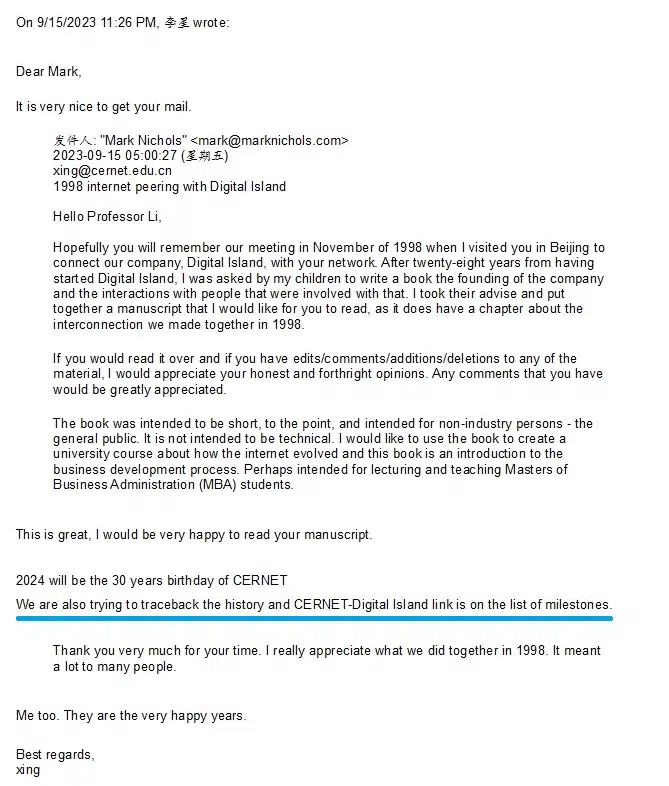
In September 2023, CERNET co-founder Professor Xing Li confirmed in writing that the CERNET-Digital Island link is on CERNET's list of milestones compiled for its thirtieth anniversary.
Verbatim transcription of document:
On 9/15/2023 11:26 PM, 李星 wrote:
Dear Mark,
It is very nice to get your mail.
发件人: "Mark Nichols" <mark@marknichols.com>
2023-09-15 05:00:27 (星期五)
xing@cernet.edu.cn
1998 internet peering with Digital IslandHello Professor Li,
Hopefully you will remember our meeting in November of 1998 when I visited you in Beijing to connect our company, Digital Island, with your network. After twenty-eight years from having started Digital Island, I was asked by my children to write a book the founding of the company and the interactions with people that were involved with that. I took their advise and put together a manuscript that I would like for you to read, as it does have a chapter about the interconnection we made together in 1998.
If you would read it over and if you have edits/comments/additions/deletions to any of the material, I would appreciate your honest and forthright opinions. Any comments that you have would be greatly appreciated.
The book was intended to be short, to the point, and intended for non-industry persons - the general public. It is not intended to be technical. I would like to use the book to create a university course about how the internet evolved and this book is an introduction to the business development process. Perhaps intended for lecturing and teaching Masters of Business Administration (MBA) students.
This is great, I would be very happy to read your manuscript.
2024 will be the 30 years birthday of CERNET
We are also trying to traceback the history and CERNET-Digital Island link is on the list of milestones.
Thank you very much for your time. I really appreciate what we did together in 1998. It meant a lot to many people.
Me too. They are the very happy years.
Best regards,
[The blue underline on "We are also trying to traceback the history and CERNET-Digital Island link is on the list of milestones" is an annotation added for exhibit presentation; it is not part of the original email. Note on record accuracy: the quoted Nichols message of September 15, 2023 references "November of 1998"; passport stamps confirm the Beijing meeting and deployment occurred in February 1998. Professor Li's reply confirms the 1998 link and its milestone status; it does not itself specify the month.]

The key distinction is access versus peering. Pre-1998 Chinese backbone records show international access lines, gateway channels, domestic interconnection, and upstream connectivity. Those records establish reachability. They do not establish peer-equivalent global commercial routing parity. The Digital Island and CERNET deployment changed CERNET’s routing posture by adding dedicated IPLC transport, bidirectional BGP, DNS symmetry, and direct route exchange with Digital Island’s multi-continent backbone.

https://www.cernet.edu.cn/html/cernet15/xing/tsld042.htm
Circuit-Specification Reconciliation: One T1, Two 512K Channels
The Digital Island records and the CERNET records agree on the material facts, and the one apparent difference resolves on inspection of CERNET's own slide.
The Digital Island side of the record is the contract and cost commitment: a dedicated international T1 private line from the CERNET data center in Beijing to Digital Island's second Northern California data center in Campbell, California, at $80,000 per month on a three-year commitment, with $275,000 wired up front. The circuit terminated in Campbell. It did not route through Hawaii; the "Hawaii" label in CERNET's record reflects Digital Island's Honolulu corporate registration of the era, not the circuit path.
For the record, Digital Island's procurement floor was T1: no circuit below T1 capacity was ever purchased anywhere in the company's global network, on any continent, for any purpose, down to the dedicated private virtual circuits provisioned to leadership team homes, including the author's, for secure email into the Stanford data center. A 512K figure therefore cannot describe anything Digital Island bought. It can only describe how the counterparty configured or recorded their side of the demarcation.
Mark Nichols did not travel to Beijing, see passport above, to provision a circuit less than T-1.
The CERNET side of the record, Professor Xing Li's published BGP policy slide, lists Digital Island twice under AS6553: 512K with six routes under the Hawaii label, and 512K with ten routes under the Japan label. Two 512K allocations totaling 1024K is consistent with a single T1's payload provisioned as two logical channels, a common practice in international circuit engineering. How CERNET configured and labeled the channels on their side of the demarcation was CERNET's operational domain, and this page does not speculate beyond their published record.
What the slide independently confirms is more than the claim requires: the autonomous system, the route exchange, and CERNET's own documentation of reaching Digital Island's fabric through two attachment identities spanning the United States and Japan. The counterparty's record does not merely corroborate the link. It corroborates the multi-continent character of the network the link joined.
The Beijing Execution: Capital Authority and Operational Control
In 1998, I personally executed the CERNET-Digital Island contract in Beijing. The agreement was written in Mandarin, so I executed it in reliance on the representations of the parties and team present regarding its contents and intended effect.
The following day, Digital Island CFO Mike Sullivan wired $275,000 on my authority, before independently reviewing the Mandarin contract text. That fact matters because the deployment was not an abstract technical proposal. It moved because Digital Island had the capital authority, carrier relationships, and operational control to make the circuit happen.
This was private risk capital applied directly to international Internet infrastructure. The purpose was to move CERNET beyond constrained access and into a direct global routing relationship through Digital Island’s multi-continent backbone.
This was not ceremony. It was infrastructure deployment.
A Final Note on Capital
This link was not funded by government, academia, or Chinese institutions. The Digital Island side of the deployment was paid for with private capital from Digital Island’s global network cost center.
Cliff Higgerson did not invent the Internet. He financed the infrastructure that made it globally usable.
See: https://marknichols.com/cliff-higgerson/
Claim for Recognition
This was not a prototype. It was operational. It was global. It was live.
The direct technical claim is CERNET. The broader historical significance is China.
CERNET was one of China’s official backbone networks. By moving CERNET from constrained international access into a direct global routing relationship through Digital Island’s commercial backbone, the deployment became a China Internet infrastructure milestone.
It should not be read to mean that Digital Island created China’s Internet or upgraded every Chinese backbone equally. It should be read as a specific, privately financed infrastructure event that changed CERNET’s international routing posture and strengthened China’s path toward peer-equivalent global Internet participation.
This page is filed as Evidence Node 5 in the Digital Island Evidence Vault.
Forensic Summary: China’s Global Integration, 1998
This record establishes that CERNET’s movement from constrained international access toward peer-equivalent global routing was a privately financed engineering project.
The 1998 Digital Island deployment, confirmed in the record by Professor Xing Li of CERNET, is the control record for this milestone. It documents the physical intervention, the technical shift, and the financial burden required to move beyond the access model.
The physical intervention was dedicated international private-line transport.
The technical shift was route exchange, BGP, DNS symmetry, and direct reach into Digital Island’s global infrastructure.
The financial burden was carried by Digital Island’s global network cost center, including the $275,000 upfront wire and the ongoing private-line commitment.
This evidence does not claim that China lacked Internet access before Digital Island. It shows that access was not peering. It shows that CERNET’s routing posture changed through a funded, operational deployment into Digital Island’s private, multi-continent commercial backbone.
If you want to discuss the record, email me here: mark@marknichols.com