Ninety-Nine Percent of All Internet-Accessible Users
Digital Island's Tier-0 Network Connected 34 Named ISPs Through Dedicated T1 Circuits and Put Their Users One Hop Apart, 1996 to 2001
Preamble: Mark Nichols provisioned at least one dedicated T1 circuit into each of 34 named ISPs, seven in the United States and twenty-seven across the rest of the world, and Digital Island's Tier-0 fabric reached approximately 99 percent of all Internet users with sub-300-millisecond round trips from 1996 to 2001.
Opinion Rules: You are visiting my record, and I am the subject matter expert on it. If you are a subject matter expert too, I want to hear from you: bring your document and I will answer it on the record. If you are not, you are welcome here to read and to learn. The documented-challenge terms of marknichols.com and the condition on opinion are stated at F40 of The Governing Definitions and Controlling Facts of Telecommunications Internetworking, and they govern this page.
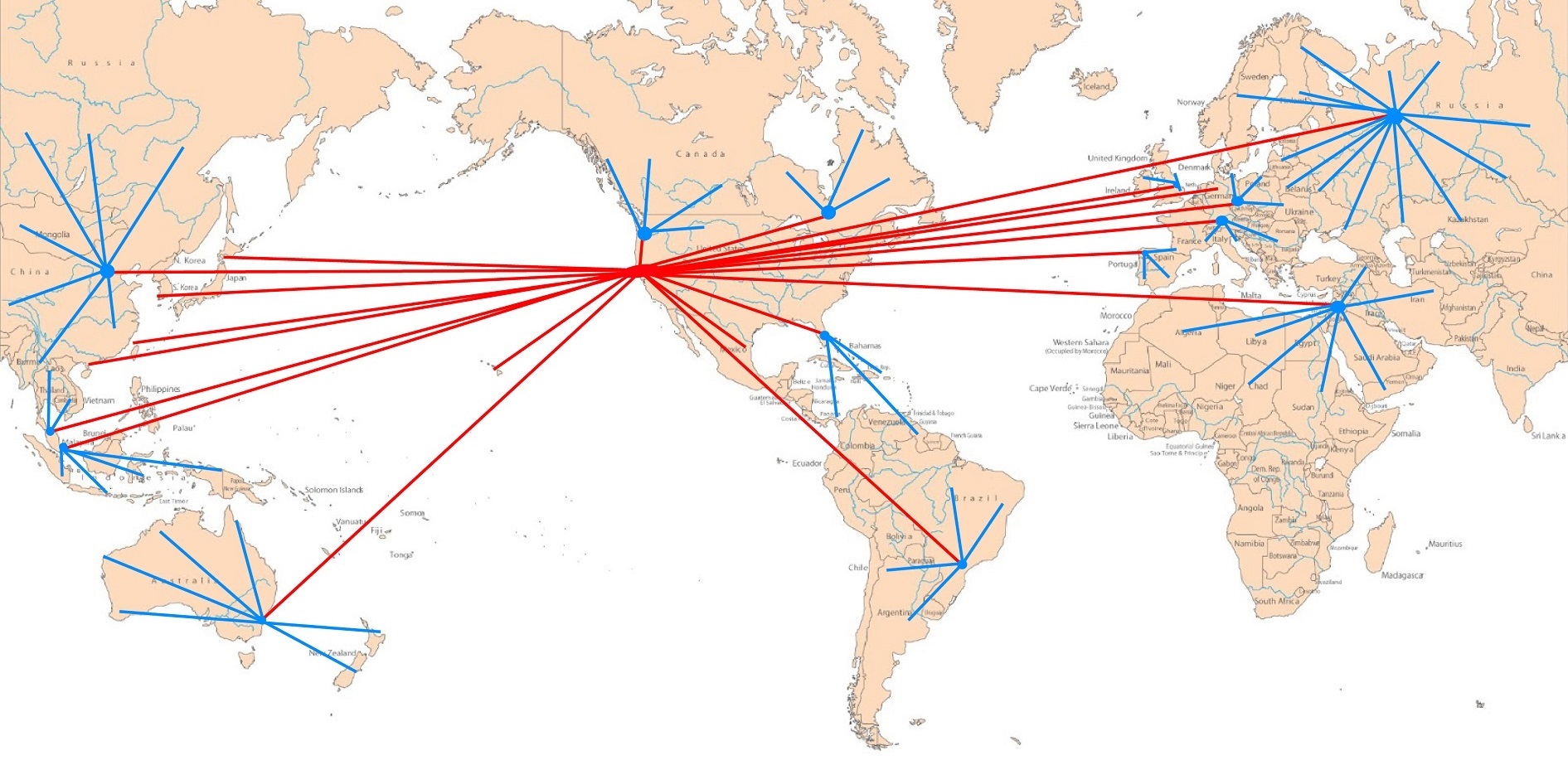

1. Digital Island connected thirty-four named ISPs, seven in the United States and twenty-seven across the rest of the world.
1.1 I, Mark Nichols, provisioned, at minimum, a dedicated T1 circuit to each of thirty-four ISPs, and to multiple geographic metropolitan areas for redundant, diverse access to their localized customer bases, and the thirty-four ISPs are AT&T, MCI, Sprint, WorldCom, British Telecom, Cable & Wireless, France Télécom, ImagiNET, Deutsche Telekom, KPN, Swisscom, HiNet, Telia, Telefónica, Telstra, NTT, Japan Telecom, KDD, IDC, ITJ, Telekom Malaysia, SingTel, Korea Telecom, SK Telecom, Embratel, TelMex, Rostelecom, Bezeq, NetVision, EasyLink, CERNET, UUNET, BBN, and GTE.
1.2 Seven of the thirty-four ISPs were United States carriers, AT&T, MCI, Sprint, WorldCom, UUNET, BBN, and GTE, and the other twenty-seven ISPs served the rest of the world.
1.3 Mark Nichols states that Digital Island connected multiple ISPs in every major metropolitan market, region, and continent, and that every international ISP on the fabric peered with one or more United States ISPs.
2. Digital Island's Tier-0 fabric reached approximately 99 percent of all Internet users, and the arithmetic is stated on this page.
2.1 From 1996 to 2000, approximately 65% of all Internet users worldwide resided in the United States, and the remaining 35% resided in the rest of the world.
2.2 Digital Island reached the United States' 65% through the seven United States ISPs and reached a further 34% of all Internet users through the twenty-seven rest-of-world ISPs, so Digital Island's Tier-0 fabric reached approximately 99% of all Internet users.
2.3 The deployment collapsed global geography: every user on the thirty-four ISPs stood exactly one hop from every other user on Digital Island's Tier-0 global network, and Digital Island unified both hemispheres under a single, deterministic transport fabric.
3. Merchant Transport made sub-300-millisecond SSL session completion reliably repeatable across that reach.
3.1 The benefit of the network, which I, Mark Nichols, described and branded as Merchant Transport, was an IPLC CBR network, dedicated International Private Line Circuits carrying constant-bit-rate ATM from end to end, that made cross-border, sub-300-millisecond round-trip SSL session completion reliably repeatable at operational scale to approximately 99% of all Internet-accessible users.
3.2 Mark Nichols states the round-trip tiers of the fabric: Digital Island's round trips ran under 25 milliseconds locally, under 50 milliseconds regionally, under 100 milliseconds within a continent, and under 300 milliseconds worldwide.
4. No other ISP and no Tier-1 carrier offered the service before Digital Island, or alongside Digital Island until Cable & Wireless agreed in May 2001 to acquire Digital Island.
4.1 No other ISP and no Tier-1 carrier offered such network services before Digital Island, and no other ISP or Tier-1 carrier offered such network services concurrently with Digital Island until Cable & Wireless agreed in May 2001 to acquire Digital Island.