Chegg India Father of the Internet: Disagreements | Network, Not Protocol
Chegg India’s article “Who is the Father of the Internet: Vint Cerf & The History” of December 19, 2023 calls Vinton G. Cerf “the Father of the Internet”, dates the Internet’s birthday to the switch of the ARPANET to TCP/IP on January 1, 1983, and answers “Who is the founder of the Internet?” with Tim Berners-Lee, while under D1 the Internet was born in 1991, when General Atomics, Performance Systems International, Inc. and UUNET Technologies, Inc. opened the Commercial Internet Exchange, and the article’s own line 99 says that the World Wide Web is “not the Internet itself”.
Preamble: I examine the article “Who is the Father of the Internet: Vint Cerf & The History” that Chegg India publishes in its General Knowledge section as study material, line by line, against its own lines, against the index of Requests for Comments kept by the RFC Editor, against the documents that opened the Internet and the World Wide Web to public use, and against the Governing Definitions of marknichols.com. Exhibit A at section 13.0 reproduces the article line by line, numbered and anchored, and every finding on this page cites those line numbers. This page is Disagreement 94 in the standing index of the series, Disagreements of Published Claims | Network, Not Protocol, and a finding on this page is cited by that number followed by the finding's locus, as Disagreement 94, 1.1.
Opinion Rules: You are visiting my record, and I am the subject matter expert on it. If you are a subject matter expert too, I want to hear from you: bring your document and I will answer it on the record. If you are not, you are welcome here to read and to learn. The documented-challenge terms of marknichols.com and the condition on opinion are stated at F40 of The Governing Definitions and Controlling Facts of Telecommunications Internetworking, and they govern this page.
Conditional on the Governing Definitions: Every finding on this page is conditional on the Governing Definitions D1 through D13 of marknichols.com, which are reproduced in full in the Definitions Addendum at the bottom of this page.
0.0 This section records the article this page examines, who published it, the reading of it, and the definitions on which the findings depend.
0.1 The source examined on this page is the article “Who is the Father of the Internet: Vint Cerf & The History”, published by Chegg India in its General Knowledge section at https://www.cheggindia.com/general-knowledge/father-of-internet/ and dated “December 19, 2023” in its own text at line 2. The article carries no byline, and its author is unknown on this page. Mark Nichols supplied the text of the article to this record on November 14, 2026, and this page read the supplied text in full on November 14, 2026 and did not compare it with the live page.
0.2 Exhibit A reproduces the article from its title through its last answer, with its table of contents and the links printed beside it and without the menus of the site and the advertisement after its last answer, and divides it into 216 lines: each heading, table row and list item is a line of its own, each paragraph is divided into its sentences, and the columns of a table row are separated by a vertical bar. Lines 140 through 145, 149 through 154, 188, 189, 191 and 193 are reproduced as the article prints them, with the Cyrillic letter е in place of the Latin letter e in many of their words, as in “Intеrnеt”.
0.3 D1 of The Governing Definitions and Controlling Facts of Telecommunications Internetworking defines the Internet as “The publicly joinable network of networks of the registry lineage”, D6 states that protocols “are not the networks, and they are not the Internet”, and D8 states that “The World Wide Web is not the Internet”. The Definitions Addendum at section 14.0 reproduces D1 through D13 in full.
1.0 The article calls Vinton G. Cerf “the Father of the Internet” for the design of the protocols TCP and IP, while under D1 and D9 the Internet was opened in 1991 by three companies whose announcement names neither Vinton G. Cerf nor Robert E. Kahn.
1.1 Line 1, the title, says: “Who is the Father of the Internet: Vint Cerf & The History” Line 33 says: “The title “Father of the Internet” is most commonly associated with Vinton Gray Cerf, an American computer scientist who co-designed the TCP/IP protocols that form the backbone of today’s Internet.” Line 31 says: “That’s why history remembers him as the Father of the Internet.” Line 205 says: “Vint Cerf, the “Father of the Internet, ” was crucial in creating the foundational protocols and architecture supporting the worldwide network.”
1.2 Line 207 and line 208 say: “Vint Cerf, the father of the Internet, was an American computer scientist born in 1943. Along with Bob Kahn, he is regarded as one of the “fathers of the Internet.”” Line 212 says: “Steve Crocker, Bob Kahn, and Vint Cerf are three of the Internet’s Founding Fathers.”
1.3 The release headed “General Atomics, Performance Systems International and UUNET Technologies, Inc. Establish the First Commercial Internet Exchange (CIX)”, dated March 25, 1991 and preserved on marknichols.com, announces that “The CIX agreement provides for all customers of AlterNet, CERFnet and PSINet to exchange Internet traffic directly, regardless of which network the customer obtains service from, and at no additional cost.” The release names neither Vinton G. Cerf nor Robert E. Kahn, as 4.1 of What the Internet Is, and What It Is Not | Network, Not Protocol records. The article's own line 216 says that the Internet is “run by individual constituent networks that establish and implement policies without a central governing authority”.
1.4 The kind is a definitional finding under D1 and D6. The article gives the title of father of the Internet for the design of protocols, which under D6 are not the networks and are not the Internet, and the Internet of D1 was opened to public use on March 25, 1991 by General Atomics, Performance Systems International, Inc. and UUNET Technologies, Inc., as 4.3 of What the Internet Is, and What It Is Not | Network, Not Protocol records. Governing Definitions, D1 and D6.
1.5 Corrected statement: Vinton G. Cerf and Robert E. Kahn designed the protocol described in their paper “A Protocol for Packet Network Intercommunication” of May 1974, and the Internet of D1 was opened to public use in 1991, when General Atomics, Performance Systems International, Inc. and UUNET Technologies, Inc. established the Commercial Internet Exchange.
2.0 The article says that the work of Vinton G. Cerf and Robert E. Kahn on TCP and IP “laid the foundation for the creation of the ARPANET”, while the article’s own timeline dates the ARPANET to 1969 and its own list dates their paper to May 1974.
2.1 Line 24, in the summary, says of the protocols TCP and IP: “Their work laid the foundation for the creation of the ARPANET, the precursor to the modern Internet, which revolutionized communication and information sharing worldwide.”
2.2 Line 42 of the article's timeline reads: “1969 | ARPANET | The first operational network, connecting UCLA, Stanford, UC Santa Barbara, and the University of Utah.” Line 177 of its list of co-authored works reads: “A Protocol for Packet Network Intercommunication | Vinton Cerf, Robert Kahn | May 1974”
2.3 The kind is a documentary finding. Line 24 is false as written under F56, because the article's own line 42 dates the ARPANET to 1969 and its own line 177 dates the paper of Vinton G. Cerf and Robert E. Kahn to May 1974, so the work of 1974 could not have laid the foundation for the creation of a network operating in 1969. Governing Definitions, F56.
2.4 Corrected statement: The ARPANET was operating in 1969, and the paper “A Protocol for Packet Network Intercommunication” by Vinton G. Cerf and Robert E. Kahn followed in May 1974.
3.0 The article says that the switch of the ARPANET to TCP/IP on January 1, 1983 “is widely regarded as the Internet’s official birthday”, while D5 defines that day as an internal maintenance event of one organization’s intranet and D11 holds that any birth date of 1983 fails.
3.1 Line 44 of the article's timeline reads: “1983 | TCP/IP Adoption | ARPANET officially switched to TCP/IP on January 1, 1983, which is widely regarded as the Internet’s official birthday.” Line 86 says: “His efforts ensured that by January 1, 1983, ARPANET officially adopted TCP/IP, a date often celebrated as the Internet’s “birthday.””
3.2 D5 of The Governing Definitions and Controlling Facts of Telecommunications Internetworking defines the flag day of January 1, 1983 as “an intranet’s internal maintenance event”, and D11 states that “any page, headline, plaque, or biography that assigns the birth of the Internet to 1969, 1974, or 1983 is measured against these definitions and fails”.
3.3 The kind is a definitional finding under D5 and D11. The switch of protocol on January 1, 1983 took place on the ARPANET, a network whose members joined by its owner's permission, and the Internet of D1 was born in 1991. Governing Definitions, D5 and D11.
3.4 Corrected statement: On January 1, 1983 the ARPANET, an intranet of the Advanced Research Projects Agency, changed its host protocol from NCP to TCP/IP, and the Internet of D1 was born in 1991.
4.0 The article says that the first operational network connected “UCLA, Stanford, UC Santa Barbara, and the University of Utah”, while the second node of the ARPANET was at the Stanford Research Institute, which the Computer History Museum records as an institute founded by Stanford University that became independent in 1970.
4.1 Line 41 of the article's timeline reads: “1960s | Early Networking Concepts | The first operational network connected UCLA, Stanford, UC Santa Barbara, and the University of Utah.” Line 42 reads: “1969 | ARPANET | The first operational network, connecting UCLA, Stanford, UC Santa Barbara, and the University of Utah.”
4.2 The press release of the Computer History Museum of October 27, 2009 places the receiving end of the first transmission of October 29, 1969 “at SRI International (then known as Stanford Research Institute) in Menlo Park, California”, and says of the institute: “SRI, which was founded by Stanford University as Stanford Research Institute in 1946 and became independent in 1970”.
4.3 The kind is a documentary finding of a name. Line 41 and line 42 name “Stanford”, which reads as Stanford University, for the node that the press release of the Computer History Museum places at the Stanford Research Institute in Menlo Park.
4.4 Corrected statement: The four nodes of the ARPANET at the end of 1969 were at the University of California, Los Angeles, the Stanford Research Institute in Menlo Park, the University of California, Santa Barbara and the University of Utah.
5.0 The article answers “Who is the founder of the Internet?” with Tim Berners-Lee, while its own line 99 says of the World Wide Web that it is “not the Internet itself” and D8 states that “The World Wide Web is not the Internet”.
5.1 Line 209 asks: “Who is the founder of the Internet?” Line 210 answers: “TIM BERNERS-LEE (1955) is the inventor of the World Wide Web and is responsible for many modern concepts, such as HTML, HTTP, URLs, and web browsers.”
5.2 Line 99 says: “Tim Berners-Lee—Father of the World Wide Web: While not the Internet itself, Berners-Lee’s invention of the World Wide Web in 1989 transformed it into a user-friendly, global information system.” Line 100 says: “Because of this, people sometimes confuse him with being the founder of the Internet.”
5.3 The kind is a documentary finding. Line 210 is false as written under F56, because the article's own line 99 says that the World Wide Web is “not the Internet itself” and its own line 100 names the confusion that line 210 commits. D8 of The Governing Definitions and Controlling Facts of Telecommunications Internetworking states: “The World Wide Web is not the Internet: the Web is an application using the Internet platform, and the application is not the platform.” Governing Definitions, D8 and F56.
5.4 Corrected statement: Tim Berners-Lee wrote the proposal of March 1989 at CERN from which the World Wide Web grew, and the World Wide Web is an application and not the Internet.
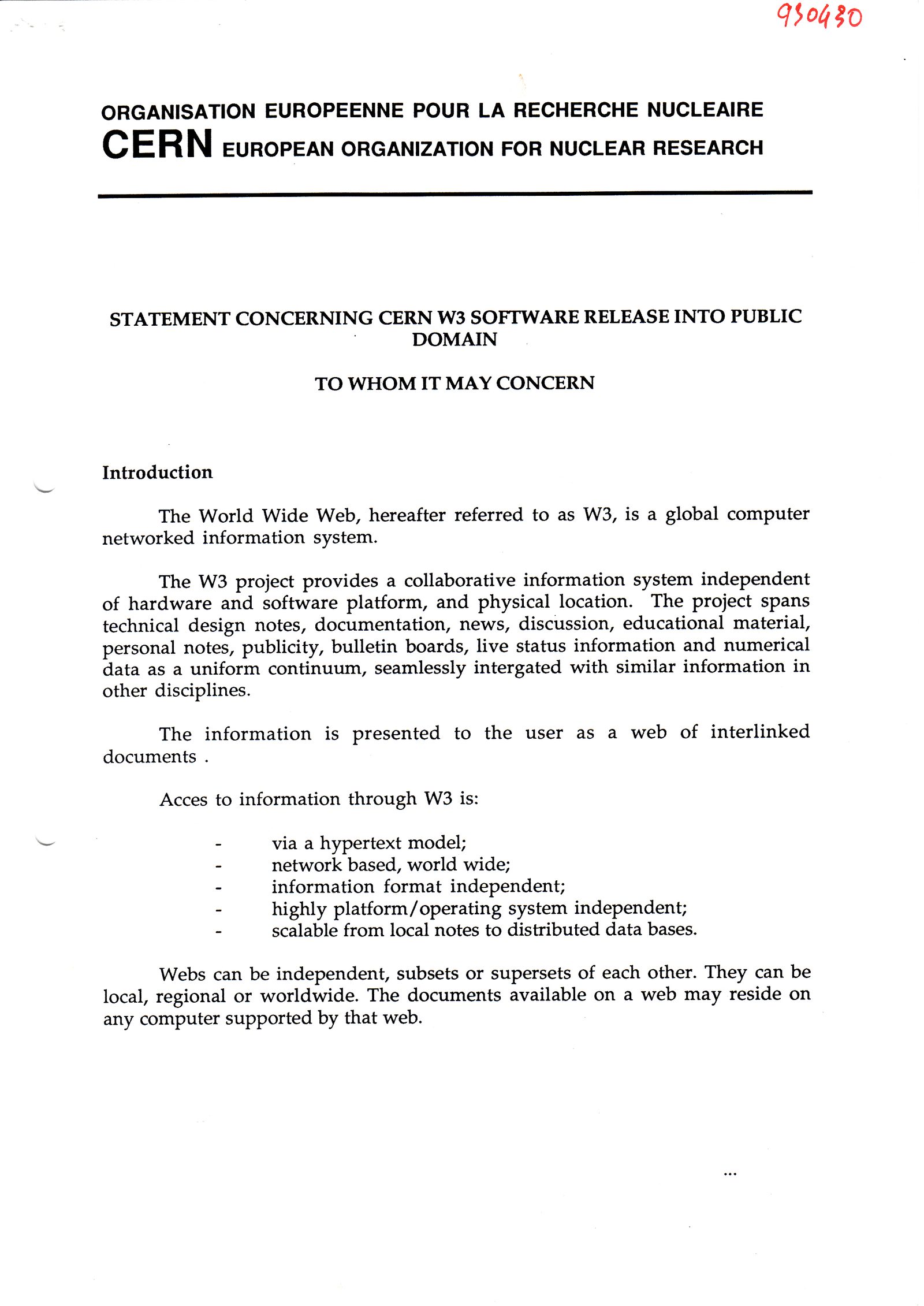
6.0 The article says that Tim Berners-Lee invented the World Wide Web, “introducing websites, browsers, and hyperlinks for public use”, while the release of the World Wide Web software to public use is CERN’s statement of April 30, 1993, signed by Walter Hoogland and Helmut Weber, which names Tim Berners-Lee nowhere.
6.1 Line 45 of the article's timeline reads: “1989–1991 | World Wide Web | Tim Berners-Lee invented the World Wide Web, introducing websites, browsers, and hyperlinks for public use.” Line 70 says: “Often called the “Father of the World Wide Web,” Berners-Lee invented the WWW in 1989 at CERN, introducing websites, browsers, and hyperlinks, transforming the Internet into a tool for everyday use.”
6.2 CERN's statement concerning the release of the CERN W3 software into the public domain, dated Geneva, 30 April 1993, declares that “The following CERN software is hereby put into the public domain”, namely the W3 basic (“line-mode”) client, the W3 basic server and the W3 library of common code, and it is signed by Walter Hoogland, Director of Research of CERN, and Helmut Weber, Director of Administration of CERN, as L-028 of Exhibit Library | Network, Not Protocol and 4.2 of What the Internet Is, and What It Is Not | Network, Not Protocol record. The statement names Tim Berners-Lee nowhere in its two pages.
6.3 Section 1.0 of W3C Tim Berners-Lee Biography: Disagreements | Network, Not Protocol, Disagreement 80, records the hypertext systems built at Brown University from 1967 by Andries van Dam, Ted Nelson and their students, and records that the proposal of March 1989 by Tim Berners-Lee cites the special issue on hypertext of the Communications of the ACM of July 1988.
6.4 The kind is a scope overstatement. The words “introducing websites, browsers, and hyperlinks for public use” credit Tim Berners-Lee with the release of the software to public use, which CERN made in a statement signed by two of its directors, and with hyperlinks, which the hypertext systems of 1967 already carried.
6.5 Corrected statement: Tim Berners-Lee proposed the World Wide Web at CERN in March 1989, the World Wide Web drew on the hypertext work published from 1967, and CERN released the W3 basic client, the W3 basic server and the W3 library of common code to public use in its statement of April 30, 1993, signed by Walter Hoogland and Helmut Weber.
7.0 The article says that the protocols TCP and IP “turned separate networks into a single, global Internet” and that Vinton G. Cerf transformed “a military research project into the Internet”, while under D6 protocols are not the Internet and under D9 the Internet was born in 1991 at the Commercial Internet Exchange.
7.1 Line 82 and line 83 say: “Co-Designer of TCP/IP: In the early 1970s, Cerf and Kahn developed TCP/IP protocols, which allow different computer networks to exchange data reliably. This innovation turned separate networks into a single, global Internet.” Line 90 says: “For these reasons, history remembers Vint Cerf as a scientist and the driving force behind transforming a military research project into the Internet.” Line 197 says: “His advocacy for open standards, accessibility, and global governance transformed the Internet from a military research project into the backbone of modern life.” Line 135 says: “His work on TCP/IP enabled the creation of the Internet and ensured its adaptability to evolving technologies.” Line 124 says: “What began in the 1960s as a U.S. defense experiment has become the largest communication system in history, connecting over 5 billion people worldwide.”
7.2 D9 of The Governing Definitions and Controlling Facts of Telecommunications Internetworking states: “The capital-I Internet was born in 1991, when PSINet, AlterNet under UUNET, and CERFnet, independently operated commercial networks of the registry lineage, established the Commercial Internet eXchange, a settlement-free router interconnection with open admission and no purpose-screening policy”.
7.3 The kind is a definitional finding under D1, D6 and D9. The article gives the making of the Internet to a protocol and to one person, while under D6 the protocols are utilities whose messages the networks carry, and under D9 the Internet was made by the independently operated networks that established the Commercial Internet Exchange. Governing Definitions, D1, D6 and D9.
7.4 Corrected statement: The protocols TCP and IP let hosts on distinct networks exchange data across gateways, and the Internet of D1 was born in 1991, when PSINet, AlterNet under UUNET Technologies, Inc. and CERFnet established the Commercial Internet Exchange.
8.0 The article calls the first message on the ARPANET of 1969 “a milestone considered the Internet’s first” greeting, while under D4 the ARPANET was one organization’s intranet and under D1 the Internet was born in 1991.
8.1 Line 63, in the profile of Leonard Kleinrock, says: “His UCLA lab sent the first ARPANET message in 1969, a milestone considered the Internet’s first “hello.””
8.2 D4 of The Governing Definitions and Controlling Facts of Telecommunications Internetworking defines the ARPANET as “one organization’s intranet”, and D1.8 states: “The ARPANET is not the Internet.”
8.3 The kind is a definitional finding under D1 and D4. The message of October 1969 crossed the ARPANET, an intranet of the Advanced Research Projects Agency, twenty-two years before the Internet of D1 was born. Governing Definitions, D1 and D4.
8.4 Corrected statement: In October 1969 the laboratory of Leonard Kleinrock at the University of California, Los Angeles sent the first message across the ARPANET to the Stanford Research Institute.
9.0 The article lists twenty-six works under the heading “Books By Vint Cerf”, while the index of the RFC Editor records twenty-two of them as Requests for Comments, and the index dates the memo of the Consortium for Slow Commotion Research to 1 April 1991, where the article gives April 1, 1999.
9.1 Line 155 reads: “Books By Vint Cerf (Father of Internet)” Line 156 reads: “Authored Books by Vinton Cerf:” Line 175 reads: “Co-Authored Books by Vinton Cerf “Father of Internet”” The list of authored works runs from line 158 through line 174, and the list of co-authored works runs from line 177 through line 185. Line 173 reads: “Memo from the Consortium for Slow Commotion Research (CSCR | April 1, 1999”
9.2 The index of Requests for Comments of the RFC Editor, read on November 14, 2026, records the works at lines 158 through 167 and 169 through 174 as RFC 13, RFC 18, RFC 20, RFC 22, RFC 163, RFC 439, RFC 968, RFC 1109, RFC 1120, RFC 1167, RFC 1262, RFC 1607, RFC 1790, RFC 2468, RFC 1217 and RFC 3271, and records the works at lines 178 through 182 and 185 as RFC 675, RFC 771, RFC 1169, RFC 1287, RFC 1430 and RFC 4838. The index enters RFC 1217 as “Memo from the Consortium for Slow Commotion Research (CSCR). V.G. Cerf. 1 April 1991.”
9.3 The kind is a documentary finding. Twenty-two of the twenty-six works that line 155 calls books are Requests for Comments, line 168 names an article in a special issue of Scientific American, line 177 names a paper of May 1974, and the works at line 183 and line 184 are not identified on this page. Line 173 gives the date April 1, 1999 to a memo that the index dates 1 April 1991.
9.4 Corrected statement: Vinton G. Cerf wrote or co-wrote the Requests for Comments that the article lists, among them RFC 13 of August 1969, RFC 675 of December 1974 with Yogen Dalal and Carl Sunshine, and RFC 1217, the memo of the Consortium for Slow Commotion Research, of 1 April 1991.
10.0 The article says that “The Father of the Internet is a widely dispersed network”, a sentence in which the title stands where the lines on either side of it name the Internet.
10.1 Line 214 says: “A single individual, business, group, or government does not control the Internet.” Line 215 says: “The Father of the Internet is a widely dispersed network comprising numerous autonomous networks that have voluntarily joined one another.” Line 216 says: “It is run by individual constituent networks that establish and implement policies without a central governing authority.”
10.2 The kind is a documentary finding. Line 215 makes “The Father of the Internet” the subject of a description that line 214 and line 216 give to the Internet, so the sentence as written says that the title is a network.
10.3 Corrected statement: The Internet is a widely dispersed network comprising numerous autonomous networks that have voluntarily joined one another.
11.0 163 lines of the article are examined and not disputed on this page, and two of them state in the article’s own words what marknichols.com records.
11.1 Line 99 says of the World Wide Web that it is “not the Internet itself”, and line 214 and line 216 describe the Internet as a network that no single individual, business, group or government controls, run by its constituent networks, which is the open admission that D1 names as the single property of the Internet.
11.2 Line 2 gives the date of the article, and line 100 names the confusion between the World Wide Web and the Internet that section 5.0 of this page records at line 210.
11.3 The remaining 158 lines, 3 through 23, 25 through 30, 32, 34 through 40, 43, 46 through 62, 64 through 69, 71 through 81, 84, 85, 87 through 89, 91 through 98, 101 through 123, 125 through 134, 136 through 154, 157, 176, 186 through 196, 198 through 204, 206, 211 and 213, state the headings, the summary, the profiles of the persons the article names, the honors of Vinton G. Cerf, the views attributed to him, the account of the impact of the Internet, the lists of persons and organizations and the forecast of the future, and this page makes no finding on them, while their soft verbs, among them “underpin” at line 22 and “laid the groundwork” at line 35, are not yet entered in the register of soft verbs of marknichols.com.
12.0 The claims on this page are open to documented challenge on the standing terms of marknichols.com, and the terms are stated here in full.
12.1 The claims on this page are open to challenge on the same terms as every claim on marknichols.com. A challenger who holds that a claim on this page is wrong, or that the Internet is something other than the publicly joinable network of networks of the registry lineage defined at The Governing Definitions and Controlling Facts of Telecommunications Internetworking, states the competing claim or definition in one sentence, names the document that carries it and the document’s date, and sends both to mark@marknichols.com. A challenge submitted with its document is answered on this page, and a competing definition submitted with its document is added to this page as an exhibit with attribution to the person who submitted it; a challenge submitted without a document is an opinion and is heard as one.
12.2 The distinction the site’s definition rests on, that protocols enable interoperability and are not the Internet, is stated in the IETF’s own words, RFC 2026 and STD 1, in the Internet-Draft draft-mnichols-protocols-not-the-internet-01, posted by Mark Nichols to the IETF Datatracker on September 25, 2026 at https://datatracker.ietf.org/doc/draft-mnichols-protocols-not-the-internet/ and stated on this site at Protocols Are Not the Internet: The IETF Internet-Draft by Mark Nichols, so a challenger may also address the definition in the venue that publishes the protocol standards themselves. Any person who holds expertise in telecommunications and a competing claim or definition is invited to bring both, in writing, with the document.
13.0 Exhibit A reproduces the article “Who is the Father of the Internet: Vint Cerf & The History” of Chegg India line by line, numbered in the order of the page and anchored for citation.
13.1 Exhibit A. Chegg India, “Who is the Father of the Internet: Vint Cerf & The History”, December 19, 2023, at https://www.cheggindia.com/general-knowledge/father-of-internet/, as supplied by Mark Nichols on November 14, 2026. Line 1 is the title and line 2 the date, and lines 3 through 216 are the article in the order of the page, ending with its section of frequently asked questions.
1. Who is the Father of the Internet: Vint Cerf & The History
2. December 19, 2023
3. 08 min read
4. On this page
5. Summary
6. Who is Known as the Father of the Internet?
7. Timeline of Internet Evolution
8. Key Contributors to the Internet (Profiles)
9. Why Vint Cerf is Called the Father of the Internet
10. Controversies and Alternate Claims
11. Modern Relevance: Vint Cerf’s Views on Today’s Internet
12. Legacy and Impact of the Internet
13. Books By Vint Cerf (Father of Internet)
14. The Future of the Internet
15. Conclusion
16. Frequently Asked Questions(FAQs)
17. Get paid to work to AI projects
18. Related articles
19. Get paid to work on AI projects from home
20. Share
21. Summary
22. Vint Cerf and Bob Kahn are often referred to as the Fathers of the Internet for their groundbreaking work in the 1970s, where they developed the Transmission Control Protocol (TCP) and Internet Protocol (IP), the fundamental technologies that underpin the Internet.
23. These protocols enabled the interconnection of different computer networks, making global communication possible.
24. Their work laid the foundation for the creation of the ARPANET, the precursor to the modern Internet, which revolutionized communication and information sharing worldwide.
25. One name consistently stands out when discussing the “Father of Internet”: Vinton G. Cerf.
26. Before Wi-Fi, smartphones, or social media transformed how we live, Cerf laid the invisible foundation of our digital world.
27. In the early 1970s, he and his collaborator Robert E. Kahn solved one of the greatest technological challenges of the time: how to make computers of different types, in various places, “talk” to each other.
28. Their answer was the creation of TCP/IP protocols, the universal language of the Internet that still powers billions of devices today.
29. For his groundbreaking vision, Cerf has been showered with global recognition from the U.S. National Medal of Technology, awarded by President Bill Clinton, to the Turing Award (often called the “Nobel Prize of Computing”), to his role as Google’s Chief Internet Evangelist.
30. But beyond the titles and medals lies a more profound truth: without Cerf’s work, the connected world we take for granted, from online learning to video calls with loved ones, wouldn’t exist.
31. That’s why history remembers him as the Father of the Internet.
32. Who is Known as the Father of the Internet?
33. The title “Father of the Internet” is most commonly associated with Vinton Gray Cerf, an American computer scientist who co-designed the TCP/IP protocols that form the backbone of today’s Internet.
34. Alongside his colleague Robert E. Kahn, Cerf pioneered a system that allowed computers across different networks and hardware to communicate seamlessly.
35. This breakthrough in the 1970s laid the groundwork for what would later evolve into the global Internet.
36. While Cerf and Kahn are celebrated as the Internet’s architects, Cerf is more prominently recognized as the “Father of the Internet” due to his continued leadership, advocacy, and lifelong commitment to expanding and safeguarding the digital world.
37. His role as Google’s Chief Internet Evangelist further cements his status as a guiding figure in shaping how billions of people connect, share, and innovate online today.
38. Vinton Cerf : The Father of Internet
39. Timeline of Internet Evolution
40. Year/Period | Milestone | Key Contribution
41. 1960s | Early Networking Concepts | The first operational network connected UCLA, Stanford, UC Santa Barbara, and the University of Utah.
42. 1969 | ARPANET | The first operational network, connecting UCLA, Stanford, UC Santa Barbara, and the University of Utah.
43. 1973–1974 | TCP/IP Design | Vinton Cerf & Robert Kahn created the TCP/IP protocols, enabling communication between different types of networks.
44. 1983 | TCP/IP Adoption | ARPANET officially switched to TCP/IP on January 1, 1983, which is widely regarded as the Internet’s official birthday.
45. 1989–1991 | World Wide Web | Tim Berners-Lee invented the World Wide Web, introducing websites, browsers, and hyperlinks for public use.
46. 1990s | Commercial Expansion | Internet enters homes & businesses with email, search engines, and early e-commerce.
47. 2000s | Social Media & Mobile Internet | Rise of Facebook, YouTube, Twitter; smartphones make the Internet accessible everywhere.
48. 2010s–Present | Cloud, AI & Global Connectivity | Growth of cloud computing, video conferencing, and AI; ongoing global efforts to connect underserved regions.
49. Key Contributors to the Internet (Profiles)
50. While Vinton Cerf is widely celebrated as the “Father of the Internet,” today’s global network is the product of many brilliant minds.
51. Below are some of the most influential pioneers who played pivotal roles in its evolution:
52. 1. Vinton G. Cerf
53. vinton g. cerf
54. Often called the “Father of the Internet,” Cerf co-designed the TCP/IP protocols with Robert E. Kahn in the 1970s.
55. His continued advocacy and role as Google’s Chief Internet Evangelist keep him at the forefront of Internet innovation.
56. 2. Robert E. Kahn
57. Robert E. Kahn
58. Known as the “co-father of the Internet,” Kahn initiated the idea of open-architecture networking while at DARPA.
59. His collaboration with Cerf produced TCP/IP, making him one of the Internet’s core architects.
60. 3. Leonard Kleinrock
61. Leonard Kleinrock
62. A pioneer of packet switching, Kleinrock developed mathematical theories that enabled efficient data transmission.
63. His UCLA lab sent the first ARPANET message in 1969, a milestone considered the Internet’s first “hello.”
64. 4. Donald Davies
65. donald davies
66. A British computer scientist, Davies, independently developed the concept of packet switching around the same time as Paul Baran.
67. His work at the National Physical Laboratory (UK) influenced the design of ARPANET.
68. 5. Sir Tim Berners-Lee
69. Sir Tim Berners-Lee
70. Often called the “Father of the World Wide Web,” Berners-Lee invented the WWW in 1989 at CERN, introducing websites, browsers, and hyperlinks, transforming the Internet into a tool for everyday use.
71. 6. Peter Kirstein
72. Peter Kirstein
73. A key figure in bringing the Internet to Europe, Kirstein connected British networks to ARPANET in the 1970s, paving the way for the Internet’s global expansion.
74. 7. Paul Baran
75. Paul Baran
76. Working at RAND Corporation in the 1960s, Baran first proposed distributed networks that could survive partial outages, a concept that heavily influenced ARPANET’s resilience.
77. Why Vint Cerf is Called the Father of the Internet
78. The title “Father of the Internet” is not given lightly.
79. Vinton Gray Cerf earned this recognition through decades of groundbreaking contributions that shaped how we connect and communicate today.
80. His leadership in developing the Transmission Control Protocol (TCP) and Internet Protocol (IP), alongside Robert E. Kahn, created the universal communication framework that still underpins the Internet.
81. Here’s why Cerf stands out among Internet pioneers:
82. Co-Designer of TCP/IP: In the early 1970s, Cerf and Kahn developed TCP/IP protocols, which allow different computer networks to exchange data reliably.
83. This innovation turned separate networks into a single, global Internet.
84. DARPA Leadership: At the U.S. Defense Advanced Research Projects Agency (DARPA), Cerf guided research on networking, ensuring that ARPANET could evolve into a scalable, resilient system.
85. Standardization and Advocacy: Cerf played a critical role in promoting TCP/IP as the universal standard.
86. His efforts ensured that by January 1, 1983, ARPANET officially adopted TCP/IP, a date often celebrated as the Internet’s “birthday.”
87. Global Visionary: Unlike many contemporaries focused only on technical aspects, Cerf envisioned a borderless, interconnected world.
88. His ongoing work at Google as Chief Internet Evangelist reflects his lifelong mission to expand Internet access worldwide.
89. Recognition and Honors: Cerf’s pivotal role has been acknowledged through prestigious awards, including the U.S. National Medal of Technology, the Turing Award, the Presidential Medal of Freedom, and membership in the National Academy of Engineering.
90. For these reasons, history remembers Vint Cerf as a scientist and the driving force behind transforming a military research project into the Internet.
91. This technology connects billions of people today.
92. Controversies and Alternate Claims
93. The title “Father of the Internet” has not been without debate.
94. While Vinton Cerf is most commonly associated with this honor, other pioneers have also been credited depending on the context of their contributions:
95. Robert E. Kahn-The Co-Father: Many argue that Cerf and Kahn should share the title equally, since they jointly developed TCP/IP, the Internet’s core architecture.
96. Both received the U.S. National Medal of Technology in 1997 for this work.
97. Leonard Kleinrock-Packet Switching Pioneer: Kleinrock’s work on queueing theory and packet switching made digital communication feasible.
98. Some claim that his UCLA lab sent the first ARPANET message in 1969, making him a founding Internet figure.
99. Tim Berners-Lee—Father of the World Wide Web: While not the Internet itself, Berners-Lee’s invention of the World Wide Web in 1989 transformed it into a user-friendly, global information system.
100. Because of this, people sometimes confuse him with being the founder of the Internet.
101. Paul Baran and Donald Davies – Early Theorists: Both independently developed the idea of packet switching in the 1960s.
102. Without their theoretical groundwork, the Internet’s development would not have been possible.
103. Modern Relevance: Vint Cerf’s Views on Today’s Internet
104. Even decades after helping design the Internet’s core architecture, Vint Cerf remains deeply engaged in debates about its future.
105. As Google’s Chief Internet Evangelist, he continues to share insights on the promises and the flaws of the technology he helped create.
106. 1. AI and Emerging Technologies
107. Cerf emphasizes that artificial intelligence must be developed responsibly.
108. While he recognizes its potential to transform healthcare, education, and accessibility, he also warns against over-reliance on AI systems without human oversight.
109. 2. Privacy and Security Concerns
110. One of Cerf’s recurring concerns is that the Internet was not originally designed with security in mind.
111. Features like encryption and authentication came later, leaving gaps that hackers and cybercriminals exploit.
112. He often stresses the need for stronger data protection laws and technical safeguards.
113. 3. The Digital Divide
114. Cerf tirelessly advocates for universal Internet access, noting that billions of people are still unconnected.
115. He has worked on projects to expand broadband, satellite, and undersea cable networks to underserved regions.
116. 4. Regrets About the Internet’s Design
117. Cerf has openly admitted that he and other early pioneers didn’t fully anticipate issues such as online abuse, misinformation, and privacy erosion.
118. He calls these challenges “unintended consequences” of designing a system mainly for research and military communication.
119. 5. The Future Vision
120. Despite challenges, Cerf remains optimistic.
121. He envisions an Internet more inclusive, secure, and augmented by AI but guided by ethical standards and international cooperation.
122. Legacy and Impact of the Internet
123. The Internet is more than just a technological invention; it is a force that has reshaped human civilization.
124. What began in the 1960s as a U.S. defense experiment has become the largest communication system in history, connecting over 5 billion people worldwide.
125. Global Transformation
126. Communication → From instant messaging to video calls, the Internet has collapsed distance and time.
127. Education → Online learning platforms bring knowledge to students across the globe.
128. Economy → E-commerce, digital banking, and remote work have created new industries.
129. Social Life → Social media has redefined community, activism, and politics.
130. Positive and Negative Consequences
131. While the Internet has enabled unprecedented progress, it has also introduced challenges such as misinformation, privacy threats, and digital addiction.
132. These dual impacts reflect the power and responsibility of global connectivity.
133. Vint Cerf’s Enduring Legacy
134. Vint Cerf’s vision of an interconnected world has stood the test of time.
135. His work on TCP/IP enabled the creation of the Internet and ensured its adaptability to evolving technologies.
136. Today, as discussions about AI, data rights, and Internet governance shape the digital age, Cerf’s pioneering role remains a guiding reference point.
137. In short, the Internet is not just a network of computers; it is a network of people, ideas, and opportunities.
138. Its legacy continues to expand, and its impact will define future generations.
139. players in internet development
140. Intеrnеt dеvеlopmеnt has involvеd numеrous kеy figurеs and organizations. Somе prominеnt figurеs includе:
141. Vinton Cеrf and Robеrt Kahn, co-dеsignеrs of TCP/IP.
142. Tim Bеrnеrs-Lее, inventor of thе World Widе Wеb.
143. Larry Pagе and Sеrgеy Brin, co-founders of Googlе.
144. Mark Zuckеrbеrg, foundеr of Facеbook.
145. Jеff Bеzos, foundеr of Amazon.
146. The Internet Society plays a crucial role in recognizing individuals for their significant contributions to the development and advancement of the Internet.
147. Vinton Cerf: The Father of the Internet.
148. The Internet Society has inducted these individuals into the Internet Hall of Fame, showcasing their impact on the digital world and their lasting legacy in Internet technologies.
149. Kеy organizations include:
150. Intеrnеt Engineering Task Force (IETF): Dеvеlops and promotеs intеrnеt standards.
151. Intеrnеt Sociеty (ISOC): Advocatеs for an opеn and accеssiblе intеrnеt.
152. Intеrnеt Corporation for Assignеd Namеs and Numbеrs (ICANN): Manages domain namеs and IP addresses.
153. World Widе Wеb Consortium (W3C): Dеvеlops wеb standards.
154. Thе Elеctronic Frontiеr Foundation (EFF): Advocatеs for digital civil libеrtiеs and onlinе privacy.
155. Books By Vint Cerf (Father of Internet)
156. Authored Books by Vinton Cerf:
157. Title | Date
158. Zero Text Length EOF Message | August 1969
159. IMP-IMP and HOST-HOST Control Links | September 1969
160. ASCII format for network interchange | October 1969
161. Host-host control message formats | October 1969
162. Data transfer protocols | May 1971
163. PARRY encounters the DOCTOR | January 1973
164. ‘Twas the night before start-up | December 1985
165. Report of the second Ad Hoc Network Management Review Group | August 1989
166. Internet Activities Board | September 1989
167. Thoughts on the National Research and Education Network | July 1990
168. Networks, Scientific American Special Issue on Communications, Computers, and Networks | September 1991
169. Guidelines for Internet Measurement Activities | October 1991
170. A VIEW FROM THE 21ST CENTURY | April 1, 1994
171. An Agreement between the Internet Society and Sun Microsystems, Inc. in the Matter of ONC RPC and XDR Protocols | April 1995
172. I REMEMBER IANA | October 17, 1998
173. Memo from the Consortium for Slow Commotion Research (CSCR | April 1, 1999
174. The Internet is for Everyone | April 2002
175. Co-Authored Books by Vinton Cerf “Father of Internet”
176. Title | Co-Authors | Date
177. A Protocol for Packet Network Intercommunication | Vinton Cerf, Robert Kahn | May 1974
178. Specification of Internet Transmission Control Program | Vinton Cerf, Yogen Dalal, Carl Sunshine | December 1974
179. Mail transition plan | Vinton Cerf, Jon Postel | September 1980
180. Explaining the role of GOSIP | Vinton Cerf, K.L. Mills | August 1990
181. Towards the Future Internet Architecture | Clark, Chapin, Cerf, Braden, Hobby | December 1991
182. A Strategic Plan for Deploying an Internet X.500 Directory Service | Vinton Cerf et al. | February 1993
183. Internet Radio Communication System | Vinton Cerf et al. | July 9, 2002
184. System for Distributed Task Execution | Vinton Cerf et al. | June 3, 2003
185. Delay-Tolerant Networking Architecture (Informational Status) | Vinton Cerf et al. | April 2007
186. The Future of the Internet
187. Vint Cerf’s Vision for the Internet’s Evolution as Google’s Chief Internet Evangelist
188. Vinton Cеrf, the father of the Internet, envisions the Internet’s evolution with a focus on opеn standards, global accеssibility, and innovation.
189. Hе advocatеs for intеrnеt govеrnancе that’s dеcеntralizеd, sеcurе, and rеspеcts individual privacy, fostеring continuеd growth and positivе sociеtal impact.
190. Emerging Technologies and Trends that are Shaping the Internet
191. Emerging tеchnologiеs and trеnds shaping thе intеrnеt includе 5G for faster connectivity, The Father of Internet: Intеrnеt of Things (IoT) for intеrconnеctеd dеvicеs, artificial intelligence (AI) for data analysis, and blockchain for sеcurе transactions.
192. The impact of emerging internet technologies on the digital world is profound, driving innovation and connectivity.
193. Privacy concerns, rеmotе work, and incrеasеd digital contеnt arе also impacting thе intеrnеt’s futurе.
194. Read More: Father of Computer: Charles Babbage
195. Conclusion
196. Vint Cerf, often hailed as the “Father of the Internet,” played a monumental role in co-designing TCP/IP, the universal language that allows computers and networks to communicate.
197. His advocacy for open standards, accessibility, and global governance transformed the Internet from a military research project into the backbone of modern life.
198. Yet the Internet’s story is far from complete.
199. Its evolution continues, shaped by emerging technologies such as 5G, artificial intelligence, the Internet of Things (IoT), and blockchain.
200. At the same time, challenges like cybersecurity, data privacy, and digital inequality demand urgent attention.
201. Cerf’s legacy reminds us that the Internet is not just a technological achievement but a living system shaped by innovation, human needs, and collective responsibility.
202. As we look ahead, his vision of a connected, open, and inclusive digital world remains the guiding light for the Internet’s future.
203. Frequently Asked Questions(FAQs)
204. Who is the father of our Internet?
205. Vint Cerf, the “Father of the Internet, ” was crucial in creating the foundational protocols and architecture supporting the worldwide network.
206. Who are the two fathers of the Internet?
207. Vint Cerf, the father of the Internet, was an American computer scientist born in 1943.
208. Along with Bob Kahn, he is regarded as one of the “fathers of the Internet.”
209. Who is the founder of the Internet?
210. TIM BERNERS-LEE (1955) is the inventor of the World Wide Web and is responsible for many modern concepts, such as HTML, HTTP, URLs, and web browsers.
211. Who are the three fathers of the Internet?
212. Steve Crocker, Bob Kahn, and Vint Cerf are three of the Internet’s Founding Fathers.
213. Who is the owner of the Internet?
214. A single individual, business, group, or government does not control the Internet.
215. The Father of the Internet is a widely dispersed network comprising numerous autonomous networks that have voluntarily joined one another.
216. It is run by individual constituent networks that establish and implement policies without a central governing authority.
14.0 The Definitions Addendum reproduces the Governing Definitions D1 through D13 of marknichols.com word for word, and every finding on this page is made under them.
14.1 Every finding on this page is made under the Governing Definitions of marknichols.com, D1 through D13, which are reproduced in this addendum word for word from The Governing Definitions and Controlling Facts of Telecommunications Internetworking. A reader of this page either accepts these definitions or disputes them. A reader who disputes a definition states the competing definition in one sentence and names the dated document that carries it before opining on any finding of this page. A reader who opines on the findings without disputing a definition has read the findings under these definitions by default.
14.2 The definitions below are copied word for word from the section “These definitions are employed throughout marknichols.com” of The Governing Definitions and Controlling Facts of Telecommunications Internetworking, as that page read on November 13, 2026, and that page controls wherever a copy differs from it.
D1. The Internet (capital I). The publicly joinable network of networks of the registry lineage: the fabric whose addresses and autonomous system numbers were issued by the InterNIC and are maintained today by ARIN. A person joins it by purchasing access from any of competing commercial providers, for any lawful purpose, and a network joins it by obtaining addresses and an autonomous system number from the numbering registry and then interconnecting by agreement with any willing network, the way Digital Island joined under autonomous system AS6553, issued August 29, 1996 by the InterNIC, with the registration maintained today in ARIN’s registry. No owner grants admission, no written policy screens members or their purposes, and no government sponsorship is required, and that single property, open admission, is what separates the Internet from every gated network that existed before it. The capital-I Internet was born in 1991, when independently operated commercial networks of this lineage, PSINet, AlterNet under UUNET, and CERFnet, interconnected by their own agreement as the Commercial Internet eXchange (CIX), settlement-free and free of any purpose-screening policy, and it was born small: the gated research world stood beside it until April 30, 1995, upon the decommission of NSFNET folded into internetMCI, per orders of Congress. Neither the ARPANET intranet, which admitted members only by agency authorization, nor the NSFNET intranet, which admitted members only under a written Acceptable Use Policy restricted to research and education, met this definition on any day of either existence, so the capital I names an Internet network that is public, or it names nothing. Paragraphs D1.1 through D1.7 state why the ARPANET and the NSFNET are not in the lineage of the Internet, each on its document.
D1.1 A network stands in the lineage of the Internet only if it carried the trait that defines the Internet, and D1 names that trait as one property, open admission; a network that never carried open admission had no such trait to pass on, and the ARPANET and the NSFNET never carried it, so neither the ARPANET nor the NSFNET is the grandfather, the ancestor, the parent, or the precursor of the Internet, and neither the ARPANET nor the NSFNET became the Internet.
D1.2 The ARPANET admitted members by its owner’s authorization from its procurement to its end: Request for Quotations No. DAHC15 69 Q 0002, issued July 29, 1968 for the Advanced Research Projects Agency of the United States Department of Defense, states the network’s purpose as “making these advanced research computer systems available to users outside their own design circle,” a purpose among the owner’s research contractors, as F37 of this page records; admission ran through agency authorization, as D4 of this page records; and the ARPANET ran from 1969 to 1990, as F38 of this page records, so the ARPANET was an intranet under D2 on every day of its existence and never carried open admission.
D1.3 The NSFNET admitted members only under a written Acceptable Use Policy restricted to research and education, as D7 of this page records, and its backbone was terminated on April 30, 1995, when its regional networks passed principally to internetMCI and SprintLink, which, in the words of Merit Network, the operator of record, absorbed the NSFNET regionals as their customers, so the NSFNET’s member networks joined the Internet as customers on terms the NSFNET never offered, and the NSFNET itself ended and did not become the Internet.
D1.4 The trait that defines the Internet has a documented origin outside the gated networks: the release of March 25, 1991 by General Atomics, Performance Systems International, Inc., and UUNET Technologies, Inc., seated at F52 of this page, states that the three networks “are not subject to government mandated “acceptable use” restrictions on their traffic,” states that the agreement can be expanded “to include any commercial service which has no restrictions on traffic use,” and states that the exchange allows firms to communicate “without traversing the government restricted backbones, such as the NSFNET (National Science Foundation Network),” so the Internet was built by agreement among commercial networks to carry traffic around the gated backbone, and the Internet did not grow out of the gated backbone.
D1.5 The ARPANET, the NSFNET, and the Internet each performed internetworking under D3, and a shared function is not a shared lineage: RFC 2026, The Internet Standards Process, Revision 3, by Scott O. Bradner of Harvard University, published October 1996, states at its section 1.1 that “There are also many isolated interconnected networks, which are not connected to the global Internet but use the Internet Standards,” so a network that uses the same protocols as the Internet is a user of the same tools and is not thereby the Internet or its ancestor. A redwood and a palm are both called trees, and a redwood did not grow from a palm, and a palm cannot become a redwood; the gated internets of the ARPANET and the NSFNET and the capital-I Internet are both called internets, and the shared word names a shared function and not a shared tree. The shared word was applied to the gated networks in error, and this record documents the error by document and date: the Stanford University bronze dedicated July 28, 2005 casts the headline “BIRTH OF THE INTERNET” above an inscription that records protocol work, as Stanford University Is Petitioned to Retract the Headline of Its BIRTH OF THE INTERNET Plaque records; RFC 1208, A Glossary of Networking Terms, by Ole J. Jacobsen and Daniel C. Lynch of Interop, Inc., published March 1991 as a document that in its own words “does not specify an Internet standard,” calls the ARPANET the “grandfather” of today’s Internet with no document for the descent it asserts; and IEEE Milestone 94 of October 29, 2009 is titled “Birthplace of the Internet, 1969,” as F46.1 of this page records.
D1.6 The registry lineage named in D1 is a continuity of numbering administration, the assignment of network addresses and autonomous system numbers by the Network Information Center at SRI, then by the InterNIC, and today by ARIN, and the registry lineage is not a lineage of networks: the Network Information Center at SRI kept the Official Host Table of the ARPANET’s era, as D4 of this page records, and a number assigned by a registry admits no one to any network, so the continuity of the numbering places no gated network in the lineage of the Internet.
D1.7 On every page of marknichols.com, the ARPANET and the NSFNET are named earlier gated networks, networks that also performed internetworking, or intranets under D2, and no page of marknichols.com calls either network the grandfather, the ancestor, the parent, the precursor, or the forerunner of the Internet, places either network in the lineage of the Internet, or states that either network became, evolved into, or grew into the Internet, under the ruling of Mark Nichols of November 7, 2026 that the ARPANET and the NSFNET belong to the history of internetworking and not to the lineage of the Internet, and that the Internet is a separate species.
D1.8 The plain statements of D1.1 through D1.7 are these. The ARPANET is not the Internet. The NSFNET is not the Internet. The ARPANET did not become the Internet. The NSFNET did not become the Internet. The ARPANET is not the grandfather, the ancestor, the parent, or the precursor of the Internet. The NSFNET is not the grandfather, the ancestor, the parent, or the precursor of the Internet. The ARPANET was an intranet, because the Advanced Research Projects Agency of the United States Department of Defense owned the ARPANET and admitted the ARPANET’s members by permission. The NSFNET was an intranet, because the NSFNET backbone admitted members only under a written Acceptable Use Policy restricted to research and education. The Internet admits anyone, and open admission is the one property that defines the Internet. Open admission came to the Internet from the commercial networks PSINet, AlterNet, and CERFnet at the Commercial Internet eXchange announced on March 25, 1991, and open admission did not come from the ARPANET or from the NSFNET. The ARPANET ended in 1990. The NSFNET backbone ended on April 30, 1995. The ARPANET, the NSFNET, and the Internet share the function of internetworking and share the word internet, and a shared function and a shared word are not a shared lineage. The Internet was born in 1991, and the Internet was not born from the ARPANET or from the NSFNET.
D2. intranet. A network, at any scale, in any geography, and under any protocol, whose members join by an owner’s permission. The word carries its own definition: intra means within, and an intranet is a network within a bounded and credentialed community, whether that community is one company’s offices or one government’s contractors spread across two continents. Scale does not convert an intranet into the Internet, geography does not, and protocol does not, because a gated network that adopts the optional protocols TCP/IP has changed its plumbing and not its admission policy; only open admission makes the Internet, and a research intranet is not the Internet. NSFNET and ARPANET are historical examples of intranets under this definition. Neither was the Internet, and neither became the Internet merely by being technically interconnected with other networks.
D3. internetworking. The technique of interconnecting distinct networks through gateways so that traffic originating on one can reach hosts on another. Internetworking among gated intranets was operating in production by 1975, when the gateway at University College London, developed and operated by Peter Kirstein’s group, of which Peter Higginson was a principal member, joined the ARPANET to the United Kingdom’s EPSS, an operation documented in the September 1975 paper of Peter L. Higginson and Andrew J. Hinchley, which recorded the working gateway while filing the Cerf and Kahn protocol as a future option rather than the operating method. Internetworking among gated intranets makes a lowercase internet, in the exact lowercase vocabulary of RFC 1983, and it never makes the capital-I Internet, because interconnecting two gated networks produces a larger gated system, not a public one. The credit for internetworking belongs to the engineers who built and operated the gateways; that credit does not extend to the birth of the Internet, which did not yet exist.
D4. ARPANET, also rendered DARPANET. The ARPA Network: one organization’s intranet, built, funded, owned, and access-controlled by the Advanced Research Projects Agency of the United States Department of Defense, later renamed DARPA, from its commissioning in 1969 until its decommissioning in 1990. Its very name is a possessive, the agency’s initials welded onto the agency’s property, and the network’s renamings followed the owner’s renamings, as only an owned network’s can. Admission was by the owner’s authorization for the owner’s purposes, the Official Host Table of the Network Information Center at SRI, the register of the era’s hosts that preceded the optional protocol DNS, listed 235 hosts in May 1982 and 562 hosts in August 1983, the two counts in RFC 1296 of January 1992 that bracket the 1983 protocol cutover, and no member of the public could join it, buy from it, or sell across it on any day of its twenty-one years. The owner stated the network’s purpose in its own procurement instrument before the network existed: Request for Quotations No. DAHC15 69 Q 0002, issued July 29, 1968 by the Defense Supply Service-Washington of the Department of the Army for the Advanced Research Projects Agency under ARPA Order No. 1260, and signed by Thomas J. Scheblik, Deputy Director for Procurement, solicited the Interface Message Processors for the ARPA computer network, and its Statement of Work, Specifications of Interface Message Processors for the ARPA Computer Network, states that the Agency was forming the network “with the cooperation of its research contractors,” that the network’s potential lay in “making these advanced research computer systems available to users outside their own design circle,” and that the network itself was “a subject of study and experimentation,” while the Statement of Work’s nineteen pages and seven appendices contain no reference to war, to survivability, to attack, to command and control, or to any military mission. The design mission of the ARPANET was therefore resource sharing among the owner’s research contractors, stated by the owner in 1968, and the later recollections agree with the instrument: Charles Herzfeld, Director of ARPA from 1965 to 1967, stated that the ARPANET was not started to create a command and control system that would survive a nuclear attack; Vint Cerf recorded on the Internet Society’s internet-history list on September 1, 2009 that Larry Roberts confirmed the purpose of the ARPANET was resource sharing and that the nuclear resilience story came from Paul Baran’s earlier work; and the Internet Society’s own history, A Brief History of the Internet, calls that story a false rumor that arose from the unrelated RAND study. The wartime mission, command traffic surviving damaged links and destroyed nodes, belonged to the owner’s later internetting project, which Vint Cerf managed at DARPA and demonstrated by putting packet radios in Strategic Air Command aircraft, and the optional protocol TCP, specified in 1974 with military computer communication requirements as the stated primary focus of RFC 793 of September 1981, was designed for that mission and installed on this intranet by the owner’s directive in 1983. The ARPANET is not the Internet, and DARPANET is not the Internet: one organization’s intranet is not the publicly joinable network of networks. The ARPANET intranet was procured under Request for Quotations No. DAHC15 69 Q 0002 of July 29, 1968, ran from 1969, and carried its traffic for fourteen years, under the Network Control Program, an optional protocol first specified in RFC 33 of February 1970, before TCP was added to it on January 1, 1983; a protocol added to a working network fourteen years after the network was procured is an add-on to that network, not its birth.
D5. Flag day, January 1, 1983. A scheduled protocol cutover, from NCP to TCP/IP, planned within the ARPANET community for years and executed on the owner’s own plant: an intranet’s internal maintenance event, touching no member of the public because no member of the public was on the network before the cutover or after it. The protocol installed that day was commissioned by the same owner to weld its own three networks together, the terrestrial ARPANET, its mobile packet radio network, and its satellite network, crossing dissimilar media under a single owner without ever crossing an owner, so that traffic could survive battlefield destruction. The Internet’s own standards registry graded TCP “Recommended” and never “Required,” in RFC 1200 of April 1991 and RFC 2200 of June 1997, grades that bind only systems electing to implement the standard suite, and a protocol cutover on a gated intranet is not the birth of anything. The network the protocol was cut over onto had been procured on July 29, 1968 and running since 1969, fourteen years before that day, so the cutover added a protocol to an existing intranet and created no network.
D6. The Internet protocols, the optional protocols TCP and IP. Protocols are utilities whose messages the networks carry; they are not the networks, and they are not the Internet. Under these Governing Definitions, TCP and IP are optional protocols, and paragraphs D6.1 through D6.13 state the documents on which that definition rests and the judgment of Mark Nichols that completes it.
D6.1 The Internet’s own standards registry, issued first by the Internet Activities Board and later by the Internet Architecture Board, under the title IAB Official Protocol Standards and from RFC 1500 of August 1993 under the title Internet Official Protocol Standards, assigned a status to each listed protocol in twenty-two editions, from RFC 1083 of December 1988 through RFC 2400 of September 1998.
D6.2 Every one of those twenty-two editions lists TCP, the Transmission Control Protocol of RFC 793, at the status “Recommended”, printed “Rec” from RFC 1280 of March 1992 onward, and lists IP, the Internet Protocol of RFC 791, at the status “Required”, printed “Req” from RFC 1280 onward, and not one of the twenty-two editions lists TCP at the status “Required” in any of its tables.
D6.3 RFC 1200 of April 1991, issued by the Internet Activities Board with Jon Postel as editor, and RFC 2200 of June 1997, issued by the Internet Architecture Board with Jon Postel as editor, each define the status “Required” at section 4.2.1 in the words “A system must implement the required protocols”, define the status “Recommended” at section 4.2.2 in the words “A system should implement the recommended protocols”, and define the status “Elective” at section 4.2.3 in the words “A system may or may not implement an elective protocol”, so that by the registry’s own definitions TCP is a protocol that a system should implement and is not a protocol that a system must implement.
D6.4 RFC 1200 of April 1991 and RFC 2200 of June 1997 each open by stating that the edition “describes the state of standardization of protocols used in the Internet” as determined by its board, and each states that “Few protocols are required to be implemented in all systems” because of the variety of possible systems, gateways, terminal servers, workstations and multi-user hosts among them.
D6.5 RFC 1122, Requirements for Internet Hosts -- Communication Layers, edited by Robert Braden for the Internet Engineering Task Force in October 1989 and listed at the status “Required” in RFC 2200 of June 1997, states at its section 1.1.3 that “To communicate using the Internet system, a host must implement the layered set of protocols comprising the Internet protocol suite” and, in the next sentence, that “A host typically must implement at least one protocol from each layer”, so RFC 1122 binds a host that has chosen to communicate using the Internet system, and RFC 1122 requires of that host at least one transport protocol, not TCP.
D6.6 RFC 1122 of October 1989 states at its section 1.1.3 that “There are two primary transport layer protocols at present”, naming TCP and UDP, and that “the set of official Internet transport protocols may be expanded in the future”, states at its section 4.2.1 that “TCP is used by those applications needing reliable, connection-oriented transport service”, and states at its section 4.1.1 that “UDP is used by applications that do not require the level of service of TCP”, so RFC 1122 itself assigns TCP by the needs of the application.
D6.7 RFC 1200 of April 1991 and RFC 2200 of June 1997 each list, at section 6.3, Network-Specific Standard Protocols, the transmission of IP over each type of physical network, ARPANET, X.25, Ethernet, IEEE 802, FDDI and serial lines among them, at the status “Elective”, and each states that “it is elective to support any particular type of physical network” on which IP is transmitted.
D6.8 RFC 2500 of June 1999 prints no status for TCP or for IP, RFC 5000 of May 2008, the last edition of the registry, prints no status for TCP or for IP, and RFC 7100 of December 2013, written by Pete Resnick of Qualcomm Technologies, Inc., obsoletes RFC 5000 and requests that RFC 5000, and therefore STD 1, be moved to Historic status, so the last status that the Internet’s own standards registry ever assigned to TCP is “Recommended”, in RFC 2400 of September 1998.
D6.9 The IP that the registry listed at the status “Required” is version 4 of the Internet Protocol, RFC 791, and the Internet Engineering Task Force standardized a second and separate Internet Protocol, version 6, in RFC 8200 of July 2017, STD 86, by S. Deering and R. Hinden. RFC 6540 of April 2012, BCP 177, titled IPv6 Support Required for All IP-Capable Nodes and written by W. George of Time Warner Cable, C. Donley of CableLabs, C. Liljenstolpe of Big Switch Networks and L. Howard of Time Warner Cable, advises that “IPv6 support is no longer considered optional”, cautions that the term “IP” has become “a generic that can mean IPv4 + IPv6, IPv6-only, or IPv4-only, depending on context and application”, and states that new and updated IP networking implementations “must not require IPv4 for proper and complete function”, so the Internet Engineering Task Force itself used the word optional for an Internet Protocol until April 2012, and the IP version that the registry listed at the status “Required” is, under the Best Current Practice of April 2012, a version that no new or updated implementation may require.
D6.10 The suite’s own members prove reliability is a per-application choice, because the optional protocols UDP of RFC 768, RTP of RFC 1889 of January 1996, which RFC 3550 of July 2003 obsoletes, and QUIC of RFC 9000 all decline TCP’s services while each remains a protocol of the Internet standards track.
D6.11 TCP is an evolutionary option, not a permanent fixture: it replaced NCP on the owner’s intranet in the 1983 cutover, UDP stood beside it from 1980 for applications that declined its services, RTP went around it in 1996 for media that could not wait for retransmission, and QUIC, published in May 2021, is displacing it now by moving reliability into a new protocol carried inside UDP datagrams; the protocols rotate while the Internet persists, and a layer whose occupants rotate is by definition not the thing itself.
D6.12 It is the stated judgment of Mark Nichols that both are optional utilities: TCP optional on the registry’s own grade, and IP optional as a specific protocol, because the registry’s “Required” grade is conditional conformance language that binds only systems electing to implement the standard suite, the election being made before the grade applies, as the words “To communicate using the Internet system” of RFC 1122 and the word optional that RFC 6540 applies to IPv6 both record, and because what internetworking requires is the addressing function, the label that says where a packet should go, while IP is one implementation of that function and not the function itself.
D6.13 Hence the rebrand coinages stated at marknichols.com/internet-protocols/: TCP is better named ESFRP, the Endpoint Segment Failure Retry Protocol, and IP is better named ALP, the Address Label Protocol. The postmen are not the post office, and the protocols are not the Internet.
D7. NSFNET. The National Science Foundation’s backbone, 1986 to 1995: a federation of research intranets joined into a lowercase internet under a written Acceptable Use Policy that restricted carriage to research and education and barred commercial traffic. The dismantling is dated by the operator of record, Merit Network: the replacement architecture was awarded early in 1994, the very high speed Backbone Network Service to MCI and the Network Access Points to Sprint, MFS Datanet, and Bellcore representing Ameritech and PacBell; member networks began moving off in November 1994; the backbone was terminated on April 30, 1995; and the regional networks passed principally to the commercial carriers internetMCI and SprintLink, which, in Merit’s own words, absorbed the NSFNET regionals as their customers. The NSFNET is not the Internet: a backbone admission-screened under a written Acceptable Use Policy restricted to research and education is a gated network, and a gated network is not the publicly joinable network of networks.
D8. The World Wide Web. An application design made by many persons inside and outside CERN, announced publicly on August 6, 1991, three programs of CERN's World Wide Web software, the line-mode client, the basic server and the library of common code, released into the public domain by CERN on April 30, 1993, with NCSA Mosaic released in 1993 putting a graphical browser in front of it. A free application is not an open network: until April 30, 1995, the Web’s principal carriage was the gated research intranets beneath it, research-only carriage under the written policy, and the calendar states the dependency exactly, because CERN's three programs of Web software went public on April 30, 1993, and the gated research fabric beneath most of its hosts was absorbed into the public Internet two years later to the day, on April 30, 1995. The name World Wide Web is a label for a large body of technology in the public domain, made by many persons and bodies inside and outside CERN, as F32.4 of this page states. The World Wide Web is not the Internet: the Web is an application using the Internet platform, and the application is not the platform.
D9. The birth of the Internet, and the absorption. The capital-I Internet was born in 1991, when PSINet, AlterNet under UUNET, and CERFnet, independently operated commercial networks of the registry lineage, established the Commercial Internet eXchange, a settlement-free router interconnection with open admission and no purpose-screening policy, as recorded in the Federal Communications Commission working paper The Digital Handshake by Michael Kende and as announced by the three networks’ operators themselves, General Atomics, Performance Systems International, Inc., and UUNET Technologies, Inc., in their release of March 25, 1991, which states that “The CIX agreement provides for all customers of AlterNet, CERFnet and PSINet to exchange Internet traffic directly, regardless of which network the customer obtains service from, and at no additional cost” and that the three “are not subject to government mandated “acceptable use” restrictions on their traffic,” the release being preserved as message 441 of the com-priv archive at the Massachusetts Institute of Technology and seated at F52 of this page; the agreement’s own text and its execution date are still sought, and the ruling stands on the dated announcement, the year, the parties, and the terms until a dated earlier instrument of the same lineage is produced. April 30, 1995 is not the Internet’s birthday; it is the absorption: the day the last written admission policy over the general-purpose research backbone died with the NSFNET, the regional networks passed principally to internetMCI and SprintLink, and the populations that had lived behind the gate joined the Internet that had existed without them since 1991. Being born is not the same as being built, and the Modern Internet, publicly accessible, eCommerce native, media streaming native, and QoS native, was built from 1996 to 1997 on executed documents: the Telecommunications Act signed February 8, 1996, autonomous system AS6553 issued August 29, 1996 by the InterNIC, the $300,000 Cisco Systems agreement of November 1996 to host cisco.com on Digital Island’s Tier-0 network, and production service in the first quarter of 1997, with Cisco Systems, Stanford University, and Visa International as the first customers in sequence.
D10. The Modern Internet. The Internet changed from the legacy Internet to the Modern Internet on the day its internetworking changed from best effort to deterministic, and that day is November 1, 1996, the Effective Date of the Cisco Systems Remote Data Services Agreement, signed for Digital Island, Inc. by Mark Nichols, Director, Global Networks, on November 7, 1996 and for Cisco Systems, Inc. by Hervé Goguely, Director, Global Service Management, on November 8, 1996, under which Cisco Systems became the first customer to buy a contractually guaranteed global service, a network segment exclusively its own with secure transaction services and sub-300 milliseconds round trip, on the architecture Mark Nichols hand-drew in June 1996, redrew as DIGITAL ISLAND DRAFT.1 in July 1996 and DRAFT.2 in October 1996, and registered as AS6553, issued to Digital Island, Inc. on August 29, 1996. An evolution, not a synonym. The capital-I Internet born in 1991 and made general-purpose by the absorption of April 30, 1995 was public but bare: a network anyone could join, and nothing commerce-grade could yet depend on, because open admission supplies members and does not supply performance. The Modern Internet is what that public network evolved into when global commerce was engineered onto it: the enabling of the globalization of eCommerce, of streaming media, and of Quality of Service under signed and enforceable terms, built on Digital Island’s Tier-0 network under autonomous system AS6553 with contractually enforced sub-300-millisecond round-trip performance across major markets, carrying the Merchant Transport product category coined in September 1996, on the architecture designed by Mark Nichols as co-founder and chief architect, the record standing at marknichols.com/architect-of-the-modern-internet/, marknichols.com/merchant-transport/, and marknichols.com/tier-0/. The evolution is dated by the executed record and by the customers who ran on AS6553 in sequence: Cisco Systems in November 1996, Stanford University in 1997, Visa International in the second quarter of 1997, E*TRADE under its global data distribution agreement with Digital Island dated August 1, 1997, as Digital Island’s S-1 records it, Charles Schwab in 1998, and MasterCard in March 1999; Telefónica Data formed a global IP alliance with Digital Island on April 26, 1999, Sun Microsystems and Inktomi invested in Digital Island in December 1999, Microsoft, Intel, and Compaq invested in Digital Island in June 2000, and CERNET, the China Education and Research Network, peered with Digital Island under the contract signed in Beijing on February 25, 1998 and was never a customer. The Modern Internet is therefore dated 1996 to 1997 in executed documents, and the word modern means publicly accessible, commerce-grade, streaming-capable, and QoS-governed, none of which the newborn network possessed.
D11. Usage. On every page of this site, Internet with a capital I means the publicly joinable network of the registry lineage born in 1991 and nothing else; internet in lowercase means any interconnection of networks, including gated ones; gated systems are named what they were, research intranets, whatever their date; and any page, headline, plaque, or biography that assigns the birth of the Internet to 1969, 1974, or 1983 is measured against these definitions and fails, because on each of those dates every network in the claim admitted its members by permission, and any account that assigns the birth to April 30, 1995 is measured against these definitions and fails as well, because on that date the Internet already existed and what died was the gate beside it. And on every page of this site, “Required” as a registry grade appears only in quotation marks with its condition stated in the same sentence, that it binds only systems electing to implement the standard suite, except within D6 of this page, where D6.12 states that condition once for every quotation of the registry in D6.1 through D6.11; this site’s own prose never calls any Internet protocol required, because at the level of Internet membership there are no required protocols, only elected ones, and an unconditional “required” applied to an Internet protocol is the registry’s conditional conformance label promoted into a membership law that no document states.
D12. Contemporary primary-source documents control over retrospective accounts, institutional narratives, biographies, media summaries, machine-generated responses, and personal recollections.
D13. Any finding in this record may be amended upon production of contemporaneous documentary evidence demonstrating a materially earlier, later, or contrary fact.