Wikipedia Defines the Internet (or Internet): Disagreements | Network, Not Protocol
On November 12, 2026, Mark Nichols assembled eight disagreements with the Wikipedia article Internet, as revised on November 10, 2026, which says of the optional protocol IP that "IP enables internetworking, essentially establishing the internet itself."
Preamble: I created this page to examine how the Wikipedia article Internet, in its revision of November 10, 2026, defines the network it is named for and what it credits with making that network. The page tests the article's opening definition, its account of capitalization and the corpus study it cites, its date for the standardization of the optional protocols TCP/IP, its date for the beginning of intercontinental networking, its dates for the modern Internet and for the end of commercial restrictions, its description of the Internet as a "homogeneous networking standard," its claim that IP establishes the Internet, and its description of IPv6 as a parallel version of the Internet. A protocol is a specification that hosts and routers implement, and a protocol does not by itself supply the networks, the equipment, the agreements, or the historical acts that put an operating network into service. Each disagreement on this page cites the article's line by its number in Exhibit A in section 11.0 and names the dated document that decides it. Wikipedia, Internet · The Governing Definitions and Controlling Facts of Telecommunications Internetworking.
Opinion Rules: You are visiting my record, and I am the subject matter expert on it. If you are a subject matter expert too, I want to hear from you: bring your document and I will answer it on the record. If you are not, you are welcome here to read and to learn. The documented-challenge terms of marknichols.com and the condition on opinion are stated at F40 of The Governing Definitions and Controlling Facts of Telecommunications Internetworking, and they govern this page.
0.0 This section records the revision of the Wikipedia article this page examines, the way the line numbers on this page are read, the definitions and rules the findings apply, the audit of the article as an authority, and the order of the sections that follow.
0.1 This page examines the Wikipedia article Internet on en.wikipedia.org in the revision whose footer reads "This page was last edited on 11 November 2026, at 05:09 (UTC)." That time is November 10, 2026 in Pacific time, and this page names the revision by that date. The copy this page reproduces shows the notice "Page semi-protected" and three maintenance notices at the head of the article: "This article has multiple issues," "This article needs more citations. (October 2025)" and "This article needs to be updated. (October 2025)." The revision ID of the revision of November 10, 2026 and the account that saved it are not recorded in the copy this page reproduces, and both are stated on this page as unknown. The text of the article is attributed to Wikipedia contributors under CC BY-SA 4.0.
0.2 Each line number on this page refers to Exhibit A in section 11.0. Exhibit A lists the text of the revision of November 10, 2026 line by line, in the order the article prints it, under the names of the article's own sections. Each disagreement also quotes the line it answers.
0.3 The capital-I Internet (D1) is the publicly joinable network of networks of the registry lineage, whose addresses and autonomous system numbers were issued by the InterNIC and are maintained today by ARIN. On that network, a person can buy access from competing providers for lawful purposes, and an independent network can obtain addresses and an autonomous system number and interconnect by agreement with a willing network, without the permission of a central owner or the sponsorship of a government. An intranet (D2) is a network, at any scale and under any protocol, whose members join by an owner's permission. Internetworking (D3) is the technique of interconnecting distinct networks through gateways so that traffic originating on one network can reach hosts on another. A lowercase internet (D11) is any interconnection of networks, including gated ones, and the capital I in this site's own prose means the publicly joinable network of the registry lineage born in 1991 and nothing else. Governing Definitions, D1, D2, D3, and D11.
0.4 This page answers three kinds of disagreement, and each disagreement on this page names the kind that applies.
- A documentary contradiction occurs when a dated record conflicts with the article's line as written. This page answers it with the dated record and a dated correction.
- A scope overstatement occurs when the evidence establishes a narrower event, network, date or function than the line claims. This page answers it with the scope the evidence establishes.
- A definitional disagreement occurs when the article and this site apply different criteria to the same term. This page answers it by attributing each usage to its source.
0.5 Under D6, the Internet protocols are the optional protocols TCP and IP, utilities whose messages the networks carry, and the optional protocols TCP and IP are not the networks and are not the Internet. The optional protocol TCP provides transport between endpoints, and the optional protocol IP supplies datagram addressing that hosts and IP-forwarding routers process. RFC 1200 of April 1991 and RFC 2200 of June 1997 grade IP "Required" and grade TCP and UDP "Recommended" for systems that elect to implement the listed suite. That grade is a grade of conformance within a standards framework and not a requirement placed on any network. Operators select the technologies they deploy, and the links, gateways and forwarding equipment of a deployment carry its traffic, while the protocol specifications describe how participating implementations handle that traffic. Governing Definitions, D6 · RFC 1200, §6.2 · RFC 2200, §6.2.
0.6 The article has no author of record. This page applies to it the five checks that Mark Nichols ruled on October 2, 2026, and extended on October 23, 2026, for every authority a page cites or disputes, and the five checks return the following results.
- The issuing body's membership rule is Wikipedia's editing rule, and the copy this page reproduces shows that the article is semi-protected, so only the accounts that Wikipedia's semi-protection admits may edit it.
- The roster on the date of the act is the account that saved the revision of November 10, 2026, and neither that account nor the person who operates it is recorded in the copy this page reproduces, so this record states both as unknown.
- The instrument carries no named author and no vote, because a Wikipedia revision is saved by one account and adopted by no body.
- The custodian is the Wikimedia Foundation, which serves the article at en.wikipedia.org as a text that changes with every saved revision, so the article is a living text and not a dated instrument, which is why 0.1 fixes the revision by its date.
- The overlap between the article's authors and the author of this page cannot be computed, because this page names its author, Mark Nichols, and the article names no author.
Under D12, contemporaneous primary documents control over retrospective accounts. The article is a retrospective account with no author of record, so no line of the article is carried on this page as controlling. Every disagreement below is decided by the dated document that the disagreement names, and not by the standing of the article. Governing Definitions, D12.
0.7 Under F56, Mark Nichols ruled on October 23, 2026 that a sentence of history or of definition is true or false as written. This page reads every line of the article as written. The meaning an author may have intended but did not write is not in the record, and a line whose predicate is false as written is false, whether the falsity arose from compression, from shorthand or from intent. Each corrected statement on this page supplies the network, the document, the date or the event that the article's line left out. Governing Definitions, F56.
0.8 Sections 1.0 through 8.0 each state one disagreement with the article, in the order of the article's own lines.
- Section 1.0 answers the opening definition at lines 4 and 5, which defines the Internet by the optional protocols TCP/IP and counts private and government networks among its parts.
- Section 2.0 answers the account of capitalization at lines 19 through 23 and the corpus study credited to the Oxford English Dictionary at line 23.
- Section 3.0 answers the standardization of the optional protocols TCP/IP dated to 1982 at line 47.
- Section 4.0 answers the beginning of intercontinental networking dated to 1988 and 1989 at line 50.
- Section 5.0 answers the transition to the modern Internet at line 54 and the end of commercial restrictions at line 64.
- Section 6.0 answers the Internet called "a homogeneous networking standard" at line 245 and the credit given to the standardization of software at line 219.
- Section 7.0 answers the claim at line 277 that IP establishes the Internet.
- Section 8.0 answers IPv6 described at lines 293 through 296 as a parallel version of the Internet.
Section 9.0 records the statements of the article that the documents support. Section 10.0 states the findings of this page and their consequences for the article as an authority. Section 11.0 holds Exhibit A, the numbered text of the revision of November 10, 2026, and the plate of October 24, 2026.
1.0 Wikipedia's opening definition of November 10, 2026 defines the Internet by the optional protocols TCP/IP and counts private and government networks among its parts, while the Internet Users' Glossary of the Internet Engineering Task Force, RFC 1983 of August 1996, calls the Internet "a multiprotocol internet."
1.1 Sentence 4 of the article says: "The internet (or Internet) is the global system of interconnected computer networks that uses the internet protocol suite (TCP/IP) to communicate between networks and devices." Sentence 5 says: "It is a network of networks that comprises private, public, academic, business, and government networks of local to global scope, linked by electronic, wireless, and optical networking technologies." Neither sentence carries a citation in the revision of November 10, 2026, and the article's own notice at line 2 reads: "This article needs more citations. (October 2025)"
1.2 Mark Nichols disputes the definition in two respects. Sentence 4 makes the use of the optional protocols TCP/IP the property that defines the Internet, and sentence 5 counts private and government networks, whose members join by an owner's permission, among the parts of the Internet. This is a definitional disagreement: the article and this site apply different criteria to the same term.
1.3 RFC 1983, the Internet Users' Glossary, FYI 18, edited by G. Malkin and published in August 1996, defines the term with a capital I: "The Internet is the largest internet in the world." The entry continues that the Internet "Is a three level hierarchy composed of backbone networks (e.g. Ultranet), mid-level networks (e.g., NEARnet) and stub networks." It then says: "The Internet is a multiprotocol internet." The same glossary defines the lowercase term by its networks: "While an internet is a network, the term "internet" is usually used to refer to a collection of networks interconnected with routers." The Internet Engineering Task Force's own glossary of August 1996 therefore defines the Internet by its networks and its hierarchy, and it records that the Internet carries more than one protocol. RFC 1983, Internet Users' Glossary, August 1996.
1.4 The same glossary places the optional protocol IP inside the protocol suite and not inside the definition of the network. Its entry "Internet Protocol (IP, IPv4)" says: "The Internet Protocol (version 4), defined in RFC 791, is the network layer for the TCP/IP Protocol Suite." Under D6, the optional protocols TCP and IP are utilities whose messages the networks carry, and they are not the networks and are not the Internet. Governing Definitions, D6.
1.5 Under D1, the capital-I Internet is the publicly joinable network of networks of the registry lineage born in 1991, on which a person can buy access from competing providers and an independent network can obtain addresses and an autonomous system number and interconnect by agreement with a willing network. Under D2, an intranet is a network, at any scale and under any protocol, whose members join by an owner's permission. A private network or a government network that admits members only by its owner's permission is an intranet under D2, and it may interconnect with the Internet without becoming a part of the Internet's definition. Governing Definitions, D1 and D2.
1.6 This section records a definitional disagreement under D1, D2 and D6 and does not count sentences 4 and 5 among the false-as-written verdicts. Sentence 4 defines the Internet by a protocol suite that RFC 1983 of August 1996 places in the network layer of that suite, and RFC 1983 defines the Internet by its networks and calls it "a multiprotocol internet." Sentence 5 counts networks of permission among the parts of the publicly joinable network.
1.7 Corrected statement: The Internet, with a capital I, is the publicly joinable network of networks of the registry lineage born in 1991, on which a person can buy access from competing providers and an independent network can obtain addresses and an autonomous system number and interconnect by agreement with a willing network. RFC 1983 of August 1996 defines the Internet as "the largest internet in the world" and "a multiprotocol internet," and the optional protocols TCP/IP are one family of protocols whose messages the Internet's networks carry. Private and government networks that admit members by an owner's permission are intranets that may interconnect with the Internet.
2.0 Wikipedia's account of capitalization misstates its own source, because the Quartz article it cites for sentence 23 describes "a "monitor corpus" of nearly 2.5 billion words from online and printed sources" kept by Oxford Dictionaries, and the article that recommends the lowercase word still writes "the Internet" at sentences 279 and 281.
2.1 Sentence 19 of the article says: "Today, the term internet most commonly refers to the global system of interconnected computer networks, though it may also refer to any group of smaller networks." Sentence 20 says: "The word internet may be capitalized as a proper noun, although this is becoming less common." Sentence 21 says: "This reflects the tendency in English to capitalize new terms and move them to lowercase as they become familiar." Sentence 22 says: "The word is sometimes still capitalized to distinguish the global internet from smaller networks, though many publications, including the AP Stylebook since 2016, recommend the lowercase form in every case." Sentence 23 says: "In 2016, the Oxford English Dictionary found that, based on a study of around 2.5 billion printed and online sources, "internet" was capitalized in 54% of cases."
2.2 Mark Nichols disputes the passage on two grounds. Sentence 23 misstates the source it cites, which is a documentary contradiction. Sentences 19 through 22 collapse the capital-I Internet and the lowercase internet into one word, which is a definitional disagreement.
2.3 Sentence 23 cites one source: Michael J. Coren, "One of the internet's inventors thinks it should still be capitalized," Quartz, June 2, 2016. The Quartz article says: "The dictionary draws on a "monitor corpus" of nearly 2.5 billion words from online and printed sources." It names the dictionary's publisher in the words "Oxford Dictionaries, for its part, is closely monitoring this controversy." It reports the count in these words: "Only 46% of total mentions of "internet" used the lowercase form." The sentence before that one places the measure "as of April." The cited source therefore describes a corpus of nearly 2.5 billion words and not a study of 2.5 billion sources, names Oxford Dictionaries and not the Oxford English Dictionary, and reports the lowercase share as 46 percent. The figure of 54 percent capitalized in sentence 23 is the remainder of 100 percent less the 46 percent that Quartz reports. Quartz does not print the figure of 54 percent. Quartz, June 2, 2016.
2.4 The article does not follow its own account of the lowercase convention. Sentence 22 reports that many publications "recommend the lowercase form in every case," and the article writes the lowercase word 184 times in its numbered sentences. Outside proper names, captions, the start of a sentence and the parenthesis "(or Internet)" in sentence 4, it writes the capital-I Internet twice. Sentence 279 says that "the Internet is facilitated by bi- or multi-lateral commercial contracts," and sentence 281 says that "the Internet provides IP addresses." The two sentences in which the article chooses the capital letter are the sentences that describe commercial interconnection contracts and the provision of addresses, the two marks by which D1 identifies the Internet.
2.5 Under D11, a lowercase internet is any interconnection of networks, including gated ones, and the capital I in this site's own prose means the publicly joinable network of the registry lineage born in 1991 and nothing else. Sentence 19 gives the one word both referents, the global system and "any group of smaller networks." A convention of style that writes both referents the same way does not change the difference between them, and this site keeps the capital letter because the two things are different networks. Governing Definitions, D1 and D11.
2.6 Sentence 23 of the Wikipedia article Internet, as revised on November 10, 2026, is false as written under F56, because the only source it cites, the Quartz article of June 2, 2016, describes "a "monitor corpus" of nearly 2.5 billion words from online and printed sources" and names Oxford Dictionaries, and that source does not describe a study of "around 2.5 billion printed and online sources" by the Oxford English Dictionary. Governing Definitions, F56.
2.7 This section records sentences 19 through 22 as a definitional disagreement under D11 and does not count them among the false-as-written verdicts. A report that publishers prefer the lowercase word can be an accurate report of their preference, and the disagreement lies in the referent: the global system of sentence 19 and "any group of smaller networks" are two different things written as one word.
2.8 Corrected statement: As of April, by the account in Quartz of June 2, 2016, Oxford Dictionaries' monitor corpus of nearly 2.5 billion words from online and printed sources showed the lowercase form "internet" in 46 percent of mentions. Under D11, the lowercase internet means any interconnection of networks, and the capital-I Internet means the publicly joinable network of networks of the registry lineage born in 1991.
3.0 Wikipedia's sentence 47 dates the standardization of the optional protocols TCP/IP to 1982 without naming the act, while RFC 760 and RFC 761 of January 1980 already present IP and TCP as DoD standards, and the article's own sentence 50 records that other networks had global reach before the period it credits to the protocols.
3.1 Sentence 47 of the article says: "In 1982, the internet protocol suite (TCP/IP) was standardized, which facilitated worldwide proliferation of interconnected networks." The sentence carries no citation of its own in the revision of November 10, 2026. The citation that follows in the same paragraph is attached to sentence 48, which concerns the National Science Foundation Network of 1986.
3.2 Mark Nichols disputes sentence 47 on two grounds. The sentence dates a standardization to 1982 and names no standard, no issuing body and no instrument, which is a scope overstatement. The sentence also credits the optional protocols TCP/IP with the "worldwide proliferation of interconnected networks," which this site credits to the networks and to the operators who built and interconnected them.
3.3 The dated record of the two specifications begins two years before the year that sentence 47 gives.
- RFC 760, IEN 128, of January 1980, prepared for the Defense Advanced Research Projects Agency by the Information Sciences Institute of the University of Southern California, carries on its cover the words "DOD STANDARD" and "INTERNET PROTOCOL," and its preface begins: "This document specifies the DoD Standard Internet Protocol."
- RFC 761 of January 1980, by J. Postel, is listed by the RFC Editor under the title "DoD standard Transmission Control Protocol."
- RFC 791 of September 1981, "Internet Protocol," carries in its header the words "Replaces: RFC 760," and RFC 793 of September 1981, "Transmission Control Protocol," by J. Postel, carries in its header the words "Replaces: RFC 761."
- RFC 801 of November 1981, "NCP/TCP TRANSITION PLAN," by J. Postel, reports the adoption in these words: "The Department of Defense has recently adopted the internet concept and the IP and TCP protocols in particular as DoD wide standards for all DoD packet networks, and will be transitioning to this architecture over the next several years." It sets 1 January 1982 as the date by which implementation must begin and states: "The goal is to make a complete switch over from the NCP to IP/TCP by 1 January 1983."
RFC 760, January 1980 · RFC 761, January 1980 · RFC 791, September 1981 · RFC 793, September 1981 · RFC 801, November 1981.
3.4 By these documents, the DoD standard specifications of IP and TCP were published in January 1980, replaced in September 1981, and reported as adopted for all DoD packet networks by November 1981, and 1 January 1982 is the date RFC 801 set for the start of implementation on the ARPANET's hosts. RFC 801 names the network that the transition served: "The collection of interconnected networks is called the ARPA Internet". RFC 801 describes the transition as the extension of "the logical connectivity of the ARPANET hosts to include hosts in other networks participating in the ARPA Internet." Under D2, a network whose members join by an owner's permission is an intranet at any scale and under any protocol. This page has not read a document of 1982 that sentence 47 could be describing, and the sentence names none.
3.5 The article's own paragraph answers the credit that sentence 47 gives to the protocols. Sentence 50 says: "Although other network protocols such as UUCP and PTT public data networks had global reach well before this time, this marked the beginning of the internet as an intercontinental network." By the article's own account, networks of other kinds and other protocols reached around the world before the period in which sentence 47 places the protocols' effect. Under the protocol-credit ruling of September 24, 2026, the growth of interconnected networks is credited to the physical networks and to the operators who built and interconnected them, and not to a protocol suite. Governing Definitions, D2 and D6.
3.6 This section records a scope overstatement and a protocol-credit finding and does not count sentence 47 among the false-as-written verdicts. The year 1982 falls inside the transition that RFC 801 of November 1981 scheduled, and this page has not read a document that decides whether some act of 1982 was the one sentence 47 means. The sentence as written names no act, and the specifications it calls "standardized" in 1982 were published as DoD standards in January 1980.
3.7 Corrected statement: The DoD standard specifications of the Internet Protocol and the Transmission Control Protocol were published as RFC 760 and RFC 761 in January 1980 and were replaced by RFC 791 and RFC 793 in September 1981. RFC 801 of November 1981 reported that the Department of Defense had adopted IP and TCP as standards for all DoD packet networks and scheduled the ARPANET's hosts to begin implementation by 1 January 1982 and to complete the switch from NCP by 1 January 1983. The worldwide interconnection of networks is the work of the networks and of the operators who built and interconnected them.
4.0 Wikipedia's sentence 50 dates "the beginning of the internet as an intercontinental network" to 1988 and 1989, while INDRA Note No. 389 of 10 October 1974 records a node of the ARPA Computer Network sited at University College London, and the paper of Peter L. Higginson and Andrew J. Hinchley of September 1975 records a gateway between "the US ARPA computer network and UK star networks."
4.1 Sentence 49 of the article says: "The NSFNet expanded into academic and research organizations in Europe, Australia, New Zealand and Japan in 1988–89." Sentence 50 says: "Although other network protocols such as UUCP and PTT public data networks had global reach well before this time, this marked the beginning of the internet as an intercontinental network."
4.2 Mark Nichols disputes sentence 50 as a scope overstatement. The sentence dates a beginning to 1988 and 1989 and names no network, no gateway and no instrument that began then, and the dated record places a node of the ARPA network in London by 1974 and a working gateway between the networks of two continents by September 1975.
4.3 INDRA Note No. 389, "The Problems of Connecting Hosts into ARPANET via Front-end Computers," by P.L. Higginson, P.T. Kirstein and A.V. Stokes of the Department of Statistics and Computer Science, University College London, dated 10 October 1974 and prepared for the Workshop "Distributed Computer Systems" at Darmstadt in October 1974, records the London node in these words: "At University College London (UCL) is sited a Terminal IMP (TIP), the Communications Computer which has been developed for the ARPA Computer Network, and which allows both Host computers and terminals to be attached." The note continues: "The TIP is connected by a leased telephone line into the ARPA Computer Network, and locally to two DEC PDP-9 computers next to the TIP." It reports of the Rutherford Laboratory's IBM 360/195 that "The 360 is now a fully fledged Host on ARPANET." The scan of INDRA Note No. 389 on this site comes from the papers of Peter L. Higginson.
4.4 "The Problems of Linking Several Networks with a Gateway Computer," by Peter L. Higginson and Andrew J. Hinchley of University College London, was presented at the European Computer Conference on Communications Networks in London, September 23 to 25, 1975, and collected as Paper 2 of INDRA Technical Report TR-22, "Collected Papers on Experiences with the London Node of the ARPA Computer Network." Its section 1 says: "At University College London (UCL) a number of bilateral connections have been made on a DEC PDP-9 between the US ARPA computer network and UK star networks." It continues: "The PDP-9 acts as a gateway between the networks by a fairly complete mapping of protocols (including higher level protocols), of one network onto the other." Its section 5 says: "In our practical situation, every Host and network has a different protocol, and our objective is to link these Hosts and networks." The scan of the paper on this site comes from the papers of Peter L. Higginson.
4.5 By these two documents, a network of the United States Advanced Research Projects Agency had a node in London by 10 October 1974, and by September 1975 a gateway at University College London joined that network to networks in the United Kingdom, mapping between networks that each used a different protocol. Under D3, internetworking is the technique of interconnecting distinct networks through gateways, and the gateway of 1975 interconnected networks on two continents. INDRA Note No. 389 describes the Rutherford Laboratory's computer as "the centre of a star-shaped network" and the Rutherford and Cambridge computers as "service machines not under the control of UCL." Under D2, a network whose members join by an owner's permission is an intranet, and the networks of 1974 and 1975 were networks of their owners, the Advanced Research Projects Agency and the British laboratories and computing centres, so their interconnection was a lowercase internet under D11 and not the capital-I Internet of D1, which was born in 1991. Governing Definitions, D1, D2, D3 and D11.
4.6 Sentence 50 concedes part of the record in its own words: "other network protocols such as UUCP and PTT public data networks had global reach well before this time." The documents of 1974 and 1975 add a gateway that interconnected distinct networks across the Atlantic thirteen years before the expansion of the NSFNet that sentence 49 dates to 1988 and 1989.
4.7 This section records sentence 50 as a scope overstatement and does not count it among the false-as-written verdicts. Sentence 50 writes "internet" in lowercase and names no network whose intercontinental beginning it dates. Read as the beginning of intercontinental internetworking, the sentence is contradicted by the documents of 1974 and 1975. Read as the beginning of the NSFNet's intercontinental reach, the sentence describes the expansion that sentence 49 reports.
4.8 Corrected statement: A node of the ARPA Computer Network was sited at University College London by 10 October 1974, as INDRA Note No. 389 records, and by September 1975 a gateway at University College London, developed and operated by Peter Kirstein's group, of which Peter L. Higginson was a principal member, interconnected the US ARPA computer network with networks in the United Kingdom, as the paper of Peter L. Higginson and Andrew J. Hinchley records. The NSFNet expanded into academic and research organizations in Europe, Australia, New Zealand and Japan in 1988 and 1989.
5.0 Wikipedia's sentence 54 dates the transition to the modern Internet by the linking of commercial networks and the Web, while D10 dates the Modern Internet to November 1, 1996, and sentence 64 gives the NSFNET's use policy an Internet-wide reach that the policy itself denies in the words "This statement applies to use of the NSFNET Backbone only."
5.1 Sentence 54 of the article says: "The linking of commercial networks and enterprises by the early 1990s, as well as the advent of the World Wide Web, marked the beginning of the transition to the modern internet." Sentence 64 says: "By 1995, the internet was fully commercialized in the U.S. when the NSFNet was decommissioned, removing the last restrictions on use of the internet to carry commercial traffic."
5.2 Mark Nichols disputes both sentences. Sentence 54 dates the modern Internet by events that this site dates to the birth of the capital-I Internet in 1991 and to the Web, an application, which is a definitional disagreement under D10. Sentence 64 gives the use policy of one backbone service the reach of a rule over the whole Internet, which is a scope overstatement.
5.3 Under D10, the Internet changed from the legacy Internet to the Modern Internet "on the day its internetworking changed from best effort to deterministic, and that day is November 1, 1996, the Effective Date of the Cisco Systems Remote Data Services Agreement," signed for Digital Island, Inc. by Mark Nichols, Director, Global Networks, on November 7, 1996 and for Cisco Systems, Inc. by Hervé Goguely, Director, Global Service Management, on November 8, 1996. D10 states the distinction in its own words: "An evolution, not a synonym." The linking of commercial networks that sentence 54 places in the early 1990s is, under D1, the birth of the capital-I Internet in 1991, and the Web is an application whose traffic the Internet's networks carry. Neither event changed the Internet's internetworking from best effort to performance guaranteed under a signed agreement. Governing Definitions, D1 and D10.
5.4 The linking of commercial networks has a dated instrument. The press release of March 25, 1991, issued by General Atomics, Performance Systems International, Inc. and UUNET Technologies, Inc., announced "the establishment of the first Commercial Internet Exchange (CIX)." It says that the three firms "are not subject to government mandated "acceptable use" restrictions on their traffic," and that the CIX "will allow firms connected to one network, such as CERFnet, to communicate with firms connected to AlterNet or PSINet without traversing the government restricted backbones, such as the NSFNET (National Science Foundation Network)." Commercial traffic was therefore exchanged across commercial networks, free of the government's use restrictions, from 1991, four years before the date that sentence 64 gives for the removal of "the last restrictions." The release is preserved on marknichols.com from message 441 of the com-priv archive at the Massachusetts Institute of Technology.
5.5 The use policy that sentence 64 describes limits itself to one backbone service. RFC 1359, FYI 16, "Connecting to the Internet: What Connecting Institutions Should Anticipate," by the Networking Taskforce of ACM SIGUCCS, August 1992, reproduces in its Appendix B "THE NSFNET BACKBONE SERVICES ACCEPTABLE USE POLICY," released in February 1992. The policy says: "This statement applies to use of the NSFNET Backbone only." It adds: "NSF expects that connecting networks will formulate their own use policies." The restriction on commercial traffic was a rule of the NSFNET Backbone, and by its own words it did not govern the networks that connected to that backbone. RFC 1359, Appendix B, August 1992.
5.6 The date in sentence 64 matches the record of the backbone's retirement. Susan R. Harris and Elise Gerich, in "Retiring the NSFNET Backbone Service: Chronicling the End of an Era," ConneXions, Volume 10, Number 4, April 1996, write: "April 30, 1996, marks the one-year anniversary of the final dismantling of the venerable NSFNET Backbone Service." The NSFNET Backbone Service was retired on April 30, 1995, which D10 records as "the absorption of April 30, 1995." Harris and Gerich, ConneXions, April 1996, reprinted by Merit.
5.7 This section records sentence 54 as a definitional disagreement under D10 and sentence 64 as a scope overstatement, and it does not count either sentence among the false-as-written verdicts. The retirement of the NSFNET Backbone Service on April 30, 1995 ended the use restrictions of that backbone, and the policy's own words of February 1992 confine those restrictions to "the NSFNET Backbone only." The commercial networks of the CIX carried commercial traffic outside those restrictions from 1991.
5.8 Corrected statement: Commercial networks interconnected without government use restrictions from March 25, 1991, when General Atomics, Performance Systems International, Inc. and UUNET Technologies, Inc. announced the first Commercial Internet Exchange, and that interconnection marks the birth of the capital-I Internet under D1. The NSFNET Backbone Services Acceptable Use Policy of February 1992 applied to "the NSFNET Backbone only," and the retirement of the NSFNET Backbone Service on April 30, 1995 ended that backbone's restrictions. Under D10, the Modern Internet dates from November 1, 1996, the Effective Date of the Cisco Systems Remote Data Services Agreement, the day the Internet's internetworking changed from best effort to deterministic.
6.0 The Internet is not "a homogeneous networking standard," because the Internet Engineering Task Force's own glossary, RFC 1983 of August 1996, calls the Internet "a multiprotocol internet," and the article's own sentences 216 and 243 describe a network of interconnected networks that physically consists of routers, media, repeaters and modems.
6.1 Sentence 245 of the article, in its section Infrastructure, says: "Internet packets are carried by other full-fledged networking protocols, with the internet acting as a homogeneous networking standard, running across heterogeneous hardware, with the packets guided to their destinations by IP routers." In the revision of November 10, 2026, the sentence carries Wikipedia's own tag "[citation needed]." Sentence 219, in the subsection IETF of the section Governance, says: "While the hardware components in the internet infrastructure can often be used to support other software systems, it is the design and the standardization process of the software that characterizes the internet and provides the foundation for its scalability and success." Sentence 219 carries no citation of its own; the citation that follows it is attached to sentence 220, which concerns the Internet Engineering Task Force.
6.2 Mark Nichols disputes both sentences. Sentence 245 calls the Internet a standard, and a standard is a written specification, while the Internet is a network of networks that operators built and interconnected; that is a documentary contradiction. Sentence 219 credits the design and standardization of software with the Internet's "scalability and success," which is a finding under the protocol-credit ruling of September 24, 2026.
6.3 RFC 1983, the Internet Users' Glossary, FYI 18, edited by G. Malkin and published in August 1996, defines the Internet with a capital I in these words: "The Internet is the largest internet in the world." The entry continues that the Internet "Is a three level hierarchy composed of backbone networks (e.g. Ultranet), mid-level networks (e.g., NEARnet) and stub networks," and it says: "The Internet is a multiprotocol internet." The glossary of the body that writes the standards defines the Internet as a hierarchy of networks that carries more than one protocol, and it does not define the Internet as a standard, homogeneous or otherwise. RFC 1983, Internet Users' Glossary, August 1996.
6.4 The article describes the Internet as a network in the sentences around sentence 245. Sentence 243, two sentences earlier in the same paragraph, says: "As with any computer network, the internet physically consists of routers, media (such as cabling and radio links), repeaters, and modems." Sentence 216 says: "The internet is a global network that comprises many voluntarily interconnected autonomous networks." The article thus calls the Internet a network that physically consists of equipment at sentence 243 and a network of interconnected autonomous networks at sentence 216, and then calls the same Internet a standard at sentence 245.
6.5 The specification of the protocol that sentence 245 names confines that protocol to delivery across networks that already exist. RFC 791 of September 1981, with Jon Postel named as editor in its preface, says in its section 1.2: "The internet protocol is specifically limited in scope to provide the functions necessary to deliver a package of bits (an internet datagram) from a source to a destination over an interconnected system of networks." The standard is the specification of IP. The interconnected system of networks is the thing over which RFC 791 says IP delivers. RFC 791, §1.2.
6.6 Sentence 219 assigns the Internet's "scalability and success" to "the design and the standardization process of the software." Under the protocol-credit ruling of September 24, 2026, the growth of the Internet is credited to the global physical network and to the operators who built and interconnected it, and not to a protocol suite or its standardization. The article's own sentence 279 lists "the complex array of physical connections that make up its infrastructure" and "bi- or multi-lateral commercial contracts (e.g., peering agreements)" ahead of the "technical specifications or protocols that describe the exchange of data over the network." Under D6, the optional protocols are utilities whose messages the networks carry, and they are not the networks and are not the Internet. Governing Definitions, D6.
6.7 Sentence 245 of the Wikipedia article Internet, as revised on November 10, 2026, is false as written under F56, because RFC 1983 of August 1996, the Internet Users' Glossary of the Internet Engineering Task Force, defines the Internet as "the largest internet in the world," a hierarchy of backbone, mid-level and stub networks, and "a multiprotocol internet," and a hierarchy of networks carrying more than one protocol is not "a homogeneous networking standard." The article's own sentence 243 says that the Internet "physically consists of routers, media (such as cabling and radio links), repeaters, and modems." Governing Definitions, F56.
6.8 This section records sentence 219 as a protocol-credit finding and does not count it among the false-as-written verdicts. Sentence 219 states an assessment of what "characterizes" the Internet and provides "the foundation for its scalability and success," and the article supplies no source for that assessment.
6.9 Corrected statement: The Internet, with a capital I, is the publicly joinable network of networks of the registry lineage born in 1991, a hierarchy of backbone, mid-level and stub networks that physically consists of routers, transmission media, repeaters and modems and that carries more than one protocol. The optional protocol IP is one of the protocols the Internet's networks carry, and the standards of the Internet Engineering Task Force specify how participating hosts and routers handle that traffic.
7.0 The optional protocol IP does not establish the Internet, because RFC 791 of September 1981 limits IP "to provide the functions necessary to deliver a package of bits (an internet datagram) from a source to a destination over an interconnected system of networks," and the article's own sentence 279 names physical connections and commercial contracts among the things that make the Internet.
7.1 Sentence 277 of the article, in the passage that describes the Internet Protocol, says: "IP enables internetworking, essentially establishing the internet itself." The sentence carries no citation in the revision of November 10, 2026. Sentence 276, which precedes it, says: "The most prominent component of the internet model is the internet protocol."
7.2 Mark Nichols disputes sentence 277 as written. A protocol is a specification that hosts and routers implement, and a specification establishes no network: the networks, the gateways that interconnect them and the agreements under which independent networks join must all exist and be in service before a single datagram crosses them. This is a documentary contradiction, decided by the specification of the protocol that sentence 277 names.
7.3 RFC 791 of September 1981, "Internet Protocol," prepared for the Defense Advanced Research Projects Agency by the Information Sciences Institute of the University of Southern California, with Jon Postel named as editor in its preface, states the protocol's purpose in its section 1.1: "The Internet Protocol is designed for use in interconnected systems of packet-switched computer communication networks." Its section 1.2 states the protocol's scope: "The internet protocol is specifically limited in scope to provide the functions necessary to deliver a package of bits (an internet datagram) from a source to a destination over an interconnected system of networks." Its section 1.4 states the protocol's work: "The internet protocol implements two basic functions: addressing and fragmentation." The specification of the optional protocol IP therefore presupposes the interconnected system of networks, confines IP to delivery across that system, and assigns IP two functions, neither of which builds, interconnects or opens a network. RFC 791, §§1.1, 1.2 and 1.4.
7.4 The article answers sentence 277 two sentences later. Sentence 279, in the same paragraph, says: "Aside from the complex array of physical connections that make up its infrastructure, the Internet is facilitated by bi- or multi-lateral commercial contracts (e.g., peering agreements), and by technical specifications or protocols that describe the exchange of data over the network." Sentence 279 names three things, the physical connections, the commercial contracts and the protocols, and it places the protocols third and describes them as specifications "that describe the exchange of data over the network." The article's own paragraph thus gives the protocols a describing role, while sentence 277 in the same paragraph gives one protocol the role of establishing the Internet.
7.5 The same claim appears in a second Wikipedia article and has been answered on this site. Sentence 108 of the Wikipedia article Internet protocol suite, revision 1381049376 of October 19, 2026, says of the internet layer: "Indeed, it defines and establishes the Internet." Sentence 130 of that article says that the internet layer "essentially establishes the Internet." Section 1.0 of Wikipedia Defines the Internet Protocol Suite: Disagreements | Network, Not Protocol finds both sentences false as written under F56 on the same words of RFC 791.
7.6 Under D1, the capital-I Internet is the publicly joinable network of networks of the registry lineage born in 1991, identified by its admission: a person can buy access from competing providers, and an independent network can obtain addresses and an autonomous system number and interconnect by agreement with a willing network. Under D3, internetworking is the technique of interconnecting distinct networks through gateways. No protocol sells access, issues an address or an autonomous system number, or signs an interconnection agreement. Governing Definitions, D1 and D3.
7.7 Sentence 277 of the Wikipedia article Internet, as revised on November 10, 2026, is false as written under F56, because RFC 791 of September 1981, the specification of the optional protocol IP, limits the protocol "to provide the functions necessary to deliver a package of bits (an internet datagram) from a source to a destination over an interconnected system of networks," and a protocol confined by its own specification to delivery across networks that already exist does not establish the Internet. Governing Definitions, F56.
7.8 Corrected statement: The optional protocol IP supplies addressing and fragmentation, the two basic functions that RFC 791 of September 1981 assigns to it, and hosts and IP-forwarding routers use those functions to deliver datagrams across networks that operators built, interconnected and put into service. The Internet, with a capital I, is the publicly joinable network of networks of the registry lineage born in 1991, made of physical connections and commercial interconnection agreements, as the article's own sentence 279 records.
8.0 IPv6 is a second version of one optional protocol and not a parallel version of the Internet, because RFC 8200 of July 2017 defines IPv6 as "a new version of the Internet Protocol (IP)" and requires "that every link in the Internet have an MTU of 1280 octets or greater," one Internet carrying both versions.
8.1 Sentence 293 of the article says: "By design, IPv6 is not directly interoperable with IPv4." Sentence 294 says: "Instead, it establishes a parallel version of the internet not directly accessible with IPv4 software." Sentence 295 says: "Thus, translation facilities exist for internetworking, and some nodes have duplicate networking software for both networks." Sentence 296 says: "Essentially all modern computer operating systems support both versions of the internet protocol." In the revision of November 10, 2026, sentence 296 carries Wikipedia's own tag "[citation needed]."
8.2 Mark Nichols disputes sentences 294 through 296. Sentence 293 is accurate. Sentences 294 and 295 turn a version of a protocol into a network: sentence 294 says "a parallel version of the internet," and sentence 295 says "both networks." Sentence 296 writes the protocol's proper name in lowercase. This is a definitional disagreement under D6 and D11.
8.3 RFC 8200, "Internet Protocol, Version 6 (IPv6) Specification," was written by Stephen E. Deering and Robert M. Hinden and published by the Internet Engineering Task Force in July 2017 as STD 86. It obsoletes RFC 2460 of December 1998 and was later updated by RFC 9673. Its Abstract says: "This document specifies version 6 of the Internet Protocol (IPv6)." Its Section 1 says: "IP version 6 (IPv6) is a new version of the Internet Protocol (IP), designed as the successor to IP version 4 (IPv4) [RFC791]." The standard therefore defines IPv6 as a version of a protocol whose proper name is "Internet Protocol," and it nowhere defines IPv6 as a version of the Internet. RFC 8200, July 2017.
8.4 The same standard speaks of a single Internet that carries IPv6. Its Section 5 says: "IPv6 requires that every link in the Internet have an MTU of 1280 octets or greater." Its Section 10 says that IPv6 addresses make it "much harder to scan the address space across the Internet," and that "IPv6 addresses of nodes are expected to be more visible on the Internet as compared with IPv4." RFC 8200 of July 2017 thus places IPv4 and IPv6 on one Internet, with a capital I, and describes no parallel Internet for IPv6. Under D6, the Internet Protocol is one optional protocol whose datagrams the networks carry, so a new version of that protocol is not a new Internet. Governing Definitions, D6.
8.5 This section records a definitional disagreement under D6 and D11 and does not count sentences 294 through 296 among the false-as-written verdicts. Sentence 294 writes "internet" in lowercase, which under D11 means any interconnection of networks, and a set of hosts that exchange only IPv6 datagrams does form its own interconnection at the protocol layer. Read as a statement about the Internet, the subject of the article, sentence 294 conflicts with RFC 8200, which places both versions on one Internet. Sentence 296 writes the proper name "Internet Protocol" of RFC 8200 in lowercase.
8.6 Corrected statement: IPv6, which RFC 8200 of July 2017 defines as "a new version of the Internet Protocol (IP), designed as the successor to IP version 4 (IPv4)," is not directly interoperable with IPv4. IPv6 is a second version of one optional protocol whose datagrams the networks of the same Internet carry, and hosts that implement both versions exchange both kinds of datagram across the same networks.
9.0 Wikipedia's article Internet, as revised on November 10, 2026, states five things correctly, and the documents that support each one are named here.
9.1 Sentence 61 says: "In 1991 the Commercial Internet eXchange was founded, allowing PSInet to communicate with the other commercial networks CERFnet and Alternet." This is supported. The press release of March 25, 1991, issued by General Atomics, Performance Systems International, Inc. and UUNET Technologies, Inc. and posted to the com-priv list by William L. Schrader, President and CEO of PSI, announced "the establishment of the first Commercial Internet Exchange (CIX)." It says: "The CIX agreement provides for all customers of AlterNet, CERFnet and PSINet to exchange Internet traffic directly, regardless of which network the customer obtains service from, and at no additional cost." The release adds that the CIX "is expected to be operational within 60 days," so the release of March 25, 1991 dates the agreement and not the first exchange of traffic. The release is preserved on marknichols.com from message 441 of the com-priv archive at the Massachusetts Institute of Technology. Governing Definitions, D1.
9.2 Sentence 216 says: "The internet is a global network that comprises many voluntarily interconnected autonomous networks." Sentence 217 says: "It operates without a central governing body." Both are supported in substance. The CIX release of March 25, 1991 records three competing firms joining their networks by an agreement that "resulted from requests by commercial customers," and it says that "The CIX agreement can be extended to other commercial Internet providers." Martin L. Schoffstall, Vice President and Chief Technical Officer of PSI, said in the release that the CIX would "reduce the uncertainty some users expressed concerning government control, such as a government owned or sanctioned monopoly." Sentence 216 writes "internet" in lowercase, and under D11 the subject of the sentence is the Internet, with a capital I.
9.3 Sentence 237 says that "The Internet Society (ISOC) was founded in 1992." The year is supported. The Internet Society's own timeline dates the "Official formation of Internet Society" to January 1, 1992. Section 6.0 of Internet Society Brief History of the Internet Disagreements sets out the documents and finds the Internet Society's own sentence 266, which gives 1991, false as written. Wikipedia sentence 237 gives the year that the Internet Society's own article does not. The mission statement quoted in sentence 237 was not checked against a document of the Internet Society, and this page makes no finding on it.
9.4 Sentence 243 says: "As with any computer network, the internet physically consists of routers, media (such as cabling and radio links), repeaters, and modems." This is supported, and it is the article's plainest statement that the Internet is a physical plant. RFC 1812 of June 1995, edited by Fred Baker of Cisco Systems, describes routers as "devices that perform the network layer forwarding function." RFC 8200 of July 2017 defines a link as "a communication facility or medium over which nodes can communicate at the link layer," and its examples include "Ethernets (simple or bridged); PPP links; X.25, Frame Relay, or ATM networks." The CIX release of March 25, 1991 says that the first CIX "will operate at T1 using Cisco Systems routers." Sentence 243 writes "internet" in lowercase, and under D11 its subject is the Internet, with a capital I.
9.5 Sentence 247 says: "Internet service providers (ISPs) establish worldwide connectivity between individual networks at various levels of scope." Sentence 248 says that the tier 1 networks are "large telecommunication companies that exchange traffic directly with each other via very high speed fiber-optic cables and governed by peering agreements." Both are supported. The CIX release of March 25, 1991 is an early dated instance of the arrangement that sentence 248 describes: providers that exchange traffic directly over their own facilities under an agreement, which the release calls "the redundant T1 facilities of the three networking firms." Under D10, the Modern Internet dates from the Cisco Systems Remote Data Services Agreement of November 1, 1996, an executed commercial contract, and sentence 248 places the governance of the top of the routing hierarchy in agreements between carriers. Neither sentence credits a protocol with the connectivity.
9.6 Section 9.0 credits sentences 61, 216, 217, 237, 243, 247 and 248 as supported. Sentence 237 is supported for its year only.
10.0 Three sentences of the Wikipedia article Internet, as revised on November 10, 2026, are false as written, eight further findings record definitional disagreements, scope overstatements and protocol-credit findings, and the article is not carried on marknichols.com as an authority on the network it is named for.
10.1 The following three sentences of the article are false as written under F56. Each is decided by the dated documents named in the section cited.
- Sentence 23 credits the Oxford English Dictionary with "a study of around 2.5 billion printed and online sources." It is false as written, because the Quartz article of June 2, 2016 that sentence 23 cites describes "a "monitor corpus" of nearly 2.5 billion words from online and printed sources" kept by Oxford Dictionaries, as section 2.0 records.
- Sentence 245 calls the Internet "a homogeneous networking standard." It is false as written, because RFC 1983 of August 1996 defines the Internet as "a multiprotocol internet," as section 6.0 records.
- Sentence 277 says that IP is "essentially establishing the internet itself." It is false as written, because RFC 791 of September 1981 limits IP to delivery "over an interconnected system of networks," as section 7.0 records.
10.2 Eight further findings record disagreements that are not counted among the false-as-written verdicts.
- Sentences 4 and 5 define the Internet by the optional protocols TCP/IP and count private and government networks among its parts, which is a definitional disagreement under D1, D2 and D6, as section 1.0 records.
- Sentences 19 through 22 give one word to the global system and to "any group of smaller networks," which is a definitional disagreement under D11, as section 2.0 records.
- Sentence 47 dates a standardization to 1982 that it does not name and credits the protocols with the "worldwide proliferation of interconnected networks," which is a scope overstatement and a protocol-credit finding, as section 3.0 records.
- Sentence 50 dates "the beginning of the internet as an intercontinental network" to 1988 and 1989, while INDRA Note No. 389 of 10 October 1974 and the gateway paper of September 1975 record intercontinental internetworking more than a decade earlier, which is a scope overstatement, as section 4.0 records.
- Sentence 54 dates the transition to the modern Internet by the linking of commercial networks and the Web, which is a definitional disagreement under D10, as section 5.0 records.
- Sentence 64 gives the NSFNET's use policy the reach of a rule over the whole Internet, while the policy of February 1992 "applies to use of the NSFNET Backbone only," which is a scope overstatement, as section 5.0 records.
- Sentence 219 credits the standardization of software with the Internet's "scalability and success," which is a protocol-credit finding, as section 6.0 records.
- Sentences 294 through 296 describe IPv6 as "a parallel version of the internet," which is a definitional disagreement under D6 and D11, as section 8.0 records.
10.3 The article answers three of its own sentences in its own text.
- Sentence 277 says that IP establishes the Internet, and sentence 279, two sentences later in the same paragraph, names "the complex array of physical connections" and "bi- or multi-lateral commercial contracts (e.g., peering agreements)" ahead of the protocols, as section 7.0 records.
- Sentence 245 calls the Internet a standard, and sentence 243, two sentences earlier in the same paragraph, says that the Internet "physically consists of routers, media (such as cabling and radio links), repeaters, and modems," as section 6.0 records.
- Sentence 22 reports that many publications "recommend the lowercase form in every case," and the article writes the capital-I Internet in the middle of a sentence, outside proper names, at sentences 279 and 281, the two sentences that describe commercial interconnection contracts and the provision of addresses, as section 2.0 records.
10.4 Under D12, contemporaneous primary documents control over retrospective accounts, and this page has decided each disagreement by the following documents.
- INDRA Note No. 389 of 10 October 1974, by P.L. Higginson, P.T. Kirstein and A.V. Stokes of University College London, records the Terminal IMP of the ARPA Computer Network sited at University College London.
- The paper of Peter L. Higginson and Andrew J. Hinchley, presented at the European Computer Conference on Communications Networks in London on September 23 to 25, 1975, records the gateway between "the US ARPA computer network and UK star networks."
- RFC 760 and RFC 761 of January 1980 are the DoD standard specifications of the Internet Protocol and the Transmission Control Protocol.
- RFC 791 of September 1981, edited by Jon Postel, is the specification of the optional protocol IP.
- RFC 801 of November 1981, by J. Postel, is the NCP/TCP transition plan of the ARPANET.
- The press release of March 25, 1991, issued by General Atomics, Performance Systems International, Inc. and UUNET Technologies, Inc., announced the first Commercial Internet Exchange.
- RFC 1359 of August 1992 reproduces the NSFNET Backbone Services Acceptable Use Policy released in February 1992.
- RFC 1983 of August 1996, edited by G. Malkin, is the Internet Users' Glossary of the Internet Engineering Task Force.
- RFC 8200 of July 2017, by Stephen E. Deering and Robert M. Hinden, is the specification of IPv6.
The page also uses the retrospective account of Susan R. Harris and Elise Gerich of April 1996 for the date of the NSFNET backbone's retirement and the Quartz article of June 2, 2016 as the source that sentence 23 itself cites. The article is a retrospective account with no author of record, and a text with three sentences false as written, two of them on what the Internet is and what makes it, is not an authority on the network it is named for. No sentence of it is carried on marknichols.com as controlling. Governing Definitions, D12.
10.5 The findings on this page are open to challenge on the terms stated at F40 of The Governing Definitions and Controlling Facts of Telecommunications Internetworking. A challenger who holds that a finding on this page is wrong states the competing claim in one sentence, names the document that carries it and the document's date, and submits both as F40 directs. A challenge submitted with its document is answered on this page, and a challenge submitted without a document is an opinion and is heard as one.
11.0 This section holds Exhibit A, the numbered text of the Wikipedia article Internet as revised on November 10, 2026, line by line in the order the article prints it, and the plate of the article captured on October 24, 2026.
11.1 Exhibit A reproduces the text of the Wikipedia article Internet in its revision of November 10, 2026, line by line, under the names of the article's own sections, so that every line number cited on this page can be read in place.
- The exhibit includes the three maintenance notices that head the article, the body sentences, the image captions, the list items, and the rows of the article's table, with the table's columns separated by vertical bars, and it includes Wikipedia's own inline tags such as "[citation needed]."
- The exhibit omits the site's navigation, the hatnotes, the sidebars and navigation boxes, the chart data, the "See also" list, the notes, the references and the external links, and it removes the article's numbered citation markers.
- The em dashes in line 213 are Wikipedia's own, and the exponents in lines 288 and 305 are restored as superscripts.
The text is attributed to Wikipedia contributors under CC BY-SA 4.0. Wikipedia, Internet.
11.2 Plate 1 is a screenshot of the Wikipedia article Internet showing the lead, the section Terminology, the maintenance notices and the start of the section History, captured on October 24, 2026, as dated by Mark Nichols. The plate shows the article as it stood on October 24, 2026, and Exhibit A reproduces the later revision of November 10, 2026.
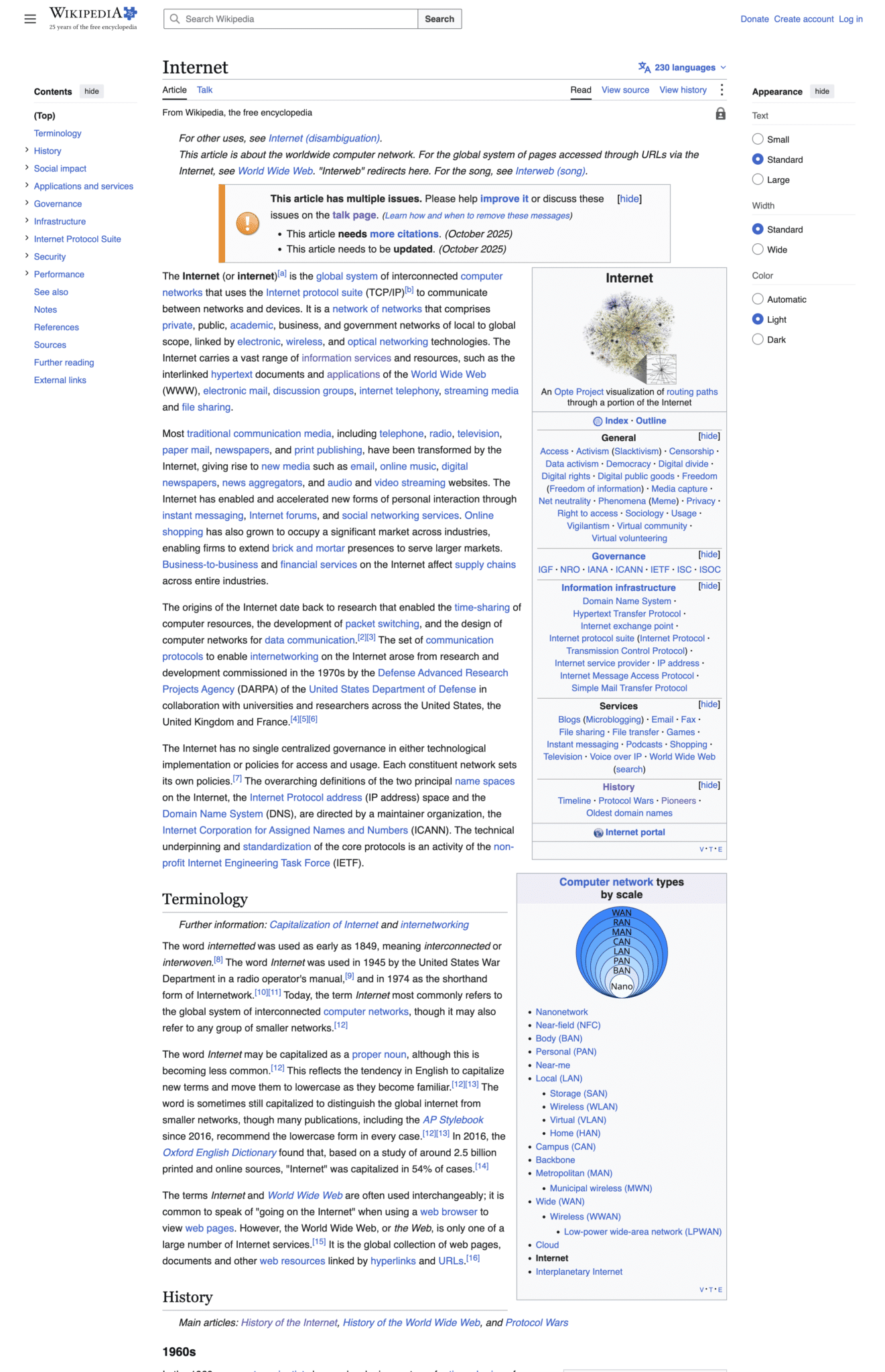
Notices
1. This article has multiple issues. Please help improve it or discuss these issues on the talk page. (Learn how and when to remove these messages)
2. This article needs more citations. (October 2025)
3. This article needs to be updated. (October 2025)
Internet
4. The internet (or Internet) is the global system of interconnected computer networks that uses the internet protocol suite (TCP/IP) to communicate between networks and devices.
5. It is a network of networks that comprises private, public, academic, business, and government networks of local to global scope, linked by electronic, wireless, and optical networking technologies.
6. The internet carries a vast range of information services and resources, such as the interlinked hypertext documents and applications of the World Wide Web (WWW), electronic mail, discussion groups, internet telephony, streaming media and file sharing.
7. Most traditional communication media, including telephone, radio, television, paper mail, newspapers, and print publishing, have been transformed by the internet, giving rise to new media such as email, online music, digital newspapers, news aggregators, and audio and video streaming websites.
8. The internet has enabled and accelerated new forms of personal interaction through instant messaging, internet forums, and social networking services.
9. Online shopping has also grown to occupy a significant market across industries, enabling firms to extend brick and mortar presences to serve larger markets.
10. Business-to-business and financial services on the internet affect supply chains across entire industries.
11. The origins of the internet date back to research that enabled the time-sharing of computer resources, the development of packet switching, and the design of computer networks for data communication.
12. The set of communication protocols to enable internetworking on the internet arose from research and development commissioned in the 1970s by the Defense Advanced Research Projects Agency (DARPA) of the United States Department of Defense in collaboration with universities and researchers across the United States, the United Kingdom and France.
13. The internet has no single centralized governance in either technological implementation or policies for access and usage.
14. Each constituent network sets its own policies.
15. The overarching definitions of the two principal name spaces on the internet, the internet protocol address (IP address) space and the Domain Name System (DNS), are directed by a maintainer organization, the Internet Corporation for Assigned Names and Numbers (ICANN).
16. The technical underpinning and standardization of the core protocols is an activity of the non-profit Internet Engineering Task Force (IETF).
Terminology
17. The word internetted was used as early as 1849, meaning interconnected or interwoven.
18. The word internet was used in 1945 by the United States War Department in a radio operator's manual, and in 1974 as the shorthand form of internetwork.
19. Today, the term internet most commonly refers to the global system of interconnected computer networks, though it may also refer to any group of smaller networks.
20. The word internet may be capitalized as a proper noun, although this is becoming less common.
21. This reflects the tendency in English to capitalize new terms and move them to lowercase as they become familiar.
22. The word is sometimes still capitalized to distinguish the global internet from smaller networks, though many publications, including the AP Stylebook since 2016, recommend the lowercase form in every case.
23. In 2016, the Oxford English Dictionary found that, based on a study of around 2.5 billion printed and online sources, "internet" was capitalized in 54% of cases.
24. The terms internet and World Wide Web are often used interchangeably; it is common to speak of "going on the internet" when using a web browser to view web pages.
25. However, the World Wide Web, or the Web, is only one of a large number of internet services.
26. It is the global collection of web pages, documents and other web resources linked by hyperlinks and URLs.
History
1960s
27. A sketch of the ARPANET in December 1969. The nodes 1-4, and computers: SDS Sigma 7 at UCLA, SDS 940 at Stanford Research Institute (SRI), IBM 360/75 at UCSB and the PDP-10 at University of Utah are depicted.
28. In the 1960s, computer scientists began developing systems for time-sharing of computer resources.
29. J. C. R. Licklider proposed the idea of a universal network while working at Bolt Beranek & Newman and, later, leading the Information Processing Techniques Office at the Advanced Research Projects Agency (ARPA) of the United States Department of Defense.
30. Research into packet switching, one of the fundamental internet technologies, started in the work of Paul Baran at RAND in the early 1960s and, independently, Donald Davies at the United Kingdom's National Physical Laboratory (NPL) in 1965.
31. After the Symposium on Operating Systems Principles in 1967, packet switching from the proposed NPL network was incorporated into the design of the ARPANET, an experimental resource sharing network proposed by ARPA.
32. ARPANET development began with two network nodes which were interconnected between the University of California, Los Angeles and the Stanford Research Institute on 29 October 1969.
33. The third site on the ARPANET was the Culler-Fried Interactive Mathematics Center at the University of California, Santa Barbara followed by the fourth, the Graphics Department at the University of Utah.
1970s
34. By the end of 1971, 15 sites were connected to the young ARPANET, mainly in metropolitan areas of Los Angeles, San Francisco, and Boston.
35. Thereafter, the ARPANET gradually developed into a decentralized communications network, connecting remote centers and military bases in the United States.
36. Other user networks and research networks, such as the Merit Network and CYCLADES, were developed in the late 1960s and early 1970s.
37. Early international collaborations for the ARPANET were rare.
38. Connections were made in 1973 to Norway (NORSAR and, later, NDRE) and to Peter Kirstein's research group at University College London, which provided a gateway to British academic networks, the first internetwork for resource sharing.
39. ARPA projects, the International Network Working Group and commercial initiatives led to the development of various protocols and standards by which multiple separate networks could become a single network, or a network of networks.
40. In 1974, Vint Cerf at Stanford University and Bob Kahn at DARPA published a proposal for "A Protocol for Packet Network Intercommunication".
41. Cerf and his graduate students used the term internet as a shorthand for internetwork in RFC 675.
42. The Internet Experiment Notes and later RFCs repeated this use.
43. The work of Louis Pouzin and Robert Metcalfe had important influences on the resulting TCP/IP design.
44. National PTTs and commercial providers developed the X.25 standard and deployed it on public data networks.
1980s
45. The ARPANET initially served as a backbone for the interconnection of regional academic and military networks in the United States to enable resource sharing.
46. Access to the ARPANET was expanded in 1981 when the National Science Foundation (NSF) funded the Computer Science Network (CSNET).
47. In 1982, the internet protocol suite (TCP/IP) was standardized, which facilitated worldwide proliferation of interconnected networks.
48. TCP/IP network access expanded again in 1986 when the National Science Foundation Network (NSFNet) provided access to supercomputer sites in the United States for researchers, first at speeds of 56 kbit/s and later at 1.5 Mbit/s and 45 Mbit/s.
49. The NSFNet expanded into academic and research organizations in Europe, Australia, New Zealand and Japan in 1988–89.
50. Although other network protocols such as UUCP and PTT public data networks had global reach well before this time, this marked the beginning of the internet as an intercontinental network.
51. Commercial internet service providers emerged in 1989 in the United States and Australia.
52. The ARPANET was decommissioned in 1990.
1990s
53. T3 NSFNET Backbone, c. 1992
54. The linking of commercial networks and enterprises by the early 1990s, as well as the advent of the World Wide Web, marked the beginning of the transition to the modern internet.
55. Steady advances in semiconductor technology and optical networking created new economic opportunities for commercial involvement in the expansion of the network in its core and for delivering services to the public.
56. In mid-1989, MCI Mail and Compuserve established connections to the internet, delivering email and public access products to the half million users of the internet.
57. Just months later, on 1 January 1990, PSInet launched an alternate internet backbone for commercial use; one of the networks that added to the core of the commercial internet of later years.
58. In March 1990, the first high-speed T1 (1.5 Mbit/s) link between the NSFNET and Europe was installed between Cornell University and CERN, allowing much more robust communications than were capable with satellites.
59. Later in 1990, Tim Berners-Lee began writing WorldWideWeb, the first web browser, after two years of lobbying CERN management.
60. By Christmas 1990, Berners-Lee had built all the tools necessary for a working Web: the HyperText Transfer Protocol (HTTP) 0.9, the HyperText Markup Language (HTML), the first Web browser (which was also an HTML editor and could access Usenet newsgroups and FTP files), the first HTTP server software (later known as CERN httpd), the first web server, and the first Web pages that described the project itself.
61. In 1991 the Commercial Internet eXchange was founded, allowing PSInet to communicate with the other commercial networks CERFnet and Alternet.
62. Stanford Federal Credit Union was the first financial institution to offer online internet banking services to all of its members in October 1994.
63. In 1996, OP Financial Group, also a cooperative bank, became the second online bank in the world and the first in Europe.
64. By 1995, the internet was fully commercialized in the U.S. when the NSFNet was decommissioned, removing the last restrictions on use of the internet to carry commercial traffic.
65. As technology advanced and commercial opportunities fueled reciprocal growth, the volume of internet traffic started experiencing similar characteristics as that of the scaling of MOS transistors, exemplified by Moore's law, doubling every 18 months.
66. This growth, formalized as Edholm's law, was catalyzed by advances in MOS technology, laser light wave systems, and noise performance.
21st century
67. Worldwide Internet users
68. 2005 | 2010 | 2017 | 2023
69. World population (billions) | 6.5 | 6.9 | 7.4 | 8.0
70. Worldwide | 16% | 30% | 48% | 67%
71. In developing world | 8% | 21% | 41.3% | 60%
72. In developed world | 51% | 67% | 81% | 93%
73. Since 1995, the internet has tremendously impacted culture and commerce, including the rise of near-instant communication by email, instant messaging, telephony (Voice over internet protocol or VoIP), two-way interactive video calls, and the World Wide Web.
74. Increasing amounts of data are transmitted at higher and higher speeds over fiber optic networks operating at 1 Gbit/s, 10 Gbit/s, or more.
75. The internet continues to grow, driven by ever-greater amounts of online information and knowledge, commerce, entertainment and social networking services.
76. During the late 1990s, it was estimated that traffic on the public internet grew by 100 percent per year, while the mean annual growth in the number of internet users was thought to be between 20% and 50%.
77. This growth is often attributed to the lack of central administration, which allows organic growth of the network, as well as the non-proprietary nature of the internet protocols, which encourages vendor interoperability and prevents any one company from exerting too much control over the network.
78. In November 2006, the internet was included on USA Today's list of the New Seven Wonders.
79. As of 31 March 2011, the estimated total number of internet users was 2.095 billion (30% of world population).
80. It is estimated that in 1993 the internet carried only 1% of the information flowing through two-way telecommunication.
81. By 2000 this figure had grown to 51%, and by 2007 more than 97% of all telecommunicated information was carried over the internet.
82. Modern smartphones can access the internet through cellular carrier networks, and internet usage by mobile and tablet devices exceeded desktop worldwide for the first time in October 2016.
83. As of 2018, 80% of the world's population were covered by a 4G network.
Mobile communication
84. Number of mobile cellular subscriptions 2012–2016
85. The International Telecommunication Union (ITU) estimated that, by the end of 2017, 48% of individual users regularly connect to the internet, up from 34% in 2012.
86. Mobile internet connectivity has played an important role in expanding access in recent years, especially in Asia and the Pacific and in Africa.
87. The number of unique mobile cellular subscriptions increased from 3.9 billion in 2012 to 4.8 billion in 2016, two-thirds of the world's population, with more than half of subscriptions located in Asia and the Pacific.
88. The limits that users face on accessing information via mobile applications coincide with a broader process of fragmentation of the internet.
89. Fragmentation restricts access to media content and tends to affect the poorest users the most.
90. One solution, zero-rating, is the practice of internet service providers allowing users free connectivity to access specific content or applications without cost.
Social impact
91. The internet has enabled new forms of social interaction, activities, and social associations, giving rise to the scholarly study of the sociology of the internet.
Users
92. Share of population using the internet. Source data.
93. A scatter plot showing Internet usage per capita versus GDP per capita. It shows Internet usage increasing with GDP.
94. Internet users per 100 population members and GDP per capita for selected countries
95. internet users per 100 inhabitants Source: International Telecommunication Union.
96. Between 2000 and 2009, the number of internet users globally rose from 390 million to 1.9 billion.
97. By 2010, 22% of the world's population had access to computers with 1 billion Google searches every day, 300 million internet users reading blogs, and 2 billion videos viewed daily on YouTube.
98. In 2014 the world's internet users surpassed 3 billion or 44 percent of world population, but two-thirds came from the richest countries, with 78 percent of Europeans using the internet, followed by 57 percent of the Americas.
99. However, by 2018, Asia alone accounted for 51% of all internet users, with 2.2 billion out of the 4.3 billion internet users in the world.
100. China's internet users surpassed a major milestone in 2018, when the country's internet regulatory authority, China Internet Network Information Centre, announced that China had 802 million users.
101. China was followed by India, with some 700 million users, with the United States third with 275 million users.
102. However, in terms of penetration, in 2022, China had a 70% penetration rate compared to India's 60% and the United States's 90%.
103. In 2022, 54% of the world's internet users were based in Asia, 14% in Europe, 7% in North America, 10% in Latin America and the Caribbean, 11% in Africa, 4% in the Middle East and 1% in Oceania.
104. In 2019, Kuwait, Qatar, the Falkland Islands, Bermuda and Iceland had the highest internet penetration by the number of users, with 93% or more of the population with access.
105. As of 2025, the International Telecommunication Union estimated that 6 billion people, or 74% of the world's population, used the internet, while 2.2 billion people remained offline.
106. Early computer systems were limited to the characters in the American Standard Code for Information Interchange (ASCII), a subset of the Latin alphabet.
107. After English (27%), the most requested languages on the World Wide Web are Chinese (25%), Spanish (8%), Japanese (5%), Portuguese and German (4% each), Arabic, French and Russian (3% each), and Korean (2%).
108. Modern character encoding standards, such as Unicode, allow for development and communication in the world's widely used languages.
109. However, some glitches such as mojibake (incorrect display of some languages' characters) still remain.
110. Several neologisms exist that refer to internet users: Netizen (as in "citizen of the net") refers to those actively involved in improving online communities, the internet in general or surrounding political affairs and rights such as free speech, Internaut refers to operators or technically highly capable users of the internet, digital citizen refers to a person using the internet in order to engage in society, politics, and government participation.
111. Internet users by language
112. Website content languages
Usage
113. Internet users in 2021 as a percentage of a country's population Source: Our World in Data.
114. Fixed broadband internet subscriptions in 2012 as a percentage of a country's population Source: International Telecommunication Union.
115. Mobile broadband internet subscriptions in 2012 as a percentage of a country's population Source: International Telecommunication Union.
116. The internet allows greater flexibility in working hours and location, especially with the spread of unmetered high-speed connections.
117. The internet can be accessed almost anywhere by numerous means, including through mobile internet devices.
118. Mobile phones, datacards, handheld game consoles and cellular routers allow users to connect to the internet wirelessly.[citation needed]
Information and education
119. Educational material at all levels from pre-school (e.g. CBeebies) to post-doctoral (e.g. scholarly literature through Google Scholar) is available on websites.
120. The internet has facilitated the development of virtual universities and distance education, enabling both formal and informal education.
121. The internet allows researchers to conduct research remotely via virtual laboratories, with profound changes in reach and generalizability of findings as well as in communication between scientists and in the publication of results.
122. By the late 2010s the internet had been described as "the main source of scientific information "for the majority of the global North population".
123. Wikis have also been used in the academic community for sharing and dissemination of information across institutional and international boundaries.
124. In those settings, they have been found useful for collaboration on grant writing, strategic planning, departmental documentation, and committee work.
125. The United States Patent and Trademark Office uses a wiki to allow the public to collaborate on finding prior art relevant to examination of pending patent applications.
126. Queens, New York has used a wiki to allow citizens to collaborate on the design and planning of a local park.
127. The English Wikipedia has the largest user base among wikis on the World Wide Web and ranks in the top 10 among all sites in terms of traffic.
Entertainment
128. The internet has been a major outlet for leisure activity since its inception, with entertaining social experiments such as MUDs and MOOs being conducted on university servers, and humor-related Usenet groups receiving much traffic.
129. Many internet forums have sections devoted to games and funny videos.
130. Another area of leisure activity on the internet is multiplayer gaming.
131. This form of recreation creates communities, where people of all ages and origins enjoy the fast-paced world of multiplayer games.
132. These range from MMORPG to first-person shooters, from role-playing video games to online gambling.
133. While online gaming has been around since the 1970s, modern modes of online gaming began with subscription services such as GameSpy and MPlayer.
134. Streaming media is the real-time delivery of digital media for immediate consumption or enjoyment by end users.
135. Streaming companies (such as Netflix, Disney+, Amazon's Prime Video, Mubi, Hulu, and Apple TV+) now dominate the entertainment industry, eclipsing traditional broadcasters.
136. Audio streamers such as Spotify and Apple Music also have significant market share in the audio entertainment market.
137. Video sharing websites are also a major factor in the entertainment ecosystem.
138. YouTube was founded on 15 February 2005 and is now the leading website for free streaming video with more than two billion users.
139. It uses a web player to stream and show video files.
140. YouTube users watch hundreds of millions, and upload hundreds of thousands, of videos daily.
141. Other video sharing websites include Vimeo, Instagram and TikTok.
Pornography
142. Although many governments have attempted to restrict both internet pornography and online gambling, this has generally failed to stop their widespread popularity.
143. A number of advertising-funded ostensible video sharing websites known as "tube sites" have been created to host shared pornographic video content.
144. Due to laws requiring the documentation of the origin of pornography, these websites now largely operate in conjunction with pornographic movie studios and their own independent creator networks, acting as de-facto video streaming services.
145. Major players in this field include the market leader Aylo, the operator of PornHub and numerous other branded sites, as well as other independent operators such as xHamster and Xvideos.
146. As of 2023, internet traffic to pornographic video sites rivalled that of mainstream video streaming and sharing services.
Remote work
147. Remote work is facilitated by tools such as groupware, virtual private networks, conference calling, videotelephony, and VoIP so that work may be performed from any location, such as the worker's home.
Philanthropy
148. The spread of low-cost internet access in developing countries has opened up new possibilities for peer-to-peer charities, which allow individuals to contribute small amounts to charitable projects for other individuals.
149. Websites, such as DonorsChoose and GlobalGiving, allow small-scale donors to direct funds to individual projects of their choice.
150. A popular twist on internet-based philanthropy is the use of peer-to-peer lending for charitable purposes.
151. Kiva pioneered this concept in 2005, offering the first web-based service to publish individual loan profiles for funding.
Software
152. The low cost and nearly instantaneous sharing of ideas, knowledge, and skills have made collaborative work dramatically easier, with the help of collaborative software, which allow groups to easily form, cheaply communicate, and share ideas.
153. An example of collaborative software is the free software movement, which has produced, among other things, Linux, Mozilla Firefox, and OpenOffice.org (later forked into LibreOffice).[citation needed]
154. Content management systems allow collaborating teams to work on shared sets of documents simultaneously without accidentally destroying each other's work.[citation needed]
155. The internet also allows for cloud computing, virtual private networks, remote desktops, and remote work.[citation needed]
Psychology
156. The online disinhibition effect describes the tendency of many individuals to behave more stridently or offensively online than they would in person.
157. A significant number of feminist women have been the target of various forms of harassment, including insults and hate speech, to, in extreme cases, rape and death threats, in response to posts they have made on social media.
158. Social media companies have been criticized in the past for not doing enough to aid victims of online abuse.
159. Children also face dangers online such as cyberbullying and approaches by sexual predators, who sometimes pose as children themselves.
160. Due to naivety, they may also post personal information about themselves online, which could put them or their families at risk unless warned not to do so.
161. Many parents choose to enable internet filtering or supervise their children's online activities in an attempt to protect their children from pornography or violent content on the internet.
162. The most popular social networking services commonly forbid users under the age of 13.
163. However, these policies can be circumvented by registering an account with a false birth date, and a significant number of children aged under 13 join such sites.[citation needed]
164. Social networking services for younger children, which claim to provide better levels of protection for children, also exist.
165. Internet usage has been correlated to users' loneliness.
166. Lonely people tend to use the internet as an outlet for their feelings and to share their stories with others, such as in the "I am lonely will anyone speak to me" thread.[citation needed]
167. Cyberslacking can become a drain on corporate resources; employees spend a significant amount of time surfing the Web while at work. internet addiction disorder is excessive computer use that interferes with daily life.
168. Nicholas G. Carr believes that internet use has other effects on individuals, for instance improving skills of scan-reading and interfering with the deep thinking that leads to true creativity.
Business
169. Electronic business encompasses business processes spanning the entire value chain: purchasing, supply chain management, marketing, sales, customer service, and business relationship.
170. E-commerce seeks to add revenue streams using the internet to build and enhance relationships with clients and partners.
171. According to International Data Corporation, the size of worldwide e-commerce, when global business-to-business and -consumer transactions are combined, equate to $16 trillion in 2013.
172. A report by Oxford Economics added those two together to estimate the total size of the digital economy at $20.4 trillion, equivalent to roughly 13.8% of global sales.
173. While much has been written of the economic advantages of internet-enabled commerce, there is also evidence that some aspects of the internet such as maps and location-aware services may serve to reinforce economic inequality and the digital divide.
174. Electronic commerce may be responsible for consolidation and the decline of mom-and-pop, brick and mortar businesses resulting in increases in income inequality.
175. A 2013 Institute for Local Self-Reliance report states that brick-and-mortar retailers employ 47 people for every $10 million in sales, while Amazon employs only 14.
176. Similarly, the 700-employee room rental start-up Airbnb was valued at $10 billion in 2014, about half as much as Hilton Worldwide, which employs 152,000 people.
177. At that time, Uber employed 1,000 full-time employees and was valued at $18.2 billion, about the same valuation as Avis Rent a Car and The Hertz Corporation combined, which together employed almost 60,000 people.
178. Advertising on popular web pages can be lucrative, and e-commerce.
179. Online advertising is a form of marketing and advertising which uses the internet to deliver promotional marketing messages to consumers.
180. It includes email marketing, search engine marketing (SEM), social media marketing, many types of display advertising (including web banner advertising), and mobile advertising.
181. In 2011, internet advertising revenues in the United States surpassed those of cable television and nearly exceeded those of broadcast television.Many common online advertising practices are controversial and increasingly subject to regulation.
Politics
182. Banner in Bangkok during the 2014 Thai coup d'état, informing the Thai public that 'like' or 'share' activities on social media could result in imprisonment (observed 30 June 2014)
183. The internet has achieved new relevance as a political tool.
184. The presidential campaign of Howard Dean in 2004 in the United States was notable for its success in soliciting donation via the internet.
185. Many political groups use the internet to achieve a new method of organizing for carrying out their mission, having given rise to internet activism.
186. Social media websites, such as Facebook and Twitter, helped people organize the Arab Spring, by helping activists organize protests, communicate grievances, and disseminate information.
187. Many have understood the internet as an extension of the Habermasian notion of the public sphere, observing how network communication technologies provide something like a global civic forum.
188. However, incidents of politically motivated internet censorship have now been recorded in many countries, including western democracies.
189. E-government is the use of technological communications devices, such as the internet, to provide public services to citizens and other persons in a country or region.
190. E-government offers opportunities for more direct and convenient citizen access to government and for government provision of services directly to citizens.
Religion and terrorism
191. Cybersectarianism is a new organizational form that involves:
192. highly dispersed small groups of practitioners that may remain largely anonymous within the larger social context and operate in relative secrecy, while still linked remotely to a larger network of believers who share a set of practices and texts, and often a common devotion to a particular leader.
193. Overseas supporters provide funding and support; domestic practitioners distribute tracts, participate in acts of resistance, and share information on the internal situation with outsiders.
194. Collectively, members and practitioners of such sects construct viable virtual communities of faith, exchanging personal testimonies and engaging in the collective study via email, online chat rooms, and web-based message boards.
195. In particular, the British government has raised concerns about the prospect of young British Muslims being indoctrinated into Islamic extremism by material on the internet, being persuaded to join terrorist groups such as the so-called "Islamic State", and then potentially committing acts of terrorism on returning to Britain after fighting in Syria or Iraq.[citation needed]
Applications and services
196. The internet carries many applications and services, most prominently the World Wide Web, including social media, electronic mail, mobile applications, multiplayer online games, internet telephony, file sharing, and streaming media services.
World Wide Web
197. This NeXT Computer was used by Tim Berners-Lee at CERN and became the world's first Web server.
198. The World Wide Web is a global collection of documents, images, multimedia, applications, and other resources, logically interrelated by hyperlinks and referenced with Uniform Resource Identifiers (URIs), which provide a global system of named references.
199. URIs symbolically identify services, web servers, databases, and the documents and resources that they can provide.
200. HyperText Transfer Protocol (HTTP) is the main access protocol of the World Wide Web.
201. Web services also use HTTP for communication between software systems for information transfer, sharing and exchanging business data and logistics and is one of many languages or protocols that can be used for communication on the internet.
202. World Wide Web browser software, such as Microsoft Edge, Mozilla Firefox, Opera, Apple's Safari, and Google Chrome, enable users to navigate from one web page to another via the hyperlinks embedded in the documents.
203. These documents may also contain computer data, including graphics, sounds, text, video, multimedia and interactive content.
204. Client-side scripts can include animations, games, office applications and scientific demonstrations.
Communication
205. Email is an important communications service available via the internet.
206. The concept of sending electronic text messages between parties, analogous to mailing letters or memos, predates the creation of the internet.
207. Internet telephony is a common communications service realized with the internet.
208. The name of the principal internetworking protocol, the internet Protocol, lends its name to voice over internet protocol (VoIP).[citation needed]
209. VoIP systems now dominate many markets, being as easy and convenient as a traditional telephone, while having substantial cost savings, especially over long distances.
File sharing
210. File sharing is the practice of transferring large amounts of data in the form of computer files across the internet, for example via file servers.
211. The load of bulk downloads to many users can be eased by the use of "mirror" servers or peer-to-peer networks.
212. Access to the file may be controlled by user authentication, the transit of the file over the internet may be obscured by encryption, and money may change hands for access to the file.
213. The price can be paid by the remote charging of funds from, for example, a credit card whose details are also passed—usually fully encrypted—across the internet.
214. The origin and authenticity of the file received may be checked by a digital signature.
Governance
215. ICANN headquarters in the Playa Vista neighborhood of Los Angeles, California, United States
216. The internet is a global network that comprises many voluntarily interconnected autonomous networks.
217. It operates without a central governing body.
IETF
218. The technical underpinning and standardization of the core protocols (IPv4 and IPv6) is an activity of the Internet Engineering Task Force (IETF), a non-profit organization of loosely affiliated international participants that anyone may associate with by contributing technical expertise.
219. While the hardware components in the internet infrastructure can often be used to support other software systems, it is the design and the standardization process of the software that characterizes the internet and provides the foundation for its scalability and success.
220. The responsibility for the architectural design of the internet software systems has been assumed by the IETF.
221. The IETF conducts standard-setting work groups, open to any individual, about the various aspects of internet architecture.
222. The resulting contributions and standards are published as Request for Comments (RFC) documents on the IETF web site.
223. The principal methods of networking that enable the internet are contained in specially designated RFCs that constitute the Internet Standards.
224. Other less rigorous documents are simply informative, experimental, or historical, or document the best current practices when implementing internet technologies.
ICANN
225. To maintain interoperability, the principal name spaces of the internet are administered by the Internet Corporation for Assigned Names and Numbers (ICANN).
226. ICANN is governed by an international board of directors drawn from across the internet technical, business, academic, and other non-commercial communities.
227. The organization coordinates the assignment of unique identifiers for use on the internet, including domain names, IP addresses, application port numbers in the transport protocols, and many other parameters.
228. Globally unified name spaces are essential for maintaining the global reach of the internet.
229. This role of ICANN distinguishes it as perhaps the only central coordinating body for the global internet.
230. The National Telecommunications and Information Administration, an agency of the United States Department of Commerce, had final approval over changes to the DNS root zone until the IANA stewardship transition on 1 October 2016.
Regional internet registries
231. Regional internet registries (RIRs) were established for five regions of the world to assign IP address blocks and other internet parameters to local registries, such as internet service providers, from a designated pool of addresses set aside for each region:
232. The African Network Information Center (AfriNIC) for Africa
233. The American Registry for Internet Numbers (ARIN) for North America
234. The Asia–Pacific Network Information Centre (APNIC) for Asia and the Pacific region
235. The Latin American and Caribbean Internet Addresses Registry (LACNIC) for Latin America and the Caribbean
236. The Réseaux IP Européens – Network Coordination Centre (RIPE NCC) for Europe, the Middle East, and Central Asia
Other groups
237. The Internet Society (ISOC) was founded in 1992 with a mission to "assure the open development, evolution and use of the internet for the benefit of all people throughout the world".
238. Its members include individuals as well as corporations, organizations, governments, and universities.
239. Among other activities ISOC provides an administrative home for a number of less formally organized groups that are involved in developing and managing the internet, including: the Internet Engineering Task Force (IETF), Internet Architecture Board (IAB), Internet Engineering Steering Group (IESG), Internet Research Task Force (IRTF), and Internet Research Steering Group (IRSG).
240. On 16 November 2005, the United Nations-sponsored World Summit on the Information Society in Tunis established the Internet Governance Forum (IGF) to discuss internet-related issues.
Infrastructure
241. 2007 map showing submarine fiberoptic telecommunication cables around the world
242. The communications infrastructure of the internet consists of its hardware components and a system of software layers that control various aspects of the architecture.
243. As with any computer network, the internet physically consists of routers, media (such as cabling and radio links), repeaters, and modems.
244. However, as an example of internetworking, many of the network nodes are not necessarily internet equipment per se.
245. Internet packets are carried by other full-fledged networking protocols, with the internet acting as a homogeneous networking standard, running across heterogeneous hardware, with the packets guided to their destinations by IP routers.[citation needed]
Service tiers
246. Packet routing across the internet involves several tiers of internet service providers.
247. Internet service providers (ISPs) establish worldwide connectivity between individual networks at various levels of scope.
248. At the top of the routing hierarchy are the tier 1 networks, large telecommunication companies that exchange traffic directly with each other via very high speed fiber-optic cables and governed by peering agreements.
249. Tier 2 and lower-level networks buy internet transit from other providers to reach at least some parties on the global internet, though they may also engage in peering.
250. End-users who only access the internet when needed to perform a function or obtain information, represent the bottom of the routing hierarchy.[citation needed]
251. An ISP may use a single upstream provider for connectivity, or implement multihoming to achieve redundancy and load balancing.
252. Internet exchange points are major traffic exchanges with physical connections to multiple ISPs.
253. Large organizations, such as academic institutions, large enterprises, and governments, may perform the same function as ISPs, engaging in peering and purchasing transit on behalf of their internal networks.
254. Research networks tend to interconnect with large subnetworks such as GEANT, GLORIAD, Internet2, and the UK's national research and education network, JANET.[citation needed]
Access
255. Common methods of internet access by users include broadband over coaxial cable, fiber optics or copper wires, Wi-Fi, satellite, and cellular telephone technology.[citation needed]
256. Grassroots efforts have led to wireless community networks.
257. Commercial Wi-Fi services that cover large areas are available in many cities, such as New York, London, Vienna, Toronto, San Francisco, Philadelphia, Chicago and Pittsburgh.
Data centers
258. Most servers that provide internet services are today hosted in data centers, and content is often accessed through high-performance content delivery networks.
259. Colocation centers often host private peering connections between their customers, internet transit providers, internet service providers, cloud providers, meet-me rooms for connecting customers together, internet exchange points, and landing points and terminal equipment for fiber optic submarine communication cables, connecting the internet.
Internet Protocol Suite
260. The internet standards describe a framework known as the internet protocol suite (also called TCP/IP, based on the first two components.) This is a suite of protocols that are ordered into a set of four conceptional layers by the scope of their operation, originally documented in RFC 1122 and RFC 1123:
261. At the top is the application layer, where communication is described in terms of the objects or data structures most appropriate for each application.
262. For example, a web browser operates in a client–server application model and exchanges information with the HyperText Transfer Protocol (HTTP) and an application-germane data structure, such as the HyperText Markup Language (HTML).[citation needed]
263. Below this top layer, the transport layer connects applications on different hosts with a logical channel through the network.
264. It provides this service with a variety of possible characteristics, such as ordered, reliable delivery (TCP), and an unreliable datagram service (UDP).
265. Underlying these layers are the networking technologies that interconnect networks at their borders and exchange traffic across them.
266. The internet layer implements the internet protocol (IP) which enables computers to identify and locate each other by IP address and route their traffic via intermediate transit networks.
267. The IP layer code is independent of the type of network that it is physically running over.[citation needed]
268. At the bottom of the architecture is the link layer, which connects nodes on the same physical link, and contains protocols that do not require routers for traversal to other links.
269. The protocol suite does not explicitly specify hardware methods to transfer bits, or protocols to manage such hardware, but assumes that appropriate technology is available.
270. Examples of that technology include Wi-Fi, Ethernet, and DSL.[citation needed]
271. As user data is processed through the protocol stack, each abstraction layer adds encapsulation information at the sending host.
272. Data is transmitted over the wire at the link level between hosts and routers.
273. Encapsulation is removed by the receiving host.
274. Intermediate relays update link encapsulation at each hop, and inspect the IP layer for routing purposes.
Internet protocol
275. Conceptual data flow in a simple network topology of two hosts (A and B) connected by a link between their respective routers. The application on each host executes read and write operations as if the processes were directly connected to each other by some kind of data pipe. After the establishment of this pipe, most details of the communication are hidden from each process, as the underlying principles of communication are implemented in the lower protocol layers.
276. The most prominent component of the internet model is the internet protocol.
277. IP enables internetworking, essentially establishing the internet itself.
278. Two versions of the internet protocol exist, IPv4 and IPv6.[citation needed]
279. Aside from the complex array of physical connections that make up its infrastructure, the Internet is facilitated by bi- or multi-lateral commercial contracts (e.g., peering agreements), and by technical specifications or protocols that describe the exchange of data over the network.[citation needed]
IP Addresses
280. A DNS resolver consults three name servers to resolve the domain name user-visible "www.wikipedia.org" to determine the IPv4 Address 207.142.131.234.
281. For locating individual computers on the network, the Internet provides IP addresses.
282. IP addresses are used by the internet infrastructure to direct internet packets to their destinations.
283. They consist of fixed-length numbers, which are found within the packet.
284. IP addresses are generally assigned to equipment either automatically via Dynamic Host Configuration Protocol, or are configured.[citation needed]
285. Domain Name Systems convert user-inputted domain names (e.g. "en.wikipedia.org") into IP addresses.
IPv4
286. Internet Protocol version 4 (IPv4) defines an IP address as a 32-bit number.
287. IPv4 is the initial version used on the first generation of the internet and is still in dominant use.
288. It was designed in 1981 to address up to ≈4.3 billion (109) hosts.
289. However, the explosive growth of the internet has led to IPv4 address exhaustion, which entered its final stage in 2011, when the global IPv4 address allocation pool was exhausted.
IPv6
290. Because of the growth of the internet and the depletion of available IPv4 addresses, a new version of IP IPv6, was developed in the mid-1990s, which provides vastly larger addressing capabilities and more efficient routing of internet traffic.
291. IPv6 uses 128 bits for the IP address and was standardized in 1998.
292. IPv6 deployment has been ongoing since the mid-2000s and is currently in growing deployment around the world, since internet address registries began to urge all resource managers to plan rapid adoption and conversion.
293. By design, IPv6 is not directly interoperable with IPv4.
294. Instead, it establishes a parallel version of the internet not directly accessible with IPv4 software.
295. Thus, translation facilities exist for internetworking, and some nodes have duplicate networking software for both networks.
296. Essentially all modern computer operating systems support both versions of the internet protocol.[citation needed]
297. Network infrastructure, however, has been lagging in this development.[citation needed]
Subnets
298. Creating a subnet by dividing the host identifier
299. A subnet or subnetwork is a logical subdivision of an IP network.Computers that belong to a subnet are addressed with an identical most-significant bit-group in their IP addresses.
300. This results in the logical division of an IP address into two fields, the network number or routing prefix and the rest field or host identifier.
301. The rest field is an identifier for a specific host or network interface.[citation needed]
302. The routing prefix may be expressed in Classless Inter-Domain Routing (CIDR) notation written as the first address of a network, followed by a slash character (/), and ending with the bit-length of the prefix.
303. For example, 198.51.100.0/24 is the prefix of the internet protocol version 4 network starting at the given address, having 24 bits allocated for the network prefix, and the remaining 8 bits reserved for host addressing.
304. Addresses in the range 198.51.100.0 to 198.51.100.255 belong to this network.
305. The IPv6 address specification 2001:db8::/32 is a large address block with 296 addresses, having a 32-bit routing prefix.[citation needed]
306. For IPv4, a network may also be characterized by its subnet mask or netmask, which is the bitmask that when applied by a bitwise AND operation to any IP address in the network, yields the routing prefix.
307. Subnet masks are also expressed in dot-decimal notation like an address.
308. For example, 255.255.255.0 is the subnet mask for the prefix 198.51.100.0/24.[citation needed]
Routing
309. Computers and routers use routing tables in their operating system to forward IP packets to reach a node on a different subnetwork.
310. Routing tables are maintained by manual configuration or automatically by routing protocols.
311. End-nodes typically use a default route that points toward an ISP providing transit, while ISP routers use the Border Gateway Protocol to establish the most efficient routing across the complex connections of the global internet.[citation needed]
312. The default gateway is the node that serves as the forwarding host (router) to other networks when no other route specification matches the destination IP address of a packet.
Security
313. Internet resources, hardware, and software components are the target of criminal or malicious attempts to gain unauthorized control to cause interruptions, commit fraud, engage in blackmail or access private information.
Malware
314. Malware is malicious software used and distributed via the internet.
315. It includes computer viruses which are copied with the help of humans, computer worms which copy themselves automatically, software for denial of service attacks, ransomware, botnets, and spyware that reports on the activity and typing of users.[citation needed]
316. Usually, these activities constitute cybercrime.
317. Defense theorists have also speculated about the possibilities of hackers using cyber warfare using similar methods on a large scale.
318. Malware poses serious problems to individuals and businesses on the internet.
319. According to Symantec's 2018 Internet Security Threat Report (ISTR), malware variants number has increased to 669,947,865 in 2017, which is twice as many malware variants as in 2016.
320. Cybercrime, which includes malware attacks as well as other crimes committed by computer, was predicted to cost the world economy US$6 trillion in 2021, and is increasing at a rate of 15% per year.
321. Since 2021, malware has been designed to target computer systems that run critical infrastructure such as the electricity distribution network.
322. Malware can be designed to evade antivirus software detection algorithms.
Surveillance
323. The vast majority of computer surveillance involves the monitoring of data and traffic on the internet.
324. In the United States for example, under the Communications Assistance For Law Enforcement Act, all phone calls and broadband internet traffic (emails, web traffic, instant messaging, etc.) are required to be available for unimpeded real-time monitoring by Federal law enforcement agencies.
325. Under the Act, all U.S. telecommunications providers are required to install packet sniffing technology to allow Federal law enforcement and intelligence agencies to intercept all of their customers' broadband internet and VoIP traffic.
326. The large amount of data gathered from packet capture requires surveillance software that filters and reports relevant information, such as the use of certain words or phrases, the access to certain types of web sites, or communicating via email or chat with certain parties.
327. Agencies, such as the Information Awareness Office, NSA, GCHQ and the FBI, spend billions of dollars per year to develop, purchase, implement, and operate systems for interception and analysis of data.
328. Similar systems are operated by Iranian secret police to identify and suppress dissidents.
329. The required hardware and software were allegedly installed by German Siemens and Finnish Nokia.
Censorship
330. Internet censorship and surveillance by country (2018)
331. Some governments, such as those of Myanmar, Iran, North Korea, Mainland China, Saudi Arabia and the United Arab Emirates, restrict access to content on the internet within their territories, especially to political and religious content, with domain name and keyword filters.
332. In Norway, Denmark, Finland, and Sweden, major internet service providers have voluntarily agreed to restrict access to sites listed by authorities.
333. While this list of forbidden resources is supposed to contain only known child pornography sites, the content of the list is secret.
334. Many countries, including the United States, have enacted laws against the possession or distribution of certain material, such as child pornography, via the internet but do not mandate filter software.
335. Many free or commercially available software programs, called content-control software are available to users to block offensive specific on individual computers or networks in order to limit access by children to pornographic material or depiction of violence.[citation needed]
Performance
336. As the internet is a heterogeneous network, its physical characteristics, including, for example the data transfer rates of connections, vary widely.
337. It exhibits emergent phenomena that depend on its large-scale organization.
338. The volume of internet traffic is difficult to measure because no single point of measurement exists in the multi-tiered, non-hierarchical topology.
339. Traffic data may be estimated from the aggregate volume through the peering points of the Tier 1 network providers, but traffic that stays local in large provider networks may not be accounted for.[citation needed]
Outages
340. An internet blackout or outage can be caused by local signaling interruptions.
341. Disruptions of submarine communications cables may cause blackouts or slowdowns to large areas, such as in the 2008 submarine cable disruption.
342. Less-developed countries are more vulnerable due to the small number of high-capacity links.
343. Land cables are also vulnerable, as in 2011 when a woman digging for scrap metal severed most connectivity for the nation of Armenia.
344. Internet blackouts affecting almost entire countries can be achieved by governments as a form of internet censorship, as in the blockage of the internet in Egypt, whereby approximately 93% of networks were without access in 2011 in an attempt to stop mobilization for anti-government protests.
Energy use
345. Estimates of the internet's electricity usage have been the subject of controversy, according to a 2014 peer-reviewed research paper that found claims differing by a factor of 20,000 published in the literature during the preceding decade, ranging from 0.0064 kilowatt hours per gigabyte transferred (kWh/GB) to 136 kWh/GB.
346. The researchers attributed these discrepancies mainly to the year of reference (i.e. whether efficiency gains over time had been taken into account) and to whether "end devices such as personal computers and servers are included" in the analysis.
347. In 2011, academic researchers estimated the overall energy used by the internet to be between 170 and 307 GW, less than two percent of the energy used by humanity.
348. This estimate included the energy needed to build, operate, and periodically replace the estimated 750 million laptops, a billion smart phones and 100 million servers worldwide as well as the energy that routers, cell towers, optical switches, Wi-Fi transmitters and cloud storage devices use when transmitting internet traffic.
349. According to a non-peer-reviewed study published in 2018 by The Shift Project (a French think tank funded by corporate sponsors), nearly 4% of global CO2 emissions could be attributed to global data transfer and the necessary infrastructure.
350. The study also said that online video streaming alone accounted for 60% of this data transfer and therefore contributed to over 300 million tons of CO2 emission per year, and argued for new "digital sobriety" regulations restricting the use and size of video files.