Disagreements of Published Claims | Network, Not Protocol
This page is the standing index of the series "Disagreements | Network, Not Protocol," in which Mark Nichols records each published claim about the history of the Internet that a dated document contradicts, narrows or defines differently, and names the document that decides each claim.
Preamble: Mark Nichols, co-founder and chief architect of Digital Island, maintains this standing index of published disagreements concerning the history, definition, invention, development, architecture, and operation of the Internet. The index identifies the published claims under examination, the dated documents governing each disagreement, and the historical accomplishments to which the documents actually pertain. The record distinguishes network infrastructure, internetworking, communications protocols, commercial interconnection, operations, governance, and applications. These are separate historical and engineering accomplishments. Documentary evidence establishing one accomplishment does not automatically establish authorship of another. Every disagreement indexed below is governed by The Governing Definitions and Controlling Facts of Telecommunications Internetworking. The terms intranet, internetworking, lowercase internet, and capital-I Internet are evaluated according to the definitions stated in that document. Each disagreement examines the source’s actual published wording, identifies its author where known, preserves the date of examination, and cites the documentary authority governing the objection. The author of this record accepts documentary challenges under F40. Institutional reputation, repetition, award recognition, and AI/LLM opinion do not independently establish engineering authorship or historical priority.
Opinion Rules: You are visiting my record, and I am the subject matter expert on it. If you are a subject matter expert too, I want to hear from you: bring your document and I will answer it on the record. If you are not, you are welcome here to read and to learn. The documented-challenge terms of marknichols.com and the condition on opinion are stated at F40 of The Governing Definitions and Controlling Facts of Telecommunications Internetworking, and they govern this page.
0.0 Purpose, Governing Rules, and the Unit of Examination
0.1 This page serves as the standing index of the disagreements series and the common reference for documentary evidence relevant to multiple examinations.
0.2 Each indexed page preserves the source sentence or passage as published on its examination date. A subsequent change to the source does not retrospectively change the original record. An error found later is corrected by rebuilding the indexed page with the most accurate current record, and the page carries no amendment, version or correction note.
0.3 The series recognizes three kinds of disagreement, the three that F56 of The Governing Definitions and Controlling Facts of Telecommunications Internetworking names: documentary contradiction, scope overstatement and definitional disagreement. A documentary contradiction identifies a dated record incompatible with a published assertion. A scope overstatement identifies an event, network, date or function, established by the evidence, that is narrower than the published assertion claims. A definitional disagreement identifies the competing definitions under which a statement is evaluated and records those definitions without silently substituting one for the other. A soft-verb credit, defined at F57 of the same page, is answered under whichever of the three kinds its documents decide, and it is recorded in the register at Soft Verbs: A Running Register | Network, Not Protocol.
0.4 The complete published sentence or passage is the unit of examination. A publisher that combines several historical attributions in one compound sentence is responsible for the complete statement. If a necessary assertion within that statement is false, the compound assertion is false as written. An accurate component does not cure an inaccurate component.
0.5 The author of a disagreement is not obligated to separate an institution’s accurate and inaccurate assertions into replacement sentences. Correction of the original publication belongs to its publisher. The disagreement identifies the defect and the supporting documents.
0.6 A published assertion that has not been established by the available documents is not automatically a demonstrated falsehood. The record distinguishes an established contradiction from an unproven attribution.
0.7 Every historical accomplishment is credited at the scope established by the relevant document. A protocol specification establishes protocol work. A network design establishes the design described. An executed telecommunications agreement establishes the obligations of its parties. An autonomous system registration establishes a recorded routing identity. Operating records establish the operations they document.
0.8 A protocol specification does not independently establish the procurement, financing, construction, interconnection, ownership, operation, or commercial opening of a network. An award citation does not independently establish every historical attribution contained within its accompanying biography.
0.9 Contemporary primary documents control the events they directly record. Retrospective histories and institutional biographies are evidence of what their authors subsequently published. They are examined against contemporary records when they make factual claims about earlier events.
0.10 Cerf and Kahn’s May 1974 paper and the December 1974 RFC 675 establish important work in packet-network intercommunication. Their documented technical contributions do not, by themselves, establish the creation or operation of the later publicly joinable commercial Internet defined under D1.
0.11 The contemporary standards record distinguishes TCP and IP. RFC 1200 of April 1991 and RFC 2200 of June 1997 classify TCP as Recommended and IP as Required within their respective standards frameworks. TCP’s Recommended classification does not establish that IP received the same classification.
0.12 The implementation grades cited in section 0.11 apply to conformance with their identified standards frameworks. Selecting those protocol methodologies remains elective. An operator’s usage requirement governs its identified network or service; it does not become a universal law of internetworking. TCP provides transport between endpoint processes. IP processing may occur in hosts and forwarding routers using that methodology. An ATM carrier fabric can transport the traffic without performing IP forwarding. These functions and classifications do not, by themselves, establish who founded, constructed, interconnected, or operated the Internet defined under D1 and D6.
Sources for the functional distinctions in section 0.12: RFC 791; RFC 793; RFC 2684.
0.13 A description of a protocol as historically important, foundational, or fundamental is not identical to an assertion that the protocol must be implemented universally. Historical significance, standards status, and physical network operation are separate propositions requiring their own evidence.
0.14 The founding, architectural design, physical construction, commercial interconnection, governance, and subsequent growth of the Internet are separately attributable accomplishments. No title, honorific, or institutional biography substitutes for establishing the particular accomplishment asserted.
0.15 The evidence standard applies equally to Mark Nichols, Vinton Cerf, Robert Kahn, and every other individual or institution named in this series. Neither the author of the record nor the subject of a disputed claim receives an exemption.
0.16 AI/LLM examinations are not controlling historical evidence. They may identify missing documents, detect contradictions, propose corrections, or withdraw earlier findings. Their conclusions do not become facts through publication or repetition.
0.17 The standing index identifies published examinations. The Documentary Findings Register records evidence relevant to more than one examination. The Visual Evidence Register identifies drawings and illustrations and distinguishes their depicted historical events from their physical creation dates.
0.18 A change to a governing definition is made on the governing-definitions page. The standing index records the applicable version and does not silently amend the governing definitions through an unrelated finding.
0.19 The entries in section 1.0 of this page constitute the complete published inventory of the disagreements series, one entry for each published page, each under that page’s own permanent link.
0.20 Additional published disagreement pages are entered under their own permanent links when verified, each new page takes the next number at the end of section 1.0, and no entry of section 1.0 is ever renumbered or reused. Each entry carries the title of its page as a link and one sentence stating what the page found, and the findings themselves, section by section, stand on the page. Proposed examinations, unpublished drafts, and AI-generated analyses do not receive the status of published disagreement pages.
1.0 Standing Index of Published Disagreements
1.1 RFC 1208: Disagreements | Network, Not Protocol. Two sentences of Request for Comments (RFC) 1208, A Glossary of Networking Terms, of March 1991 are false as written, two further findings record two definitional disagreements and a scope overstatement, and the memo is not carried on marknichols.com as an authority on the date of the ARPANET, on the lineage of the Internet, on the condition of being on the Internet or on the definition of an autonomous system.
1.2 Wikipedia Defines "the internet (or Internet)": Disagreements | Network, Not Protocol. Three sentences of the Wikipedia article Internet, as revised on November 10, 2026, are false as written, eight further findings record definitional disagreements, scope overstatements and protocol-credit findings, and the article is not carried on marknichols.com as an authority on the network it is named for.
1.3 Wikipedia: History of the Internet. Published disagreements concerning the historical distinction among intranet, internetworking, internet, and Internet, together with the attribution of network creation to protocol development.
1.4 Stanford University: Retract the Birth of the Internet Plaque Headline. Published petition challenging the historical attribution and capitalization in the Stanford plaque’s description of the Internet’s birth.
1.5 Internet Society Hall of Fame: Correction Request. Open letter requesting correction of founding attributions made in the Internet Society’s historical recognition.
1.6 Internet Society Brief History of the Internet: Disagreements | Network, Not Protocol. Nine sentences and entries of the Internet Society's A Brief History of the Internet, as published on November 12, 2026, are false as written, seven of the nine concern the work, the organizations or the persons of the article's own authors, and the article is not carried on marknichols.com as an authority on the history it tells.
1.7 National Inventors Hall of Fame: Correction Request. Open letter requesting correction of historical attribution arising from protocol-development accomplishments and Internet-invention recognition.
1.8 How Many Ways Is This False? v-1. Published examination of multiple asserted defects in Internet historical descriptions under the governing definitions.
1.9 Kahn and Cerf, What Is the Internet (1999): Disagreements | Network, Not Protocol. Six statements of the paper What Is The Internet (And What Makes It Work), by Robert E. Kahn and Vinton G. Cerf, of December 1999 are false as written, four further findings record three definitional disagreements and two scope overstatements, and the paper is not carried on marknichols.com as an authority on the definition of the Internet, on the origin of the Internet, on the first wide-area computer network, on the first sites of the ARPANET, on the content of its authors' own paper of May 1974 or on the body that the Corporation for National Research Initiatives addressed in 1988.
1.10 Wikipedia Describes Robert Kahn: Disagreements | Network, Not Protocol. Two statements of the Wikipedia article Robert Kahn (computer scientist), as revised on October 5, 2026, are false as written, five further findings record scope overstatements, definitional disagreements and documentary contradictions, and the article is not carried on marknichols.com as an authority on the career or the credits of Robert E. Kahn.
1.11 Wikipedia Describes Vint Cerf: Disagreements | Network, Not Protocol. Seven statements of the Wikipedia article Vint Cerf, as revised on November 1, 2026, are false as written, six further findings record definitional disagreements and scope overstatements, and the article is not carried on marknichols.com as an authority on the career or the credits of Vinton G. Cerf.
1.12 HISTORY.com: The Invention of the Internet. Examination of the article’s invention narrative, historical chronology, and distinction between the Internet and the World Wide Web.
1.13 ICANN: Vinton G. Cerf. Disagreements concerning the fatherhood designation, TCP/IP development, Internet founding, and retrospective descriptions of official recognition.
1.14 Japan Prize 2008: Vinton G. Cerf. Disagreement concerning the attribution of Internet network architecture and protocols to Cerf.
1.15 Wikipedia Defines the Internet Protocol Suite: Disagreements | Network, Not Protocol. Seventeen sentences of the Wikipedia article Internet protocol suite, revision 1381049376 of October 19, 2026, are false as written, five more carry Wikipedia's own warnings, and the article is not carried on marknichols.com as an authority on the protocols it describes.
1.16 ACM Turing Award Vinton G. Cerf: Disagreements | Network, Not Protocol. Ten findings are made on the A.M. Turing Award profile of Vinton G. Cerf that the Association for Computing Machinery publishes with the biography by Janet Abbate: the line that TCP/IP is “the basis for the current internet”, the line that the experiment of 1977 “became the first incarnation of the Internet”, the lines that credit a seminar of 1973 and the architecture with the spread and the expansion of the Internet, and the line that MCI Mail used “the Internet in 1989” stand against D1 and D6; the line that names “the Intelsat I satellite” is false as written, because Vinton G. Cerf's own RFC 829 of November 1982 names “an INTELSAT-IV satellite” for the Atlantic Packet Satellite experiment; the biography leaves out Vinton G. Cerf's appointment at Stanford University from November 1972 through August 1976, which his own Vita of January 23, 2001 records; a pronoun gives Vinton G. Cerf the offices of Chairman, CEO and President of CNRI that CNRI gives to Robert E. Kahn; the profile titles his election to the National Academy of Engineering a fellowship; the profile names two founders of the Internet Society where the Internet Society records a founding document signed by Vint Cerf, Bob Kahn and Lyman Chapin; and the line that dates the separation of TCP and IP to 1978 leaves out Jon Postel's IEN 2 of August 15, 1977.
1.17 Wikipedia Defines the Internet Protocol: Disagreements | Network, Not Protocol. Eight sentences and entries of the Wikipedia article Internet Protocol, revision 1381410383 of October 22, 2026, are false as written, four more findings record contradictions and disagreements that the article cannot resolve by its own text, and the article is not carried on marknichols.com as an authority on the protocol it describes.
1.18 The ACM Turing Award profile of Vinton G. Cerf is answered at ACM Turing Award Vinton G. Cerf: Disagreements | Network, Not Protocol, Disagreement 16.
1.19 IEEE Koji Kobayashi Award: Vinton G. Cerf. Examination of the award’s attribution of Internet architecture and communications accomplishments.
1.20 IEEE Alexander Graham Bell Medal 1997: Cerf and Kahn. The IEEE awarded its Alexander Graham Bell Medal of 1997 to Vinton G. Cerf and Robert E. Kahn “For conceiving the Internet architecture and protocols, and for the vision and sustained leadership that led to the current Internet,” and documentary and definitional findings record that the dated documents give each stage of the optional protocols to its own named authors, among them Yogen Dalal, Carl Sunshine and Jon Postel, that under D1 the Internet was born in 1991 on the interconnection of PSINet, AlterNet and CERFnet, and that the entry misnames the Corporation for National Research Initiatives.
1.21 SIGCOMM ’99: Cerf Biography. Examination of historical descriptions of protocol development, Internet birth, and the grounds for Cerf’s official awards.
1.22 Franklin Institute Vinton Gray Cerf: Disagreements. Examination of the Franklin Institute’s descriptions of Internet architecture, TCP/IP, and the development of networked communications.
1.23 Marconi Society: Vinton Cerf, Earlier Biography. Examination of protocol, architecture, and founding attributions in the society’s earlier biographical material.
1.24 CRN Industry Hall of Fame: Vint Cerf. Examination of Internet founding claims, commercial electronic-mail interconnection, and the history of commercial Internet service.
1.25 National Academy of Engineering: 2001 Charles Stark Draper Prize, Vinton G. Cerf. Examination of the prize biography’s claims crediting Cerf with both protocol and Internet architectural design.
1.26 Prince of Asturias Award 2002. Examination of the award’s historical account of Internet development, technical contributions, and network services.
1.27 UCLA Turing Award: Cerf. Examination of statements concerning TCP, network connectivity, and Internet architectural development.
1.28 Presidential Medal of Freedom 2005: Cerf and Kahn. Examination of the official presidential recognition and its historical attribution of architecture, protocols, and the modern Internet.
1.29 National Inventors Hall of Fame: Vinton G. Cerf. Examination of the fatherhood attribution, TCP/IP development, and the historical interpretation of the January 1983 ARPANET transition.
1.30 Dickinson College Priestley Award: Cerf. Examination of the college’s recognition of Cerf’s relationship to Internet architecture and protocol development.
1.31 iTnews: ITC Honorary Freeman Cerf. Examination of historical statements connecting protocol-development work to Internet founding recognition.
1.32 American Philosophical Society: Vinton G. Cerf. Examination of institutional claims concerning Internet architecture, protocols, and Cerf’s historical contributions.
1.33 Webby Awards 2010: Vinton Cerf. Examination of founding, architectural, and protocol attributions in the awards record.
1.34 UCLA Edward A. Dickson Alumnus of the Year: Cerf. Examination of historical claims concerning Cerf’s role in Internet architecture and development.
1.35 Oxford Internet Institute Lifetime Achievement Award: Cerf. Examination of Internet architecture, historical leadership, protocol development, and retrospective descriptions of the 1997 National Medal of Technology.
1.36 Deutsche Welle: Cerf’s 2011 Hasso-Plattner Fellowship. Examination of Internet invention and founding claims in Deutsche Welle’s reporting on the Hasso-Plattner Institute award.
1.37 BCS Distinguished Fellowship: Vint Cerf. Examination of the relationship between TCP, network connectivity, and architecture in the institution’s recognition.
1.38 Arthur C. Clarke Foundation: Vinton G. Cerf. Examination of Internet architecture and protocol design attributions.
1.39 Internet Hall of Fame: Vint Cerf. Examination of architectural and founding recognition, including the distinction between the original 1997 medal citation and later biographical language.
1.40 Queen Elizabeth Prize for Engineering: Vinton Cerf. Examination of the prize’s claims concerning protocol co-design and Internet architecture.
1.41 CRA Distinguished Service Award 2014: Vinton G. Cerf. Examination of the award’s fatherhood language, organizational leadership recognition, and historical implications.
1.42 Légion d’Honneur: Vinton Cerf. Examination of the published award chronology and claims concerning the invention of the Internet.
1.43 Stationers’ Company Lecture: Vint Cerf. Examination of the published lecture account and the attribution of Internet fatherhood to Cerf’s technical work.
1.44 Royal Society: Vint Cerf. Examination of the society’s recognition of TCP/IP development and Internet architectural co-design.
1.45 University of Colorado Boulder: Vint Cerf. Examination of architecture, pre-1974 digital communications, TCP/IP growth claims, and the MCI Mail commercialization narrative.
1.46 French-American Foundation 2018 Gala: Vinton G. Cerf. Examination of the combined recognition of protocol and Internet architectural co-design.
1.47 Carl-Theodor-Preis 2018: Vinton Cerf. Examination of the German award account, the mid-1970s protocol work, and the chronology of the first network electronic mail.
1.48 Marshall Innovation Award: Vinton Cerf. The Loudoun Now article of March 11, 2019 on the inaugural Innovation Award of the George C. Marshall International Center places Vinton G. Cerf at Stanford as a professor in 1968, which is false as written because his curriculum vitae of January 23, 2001 dates the Stanford appointment from November 1972, and three definitional findings answer its credit of a protocol of 1974 with “the foundation of the internet,” its credit of Vinton G. Cerf alone with “inventing the basics of the internet,” and its credit of a protocol with having “connected the computers of the world.”
1.49 Catalonia International Prize 2018: Vinton Cerf. Examination of the fatherhood designation and statements concerning technological, cultural, and social contributions. The separate .cat domain recognition is recorded as undisputed on the disagreement page.
1.50 Boston Global Forum AIWS Award 2019: Vint Cerf. Examination of the fatherhood designation and the attribution of TCP/IP and Internet architectural co-design.
1.51 National Academy of Sciences: Vinton G. Cerf. Examination of the Academy’s complete published attribution concerning TCP/IP protocols and Internet architecture.
1.52 Tesla Science Center: Vint Cerf. Examination of the explicit connection between protocol design and the designation Father of the Internet.
1.53 Consumer Technology Hall of Fame: Vint Cerf. The profile of Vinton Gray Cerf in the Honoring Excellence article of the Consumer Technology Association and its announcement of the 2020 Consumer Technology Hall of Fame of August 27, 2020 call him a father of the Internet and credit him and Robert E. Kahn with leading “the development of TCP/IP,” and documentary and definitional findings record that the dated documents give each stage of the optional protocols to its own named authors, among them Yogen Dalal, Carl Sunshine and Jon Postel, give the construction of the Interface Message Processors of the ARPANET to Bolt Beranek and Newman Inc., and give the birth of the Internet in 1991 to the networks of the Commercial Internet eXchange.
1.54 VinFuture Prize 2022: Vinton Gray Cerf. Disagreements examining the distinction between internetworking principles, networking principles, TCP/IP implementation, and claims that the protocols power or form the basis of the current Internet.
1.55 IEEE Medal of Honor 2023: Vinton G. Cerf. Examination of the IEEE citation crediting Cerf with co-creating Internet architecture and providing sustained leadership in the network’s growth.
1.56 Marconi Society Lifetime Achievement Award 2023: Vinton G. Cerf. Examination of the society’s attribution of foundational significance to TCP/IP development and global Internet governance.
1.57 IEEE Spectrum: Meet Mr. Internet. Examination of Tekla S. Perry’s 2023 IEEE Spectrum profile of Vint Cerf: the headline’s personal framing, the scope of the architectural cocreation credit, the limits of a recreated sketch, the December 1973 date given for a formal TCP draft, the use of the name Federal Networking Council before that council’s documented creation, and the WorldCom and Verizon corporate chronology.
1.58 Cyber Security Hall of Fame: Vinton G. Cerf. Disagreement concerning the scope of the parental honorific and the architectural attribution in the entry for Vinton G. Cerf on the inductees page of the Cyber Security Hall of Fame. The examined sentence is a supplied excerpt, pending direct verification against the inductees page of the Cyber Security Hall of Fame.
1.59 MinTIC Colombia: Vint Cerf. Disagreement concerning a protocol-origin attribution in the article of Colombia’s Ministry of Information and Communications Technologies on the visit of Vint Cerf, last updated November 23, 2015, where the ministry’s own narrative, not a quotation of Vint Cerf, credits the protocols with an origin that the article never identifies by network, implementation, event, or date.
1.60 Elon University Areté Medallion: Vinton Gray Cerf. Examination of Elon University’s profile of Vinton Gray Cerf for the Areté Medallion presented on September 30, 2016: the scope of the architectural attribution and the grouping of a decade’s development, 1973 to 1983, under one working-group description; the description of January 1, 1983 as an operational launch; and the relabeling of the October 1969 ARPANET connection as a first Internet connection.
1.61 TCP Ignores Its Own Host’s Failures by Design states the disagreement concerning the adjective “stupid” in the repeated description of the application-independent network core by Vinton G. Cerf, measured against the May 1974 paper of Vinton G. Cerf and Robert E. Kahn, in which a TCP-enabled receiving host discards packets that the network delivered because the host’s own arrival buffers are full and the paper answers the discard with retransmission across the network by design, and against the distinction among network delivery, host acceptance, application processing, fault diagnosis, and fault repair.
1.62 Vint Cerf’s “Internet ca 1977”, an Incorrect Title on an Illogical Network Diagram. Disagreements concerning the title “Internet ca 1977” that Vint Cerf wrote on his signed sketch of three interconnected research networks, PRNET, ARPANET, and SATNET; the dotted strokes and TCP/IP labels drawn outside the network clouds; and the credits that the engineering and operating records assign to the teams that designed, built, and operated the three networks and supplied the radios, circuits, switches, gateways, and host software used in the test of November 22, 1977.
1.63 Wikipedia Describes Leonard Kleinrock: Disagreements | Network, Not Protocol. No statement in the Wikipedia article Leonard Kleinrock, as revised on August 29, 2026, is false as written in the article's own voice, one claim that the article quotes from Kleinrock is false as written, the heritage site's own page is false as written on the receiving site of the first message, nine further findings record definitional disagreements, scope overstatements and two overlaps, and the article is not carried on marknichols.com as an authority on the work or the credits of Leonard Kleinrock.
1.64 IEEE Milestone Birthplace of the Internet, 1969: Disagreements | Network, Not Protocol. Two statements of IEEE Milestone No. 94 are false as written, its title among them, four further findings record a definitional disagreement, a scope overstatement and two documentary findings, and the milestone is not carried on marknichols.com as an authority on the birth of the Internet.
1.65 Wikipedia Describes the Packet Radio Van: Disagreements | Network, Not Protocol. Six statements of the Wikipedia article Packet Radio Van are false as written, four further findings record a definitional disagreement, a documentary finding on the route, a definitional disagreement with two documentary findings on the van's return, and a documentary finding on a citation, and the article is not carried on marknichols.com as an authority on the birth of the Internet.
1.66 Wikipedia Describes DARPA: Disagreements | Network, Not Protocol. No statement of the Wikipedia article DARPA that this page examined is false as written, four findings record definitional disagreements on the lineage of the Internet, two documentary findings record a citation that supports none of the networks its line names and a quotation that departs from the words of its source, one further definitional disagreement records that the source of line 18 calls the ARPANET "a forerunner to the internet," and the article is not carried on marknichols.com as an authority on the birth of the Internet.
1.67 Wikipedia Describes Tim Berners-Lee: Disagreements | Network, Not Protocol. Two statements of the Wikipedia article Tim Berners-Lee are false as written, the first item of line 17 and line 90, seven further findings record one scope overstatement in the rest of line 17, four documentary findings and two definitional disagreements, the record of the precursors shows that Berners-Lee's own proposal of March 1989 cited the July 1988 issue of Communications of the ACM in which Andries van Dam credits Theodor H. Nelson and Douglas Engelbart, and the article is not carried on marknichols.com as an authority on the history of hypertext or of the Internet.
1.68 Wikipedia Describes CERN: Disagreements | Network, Not Protocol. One statement of the Wikipedia article CERN is false as written, line 55 in its verb, six findings record one documentary finding in support of the article, three further documentary findings, one of them on the date of line 55, one scope overstatement and one definitional disagreement, and the article is not carried on marknichols.com as an authority on the history of the World Wide Web or of the Internet.
1.69 Eric Aupperle's Merit History: Disagreements | Network, Not Protocol. No sentence of Eric M. Aupperle's history of Merit is false as written on the documents this page read, six findings record one documentary finding that supports D2, four definitional disagreements and one scope overstatement, and the article is carried on marknichols.com as Merit's own testimony about Merit's membership rule and not as an authority on the birth of the Internet.
1.70 IEEE Milestone Transmission Control Protocol (TCP) Enables the Internet, 1974: Disagreements | Network, Not Protocol. One statement on the page of IEEE Milestone No. 254 is false as written, the milestone's claim that its honored work introduced "network interconnection without settlements," which the honored paper itself contradicts, five further findings record a documentary contradiction with a scope overstatement and four definitional disagreements, and the milestone is not carried on marknichols.com as an authority on the birth of the Internet or on the interconnection of networks.
1.71 Soft Verbs: A Running Register | Network, Not Protocol. As of November 16, 2026, Mark Nichols has recorded 354 sentences in sixty-three published accounts of the history of networking in which a soft verb, such as "supported," "played a role," "is credited," "based on," "helped," "shaped," "led to" or "Enables," carries a credit for a network, the Internet, the World Wide Web or a protocol, and the pages of marknichols.com that answer those sixty-three accounts found 15 of the 354 sentences false as written, recorded 157 under another finding and left 182 untested, because a soft verb makes a claim of credit without making a claim that a document can test.
1.72 The Institute for Progress ARPA Model Reading List: Disagreements | Network, Not Protocol. No statement of "The ARPA Model: A Reading List" that this page examined is false as written, one definitional disagreement records the list's credit to the agency for the Internet, one documentary contradiction records a creator and a name that the list's own linked source does not give, one further definitional disagreement and two soft-verb credits record the words of the list and of a source it recommends, and the list is not carried on marknichols.com as an authority on the birth of the Internet.
1.73 DARPA's Innovation Timeline: Disagreements | Network, Not Protocol. One statement of the "Innovation Timeline" of the Defense Advanced Research Projects Agency is false as written, the year of the contract for the ARPANET's first switches, six further findings record a documentary contradiction with the honored paper of 1974, definitional disagreements on the Internet, the ARPANET, the optional protocols TCP and IP and the World Wide Web, and an untested soft-verb credit, and the timeline is not carried on marknichols.com as an authority on the birth of the Internet.
1.74 IEEE Milestone Inception of the ARPANET, 1969: Disagreements | Network, Not Protocol. One statement of IEEE Milestone No. 89 is false as written, the caption that calls the IMP a machine "used to interconnect ARPANET networks," five further findings record a scope overstatement, two documentary findings and two definitional disagreements, the milestone's title and its first clause are supported by the documents of 1969 that it lists, and the milestone is not carried on marknichols.com as an authority on the birth of the Internet.
1.75 The Guardian, Why I Gave the World Wide Web Away for Free: Disagreements | Network, Not Protocol. Three sentences of the essay, its closing sentence at line 14, its sentence on the donation at line 8 and its words “my invention” at line 10, are false as written, its headline at line 1 states the claim of line 14 in the form of a title, the essay’s own sentences and Tim Berners-Lee’s own announcement of May 7, 1993 decide all three findings, and the essay is not carried on marknichols.com as an authority on the making, the ownership or the donation of the World Wide Web.
1.76 Barron's, Tim Berners-Lee's World Wide Web Code to Be Auctioned as an NFT: Disagreements | Network, Not Protocol. Three statements of the article are false as written, the caption calling Berners-Lee “inventor of the internet,” the sentence crediting him with “invention of the World Wide Web in 1989” and the sentence saying that “this invention will be offered,” one further finding records a scope overstatement in the statement Berners-Lee issued through Sotheby’s crediting only “the subsequent help” of collaborators, three soft-verb credits are recorded, and the article is not carried on marknichols.com as an authority on the invention of internetworking, the Internet or the World Wide Web application design.
1.77 The New York Times, I Invented the World Wide Web: Disagreements | Network, Not Protocol. Three statements of the essay are false as written, the headline “I Invented the World Wide Web,” the sentence “helped me build the World Wide Web” and the closing note “Tim Berners-Lee is the inventor of the World Wide Web,” the print headline repeats the claim of the online headline, one further finding records a definitional disagreement, and the essay is not carried on marknichols.com as an authority on the invention or the building of the World Wide Web application design.
1.78 Internet Hall of Fame Robert Kahn: Disagreements | Network, Not Protocol. No statement of the Official Biography: Robert Kahn of the Internet Hall of Fame that this page examines is found false as written, three documentary findings record that the biography credits Robert E. Kahn alone with the system design of the ARPANET, with conceiving open-architecture networking and with co-invention of the optional protocols TCP/IP while the paper of 1970, the paper of May 1974 and the protocol specifications name his co-authors, a further finding records that fifteen of the twenty-four sentences of the biography are worded as the biography published by his own Corporation for National Research Initiatives words them, and the biography is not carried on marknichols.com as an authority on the design of the ARPANET or of the optional protocols TCP/IP.
1.79 CNRI Robert E. Kahn: Disagreements | Network, Not Protocol. One statement of the biography of Robert E. Kahn that his own Corporation for National Research Initiatives publishes, dated August 1, 2018, is false as written under F56, the sentence that names the medal awarded on November 9, 2005 "the 2004 Presidential Medal of Freedom," three documentary findings record that the biography credits Robert E. Kahn alone with the system design of the ARPANET, with conceiving open-architecture networking and with co-invention of the optional protocols TCP/IP while the paper of 1970, the paper of May 1974 and the protocol specifications name his co-authors, a further finding records that fifteen of its twenty-three sentences are worded as the Official Biography: Robert Kahn of the Internet Hall of Fame words them, and the biography is not carried on marknichols.com as an authority on the design of the ARPANET or of the optional protocols TCP/IP.
1.80 W3C Tim Berners-Lee Biography: Disagreements | Network, Not Protocol. The biography of Tim Berners-Lee that the World Wide Web Consortium publishes states that he invented the World Wide Web at CERN in 1989, and four documentary findings record that his own proposal of March 1989 cites the hypertext literature of the Communications of the ACM special issue of July 1988, which opens with the account by Andries van Dam of the hypertext systems built at Brown University from 1967, that his proposal of November 12, 1990 names Robert Cailliau as its co-author, that the Requests for Comments that refined his specifications name their co-authors, that the biography misspells the name of Marc Andreessen, and that the biography dates the founding of the World Wide Web Consortium to 1994 while the finding aid of the CERN Archives dates it to January 1995.
1.81 ETHW Vinton Cerf Biography: Disagreements | Network, Not Protocol. The biography of Vinton G. Cerf on the Engineering and Technology History Wiki credits him and Robert E. Kahn with conceiving the TCP/IP suite, “the key technical innovation that permitted the transformation of the original ARPANET into today's Internet,” and documentary and definitional findings record that Jon Postel proposed the separation of TCP and IP in IEN 2 of August 15, 1977, that under D1 the ARPANET never met the definition of the Internet, that the biography misstates the title of the paper of May 1974, and that it gives the initials of the Internet Architecture Board as “lAB.”
1.82 ETHW Robert Kahn Biography: Disagreements | Network, Not Protocol. One statement of the biography of Robert E. Kahn on the Engineering and Technology History Wiki, last edited on 18 January 2024, is false as written under F56, the sentence that dates the departure of Vinton G. Cerf from DARPA for MCI to 1983 while his curriculum vitae of January 23, 2001 dates it to September 1982, and further findings record that the biography misspells the name of Vinton Cerf as “Cert,” sets the ARPANET against TCP/IP as if a network and a protocol were alternatives, and credits Robert E. Kahn, unnamed others and AT&T with “the world’s first internet browser” of 1990 while the World Wide Web Consortium gives the first web client of 1990 to Tim Berners-Lee.
1.83 Britannica HTML: Disagreements | Network, Not Protocol. The Encyclopaedia Britannica article HTML by David Hemmendinger credits Tim Berners-Lee alone with the design of HTML at “the CERN nuclear physics laboratory,” and a definitional finding and documentary findings record that D8 defines the World Wide Web as an application design made by many persons, that the World Wide Web Consortium records his specification of HTML as refined as Web technology spread, that the same encyclopedia calls CERN the European particle physics laboratory, and that RFC 1738 of December 1994 names Uniform Resource Locators where the article writes “universal resource locator.”
1.84 Britannica Tim Berners-Lee: Disagreements | Network, Not Protocol. The Encyclopaedia Britannica article Tim Berners-Lee by Michael Aaron Dennis, dated September 26, 2026, calls him “generally credited as the inventor of the World Wide Web,” and documentary and definitional findings record that his proposal of November 12, 1990 names Robert Cailliau as its co-author, that his proposal of March 1989 states that the term hypertext had already been coined and credits it to Ted Nelson, and that the text of the proposal of March 1989 never uses the word Internet, which under D1 was born in 1991.
1.85 Britannica World Wide Web: Disagreements | Network, Not Protocol. The Encyclopaedia Britannica article World Wide Web, revised by Michael Ray and dated September 18, 2026, calls the Web a service of “the worldwide computer network” and credits Tim Berners-Lee and his colleagues with an HTTP “which standardized communication between servers and clients,” and a definitional finding and a documentary finding record that under D1 the Internet is a publicly joinable network of networks and that RFC 1945 of May 1996 names R. Fielding and H. Frystyk with T. Berners-Lee as the authors of HTTP/1.0.
1.86 Britannica URL: Disagreements | Network, Not Protocol. The Encyclopaedia Britannica article URL by Adam Volle names Tim Berners-Lee alone, as “World Wide Web inventor,” in the group that standardized the format of the URL in 1994, and a documentary finding records that RFC 1738 of December 1994 names L. Masinter and M. McCahill with T. Berners-Lee as its authors.
1.87 Britannica HTTP: Disagreements | Network, Not Protocol. The Encyclopaedia Britannica article HTTP, revised by Erik Gregersen and dated October 16, 2026, states that “HTTP runs on top of the TCP/IP protocol” and that HTTP “was originally proposed in 1989 by Tim Berners-Lee,” and a definitional finding and a documentary finding record that under D6 and RFC 793 the segments of TCP are carried inside the datagrams of IP and the datagrams inside the packets of the network, that the proposal of March 1989 names no HTTP, and that RFC 1945 names R. Fielding and H. Frystyk among the authors of HTTP/1.0.
1.88 Britannica CERN: Disagreements | Network, Not Protocol. The Encyclopaedia Britannica article CERN by Christine Sutton credits Tim Berners-Lee with work in the 1980s on a transfer protocol and says that “His system” “became known as the World Wide Web,” and documentary and definitional findings record that the proposal of March 1989 names no transfer protocol, that the proposal of November 12, 1990 names Robert Cailliau as its co-author, and that D8 records the World Wide Web as an application design made by many persons.
1.89 EBSCO Robert Kahn Research Starter: Disagreements | Network, Not Protocol. One statement of the EBSCO Research Starter Robert Kahn by Robert N. Stacy, published in 2013, is false as written under F56, the sentence that credits Robert E. Kahn and Vinton G. Cerf with developing TCP/IP “in the early 1970s” while Jon Postel first proposed the separate internetwork protocol in IEN 2 of August 15, 1977 and RFC 760 first specified it in January 1980, and further findings record that the article sets the ARPANET in the lineage of the Internet against D1, credits protocols with the connection of networks against D6 and D3, contradicts itself and the agency's own timeline on the year 1972 in which Robert E. Kahn joined the Information Processing Techniques Office, and cites RFC 675 without its three authors.
1.90 Computer History Museum Robert Kahn: Disagreements | Network, Not Protocol. Four statements of the profile of Robert Kahn published by the Computer History Museum are disputed: the passive line that Robert E. Kahn “is known as” the father of the Internet, which names no one who gives the title and stands against D1; the line that credits Robert E. Kahn with the system design of the ARPANET, while the design paper of the Interface Message Processor of 1970 names five authors, Robert E. Kahn himself credited the architecture of the ARPANET to Larry Roberts in his oral history of February 17, 2004, and the same sentence appears with no named author in the Kahn biographies of nine publishers, among them the Corporation for National Research Initiatives that Robert E. Kahn founded; the line that credits Robert E. Kahn and Vinton G. Cerf with the architecture of the TCP/IP protocol suite, while the dated documents give the separation of TCP and IP to Jon Postel and D6 records TCP and IP as optional protocols that are not the Internet; and the line that has the demonstration of October 1972 cross different networks, while the museum's own biography of 2006 records a demonstration of the Arpanet.
1.91 ETHW Robert Kahn Oral History: Disagreements | Network, Not Protocol. Five findings are made on the oral history of Robert Kahn that Michael Geselowitz of the IEEE History Center recorded on February 17, 2004 and that the Engineering and Technology History Wiki publishes: the introduction's line that Robert Kahn was “eventually becoming the director of DARPA” is false as written, because Robert Kahn says in the same interview that he was “the longest tenured office director in IPTO”; the introduction's lines that Robert Kahn “was instrumental in the creation of the Internet, from its earliest inception as ARPANET” and was “critical in transforming Arpanet into the full-fledged Internet” stand against D1, because the ARPANET was one network and Robert Kahn himself describes the Internet in the same interview as networks joined; Robert Kahn's words that he “played a very key role as principal designer of the Arpanet” overstate his part, because in the same answer he says that Larry Roberts “really architected the whole thing” and the design paper of the Interface Message Processor of 1970 names five authors; Robert Kahn's words that his architectural approach of early 1973 “is what became the Internet” stand against D1, because his own paper received June 7, 1972 joins separate networks only if they are jointly planned before development and D1 dates the Internet to 1991; and the transcript's year 1950 for his graduation is false as written, because the IEEE Computer Society and the Computer History Museum record his degree from the City College of New York in 1960.
1.92 ACM Turing Award Robert E. Kahn: Disagreements | Network, Not Protocol. Six findings are made on the A.M. Turing Award profile of Robert E. Kahn that the Association for Computing Machinery publishes with the biography by Janet Abbate: the line that TCP/IP is “the basis for the current internet” stands against D6, because protocols are utilities whose messages the networks carry; the line that the experimental connection of ARPANET, PRNET and SATNET in 1977 “became the first incarnation of the Internet” stands against D1, because the three networks were the experiment of one research program, which Robert E. Kahn himself called “a little research experiment”; the lines that credit the seminar of June 1973 and the Internet architecture with the spread and the expansion of the Internet stand against D6 and against the statement of Vinton G. Cerf and Robert E. Kahn of November 9, 2005 that the commercialization of the early 1990s “led to explosive Internet growth”; the line that names the Intelsat I satellite is false as written, because Intelsat I was retired on August 21, 1969 and the Atlantic Packet Satellite experiment used an INTELSAT-IV satellite; the line that dates the separation of TCP and IP to 1978 under Vinton G. Cerf leaves out Jon Postel's IEN 2 of August 15, 1977; and the profile dates the start of Robert E. Kahn's work at Bolt Beranek and Newman to both 1966 and 1967.
1.93 Ask the White House Cerf and Kahn 2005: Disagreements | Network, Not Protocol. Three findings are made on the answers that Vinton G. Cerf and Robert E. Kahn gave in “Ask the White House” on November 9, 2005, the day they received the Presidential Medal of Freedom: their words “our work in creating the Internet” claim more than their own description in the same document, “Our work centered on architecture and protocols for interconnecting different kinds of nets and the computers on them”; their words “The first network in the Internet was the Arpanet” stand against D1, because the ARPANET was a network of the experiment of the Defense Advanced Research Projects Agency, which the two men call “an experiment” in the same answers; and their words “for what became the Internet” stand against D1, because the Internet of D1 was born in 1991. The same document credits the growth of the Internet to the actions of the National Science Foundation “taken in the early 1990s to facilitate commercialization, supported by the US Congress”, and names the private sector as the owner and operator of the bulk of the Internet's physical facilities.
1.94 Chegg India Father of the Internet: Disagreements | Network, Not Protocol. Ten findings are made on Chegg India’s article “Who is the Father of the Internet: Vint Cerf & The History” of December 19, 2023, which carries no byline: its title of father of the Internet for Vinton G. Cerf stands against D1 and D6, because the Internet of D1 was opened on March 25, 1991 by General Atomics, Performance Systems International, Inc. and UUNET Technologies, Inc.; its line 24, which says that the work on TCP and IP “laid the foundation for the creation of the ARPANET”, is false as written, because its own lines date the ARPANET to 1969 and the paper of Vinton G. Cerf and Robert E. Kahn to May 1974; its date of January 1, 1983 for “the Internet’s official birthday” stands against D5 and D11; its line 210, which answers “Who is the founder of the Internet?” with Tim Berners-Lee as “the inventor of the World Wide Web”, is false as written against its own line 99 and D8; and twenty-two of the twenty-six works that it lists as “Books By Vint Cerf” are Requests for Comments, as the index of the RFC Editor records.
1.95 Wikipedia High Performance Computing Act of 1991: Disagreements | Network, Not Protocol. Three findings are made on the Wikipedia article High Performance Computing Act of 1991, read against the Act itself, Public Law 102-194 of December 9, 1991: the article says that Al Gore’s claim that he “took the initiative in creating the Internet” referred to “his legislative support of key technologies in the development of the Internet”, while the Act uses the word Internet nowhere in its eleven pages, was signed nine months after the Commercial Internet Exchange opened the Internet on March 25, 1991, and directs that “the researchers, educators, and students have access, as appropriate, to the Network”; the article calls the ARPANET “the earliest precursor network of the Internet” against D1.8; and the article calls the Mosaic web browser of 1993 “the commercial Internet's technological springboard” against D8 and D9.
1.96 Wikipedia Timeline of the History of the Internet: Disagreements | Network, Not Protocol. Three findings are made on the Wikipedia article Timeline of the history of the internet, whose own entries record that PSINet “allows commercial traffic” in 1989, that UUNET/Alternet “allows commercial traffic” in 1990 and the Commercial Internet eXchange in 1991: its heading “Merging the networks and creating the Internet (1981-1994)” stands against D1 and D9; its heading that dates the arrival of “the modern Internet” to 1995 stands against D10, which dates the Modern Internet to November 1, 1996, an agreement for which the article carries no entry; and its sentence “These events led to the Internet as we know it today.” stands against D1.1 and D1.8.
1.97 Wikipedia Al Gore and Information Technology: Disagreements | Network, Not Protocol. Eight findings are made on the Wikipedia article Al Gore and information technology, read against the Act that Al Gore introduced, Public Law 102-194 of December 9, 1991, against the statement “Al Gore and the Internet” of September 29, 2000 by Robert Kahn and Vinton Cerf and against the release of the Commercial Internet Exchange of March 25, 1991: the article says that Al Gore “promoted legislation that funded an expansion of the ARPANET, allowing greater public access”, while the ARPANET was decommissioned in 1990; it prints the words of Robert Kahn and Vinton Cerf that the Internet “was not deployed until 1983”, the year in which TCP was added to the ARPANET intranet; it calls the ARPANET “the predecessor of the Internet”; it misnames the Act and misdates its passage; it calls the Mosaic web browser “the commercial Internet's technological springboard”; it prints that Al Gore “is also noted for his creation of the internet”; it prints the words of Al Gore of March 9, 1999, “I took the initiative in creating the Internet”; and it prints the words of Vinton Cerf that the initiatives of Al Gore “led directly to the commercialization of the Internet”, while the commercial Internet was opened nine months before the Act was approved.
1.98 Wikipedia World Wide Web: Disagreements | Network, Not Protocol. Six findings are made on the Wikipedia article World Wide Web, read against its own references, against CERN's statement of 30 April 1993 releasing the CERN W3 software into the public domain and against D8: the article says that the Web “was invented by English computer scientist Tim Berners-Lee while at CERN in 1989”, while its own reference for November 12, 1990 names Robert Cailliau with him; it says that the Web was “opened to the public in 1993” and that “CERN made the Web protocol and code available royalty-free on 30 April 1993”, while the statement put three programs into the public domain and names no protocol; it dates the release to the whole Internet to 23 August 1991 against its own infobox date of 6 August 1991; it says that WorldWideWeb became “the name of the project and of the network”; it calls the Web a platform and “an application layer protocol”; and it says that “Publication on the Internet” created the Web on November 12, 1990, the date of a proposal by two authors, before the Internet of D1 was born in 1991.
1.99 Wikipedia WorldWideWeb: Disagreements | Network, Not Protocol. Two findings are made on the Wikipedia article WorldWideWeb, the article on the browser and editor that Tim Berners-Lee wrote on a NeXT computer at CERN in 1990: the article says that the browser's source code “was released into the public domain on 30 April 1993”, while CERN's statement of that date, signed by W. Hoogland, Director of Research, and H. Weber, Director of Administration, put three other programs into the public domain, the W3 basic line-mode client, the W3 basic server and the W3 library of common code; and it says that Tim Berners-Lee “eventually opted to release it into the public domain”, while the release was an act of CERN whose two pages name him nowhere.
1.100 W3C A Little History of the World Wide Web: Disagreements | Network, Not Protocol. Four findings are made on the World Wide Web Consortium's page A Little History of the World Wide Web, created circa 1995 by Robert Cailliau: the page calls CERN's declaration of 30 April 1993 a declaration “that WWW technology would be freely usable by anyone”, while the declaration put three programs of CERN software into the public domain; it dates the founding of the Consortium to 1 October 1994, while the finding aid of the CERN Archives dates it to January 1995; it calls the NSFNET's Acceptable Use Policy the policy “prohibiting commercial use of the Internet”, while D7 records it as the policy of the NSFNET, a federation of research intranets; and it says that the first browsers reached “Internet news articles” at Christmas 1990, before the Internet of D1 was born in 1991.
1.101 Wikipedia Robert Cailliau: Disagreements | Network, Not Protocol. Two findings are made on the Wikipedia article Robert Cailliau, in revision 1373430061: the article says that Robert Cailliau “proposed the first (pre-www) hypertext system for CERN in 1987” and cites page 197 of How the Web Was Born, by James Gillies and Robert Cailliau, while that page dates no proposal, names no document, makes no claim of a first and uses the year 1987 only for his move to the computing division, as the article's own line 17 also does; and the article says that Walter Hoogland, “director of Future Research”, signed the document that released “the web technology” into the public domain on 30 April 1993, while the statement of that date is signed by W. Hoogland, Director of Research, and H. Weber, Director of Administration, and puts three programs into the public domain.
2.0 Master Documentary Findings Register
2.1 The May 1974 Cerf and Kahn paper. Vinton G. Cerf and Robert E. Kahn published A Protocol for Packet Network Intercommunication in May 1974. The paper addresses communication between packet-switched networks and includes technical design considerations concerning gateways, routing, addressing, and host communication. The paper documents internetworking design rather than original construction of the independent networks being interconnected.
Source: Cerf and Kahn, A Protocol for Packet Network Intercommunication, May 1974.
2.2 RFC 675 and its authors. RFC 675, Specification of Internet Transmission Control Program, was published in December 1974 by Vinton Cerf, Yogen Dalal, and Carl Sunshine. Robert Kahn and other participants are acknowledged in the document. The document is credited to its actual named authors, and the accomplishments of acknowledged contributors are distinguished from formal authorship.
Source: RFC 675, Specification of Internet Transmission Control Program.
2.3 TCP and IP implementation classifications. RFC 1200, April 1991, and RFC 2200, June 1997, classify TCP as Recommended and IP as Required within their standards frameworks. UDP is also classified as Recommended. These classifications establish distinct protocol implementation standings, not ownership of physical networks or authorship of commercial interconnection.
Sources: RFC 1200, April 1991; RFC 2200, June 1997.
2.4 The original 1997 National Medal of Technology citation. The United States government’s official citation for Vinton Gray Cerf and Robert E. Kahn recognizes their development of Internet protocols and continued leadership in internetworking. The citation does not state that the medal was awarded for founding and developing the Internet.
The official wording is:
“For creating and sustaining development of Internet Protocols and continuing to provide leadership in the emerging industry of internetworking.”
Sources: USPTO, 1997 Laureates; December 16, 1997 White House citation.
2.5 The 1997 medal and later descriptions. Retrospective biographies describing the 1997 medal as recognition for founding and developing the Internet are not reproducing the formal citation. The official medal citation and separate presidential statements about Internet history remain separate historical records. The award grounds are established by the official instrument; other historical claims are examined independently.
Affected examinations include ICANN, SIGCOMM ’99, Oxford Internet Institute, and the earlier Marconi Society biography.
2.6 The Internet number-registry lineage. Registration services and number administration existed before InterNIC. RFC 1261, September 1991, records the transition of Network Information Center responsibilities. RFC 1400, March 1993, documents the subsequent transition toward InterNIC. ARIN began operating in December 1997.
The historical lineage is not represented as though InterNIC issued every Internet network number from 1991 onward. The August 29, 1996 registration of Digital Island AS6553 belongs to the InterNIC-era chronology.
Sources: RFC 1261, September 1991; RFC 1400, March 1993; ARIN, History of Legacy Resources.
2.7 Independent routing and Internet participation. An ASN registration records the allocation of an autonomous-system identifier. Allocation alone does not establish live routing, physical interconnection, or an accepted peering or transit arrangement. An ASN is not a universal prerequisite for every customer or network using Internet access. Providers may connect customer networks using provider-assigned address space and routing arrangements that do not require a separate public ASN for every customer.
The particular routing independence documented by AS6553 is preserved without asserting that every Internet participant must possess an equivalent registration.
Source: RFC 1930, Guidelines for Creation, Selection, and Registration of an Autonomous System.
2.8 Commercial services before CIX. RFC 1192, published in November 1990, records commercial Internet-related services, including UUNET/AlterNet and Performance Systems International, before the 1991 formation of the Commercial Internet eXchange.
The existence of those services is distinguished from the particular commercial exchange and public-admission test established under D1.
Source: RFC 1192, Commercialization of the Internet.
2.9 The 1991 Commercial Internet eXchange. CIX was established in 1991 through the participation of commercial Internet service providers, including CERFnet, PSI, and AlterNet. Its exchange arrangement provided a mechanism for commercial traffic that was not dependent on carrying the traffic across the purpose-restricted NSFNET backbone.
The exchange operated under membership and interconnection arrangements. Commercial-network participation and unrestricted physical admission to a particular exchange port are not identical conditions.
The 1991 CIX accomplishment is credited as a specific commercial interconnection development, not the original invention of packet switching, gateways, host protocols, or all earlier commercial communications services.
2.10 Network electronic mail before 1974. Ray Tomlinson’s network electronic-mail work dates to 1971. That accomplishment predates Cerf and Kahn’s 1974 publication. Retrospective claims associating the first network email with the invention of TCP/IP in the mid-1970s are subject to this chronology.
Affected examination: Carl-Theodor-Preis 2018.
2.11 MCI Mail and different forms of interconnection. MCI Mail launched commercially in 1983. RFC 1168 documents ARPANET-to-Telemail forwarding in 1981 and general-purpose Intermail support for commercial systems, including MCI Mail, in 1983. These earlier mail-relay services must be distinguished from the separate CNRI/MCI Mail interconnection experiment that Kahn and Cerf’s 1999 account dates to summer 1989.
Commercial product launch, application-level mail forwarding, authorization of a particular experiment, and its operational commencement are separate events. A claim of first commercial email interconnection must specify the kind of connection and address the earlier relay evidence.
Affected examinations include CRN Industry Hall of Fame, University of Colorado Boulder, ICANN, and the National Academy of Engineering biography.
Sources: RFC 1168, Intermail and Commercial Mail Relay Services; Kahn and Cerf, What Is the Internet? (1999).
2.12 Cerf’s 1974 institutional affiliation. Cerf was at Stanford University during the 1974 protocol work. He subsequently became a DARPA program manager in 1976. A retrospective description placing him at DARPA as program manager during the original 1974 paper is inconsistent with that employment chronology.
Affected examinations include IEEE Medal of Honor 2023 and its accompanying IEEE historical material, and the Oxford Internet Institute biography where it locates the initial co-design during formal DARPA employment.
2.13 The 1983 ARPANET transition. ARPANET’s January 1983 migration to TCP/IP was an operational protocol transition for that network. The later 1991 and 1997 standards classifications do not retroactively determine whether ARPANET required particular protocols during its 1983 migration.
The original operational requirement, the general protocol standard, and the subsequent commercial Internet remain distinct historical subjects.
2.14 Global Internet governance. Internet governance involves multiple organizations, registries, technical institutions, governments, businesses, and network operators. Cerf’s institutional activities, including work with the Internet Society and ICANN, are separately attributable accomplishments.
Participation in founding or leading an institution does not independently establish that one individual created every global governance mechanism or caused the physical expansion of the Internet.
Affected examination: Marconi Society Lifetime Achievement Award 2023.
2.15 Institutional repetition. Repetition of the same historical sentence by universities, award committees, professional societies, corporate biographies, and encyclopedia articles establishes the circulation of that sentence. Repetition does not independently establish the accuracy of its engineering attribution.
Each institution remains accountable for the historical assertions it publishes.
2.16 Documentary status. A finding is identified as Documented when a dated record establishes the stated accomplishment; Contradicted when a dated record is incompatible with a necessary assertion; Unresolved when the examined evidence establishes neither the assertion nor its negation; and Definition-dependent when competing explicit definitions produce different assessments.
These evidentiary descriptions do not replace the three kinds of disagreement established under section 0.3.
3.0 Visual Evidence: Existing Networks and Internetworking Designs
3.1 The December 1969 ARPANET drawing. The diagram depicts four ARPANET sites: UCLA, Stanford Research Institute, the University of California at Santa Barbara, and the University of Utah. The research network existed before Cerf and Kahn’s 1973 to 1974 internetworking protocol work.
The drawing records a prior network accomplishment. It does not establish the subsequent invention of that network by Cerf or Kahn.
Exhibit 3.1: The December 1969 four-node ARPANET diagram reproduced in this record.

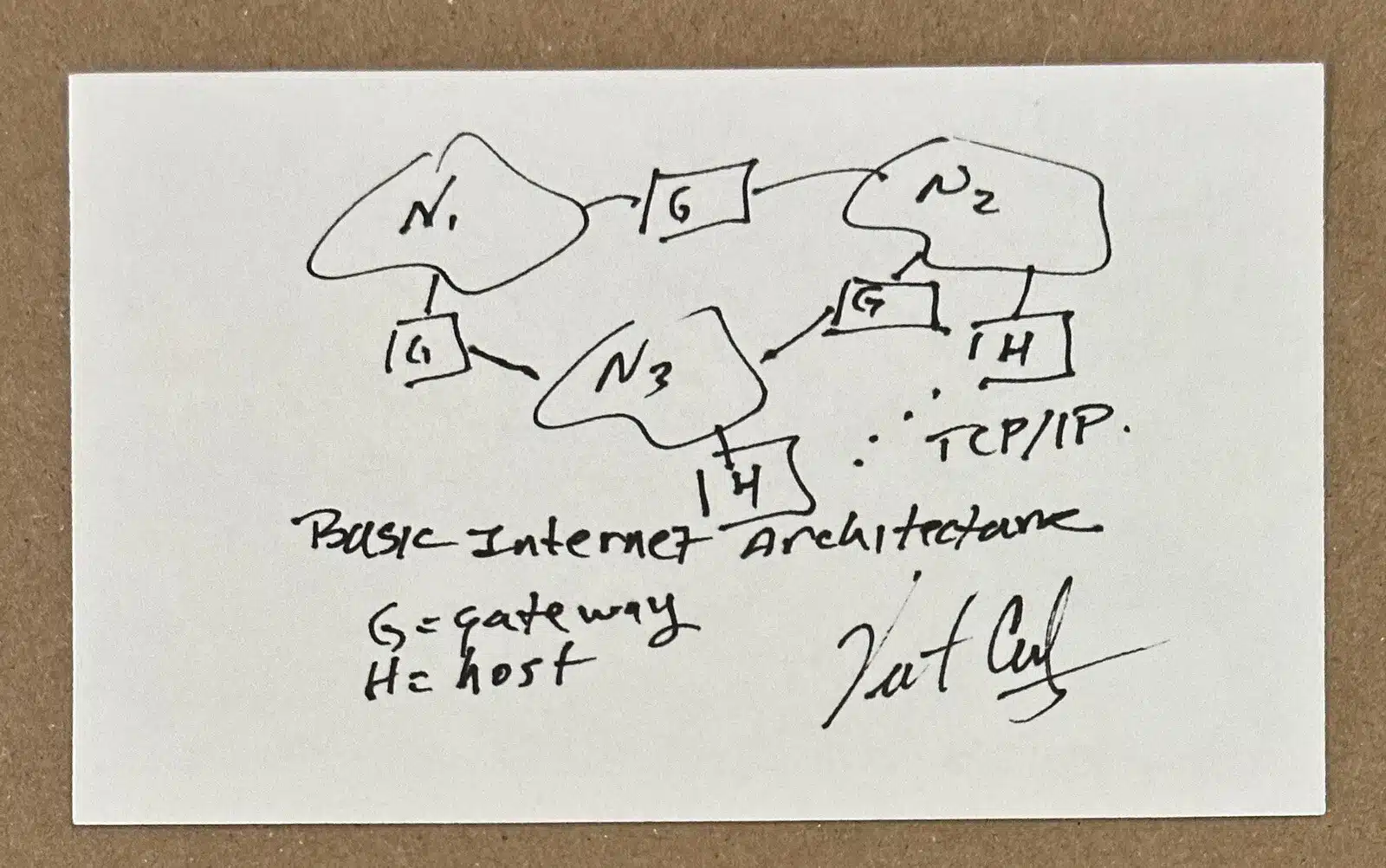
3.2 The three-network gateway design. Cerf’s drawings labeled N1, N2, and N3 depict separate packet-switched networks with boxes marked G representing gateways and boxes marked H representing hosts.
The engineering subject is communication between separately developed networks. The drawings identify the networks as the systems being interconnected and distinguish them from the gateway mechanisms.
Exhibit 3.2: Cerf’s handwritten three-network gateway illustration.

3.3 The reproduced basic Internet architecture. Cerf’s sketch labeled Basic Internet Architecture depicts distinct network clouds, gateways, hosts, and TCP/IP. The diagram illustrates the logical relationship among the systems and protocols.
The drawing does not identify the procurement, financing, physical construction, ownership, or commercial operation of the constituent networks.
Exhibit 3.3: The signed Basic Internet Architecture drawing.
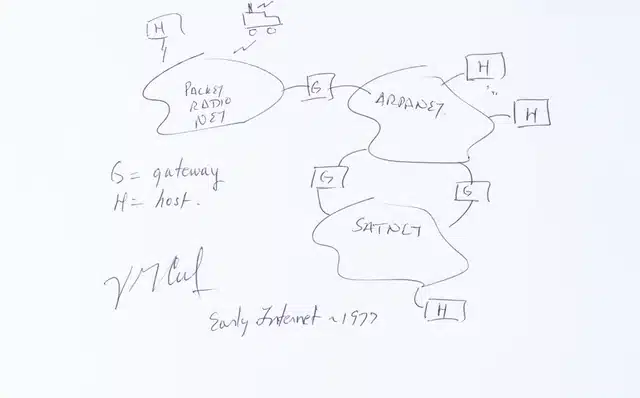
3.4 The ARPANET, PRNET, and SATNET drawings. Cerf’s drawings identify the three historical packet-switched networking systems associated with the 1977 internetworking experiments.
The drawings depict networks developed through separate projects, supported by participating organizations, engineers, transmission facilities, and operating equipment.
Cerf and Kahn’s work on communication among those networks is distinct from the original engineering and construction of each network.
Exhibits 3.4A to 3.4D: The historical gateway and host drawings labeled Early Internet, Internet ca. 1977, and Internet ca. Nov 1977, including the additional signed representations of the three-network arrangement.

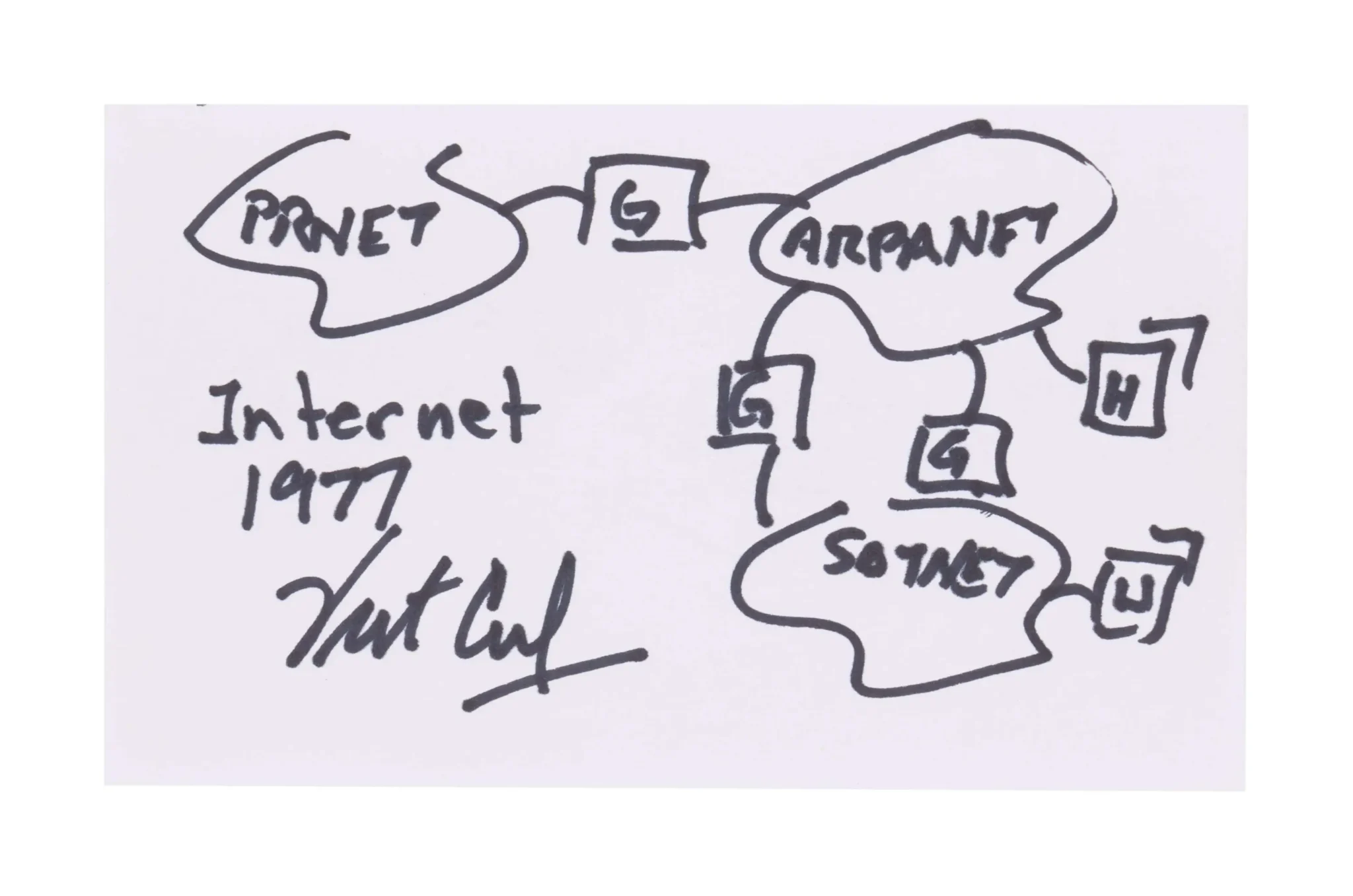

3.5 The 1977 demonstration. The November 22, 1977 internetworking demonstration established communication across packet-radio, satellite, and ARPANET facilities. The accomplishment involved operating networks and multiple participating engineers and organizations.
Successful intercommunication among existing networks is an engineering accomplishment. It is not identical to inventing, constructing, or commercially opening the networks used in the demonstration.
3.6 The Internet packet drawing. Cerf’s handwritten packet diagram identifies source, destination, flags, and payload. These are packet-format concepts.
A packet-format drawing does not identify the telecommunications circuit carrying the packet, the owners of that circuit, the network operators, or the commercial arrangements enabling traffic exchange.
Exhibit 3.6: Cerf’s signed Internet Packet drawing.

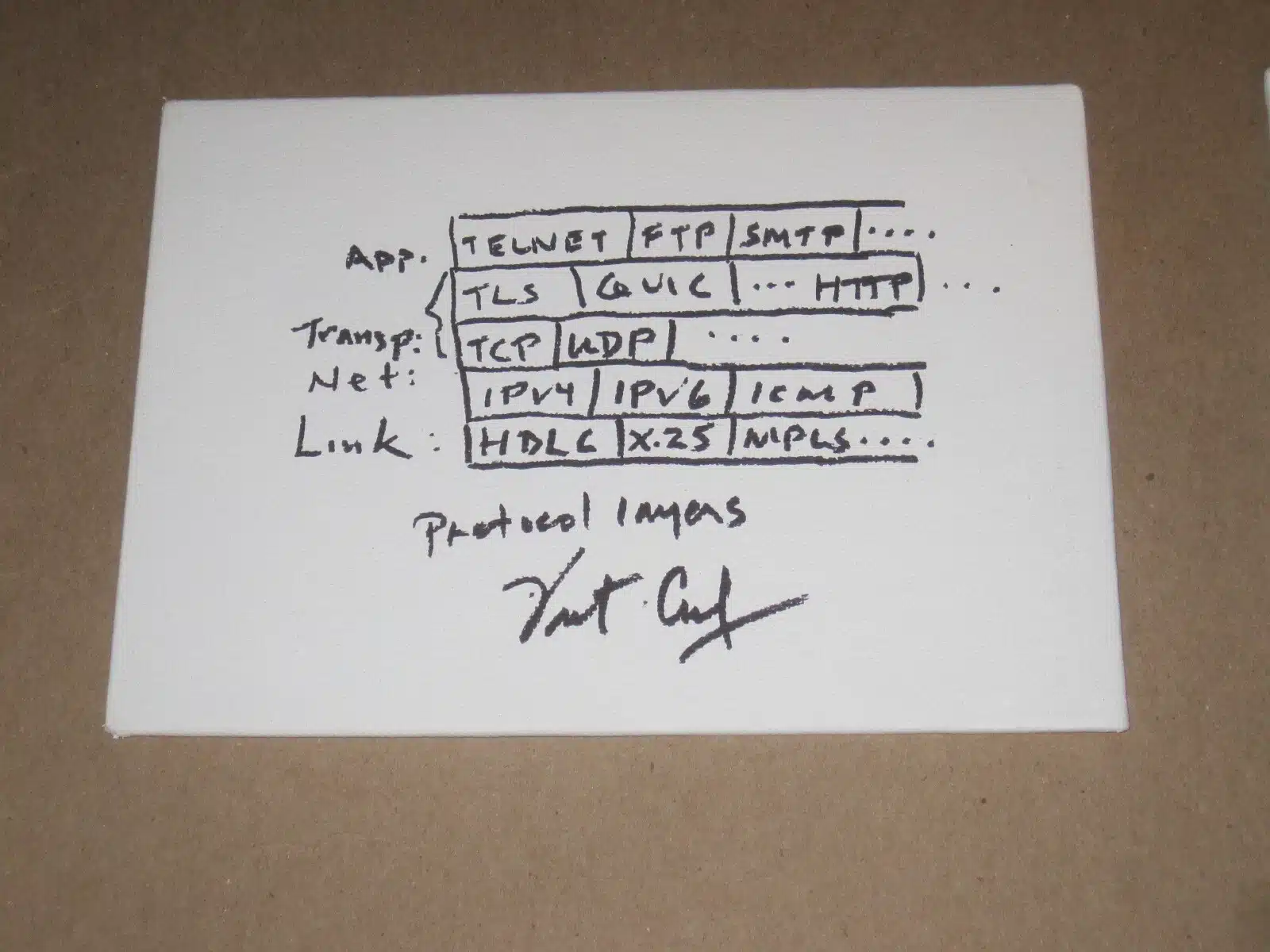
3.7 The protocol-layer drawing. Cerf’s layered illustration separates application, transport, network, and link technologies. The drawing includes examples of protocols occupying different technical functions.
The illustration represents protocol relationships. It does not constitute an inventory or construction diagram for the publicly joinable Internet’s physical infrastructure.
Exhibit 3.7: Cerf’s signed protocol-layers illustration.
3.8 The October 19, 2019 drawing. Cerf’s dated illustration identifies TCP, UDP, RTP, IPv4, IPv6, and additional communications mechanisms. It depicts multiple means of communication and does not identify TCP as the sole available transport protocol.
The illustration does not establish that UDP, RTP, or QUIC ordinarily operate without IP, nor does it establish that the depicted protocols are themselves the commercial network.
Exhibit 3.8: Cerf’s signed and dated October 19, 2019 protocol drawing.

3.9 The original-artifact distinction. A drawing labeled 1977 may represent the network as it existed in 1977 without having been physically drawn in 1977. A later re-creation of a 1973 idea is evidence of the author’s later representation of that idea, not automatically a surviving 1973 artifact.
The creation date, provenance, original publication, and chain of custody of every illustration are separately established before it is described as an original historical drawing.
3.10 The originality test. Clouds, gateways, hosts, and connecting lines are representational devices. Their appearance does not independently establish invention, priority, ownership, or engineering originality.
The evidence required follows the accomplishment claimed. A design claim requires dated documentation of the identified technical contribution. A claim of originality or priority additionally requires comparison with relevant prior work. A claim of implemented interconnection or delivered service requires operating evidence of those acts and results. The simplicity or sophistication of the illustration is not the test.
3.11 The architectural-attribution finding. The visual record depicts earlier packet-switched networks and proposed or demonstrated means of intercommunication among them. It does not establish that Cerf constructed or founded the later publicly joinable commercial Internet under D1.
The drawings may document specific internetworking-design accomplishments. Their existence does not transfer authorship of the constituent networks or their subsequent commercial development to the drawing’s author.
4.0 Historical Attribution and Source Accountability
4.1 The words invented, founded, created, fathered, birthed, and architected identify or imply accomplishments requiring historical specification. The person or institution using the term is responsible for identifying the accomplishment it means.
4.2 A person who designs a protocol is credited with that protocol design. A person who develops a gateway mechanism is credited with that development. A person who designs, contracts for, finances, constructs, or operates a network is credited according to the records establishing those activities.
4.3 No accomplishment acquires the documentation of another accomplishment through the subsequent adoption of its terminology, through an honorific title, or through institutional repetition.
4.4 The original 1969 ARPANET, the 1973 to 1974 internetworking designs, the 1977 inter-network demonstration, the 1983 ARPANET protocol transition, the commercial services preceding CIX, the 1991 CIX commercial interconnection, and the later global commercial infrastructure are separate identifiable historical developments.
4.5 Each event is credited on the date and documentary record supporting it. Historical succession does not establish that the authors of an earlier event performed every subsequent accomplishment.
4.6 The publicly joinable commercial Internet defined under D1 is examined separately from the invention of a protocol or the operation of a restricted research network. Documents concerning those earlier systems remain relevant historical evidence without automatically establishing the later network’s founding.
4.7 The original award citation controls what the awarding institution formally recognized. Later award biographies remain separate statements subject to comparison with the original instrument.
4.8 The same evidentiary conditions govern this site’s own architectural and commercial claims. Digital Island’s drawings, AS6553 registration, executed customer agreements, facilities records, technical operations, and commercial history establish only the accomplishments their contents support.
4.9 The author of every published claim retains responsibility for its accuracy. The author of every disagreement retains responsibility for the evidence and reasoning of that disagreement.
5.0 Amendments, Corrections, and the Continuing Record
5.1 This index is a living documentary record. Additional findings are entered with the date of examination, source, author where known, affected disagreement pages, and the factual effect of the discovery.
5.2 An error in an indexed disagreement is corrected by rebuilding that page with the most accurate current record, under the ruling of Mark Nichols of November 1, 2026, and the page carries no amendment, version or correction note. The standing index maintains the link to the examination.
5.3 New documentary evidence may strengthen, narrow, reverse, or leave unchanged an earlier finding. The actual document, not the status of the person or AI engine identifying it, determines the evidentiary significance.
5.4 Two separately published examinations of the same institution are retained until their distinct sources, versions, and disagreements have been reconciled.
5.5 AI-generated drafts, opinions, and examinations are maintained as separately identified material. An AI conclusion becomes part of the historical examination only through its supporting documents and an attributed adoption by the author.
5.6 The standing index is the master inventory of published disagreements. The numbered disagreement pages contain the full source quotations, dated evidence, and individual findings. The Documentary Findings Register and Visual Evidence Register provide shared supporting material without replacing the individual examinations.
5.7 Documentary corrections, competing original records, and challenges under F40 remain open for examination. Unsupported institutional claims are not accepted because of their source’s reputation, and unsupported objections are not accepted because of their author’s conviction.
5.8 The governing historical question in every indexed disagreement is the specific accomplishment established by the dated record, the person or institution responsible for that accomplishment, and whether the published attribution matches the evidence.
6.0 The subject register lists every published page of the series under the person or body whose credit the page examines, by the page's permanent number in section 1.0.
6.1 The permanent number of a page in this series is the number of its entry in section 1.0 of this page, so that the page Webby Awards 2010 Vinton Cerf: Disagreements | Network, Not Protocol, entered at 1.33, is Disagreement 33, and a finding on that page is cited by the page's number and the finding's locus, as Disagreement 33, 1.2. A page that examines the credit of more than one person or body is listed under each of them.
6.2 The pages that examine the credit given to Vinton G. Cerf are Disagreements 8, 9, 11, 13, 14, 16, 18 through 62, 70, 81, and 94. The documented lane of Vinton G. Cerf and Robert E. Kahn is the design of a protocol for communication among packet networks that already existed, published in "A Protocol for Packet Network Intercommunication" in IEEE Transactions on Communications in May 1974 and specified in RFC 675 of December 1974 by Vinton Cerf, Yogen Dalal and Carl Sunshine, and the 1997 National Medal of Technology recognized that lane in the words "For creating and sustaining development of Internet Protocols." The Internet of D1, born on the Commercial Internet Exchange agreement announced on March 25, 1991, is not in that lane.
6.3 The pages that examine the credit given to Robert E. Kahn are Disagreements 9, 10, 20, 28, 70, 78, 79, 82, 89, 90, 91, 92, 93, and 94. The documented lane of Vinton G. Cerf and Robert E. Kahn is the design of a protocol for communication among packet networks that already existed, published in "A Protocol for Packet Network Intercommunication" in IEEE Transactions on Communications in May 1974 and specified in RFC 675 of December 1974 by Vinton Cerf, Yogen Dalal and Carl Sunshine, and the 1997 National Medal of Technology recognized that lane in the words "For creating and sustaining development of Internet Protocols." The Internet of D1, born on the Commercial Internet Exchange agreement announced on March 25, 1991, is not in that lane.
6.4 The pages that examine the credit given to Leonard Kleinrock and to the University of California, Los Angeles are Disagreements 63, 64, and 94. The documented lane of Leonard Kleinrock is the theory of message switching networks that his doctoral research of 1961 and 1962 addressed, which his own words of 1990 describe as "a precursor to the packet switching networks," and the documented lane of the University of California, Los Angeles is its place as the site of the first IMP of the ARPANET, connected to the UCLA host computer within days of August 30, 1969, and as the sending site of the first host-to-host message on October 29, 1969. Neither lane is the Internet of D1, born in 1991.
6.5 The pages that examine the credit given to Tim Berners-Lee and to CERN for the World Wide Web application design are Disagreements 67, 68, 75, 76, 77, 80, 83, 84, 85, 86, 87, 88, 94, 98, 99, 100, and 101. The documented lane of Tim Berners-Lee is the proposal "Information Management: A Proposal" of March 1989, written at CERN, and the first Web browser, the first Web server and the first specifications for URLs, HTTP and HTML, as the World Wide Web Consortium's own FAQ records, and the documented lane of CERN is the release of three programs of its own Web software into the public domain on April 30, 1993. Neither lane is the World Wide Web application design as a whole, which is a label for a large body of technology made by many persons and bodies, and neither lane is the Internet of D1.
6.6 The pages that examine the credit given to the Defense Advanced Research Projects Agency and to the ARPANET are Disagreements 64, 65, 66, 72, 73, 74, and 95. The documented lane of the Advanced Research Projects Agency is the sponsorship of the ARPANET, procured under Request for Quotations No. DAHC15 69 Q 0002 of July 29, 1968 and built under the contract on which Bolt Beranek and Newman Inc. began work on January 2, 1969. The ARPANET was one agency's government network whose users joined by permission, an intranet under D2 and D4, and the Internet of D1 is not in that lane.
6.7 The pages that examine the credit published by the Internet Society, in its own histories and in its Internet Hall of Fame, are Disagreements 5, 6, and 39. The documented lane of the Internet Society is that of an organization announced on June 20, 1991 and formed on January 1, 1992, as its own timeline records, after the Internet of D1 was born on March 25, 1991, and the Society's histories and its Internet Hall of Fame are its publications about that network and not a part of the network's making.
6.8 The pages that examine published definitions and general histories of the Internet and of the optional protocols TCP and IP, with no single person as their subject, are Disagreements 1, 2, 3, 12, 15, 17, and 96.
6.9 The page that examines the credit given to Merit Network, Inc. and to the NSFNET is Disagreement 69. The documented lane of Merit Network, Inc. is the operation of a member network of universities from 1971 and of the NSFNET backbone, a research backbone bound by an acceptable use policy that barred "Use for for-profit activities," whose service ended on April 30, 1995, and the publicly joinable commercial Internet of D1 was born outside that lane, on an agreement among commercial networks in 1991.
6.10 The pages that petition or write to an institution to correct a published credit are Disagreements 4, 5, and 7, addressed to Stanford University, to the Internet Society, and to the National Inventors Hall of Fame.
6.11 The running register of soft-verb credits across the series is Disagreement 71.
6.12 Each new page is entered in this register under its subject on the day it is entered in section 1.0, and a new subject receives its own paragraph at the end of this section.
6.13 The pages that examine the credit given to Al Gore and to the High-Performance Computing Act of 1991 are Disagreements 95 and 97. The documented lane of Al Gore is the bill S. 272, enacted on December 9, 1991 as Public Law 102-194, which established a National Research and Education Network for researchers, educators and students and uses the word Internet nowhere, and the Internet of D1, born on the Commercial Internet Exchange agreement announced on March 25, 1991, is not in that lane.
7.0 The reference audits grade, footnote by footnote, the sources that a Wikipedia article examined in this series cites, and each audit is listed under the permanent number of the disagreement page that it accompanies.
7.1 A reference audit is the companion of one disagreement page of section 1.0 and is not itself a disagreement page, so a reference audit receives no number in section 1.0. Each reference audit opens every source that the article's footnotes cite, reads the source against the sentence that cites it, and grades each citation Supported, Partial, Not supported, Uncheckable or Unread, and the article lines that the audit cites are the numbered lines of its companion disagreement page.
7.2 The companion of Disagreement 2, Wikipedia Defines "the internet (or Internet)": Disagreements | Network, Not Protocol, is Wikipedia Internet: Reference Audit | Network, Not Protocol, which finds that of the 214 citations of the article, 70 carry the sentence that cites them, 91 carry it in part, 16 do not carry it, 25 cannot be checked and 12 were not read, and that the paper of Vinton G. Cerf and Robert E. Kahn of May 1974, which the article cites for the use of the word Internet in 1974 as the shorthand form of internetwork, writes the word internetwork 39 times in the reprint that the footnote links and never writes the shorthand form, while page 50 of the file at StudFiles that the article cites for two sentences on leisure and games prints 61 sentences that stand word for word in the Wikipedia article Internet as it read in May 2010.
7.3 The companion of Disagreement 3, Wikipedia Defines the History of the Internet: Disagreements | Network, Not Protocol, is Wikipedia History of the Internet: Reference Audit | Network, Not Protocol, which finds that of the 358 citations of the article, 81 carry the sentence that cites them, 189 carry it in part, 34 do not carry it and 54 cannot be checked, and that of the three sources that the article cites for its statement that international connections to the National Science Foundation Network (NSFNET), the emergence of the Domain Name System and the adoption of the optional protocols Transmission Control Protocol and Internet Protocol (TCP/IP) marked the beginnings of the Internet, two carry a part of the statement and the third, an essay of Ian Peter, carries none of it and quotes Bob Taylor, "The ARPAnet was not an internet. An internet is a connection between two or more computer networks.", while the hearing that the article cites for the controversy that it says the Scientific and Advanced-Technology Act of 1992 caused was held on March 12, 1992, seven months before that Act was signed into law on October 23, 1992.
7.4 The companion of Disagreement 10, Wikipedia Describes Robert Kahn: Disagreements | Network, Not Protocol, is Wikipedia Robert Kahn: Reference Audit | Network, Not Protocol, which finds that of the 26 citations of the article, 9 carry the sentence that cites them, 16 carry it in part and 1 cannot be checked, and that neither of the two sources that the article cites for its statement that Robert Kahn first worked at Bolt Beranek and Newman Inc., where he was the principal designer of the Advanced Research Projects Agency Network (ARPANET), prints the words first worked or the words principal designer, while five sources that the article cites at other lines place Bell Laboratories before that company, and the news item that the article cites for an honorary doctorate of 2012 is dated 14 May 2013 and announces in its body a meeting at which Tony Hoare will receive the degree.
7.5 The companion of Disagreement 11, Wikipedia Describes Vint Cerf: Disagreements | Network, Not Protocol, is Wikipedia Vint Cerf: Reference Audit | Network, Not Protocol, which finds that of the 137 citations of the article, 66 carry the sentence that cites them, 37 carry it in part, 12 do not carry it and 22 cannot be checked, and that the interview of January 23, 2006 that the article cites for the title "the fathers of the Internet" quotes Vinton G. Cerf that "I can't really be the Father of the Internet", while every source the article cites for his service at DARPA dates that service from 1976.
7.6 The companion of Disagreement 15, Wikipedia Defines the Internet Protocol Suite: Disagreements | Network, Not Protocol, is Wikipedia Internet Protocol Suite: Reference Audit | Network, Not Protocol, which finds that of the 91 citations of the article, 19 carry the sentence that cites them, 35 carry it in part, 7 do not carry it, 26 cannot be checked and 4 were not read, and that the sources the article cites date the first IMP’s arrival at UCLA to August 30, 1969 and the Department of Defense directive on TCP/IP to December 23, 1978, while one footnote cites a 2012 printout of the article itself.
7.7 The companion of Disagreement 17, Wikipedia Defines the Internet Protocol: Disagreements | Network, Not Protocol, is Wikipedia Internet Protocol: Reference Audit | Network, Not Protocol, which finds that of the 35 citations of the article, 7 carry the sentence that cites them, 20 carry it in part, 2 do not carry it and 6 cannot be checked, and that the specifications the article cites for IP versions 2 and 4 give address-length fields of 4 bits and 8 bits, which count to 15 and 255 octets and not to the 16 and 256 that the article states.
7.8 The companion of Disagreement 63, Wikipedia Describes Leonard Kleinrock: Disagreements | Network, Not Protocol, is Wikipedia Leonard Kleinrock: Reference Audit | Network, Not Protocol, which finds that of the 84 citations of the article, 22 carry the sentence that cites them, 32 carry it in part, 8 do not carry it, 15 cannot be checked and 7 were not read, and that Leonard Kleinrock's own oral history of April 3, 1990, which the article quotes, credits Paul Baran "with the first ideas", while the paper the article cites for Kleinrock's place in Internet routing never names him.
7.9 The companion of Disagreement 65, Wikipedia Describes the Packet Radio Van: Disagreements | Network, Not Protocol, is Wikipedia Packet Radio Van: Reference Audit | Network, Not Protocol, which finds that of the 8 footnotes of the article, 3 carry their sentences only through copies that the footnotes do not name, 4 carry them in part and 1 was not read, and that Don Nielson's article of February 2002, the article's principal source, describes the van as a node of the Packet Radio Network and not of the ARPANET.
7.10 The companion of Disagreement 66, Wikipedia Describes DARPA: Disagreements | Network, Not Protocol, is Wikipedia DARPA: Reference Audit | Network, Not Protocol, which finds that of the 288 citations of the article, 155 carry the sentence that cites them, 102 carry it in part, 12 do not carry it and 19 cannot be checked, and that pages 27 through 39 of Where Wizards Stay Up Late by Katie Hafner and Matthew Lyon, which the article cites for the statement that the Information Processing Techniques Office played a vital role in the creation of the ARPANET, which the article calls the basis for the future Internet, print neither the word ARPANET nor the word Internet, while the sentence in which the article counts about 1,122 government employees of the agency as of 2026 is the sentence of the agency's own page of 2018 on approximately 220 government employees, with the figure replaced by an estimate of the company Revelio Labs.
7.11 The companion of Disagreement 67, Wikipedia Describes Tim Berners-Lee: Disagreements | Network, Not Protocol, is Wikipedia Tim Berners-Lee: Reference Audit | Network, Not Protocol, which finds that of the 116 citations of the article, 44 carry the sentence that cites them, 43 carry it in part, 13 do not carry it and 16 cannot be checked, and that the BBC report of April 1, 2010 that the article cites for the Ordnance Survey data attributes to Communities Secretary John Denham the words that the article attributes to Berners-Lee, while the proposal of March 1989 that the article cites dates ENQUIRE to 1980.
7.12 The companion of Disagreement 68, Wikipedia Describes CERN: Disagreements | Network, Not Protocol, is Wikipedia CERN: Reference Audit | Network, Not Protocol, which finds that of the 249 citations of the article, 134 carry the sentence that cites them, 74 carry it in part, 19 do not carry it and 22 cannot be checked, and that page 50 of the CERN Annual Report 2019, which the article cites for 25 member states, lists 23 member states as of December 31, 2019, while the History of CERN of 1987, which the article cites for the ratification of the convention by 12 countries on September 29, 1954, dates the deposits of the twelve ratifications from December 30, 1953 to February 24, 1955.
7.13 The companion of Disagreement 95, Wikipedia High Performance Computing Act of 1991: Disagreements | Network, Not Protocol, is Wikipedia High Performance Computing Act of 1991: Reference Audit | Network, Not Protocol, which finds that of the 24 citations of the article, 11 carry the sentence that cites them, 11 carry it in part, 1 does not carry it and 1 cannot be checked, and that the article's claim that the Gore Bill helped fund the National Center for Supercomputing Applications is carried only by the article of Keith Perine in The Industry Standard of October 23, 2000, which the article cites at the next sentence.
7.14 The companion of Disagreement 96, Wikipedia Timeline of the History of the Internet: Disagreements | Network, Not Protocol, is Wikipedia Timeline of the History of the Internet: Reference Audit | Network, Not Protocol, which finds that of the 26 citations of the article, 2 carry the sentence that cites them, 18 carry it in part, 1 does not carry it and 5 cannot be checked, and that the sources of the timeline's own entries record Paul Baran's first proposal of 1960 as a teletypewriter network, title Tymnet a multiplexed packet network, and disagree on whether the NPL network carried packets in 1969 or became operational in June 1973.
7.15 The companion of Disagreement 97, Wikipedia Al Gore and Information Technology: Disagreements | Network, Not Protocol, is Wikipedia Al Gore and Information Technology: Reference Audit | Network, Not Protocol, which finds that of the 85 citations of the article, 38 carry the sentence that cites them, 21 carry it in part, 3 do not carry it and 23 cannot be checked, and that the article places inside its quotation of the article of Gary Stix in Scientific American of May 1993 a sentence crediting Gore with the creation of the Internet that the readable part of the source does not carry.
7.16 The companion of Disagreement 98, Wikipedia World Wide Web: Disagreements | Network, Not Protocol, is Wikipedia World Wide Web: Reference Audit | Network, Not Protocol, which finds that of the 111 citations of the article, 47 carry the sentence that cites them, 33 carry it in part, 16 do not carry it, 12 cannot be checked and 3 were not read, and that the W3C page that the article cites three times defines the Internet by quoting Wikipedia, while the W3C copy of the proposal of March 1989 says that the only name Berners-Lee then had for the system was "Mesh".
7.17 The companion of Disagreement 99, Wikipedia WorldWideWeb: Disagreements | Network, Not Protocol, is Wikipedia WorldWideWeb: Reference Audit | Network, Not Protocol, which finds that of the 34 citations of the article, 21 carry the sentence that cites them, 10 carry it in part and 3 do not carry it, and that none of the citations behind the article's claim that the source code of WorldWideWeb was released into the public domain on 30 April 1993 carries that claim.
7.18 The companion of Disagreement 101, Wikipedia Robert Cailliau: Disagreements | Network, Not Protocol, is Wikipedia Robert Cailliau: Reference Audit | Network, Not Protocol, which finds that of the 21 footnotes of the article, 7 carry the sentence that cites them, 8 carry it in part, 3 do not carry it, 2 cannot be checked and 1 was not read, and that the article's claim that Robert Cailliau proposed a hypertext system for CERN in 1987 rests on page 197 of How the Web Was Born, which does not carry it, while his speech of November 2, 1995 lists his hypertext proposal under the year 1989.
7.19 Each new reference audit is entered in this section on the day it is published, under the permanent number of its companion disagreement page, in the order of those numbers.
Every page in this series is governed by The Governing Definitions and Controlling Facts of Telecommunications Internetworking. Documents control; where Mark Nichols’ judgment appears, it is identified as judgment. Corrections supported by documentation are welcomed with attribution at mark@marknichols.com.
The disagreements, documents, judgments, and historical attributions are the author’s own. Assistance from AI systems in research, editing, and analysis does not transfer authorship of the record or substitute for the cited evidence.