Wikipedia World Wide Web: Disagreements | Network, Not Protocol
Wikipedia’s article World Wide Web says that the Web “was invented by English computer scientist Tim Berners-Lee while at CERN in 1989 and opened to the public in 1993”, calls the Web “an application layer protocol”, and says that WorldWideWeb became “the name of the project and of the network”, while its own reference for November 12, 1990 names Tim Berners-Lee and Robert Cailliau as authors of a proposal, CERN’s statement of 30 April 1993 put three programs of CERN software into the public domain, and D8 records that the World Wide Web is an application design made by many persons and announced publicly on August 6, 1991.
Preamble: I examine the Wikipedia article World Wide Web, line by line, against its own references, against CERN's statement of 30 April 1993 releasing the CERN W3 software into the public domain, against the proposals of March 1989 and November 12, 1990 as earlier pages of this series record them, and against the Governing Definitions of marknichols.com. Exhibit A at section 9.0 reproduces the article line by line, numbered and anchored, and every finding on this page cites those line numbers. This page is Disagreement 98 in the standing index of the series, Disagreements of Published Claims | Network, Not Protocol, and a finding on this page is cited by that number followed by the finding's locus, as Disagreement 98, 1.1.
Opinion Rules: You are visiting my record, and I am the subject matter expert on it. If you are a subject matter expert too, I want to hear from you: bring your document and I will answer it on the record. If you are not, you are welcome here to read and to learn. The documented-challenge terms of marknichols.com and the condition on opinion are stated at F40 of The Governing Definitions and Controlling Facts of Telecommunications Internetworking, and they govern this page.
Conditional on the Governing Definitions: Every finding on this page is conditional on the Governing Definitions D1 through D13 of marknichols.com, which are reproduced in full in the Definitions Addendum at the bottom of this page.
0.0 This section records the article this page examines, the documents it is read against, and the definitions on which the findings depend.
0.1 The source examined on this page is the article World Wide Web of the English Wikipedia at https://en.wikipedia.org/wiki/World_Wide_Web. Mark Nichols supplied the text of the article as it read on November 14, 2026, and this page read the supplied text in full on November 14, 2026 and did not compare it with the live page. The supplied text does not carry the number of its revision, and the revision number is unknown on this page. The article names no author, and its authors are the editors of Wikipedia, whose names are unknown on this page.
0.2 CERN's statement of 30 April 1993 is CERN's statement concerning the release of the CERN W3 software into the public domain, two pages, page 1 and page 2, held on marknichols.com as L-028 of Exhibit Library | Network, Not Protocol, which this page read in full on November 14, 2026. The proposals of March 1989 and November 12, 1990 are recorded at 1.2 through 1.5 of W3C Tim Berners-Lee Biography: Disagreements | Network, Not Protocol, Disagreement 80, and this page relies on that record of them. Disagreement 67, Wikipedia Describes Tim Berners-Lee: Disagreements | Network, Not Protocol, and Disagreement 68, Wikipedia Describes CERN: Disagreements | Network, Not Protocol, examine the Wikipedia articles Tim Berners-Lee and CERN.
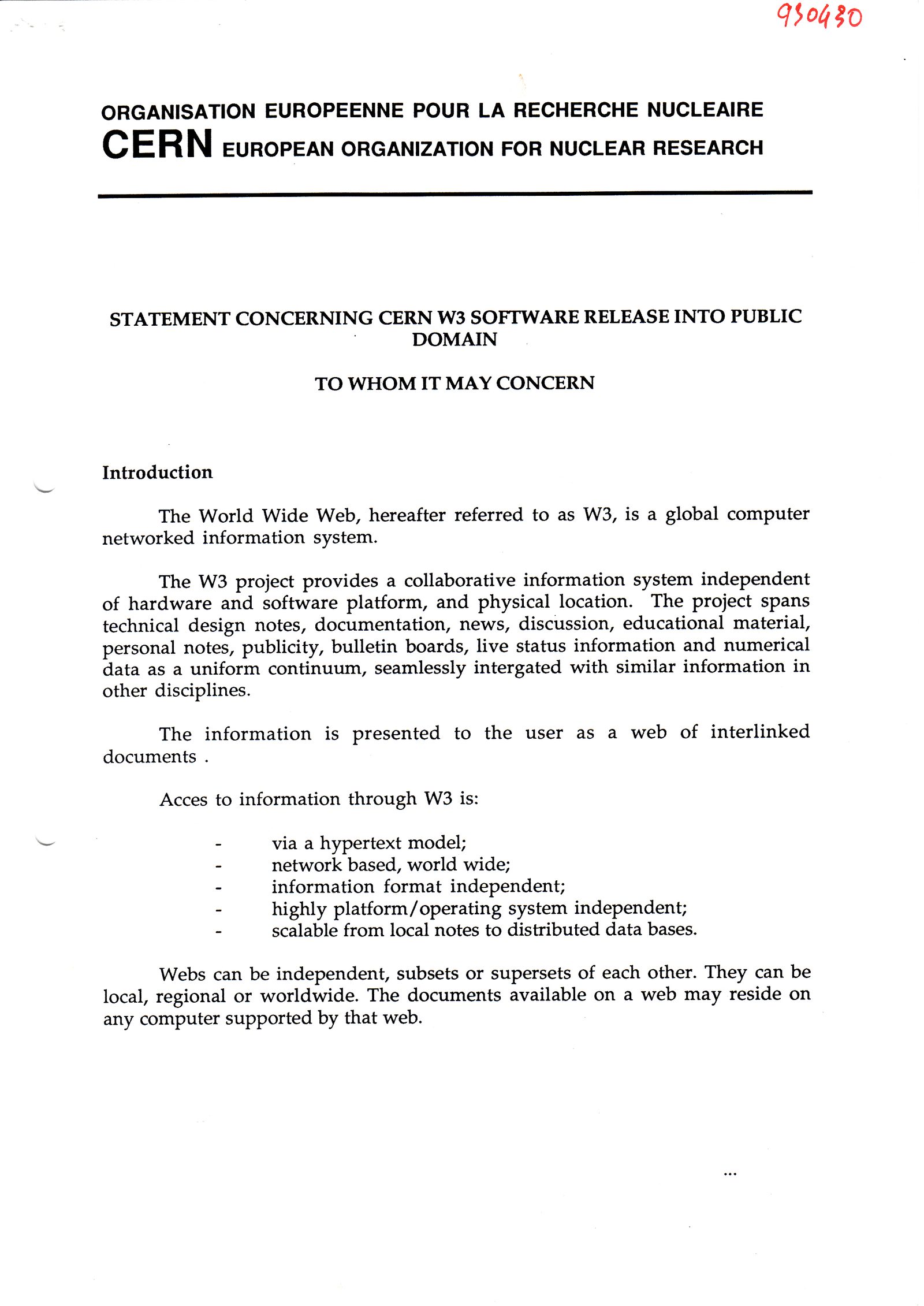
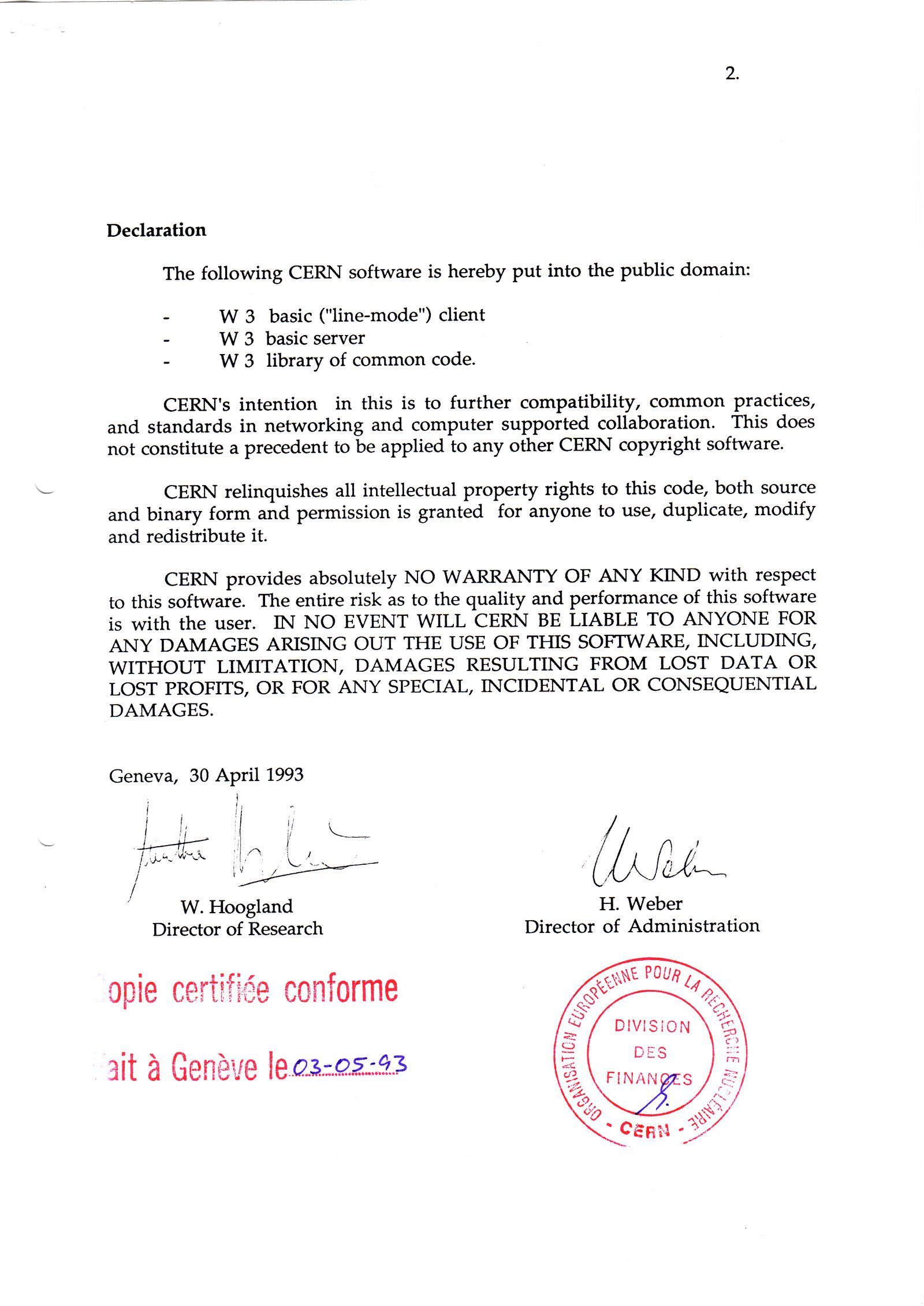
0.3 Exhibit A reproduces the article from its title through its list of references, without the menus of the site, its further reading and its external links, and divides it into 496 lines: each notice, line of the infobox, caption, heading, line of code, item of a list and reference is a line of its own, each paragraph is divided into its sentences, and the label and value of an infobox line are separated by a vertical bar. D1 of The Governing Definitions and Controlling Facts of Telecommunications Internetworking defines the Internet as “The publicly joinable network of networks of the registry lineage”, and D8 defines the World Wide Web. The Definitions Addendum at section 10.0 reproduces D1 through D13 in full.
1.0 The article says that the Web “was invented by English computer scientist Tim Berners-Lee while at CERN in 1989”, names him as its one author, and prints in a reference the words “the World Wide Web is Berners-Lee's alone”, while the document of 1989 is a proposal that cites the hypertext literature already published, the article's own reference for November 12, 1990 names Robert Cailliau with him, and D8 records an application design made by many persons.
1.1 Line 22 says: “The Web was invented by English computer scientist Tim Berners-Lee while at CERN in 1989 and opened to the public in 1993.” Line 39 says: “The Web was invented by English computer scientist Tim Berners-Lee while working at CERN.[12][13]” Line 16, in the infobox, reads: “Authors | Tim Berners-Lee” Line 409, the reference that line 39 cites as its citation 12, prints the words of Time Magazine of 29 March 1999: “But the World Wide Web is Berners-Lee's alone.”
1.2 1.2 of W3C Tim Berners-Lee Biography: Disagreements | Network, Not Protocol records that the proposal Information Management: A Proposal, March 1989, revised May 1990 names Tim Berners-Lee of CERN as its one author and states that “The Communications of the ACM special issue on Hypertext contains many references to hypertext papers” and that “There have been two conferences, Hypertext '87 and '88”. 1.5 of W3C Tim Berners-Lee Biography: Disagreements | Network, Not Protocol records that the proposal WorldWideWeb: Proposal for a HyperText Project, November 12, 1990 prints its authors as “T. Berners-Lee/CN, R. Cailliau/ECP”. The article's own line 444 reads: “Berners-Lee, Tim; Cailliau, Robert (12 November 1990). "WorldWideWeb: Proposal for a HyperText Project". Archived from the original on 2 May 2015. Retrieved 12 May 2015.” The article's own line 413 names four authors of the paper of 1992 “World-Wide Web: The Information Universe”: “Berners-Lee, T.; Cailliau, R.; Groff, J.-F.; Pollermann, B.”.
1.3 D8 of The Governing Definitions and Controlling Facts of Telecommunications Internetworking defines the World Wide Web as “An application design made by many persons inside and outside CERN, announced publicly on August 6, 1991”, and states that “The name World Wide Web is a label for a large body of technology in the public domain, made by many persons and bodies inside and outside CERN”.
1.4 The kind is a documentary finding. The hard verb “invented” and the single name in the infobox give to one man in 1989 a design whose document of 1989 is a single-author proposal citing an existing literature of hypertext, whose proposal of November 12, 1990 names two authors, and whose paper of 1992 names four, all three as the article's own lines and references record or as Disagreement 80 records them. The words “the World Wide Web is Berners-Lee's alone” stand against the article's own reference at line 444. Governing Definitions, D8.
1.5 Corrected statement: Tim Berners-Lee of CERN proposed a linked information system in March 1989 in a proposal that cites the existing literature of hypertext, Tim Berners-Lee and Robert Cailliau wrote the proposal WorldWideWeb: Proposal for a HyperText Project of November 12, 1990, and the World Wide Web is an application design made by many persons inside and outside CERN.
2.0 The article says that the Web was “opened to the public in 1993”, gives the Web the license “Public domain (Since April 1993)”, and says that “CERN made the Web protocol and code available royalty-free on 30 April 1993”, while CERN's statement of 30 April 1993 put three programs of CERN software into the public domain, names no protocol, and states that it “does not constitute a precedent to be applied to any other CERN copyright software.”
2.1 Line 22 says that the Web was “opened to the public in 1993”. Line 17 and line 18, in the infobox, read: “License | Public domain” and “(Since April 1993)[1]” Line 59 says: “CERN made the Web protocol and code available royalty-free on 30 April 1993, enabling its widespread use.[20][21][22]”
2.2 CERN's statement concerning the release of the CERN W3 software into the public domain, dated Geneva, 30 April 1993, states on page 2: “The following CERN software is hereby put into the public domain:”, and lists “W 3 basic ("line-mode") client”, “W 3 basic server” and “W 3 library of common code.” It continues: “CERN's intention in this is to further compatibility, common practices, and standards in networking and computer supported collaboration. This does not constitute a precedent to be applied to any other CERN copyright software.” The statement is signed by W. Hoogland, Director of Research, and H. Weber, Director of Administration, and its two pages name no protocol.
2.3 D8 of The Governing Definitions and Controlling Facts of Telecommunications Internetworking defines the World Wide Web as “An application design made by many persons inside and outside CERN, announced publicly on August 6, 1991”, and records “three programs of CERN's World Wide Web software, the line-mode client, the basic server and the library of common code, released into the public domain by CERN on April 30, 1993”. D8 also states: “A free application is not an open network: until April 30, 1995, the Web’s principal carriage was the gated research intranets beneath it, research-only carriage under the written policy”.
2.4 The kind is a scope overstatement. The statement of 30 April 1993 released three programs of CERN software and no protocol, so the article's words give to the Web as a whole, and to “the Web protocol”, a release that CERN made for three programs, and D8 dates the public announcement of the Web to August 6, 1991, not to 1993. 5.0 of Wikipedia Describes CERN: Disagreements | Network, Not Protocol records the same statement against the words “free to anyone” in the Wikipedia article CERN. Governing Definitions, D8.
2.5 Corrected statement: On 30 April 1993, CERN put three programs of its W3 software, the basic line-mode client, the basic server and the library of common code, into the public domain by a statement signed by W. Hoogland, Director of Research, and H. Weber, Director of Administration, which names no protocol, and the World Wide Web had been announced publicly on August 6, 1991.
3.0 The article dates the release of the Web “to the whole Internet” to 23 August 1991, while its own infobox gives the Web the date “First published | 6 August 1991”, and D8 records that the World Wide Web was announced publicly on August 6, 1991.
3.1 Line 56 says: “The technology was released outside CERN to other research institutions starting in January 1991, and then to the whole Internet on 23 August 1991.” Line 12, in the infobox, reads: “First published | 6 August 1991; 35 years ago”
3.2 D8 of The Governing Definitions and Controlling Facts of Telecommunications Internetworking defines the World Wide Web as “An application design made by many persons inside and outside CERN, announced publicly on August 6, 1991”.
3.3 The kind is a documentary finding. The article gives two dates in August 1991 for the same release, and the date of 23 August 1991 at line 56 disagrees with the article's own infobox and with D8, which both give August 6, 1991. Governing Definitions, D8.
3.4 Corrected statement: The technology was released outside CERN to other research institutions starting in January 1991, and the World Wide Web was announced publicly on August 6, 1991.
4.0 The article says that WorldWideWeb became “the name of the project and of the network”, while its own notice at line 4 sends the reader to the Internet “For the underlying network”, its own line 93 names the Internet as the system of networks, and D8 states that the World Wide Web is not the Internet.
4.1 Line 54 says: “He got a working system implemented by the end of 1990, including a browser called WorldWideWeb (which became the name of the project and of the network) and an HTTP server running at CERN.”
4.2 Line 4 reads: “For the underlying network, see Internet.” Line 92 says: “However, the two terms do not mean the same thing.” Line 93 says: “The Internet is a global system of computer networks interconnected through telecommunications and optical networking.” D8 of The Governing Definitions and Controlling Facts of Telecommunications Internetworking states: “The World Wide Web is not the Internet: the Web is an application using the Internet platform, and the application is not the platform.”
4.3 The kind is a definitional finding under D1 and D8. WorldWideWeb was the name of a browser and of a project, and the network across which the World Wide Web ran is the Internet of D1, as the article's own lines 4, 92 and 93 say. Governing Definitions, D1 and D8.
4.4 Corrected statement: Tim Berners-Lee had a working system implemented by the end of 1990, including a browser called WorldWideWeb, which became the name of the project, and the World Wide Web is an application design whose traffic is carried by the networks of the Internet.
5.0 The article calls the World Wide Web “the world's dominant information systems platform” and says that it “functions as an application layer protocol”, while D8 states that the Web is an application using the Internet platform and that the application is not the platform, and the article's own line names HTTP and HTTPS as the protocols.
5.1 Line 35 says: “The World Wide Web has become the world's dominant information systems platform.[8][9][10][11]” Line 89 says: “The World Wide Web functions as an application layer protocol that is run "on top of" (figuratively) the Internet, helping it to make it more functional.”
5.2 D8 of The Governing Definitions and Controlling Facts of Telecommunications Internetworking defines the World Wide Web as “An application design made by many persons inside and outside CERN, announced publicly on August 6, 1991”, and states: “The World Wide Web is not the Internet: the Web is an application using the Internet platform, and the application is not the platform.” The article's own line 95 says: “Web resources are accessed using HTTP or HTTPS, which are application-level Internet protocols that use the Internet transport protocols.[4]”
5.3 The kind is a definitional finding under D8. The World Wide Web is an application design, and its protocol is HTTP, as the article's own line 95 says, so the Web is neither the platform beneath its traffic nor a protocol. Governing Definitions, D8.
5.4 Corrected statement: The World Wide Web is an application design that uses the Internet platform, and its documents are requested and delivered with the application protocols HTTP and HTTPS.
6.0 The article says that “Publication on the Internet created what Tim Berners-Lee first called the WorldWideWeb” on November 12, 1990, while the reference it cites for that date is a proposal by Tim Berners-Lee and Robert Cailliau, and D9 records that the Internet was born in 1991.
6.1 Line 149 says: “Publication on the Internet created what Tim Berners-Lee first called the WorldWideWeb (in its original CamelCase, which was subsequently discarded) in November 12, 1990.[47]”
6.2 The article's citation 47 is its line 444, which reads: “Berners-Lee, Tim; Cailliau, Robert (12 November 1990). "WorldWideWeb: Proposal for a HyperText Project". Archived from the original on 2 May 2015. Retrieved 12 May 2015.” 1.5 of W3C Tim Berners-Lee Biography: Disagreements | Network, Not Protocol records that the proposal WorldWideWeb: Proposal for a HyperText Project, November 12, 1990 prints its authors as “T. Berners-Lee/CN, R. Cailliau/ECP”. D9 of The Governing Definitions and Controlling Facts of Telecommunications Internetworking states: “The capital-I Internet was born in 1991, when PSINet, AlterNet under UUNET, and CERFnet, independently operated commercial networks of the registry lineage, established the Commercial Internet eXchange”.
6.3 The kind is a documentary finding, with a definitional finding under D9. The document of November 12, 1990 that the article cites is a proposal with two authors, not a publication that created the Web, and the Internet of D1 was born in 1991, after November 12, 1990. Governing Definitions, D9.
6.4 Corrected statement: On November 12, 1990, Tim Berners-Lee and Robert Cailliau dated their proposal WorldWideWeb: Proposal for a HyperText Project, and the Internet of D1 was born in 1991, when PSINet, AlterNet and CERFnet established the Commercial Internet Exchange.
7.0 483 lines of the article are examined and not disputed on this page, and several of them state in the article's own words that the Internet is the network and the Web is not.
7.1 Line 4 sends the reader to the Internet “For the underlying network”, line 92 says that the terms Internet and World Wide Web “do not mean the same thing”, line 93 says that “The Internet is a global system of computer networks interconnected through telecommunications and optical networking”, and line 95 names HTTP and HTTPS as the protocols of the Web, and these lines agree with D1 and D8. Line 221 says that private websites “are typically a part of an intranet”, which agrees with D2.
7.2 Line 53 says that Tim Berners-Lee submitted his proposal “in March 1989, without giving the system a name”, which agrees with the proposal of March 1989 as W3C Tim Berners-Lee Biography: Disagreements | Network, Not Protocol records it. Line 45 credits the former logo of the World Wide Web to Robert Cailliau, and line 413 and line 444 name Robert Cailliau as a co-author of the paper of 1992 and of the proposal of November 12, 1990. Line 60 dates the Mosaic web browser of the NCSA to 1993, which agrees with D8.
7.3 Line 77 dates the creation of Gopher to 1991, line 282 dates the search engine Archie to 1990, and line 388 calls Minitel “a predecessor of the WWW”, and this page does not test these lines.
7.4 The remaining 470 lines, 1 through 3, 5 through 11, 13 through 15, 19 through 21, 23 through 34, 36 through 38, 40 through 44, 46 through 52, 55, 57, 58, 61 through 76, 78 through 88, 90, 91, 94, 96 through 148, 150 through 220, 222 through 281, 283 through 387, 389 through 408, 410 through 412, 414 through 443 and 445 through 496, state the title, the notices, the infobox, the captions, the headings, the account of the history, the nomenclature, the function, HTML, linking, the www prefix, the scheme specifiers, pages, websites, browsers, servers, cookies, search engines, the deep web, caching, security, privacy, standards, accessibility and internationalisation of the Web, the list of related articles and the references, and this page makes no finding on them.
8.0 The claims on this page are open to documented challenge on the standing terms of marknichols.com, and the terms are stated here in full.
8.1 The claims on this page are open to challenge on the same terms as every claim on marknichols.com. A challenger who holds that a claim on this page is wrong, or that the Internet is something other than the publicly joinable network of networks of the registry lineage defined at The Governing Definitions and Controlling Facts of Telecommunications Internetworking, states the competing claim or definition in one sentence, names the document that carries it and the document’s date, and sends both to mark@marknichols.com. A challenge submitted with its document is answered on this page, and a competing definition submitted with its document is added to this page as an exhibit with attribution to the person who submitted it; a challenge submitted without a document is an opinion and is heard as one.
8.2 The distinction the site’s definition rests on, that protocols enable interoperability and are not the Internet, is stated in the IETF’s own words, RFC 2026 and STD 1, in the Internet-Draft draft-mnichols-protocols-not-the-internet-01, posted by Mark Nichols to the IETF Datatracker on September 25, 2026 at https://datatracker.ietf.org/doc/draft-mnichols-protocols-not-the-internet/ and stated on this site at Protocols Are Not the Internet: The IETF Internet-Draft by Mark Nichols, so a challenger may also address the definition in the venue that publishes the protocol standards themselves. Any person who holds expertise in telecommunications and a competing claim or definition is invited to bring both, in writing, with the document.
9.0 Exhibit A reproduces the Wikipedia article World Wide Web line by line, numbered in the order of the page and anchored for citation.
9.1 Exhibit A. Wikipedia, World Wide Web, at https://en.wikipedia.org/wiki/World_Wide_Web, as supplied by Mark Nichols on November 14, 2026. Line 1 is the title, lines 2 through 7 are the notices, lines 8 through 18 are the infobox, lines 19 through 36 are the caption and the opening paragraphs, lines 37 through 370 are the body of the article, lines 371 through 396 are its list of related articles, and lines 397 through 496 are its heading of references and its references, in the order of the page.
1. World Wide Web
2. From Wikipedia, the free encyclopedia
3. (Redirected from World wide web)
4. For the underlying network, see Internet.
5. For the historical web browser, see WorldWideWeb.
6. "WWW", "The Web", and "Internet surfing" redirect here.
7. For other uses, see WWW (disambiguation) and The Web (disambiguation).
8. World Wide Web
9. Abbreviation | WWW, W3
10. Status | Active
11. Year started | 1989; 37 years ago
12. First published | 6 August 1991; 35 years ago
13. Organization
14. CERN (1989–1994)
15. W3C (1994–present)
16. Authors | Tim Berners-Lee
17. License | Public domain
18. (Since April 1993)[1]
19. A web page from Wikipedia displayed in Google Chrome
20. The World Wide Web (also known as WWW, W3, or simply the Web)[2] is a global interconnected information system that enables content sharing over the Internet.[3]
21. It facilitates access to documents and other web resources according to specific rules of the Hypertext Transfer Protocol (HTTP).[4]
22. The Web was invented by English computer scientist Tim Berners-Lee while at CERN in 1989 and opened to the public in 1993.
23. It was conceived as a "universal linked information system".[5][6][7]
24. Documents and other media content are made available to the network through web servers and can be accessed by programs such as web browsers.
25. Servers and resources on the World Wide Web are identified and located through a character string called a uniform resource locator (URL).
26. The original and still very common document type is a web page formatted in Hypertext Markup Language (HTML).
27. This markup language supports plain text, images, embedded video and audio contents, and scripts (short programs) that implement complex user interaction.
28. The HTML language also supports hyperlinks (embedded URLs), which provide immediate access to other web resources.
29. Web navigation, or web surfing, is the common practice of following such hyperlinks across multiple websites.
30. Web applications are web pages that function as application software.
31. The information on the Web is transferred across the Internet using HTTP.
32. Multiple web resources with a common theme and usually a common domain name make up a website.
33. A single web server may provide multiple websites, while some websites, especially the most popular ones, may be provided by multiple servers.
34. Website content is provided by a myriad of companies, organisations, government agencies, and individual users; and comprises an enormous amount of educational, entertainment, commercial, and government information.
35. The World Wide Web has become the world's dominant information systems platform.[8][9][10][11]
36. It is the primary tool that billions of people worldwide use to interact with the Internet.[4]
37. History
38. Main article: History of the World Wide Web
39. The Web was invented by English computer scientist Tim Berners-Lee while working at CERN.[12][13]
40. He was motivated by the problem of storing, updating, and finding documents and data files in that large and constantly changing organisation, as well as distributing them to collaborators outside CERN.
41. In his design, Berners-Lee dismissed the common tree structure approach, used for instance in the existing CERNDOC documentation system and in the Unix filesystem, as well as approaches that relied on tagging files with keywords, as in the VAX/NOTES system.
42. Instead, he adopted concepts he had put into practice with his private ENQUIRE system (1980), which was built at CERN.
43. When he became aware of Ted Nelson's hypertext model (1965), in which documents can be linked in unconstrained ways through hyperlinks associated with "hot spots" embedded in the text, it helped to confirm the validity of his concept.[14][15]
44. The world’s first web server, exhibited at CERN in Geneva.
45. The former World Wide Web logo, designed by Robert Cailliau.
46. Currently, there is no widely accepted logo in use for the WWW.
47. The model was later popularised by Apple's HyperCard system.
48. Unlike Hypercard, Berners-Lee's new system from the outset was meant to support links between multiple databases on independent computers, and to allow simultaneous access by many users from any computer on the Internet.
49. He also specified that the system should eventually handle other media besides text, such as graphics, speech, and video.
50. Links could refer to mutable data files, or even fire up programs on their server computer.
51. He also conceived "gateways" that would allow access through the new system to documents organised in other ways (such as traditional computer file systems or the Usenet).
52. Moreover, he insisted that the system should be decentralised, without any central control or coordination over the creation of links.[6][16][12][13]
53. Berners-Lee submitted a proposal to CERN in March 1989, without giving the system a name.[6]
54. He got a working system implemented by the end of 1990, including a browser called WorldWideWeb (which became the name of the project and of the network) and an HTTP server running at CERN.
55. As part of that development, he defined the first version of the HTTP protocol, the basic URL syntax, and implicitly made HTML the primary document format.[17]
56. The technology was released outside CERN to other research institutions starting in January 1991, and then to the whole Internet on 23 August 1991.
57. The Web was a success at CERN and began to spread to other scientific and academic institutions.
58. Within the next two years, there were 50 websites created.[18][19]
59. CERN made the Web protocol and code available royalty-free on 30 April 1993, enabling its widespread use.[20][21][22]
60. After the NCSA released the Mosaic web browser later that year, the Web's popularity grew rapidly as thousands of websites sprang up in less than a year.[23][24]
61. Mosaic was a graphical browser that could display inline images and submit forms that were processed by the HTTPd server.[25][26]
62. Marc Andreessen and Jim Clark founded Netscape the following year and released the Navigator browser, which introduced Java and JavaScript to the Web.
63. It quickly became the dominant browser.
64. Netscape became a public company in 1995, which triggered a frenzy for the Web and started the dot-com bubble.[27]
65. Microsoft responded by developing its own browser, Internet Explorer, starting the browser wars.
66. By bundling it with Windows, it became the dominant browser for 14 years.[28]
67. Berners-Lee founded the World Wide Web Consortium (W3C) which created XML in 1996 and recommended replacing HTML with stricter XHTML.[29]
68. In the meantime, developers began exploiting an Internet Explorer feature called XMLHttpRequest to make Ajax applications and launched the Web 2.0 revolution.
69. Mozilla, Opera, and Apple rejected XHTML and created the WHATWG which developed HTML5.[30]
70. In 2009, the W3C conceded and abandoned XHTML.[31]
71. In 2019, it ceded control of the HTML specification to the WHATWG.[32]
72. The World Wide Web has been central to the development of the Information Age and is the primary tool billions of people use to interact on the Internet.[33][34][35][11]
73. Competition with Gopher
74. Gopher is a historical competitor to the World Wide Web and is maintained by the University of Minnesota.
75. The Gopher system is designed around a hierarchical model of menus, which hold pointers to individual documents, and to other menus.
76. This contrasts with the World Wide Web model, where HTML documents hold both content and links to other documents.
77. Created in 1991, Gopher initially saw significant growth, with nearly seven thousand servers known by April 1994, but subsequently stagnated and declined, while the World Wide Web accelerated.[36]
78. Among the reasons for this decline were its more rigid structure, bad early publicity, and the decision not to follow open collaboration principles.[36]
79. Nomenclature
80. Tim Berners-Lee states that World Wide Web is officially spelled as three separate words, each capitalised, with no intervening hyphens.[37]
81. Use of the www prefix has been declining, especially when web applications sought to brand their domain names and make them easily pronounceable.
82. As the mobile web grew in popularity,[38] services like Gmail.com, Outlook.com, Myspace.com, Facebook.com and Twitter.com are most often mentioned without adding "www." (or, indeed, ".com") to the domain.[39]
83. In English, www is usually read as double-u double-u double-u.[40]
84. Some users pronounce it dub-dub-dub, particularly in New Zealand.[41]
85. Stephen Fry, in his "Podgrams" series of podcasts, pronounces it wuh wuh wuh.[42]
86. The English writer Douglas Adams once quipped in The Independent on Sunday (1999): "The World Wide Web is the only thing I know of whose shortened form takes three times longer to say than what it's short for".[43]
87. Function
88. Main articles: HTTP and HTML
89. The World Wide Web functions as an application layer protocol that is run "on top of" (figuratively) the Internet, helping it to make it more functional.
90. The advent of the Mosaic web browser helped to make the web much more usable, including the display of images and moving images (GIFs).
91. The terms Internet and World Wide Web are often used without much distinction.
92. However, the two terms do not mean the same thing.
93. The Internet is a global system of computer networks interconnected through telecommunications and optical networking.
94. In contrast, the World Wide Web is a global collection of documents and other resources, linked by hyperlinks and URIs.
95. Web resources are accessed using HTTP or HTTPS, which are application-level Internet protocols that use the Internet transport protocols.[4]
96. Viewing a web page on the World Wide Web normally begins either by typing the URL of the page into a web browser or by following a hyperlink to that page or resource.
97. The web browser then initiates a series of background communication messages to fetch and display the requested page.
98. In the 1990s, using a browser to view web pages—and to move from one web page to another through hyperlinks—came to be known as 'browsing,' 'web surfing' (after channel surfing), or 'navigating the Web'.
99. Early studies of this new behaviour investigated user patterns in using web browsers.
100. One study, for example, found five user patterns: exploratory surfing, window surfing, evolved surfing, bounded navigation, and targeted navigation.[44]
101. The following example demonstrates the functioning of a web browser when accessing a page at the URL http://example.org/home.html.
102. The browser resolves the server name of the URL (example.org) into an Internet Protocol address using the globally distributed Domain Name System (DNS).
103. This lookup returns an IP address such as 203.0.113.4 or 2001:db8:2e::7334.
104. The browser then requests the resource by sending an HTTP request across the Internet to the computer at that address.
105. It requests service from a specific TCP port number that is well known for the HTTP service, so that the receiving host can distinguish an HTTP request from other network protocols it may be servicing.
106. HTTP normally uses port number 80 and, for HTTPS, it normally uses port number 443.
107. The content of the HTTP request can be as simple as two lines of text:
108. GET /home.html HTTP/1.1
109. Host: example.org
110. The computer receiving the HTTP request delivers it to the web server software listening for requests on port 80.
111. If the web server can fulfil the request, it sends an HTTP response back to the browser indicating success:
112. HTTP/1.1 200 OK
113. Content-Type: text/html; charset=UTF-8
114. Followed by the content of the requested page.
115. Hypertext Markup Language (HTML) for a basic web page might look like this:
116. <html>
117. <head>
118. <title>Example.org – The World Wide Web</title>
119. </head>
120. <body>
121. <p>The World Wide Web, abbreviated as WWW and commonly known ...</p>
122. </body>
123. </html>
124. The web browser parses the HTML and interprets the markup (<title>, <p> for paragraph, and such) that surrounds the words to format the text on the screen.
125. Many web pages use HTML to reference the URLs of other resources such as images, other embedded media, scripts that affect page behaviour, and Cascading Style Sheets that affect page layout.
126. The browser makes additional HTTP requests to the web server for these other Internet media types.
127. As it receives its content from the web server, the browser progressively renders the page onto the screen as specified by its HTML and these additional resources.
128. HTML
129. Main article: HTML
130. Hypertext Markup Language (HTML) is the standard markup language for creating web pages and web applications.
131. With Cascading Style Sheets (CSS) and JavaScript, it forms a triad of cornerstone technologies for the World Wide Web.[45]
132. Web browsers receive HTML documents from a web server or from local storage and render the documents into multimedia web pages.
133. HTML describes the structure of a web page semantically and originally included cues for the appearance of the document.
134. HTML elements are the building blocks of HTML pages.
135. With HTML constructs, images and other objects such as interactive forms may be embedded into the rendered page.
136. HTML provides a means to create structured documents by denoting structural semantics for text such as headings, paragraphs, lists, links, quotes, and other items.
137. HTML elements are delineated by tags, written using angle brackets.
138. Tags such as <img /> and <input /> directly introduce content into the page.
139. Other tags, such as <p>, surround and provide information about document text and may include other tags as sub-elements.
140. Browsers do not display the HTML tags, but use them to interpret the content of the page.
141. HTML can embed programs written in a scripting language such as JavaScript, which affects the behaviour and content of web pages.
142. Inclusion of CSS defines the look and layout of content.
143. The World Wide Web Consortium (W3C), maintainer of the CSS standard, has encouraged the use of CSS over explicit presentational HTML since 1997.[46]
144. Linking
145. Most web pages contain hyperlinks to other related pages and perhaps to downloadable files, source documents, definitions, and other web resources.
146. In the underlying HTML, a hyperlink is coded like this: <a href="http://example.org/home.html">Example.org Homepage</a>.
147. Graphic representation of a minute fraction of the WWW, demonstrating hyperlinks
148. Such a collection of useful, related resources interconnected via hypertext links is dubbed a web of information.
149. Publication on the Internet created what Tim Berners-Lee first called the WorldWideWeb (in its original CamelCase, which was subsequently discarded) in November 12, 1990.[47]
150. The hyperlink structure of the web is described by the webgraph: the nodes of the web graph correspond to the web pages (or URLs), the directed edges between them to the hyperlinks.
151. Over time, many web resources pointed to by hyperlinks disappear, relocate, or are replaced with different content.
152. This makes hyperlinks obsolete, a phenomenon referred to in some circles as link rot, and the hyperlinks affected by it are often called "dead" links.
153. The ephemeral nature of the Web has prompted many efforts to archive websites.
154. The Internet Archive, active since 1996, is the best known of such efforts.
155. www prefix
156. Many hostnames used for the World Wide Web begin with www because of the long-standing practice of naming Internet hosts according to the services they provide.
157. The hostname of a web server is often www, in the same way that it may be ftp for an FTP server, and news or nntp for a Usenet news server.
158. These hostnames appear as Domain Name System (DNS) or subdomain names, as in www.example.com.
159. The use of www is not required by any technical or policy standard and many websites do not use it; the first web server was nxoc01.cern.ch.[48]
160. According to Paolo Palazzi, who worked at CERN along with Tim Berners-Lee, the popular use of www as subdomain was accidental; the World Wide Web project page was intended to be published at www.cern.ch while info.cern.ch was intended to be the CERN home page; however the DNS records were never switched, and the practice of prepending www to an institution's website domain name was subsequently copied.[49][better source needed]
161. Many established websites still use the prefix, or they employ other subdomain names such as www2, secure or en for special purposes.
162. Many such web servers are set up so that both the main domain name (e.g., example.com) and the www subdomain (e.g., www.example.com) refer to the same site; others require one form or the other, or they may map to different websites.
163. The use of a subdomain name is useful for load balancing incoming web traffic by creating a CNAME record that points to a cluster of web servers.
164. Since, currently[as of?], only a subdomain can be used in a CNAME, the same result cannot be achieved by using the bare domain root.[50][dubious – discuss]
165. When a user submits an incomplete domain name to a web browser in its address bar input field, some web browsers automatically try adding the prefix "www" to the beginning of it and possibly ".com", ".org" and ".net" at the end, depending on what might be missing.
166. For example, entering "microsoft" may be transformed to http://www.microsoft.com/ and "openoffice" to http://www.openoffice.org.
167. This feature started appearing in early versions of Firefox, when it still had the working title 'Firebird' in early 2003, from an earlier practice in browsers such as Lynx.[51][unreliable source?]
168. It is reported that Microsoft was granted a US patent for the same idea in 2008, but only for mobile devices.[52]
169. Scheme specifiers
170. The scheme specifiers http:// and https:// at the start of a web URI refer to Hypertext Transfer Protocol or HTTP Secure, respectively.
171. They specify the communication protocol to use for the request and response.
172. The HTTP protocol is fundamental to the operation of the World Wide Web, and the added encryption layer in HTTPS is essential when browsers send or retrieve confidential data, such as passwords or banking information.
173. Web browsers usually automatically prepend http:// to user-entered URIs, if omitted.[citation needed]
174. Pages
175. Main article: Web page
176. A screenshot of the home page of Wikimedia Commons
177. A web page (also written as webpage) is a document that is suitable for the World Wide Web and web browsers.
178. A web browser displays a web page on a monitor or mobile device.
179. The term web page usually refers to what is visible, but may also refer to the contents of the computer file itself, which is usually a text file containing hypertext written in HTML or a comparable markup language.
180. Typical web pages provide hypertext for browsing to other web pages via hyperlinks, often referred to as links.
181. Web browsers will frequently have to access multiple web resource elements, such as reading style sheets, scripts, and images, while presenting each web page.
182. On a network, a web browser can retrieve a web page from a remote web server.
183. The web server may restrict access to a private network, such as a corporate intranet.
184. The web browser uses the Hypertext Transfer Protocol (HTTP) to make such requests to the web server.
185. A static web page is delivered exactly as stored, as web content in the web server's file system.
186. In contrast, a dynamic web page is generated by a web application, usually driven by server-side software.
187. Dynamic web pages are used when each user may require completely different information, for example, bank websites, web email, etc.
188. Static page
189. Main article: Static web page
190. A static web page (sometimes called a flat page/stationary page) is a web page that is delivered to the user exactly as stored, in contrast to dynamic web pages which are generated by a web application.
191. Consequently, a static web page displays the same information for all users, from all contexts, subject to modern capabilities of a web server to negotiate content-type or language of the document where such versions are available and the server is configured to do so.
192. Dynamic pages
193. Main articles: Dynamic web page and Ajax (programming)
194. Dynamic web page: example of server-side scripting (PHP and MySQL)
195. A server-side dynamic web page is a web page whose construction is controlled by an application server processing server-side scripts.
196. In server-side scripting, parameters determine how the assembly of every new web page proceeds, including the setting up of more client-side processing.
197. A client-side dynamic web page processes the web page using JavaScript running in the browser.
198. JavaScript programs can interact with the document via Document Object Model, or DOM, to query page state and alter it.
199. The same client-side techniques can then dynamically update or change the DOM in the same way.
200. A dynamic web page is then reloaded by the user or by a computer program to change some variable content.
201. The updated information could come from the server, or from changes made to that page's DOM.
202. This may or may not truncate the browsing history or create a saved version to go back to, but a dynamic web page update using Ajax technologies will neither create a page to go back to nor truncate the web browsing history forward of the displayed page.
203. Using Ajax technologies, the end user gets one dynamic page managed as a single page in the web browser while the actual web content rendered on that page can vary.
204. The Ajax engine sits only on the browser requesting parts of its DOM, the DOM, for its client, from an application server.
205. Dynamic HTML, or DHTML, is the umbrella term for technologies and methods used to create web pages that are not static web pages, though it has fallen out of common use since the popularisation of AJAX, a term which is now itself rarely used.
206. Client-side scripting, server-side scripting, or a combination of these make for the dynamic web experience in a browser.[citation needed]
207. JavaScript is a scripting language that was initially developed in 1995 by Brendan Eich, then of Netscape, for use within web pages.[53]
208. The standardised version is ECMAScript.[53]
209. To make web pages more interactive, some web applications also use JavaScript techniques such as Ajax (asynchronous JavaScript and XML).
210. Client-side script is delivered with the page that can make additional HTTP requests to the server, either in response to user actions such as mouse movements or clicks, or based on elapsed time.
211. The server's responses are used to modify the current page rather than creating a new page with each response, so the server needs only to provide limited, incremental information.
212. Multiple Ajax requests can be handled at the same time, and users can interact with the page while data is retrieved.
213. Web pages may also regularly poll the server to check whether new information is available.[54]
214. Website
215. Main article: Website
216. The usap.gov website
217. A website[55] is a collection of related web resources including web pages, multimedia content, typically identified with a common domain name, and published on at least one web server.
218. Notable examples are wikipedia.org, google.com, and amazon.com.
219. A website may be accessible via a public Internet Protocol (IP) network, such as the Internet, or a private local area network (LAN), by referencing a uniform resource locator (URL) that identifies the site.
220. Websites can have many functions and can be used in various fashions; a website can be a personal website, a corporate website for a company, a government website, an organisation website, etc. Websites are typically dedicated to a particular topic or purpose, ranging from entertainment and social networking to providing news and education.
221. All publicly accessible websites collectively constitute the World Wide Web, while private websites, such as a company's website for its employees, are typically a part of an intranet.
222. Web pages, which are the building blocks of websites, are documents, typically composed in plain text interspersed with formatting instructions of Hypertext Markup Language (HTML, XHTML).
223. They may incorporate elements from other websites with suitable markup anchors.
224. Web pages are accessed and transported with the Hypertext Transfer Protocol (HTTP), which may optionally employ encryption (HTTP Secure, HTTPS) to provide security and privacy for the user.
225. The user's application, often a web browser, renders the page content according to its HTML markup instructions onto a display terminal.
226. Hyperlinking between web pages conveys to the reader the site structure and guides the navigation of the site, which often starts with a home page containing a directory of the site web content.
227. Some websites require user registration or subscription to access content.
228. Examples of subscription websites include many business sites, news websites, academic journal websites, gaming websites, file-sharing websites, message boards, web-based email, social networking websites, websites providing real-time price quotations for different types of markets, as well as sites providing various other services.
229. End users can access websites on a range of devices, including desktop and laptop computers, tablet computers, smartphones, and smart TVs.
230. Browser
231. Main article: Web browser
232. A web browser (commonly referred to as a browser) is a software user agent for accessing information on the World Wide Web.
233. To connect to a website's server and display its pages, a user needs to have a web browser program.
234. This is the program that the user runs to download, format, and display a web page on the user's computer.
235. In addition to allowing users to find, display, and move between web pages, a web browser will usually have features like keeping bookmarks, recording history, managing cookies (see below), and home pages and may have facilities for recording passwords for logging into websites.
236. The most popular browsers are Chrome, Safari, Edge, Samsung Internet and Firefox.[56]
237. Server
238. Main article: Web server
239. The inside and front of a Dell PowerEdge web server, a computer designed for rack mounting
240. A Web server is server software, or hardware dedicated to running said software, that can satisfy World Wide Web client requests.
241. A web server can, in general, contain one or more websites.
242. A web server processes incoming network requests over HTTP and several other related protocols.
243. The primary function of a web server is to store, process and deliver web pages to clients.[57]
244. The communication between client and server takes place using the Hypertext Transfer Protocol (HTTP).
245. Pages delivered are most frequently HTML documents, which may include images, style sheets and scripts in addition to the text content.
246. Multiple web servers may be used for a high traffic website; here, Dell servers are installed together to be used for the Wikimedia Foundation.
247. A user agent, commonly a web browser or web crawler, initiates communication by making a request for a specific resource using HTTP and the server responds with the content of that resource or an error message if unable to do so.
248. The resource is typically a real file on the server's secondary storage, but this is not necessarily the case and depends on how the web server is implemented.
249. While the primary function is to serve content, full implementation of HTTP also includes ways of receiving content from clients.
250. This feature is used for submitting web forms, including uploading of files.
251. Many generic web servers also support scripting using Active Server Pages (ASP), PHP (Hypertext Preprocessor), or other scripting languages.
252. This means that the behaviour of the web server can be scripted in separate files, while the actual server software remains unchanged.
253. Usually, this function is used to generate HTML documents dynamically ("on-the-fly") as opposed to returning static documents.
254. The former is primarily used for retrieving or modifying information from databases.
255. The latter is typically much faster and more easily cached but cannot deliver dynamic content.
256. Web servers can also frequently be found embedded in devices such as printers, routers, webcams and serving only a local network.
257. The web server may then be used as a part of a system for monitoring or administering the device in question.
258. This usually means that no additional software has to be installed on the client computer since only a web browser is required (which now is included with most operating systems).
259. Cookie
260. Main article: HTTP cookie
261. An HTTP cookie (also called web cookie, Internet cookie, browser cookie, or simply cookie) is a small piece of data sent from a website and stored on the user's computer by the user's web browser while the user is browsing.
262. Cookies were designed to be a reliable mechanism for websites to remember stateful information (such as items added in the shopping cart in an online store) or to record the user's browsing activity (including clicking particular buttons, logging in, or recording which pages were visited in the past).
263. They can also be used to remember arbitrary pieces of information that the user previously entered into form fields, such as names, addresses, passwords, and credit card numbers.
264. Cookies perform essential functions in the modern web.
265. Perhaps most importantly, authentication cookies are the most common method used by web servers to know whether the user is logged in or not, and which account they are logged in with.
266. Without such a mechanism, the site would not know whether to send a page containing sensitive information or require the user to authenticate themselves by logging in.
267. The security of an authentication cookie generally depends on the security of the issuing website and the user's web browser, and on whether the cookie data is encrypted.
268. Security vulnerabilities may allow a cookie's data to be read by a hacker, used to gain access to user data, or used to gain access (with the user's credentials) to the website to which the cookie belongs (see cross-site scripting and cross-site request forgery for examples).[58]
269. Tracking cookies, and especially third-party tracking cookies, are commonly used as ways to compile long-term records of individuals' browsing histories – a potential privacy concern that prompted European[59] and U.S. lawmakers to take action in 2011.[60][61]
270. European law requires that all websites targeting European Union member states gain "informed consent" from users before storing non-essential cookies on their device.
271. Google Project Zero researcher Jann Horn describes ways cookies can be read by intermediaries, like Wi-Fi hotspot providers.
272. When in such circumstances, he recommends using the browser in private browsing mode (widely known as Incognito mode in Google Chrome).[62]
273. Search engine
274. Main article: Search engine
275. The results of a search for the term "lunar eclipse" in a web-based image search engine
276. A web search engine or Internet search engine is a software system that is designed to carry out web search (Internet search), which means to search the World Wide Web in a systematic way for particular information specified in a web search query.
277. The search results are generally presented in a line of results, often referred to as search engine results pages (SERPs).
278. The information may be a mix of web pages, images, videos, infographics, articles, research papers, and other types of files.
279. Some search engines also mine data available in databases or open directories.
280. Unlike web directories, which are maintained only by human editors, search engines also maintain real-time information by running an algorithm on a web crawler.
281. Internet content that is not capable of being searched by a web search engine is generally described as the deep web.
282. The first search engine, Archie, was released in 1990 as an index of FTP files.[63]
283. Deep web
284. Main article: Deep web
285. The deep web,[64] invisible web,[65] or hidden web[66] are parts of the World Wide Web whose contents are not indexed by standard web search engines.
286. The opposite term to the deep web is the surface web, which is accessible to anyone using the Internet.[67]
287. Computer scientist Michael K. Bergman is credited with coining the term deep web in 2001 as a search indexing term.[68]
288. The content of the deep web is hidden behind HTTP forms,[69][70] and includes many very common uses such as web mail, online banking, and services that users must pay for, and which is protected by a paywall, such as video on demand, some online magazines and newspapers, among others.
289. The content of the deep web can be located and accessed by a direct URL or IP address and may require a password or other security access past the public website page.
290. Caching
291. A web cache is a server computer located either on the public Internet or within an enterprise that stores recently accessed web pages to improve response time for users when the same content is requested within a certain time after the original request.
292. Most web browsers also implement a browser cache by writing recently obtained data to a local data storage device.
293. HTTP requests by a browser may ask only for data that has changed since the last access.
294. Web pages and resources may contain expiration information to control caching to secure sensitive data, such as in online banking, or to facilitate frequently updated sites, such as news media.
295. Even sites with highly dynamic content may permit basic resources to be refreshed only occasionally.
296. Website designers find it worthwhile to collate resources such as CSS data and JavaScript into a few site-wide files so that they can be cached efficiently.
297. Enterprise firewalls often cache Web resources requested by one user for the benefit of many users.
298. Some search engines store cached content of frequently accessed websites.
299. Security
300. For criminals, the Web has become a venue to spread malware and engage in a range of cybercrime, including (but not limited to) identity theft, fraud, espionage, and intelligence gathering.[71]
301. Web-based vulnerabilities now outnumber traditional computer security concerns,[72][73] and as measured by Google, about one in ten web pages may contain malicious code.[74]
302. Most web-based attacks take place on legitimate websites, and most, as measured by Sophos, are hosted in the United States, China and Russia.[75]
303. The most common of all malware threats is SQL injection attacks against websites.[76]
304. Through HTML and URIs, the Web was vulnerable to attacks like cross-site scripting (XSS) that came with the introduction of JavaScript[77] and were exacerbated to some degree by Web 2.0 and Ajax web design that favours the use of scripts.[78]
305. In one 2007 estimate, 70% of all websites are open to XSS attacks on their users.[79]
306. Phishing is another common threat to the Web.
307. In February 2013, RSA (the security division of EMC) estimated the global losses from phishing at $1.5 billion in 2012.[80]
308. Two of the well-known phishing methods are Covert Redirect and Open Redirect.
309. Proposed solutions vary.
310. Large security companies like McAfee already design governance and compliance suites to meet post-9/11 regulations,[81] and some, like Finjan Holdings have recommended active real-time inspection of programming code and all content regardless of its source.[71]
311. Some have argued that for enterprises to see Web security as a business opportunity rather than a cost centre,[82] while others call for "ubiquitous, always-on digital rights management" enforced in the infrastructure to replace the hundreds of companies that secure data and networks.[83]
312. Jonathan Zittrain has said users sharing responsibility for computing safety is far preferable to locking down the Internet.[84]
313. Privacy
314. Main article: Internet privacy
315. Every time a client requests a web page, the server can identify the request's IP address.
316. Web servers usually log IP addresses in a log file.
317. Also, unless set not to do so, most web browsers record requested web pages in a viewable history feature, and usually cache much of the content locally.
318. Unless the server-browser communication uses HTTPS encryption, web requests and responses travel in plain text across the Internet and can be viewed, recorded, and cached by intermediate systems.
319. Another way to hide personally identifiable information is by using a virtual private network.
320. A VPN encrypts traffic between the client and VPN server, and masks the original IP address, lowering the chance of user identification.
321. When a web page asks for, and the user supplies, personally identifiable information—such as their real name, address, e-mail address, etc. web-based entities can associate current web traffic with that individual.
322. If the website uses HTTP cookies, username, and password authentication, or other tracking techniques, it can relate other web visits, before and after, to the identifiable information provided.
323. In this way, a web-based organisation can develop and build a profile of the individual people who use its site or sites.
324. It may be able to build a record for an individual that includes information about their leisure activities, their shopping interests, their profession, and other aspects of their demographic profile.
325. These profiles are of potential interest to marketers, advertisers, and others.
326. Depending on the website's terms and conditions and the local laws that apply, information from these profiles may be sold, shared, or passed to other organisations without the user being informed.
327. For many ordinary people, this means little more than some unexpected emails in their inbox or some uncannily relevant advertising on a future web page.
328. For others, it can mean that time spent indulging an unusual interest can result in a deluge of further targeted marketing that may be unwelcome.
329. Law enforcement, counterterrorism, and espionage agencies can also identify, target, and track individuals based on their interests or proclivities on the Web.
330. Social networking sites usually try to get users to use their real names, interests, and locations, rather than pseudonyms, as their executives believe that this makes the social networking experience more engaging for users.
331. On the other hand, uploaded photographs or unguarded statements can be identified with an individual, who may regret this exposure.
332. Employers, schools, parents, and other relatives may be influenced by aspects of social networking profiles, such as text posts or digital photos, that the posting individual did not intend for these audiences.
333. Online bullies may make use of personal information to harass or stalk users.
334. Modern social networking websites allow fine-grained control of the privacy settings for each posting, but these can be complex and not easy to find or use, especially for beginners.[85]
335. Photographs and videos posted onto websites have caused particular problems, as they can add a person's face to an online profile.
336. With modern and potential facial recognition technology, it may then be possible to relate that face with other, previously anonymous, images, events, and scenarios that have been imaged elsewhere.
337. Due to image caching, mirroring, and copying, it is difficult to remove an image from the World Wide Web.
338. Standards
339. Main article: Web standards
340. Web standards include many interdependent standards and specifications, some of which govern aspects of the Internet, not just the World Wide Web.
341. Even when not web-focused, such standards directly or indirectly affect the development and administration of websites and web services.
342. Considerations include the interoperability, accessibility and usability of web pages and websites.
343. Web standards, in the broader sense, consist of the following:
344. Recommendations published by the World Wide Web Consortium (W3C)[86]
345. "Living Standard" made by the Web Hypertext Application Technology Working Group (WHATWG)
346. Request for Comments (RFC) documents published by the Internet Engineering Task Force (IETF)[87]
347. Standards published by the International Organization for Standardization (ISO)[88]
348. Standards published by Ecma International (formerly ECMA)[89]
349. The Unicode Standard and various Unicode Technical Reports (UTRs) published by the Unicode Consortium[90]
350. Name and number registries maintained by the Internet Assigned Numbers Authority (IANA)[91]
351. Web standards are not fixed sets of rules but are constantly evolving sets of finalised technical specifications of web technologies.[92]
352. Web standards are developed by standards organisations—groups of interested and often competing parties chartered with the task of standardisation—not technologies developed and declared to be a standard by a single individual or company.
353. It is crucial to distinguish those specifications that are under development from the ones that already reached the final development status (in the case of W3C specifications, the highest maturity level).
354. Accessibility
355. Main article: Web accessibility
356. There are methods for accessing the Web in alternative mediums and formats to facilitate use by individuals with disabilities.
357. These disabilities may be visual, auditory, physical, speech-related, cognitive, neurological, or some combination.
358. Accessibility features also help people with temporary disabilities, like a broken arm, or ageing users as their abilities change.[93]
359. The Web is receiving information as well as providing information and interacting with society.
360. The World Wide Web Consortium claims that it is essential that the Web be accessible, so it can provide equal access and equal opportunity to people with disabilities.[94]
361. Tim Berners-Lee once said, "The power of the Web is in its universality.
362. Access by everyone regardless of disability is an essential aspect."[93]
363. Many countries regulate web accessibility as a requirement for websites.[95]
364. International co-operation in the W3C Web Accessibility Initiative led to simple guidelines that web content authors as well as software developers can use to make the Web accessible to persons who may or may not be using assistive technology.[93][96]
365. Internationalisation
366. A global map of the Web Index for countries in 2014
367. The W3C Internationalisation Activity assures that web technology works in all languages, scripts, and cultures.[97]
368. Beginning in 2004 or 2005, Unicode gained ground and eventually in December 2007 surpassed both ASCII and Western European as the Web's most frequently used character map.[98]
369. Originally RFC 3986 allowed resources to be identified by URI in a subset of US-ASCII.
370. RFC 3987 allows more characters—any character in the Universal Character Set—and now a resource can be identified by IRI in any language.[99]
371. See also
372. icon | Engineering portal
373. icon | Internet portal
374. World portal
375. icon | 1980s portal
376. icon | 1990s portal
377. 2000s portal
378. icon | 2010s portal
379. icon | 2020s portal
380. Decentralized web
381. Electronic publishing
382. Electronic literature
383. Gopher (protocol), an early alternative to the WWW
384. Internet metaphors
385. Internet security
386. List of public domain projects
387. Lists of websites
388. Minitel, a predecessor of the WWW
389. Streaming media
390. Web 1.0
391. Web 2.0
392. Web 3.0
393. Web3
394. Web3D
395. Web development tools
396. Web literacy
397. References
398. "Software release of WWW into public domain". 1993.
399. "World Wide Web - MDN Web Docs Glossary: Definitions of Web-related terms | MDN". developer.mozilla.org. Retrieved 25 April 2023.
400. Wright, Edmund, ed. (2006). The Desk Encyclopedia of World History. New York: Oxford University Press. p. 312. ISBN 978-0-7394-7809-7.
401. "What is the difference between the Web and the Internet?". W3C Help and FAQ. W3C. 2009. Archived from the original on 9 July 2015. Retrieved 16 July 2015.
402. "World Wide Web (WWW) launches in the public domain | April 30, 1993". HISTORY. 30 March 2020. Archived from the original on 6 February 2025. Retrieved 21 January 2025.
403. Berners-Lee, Tim. "Information Management: A Proposal". w3.org. The World Wide Web Consortium. Archived from the original on 1 April 2010. Retrieved 12 February 2022.
404. "The World's First Web Site". HISTORY. 30 August 2009. Archived from the original on 19 August 2023. Retrieved 4 August 2016.
405. Bleigh, Michael (16 May 2014). "The Once And Future Web Platform". TechCrunch. Archived from the original on 5 December 2021. Retrieved 9 March 2022.
406. "World Wide Web Timeline". Pews Research Center. 11 March 2014. Archived from the original on 29 July 2015. Retrieved 1 August 2015.
407. Dewey, Caitlin (12 March 2014). "36 Ways The Web Has Changed Us". The Washington Post. Archived from the original on 9 September 2015. Retrieved 1 August 2015.
408. "Internet Live Stats". internetlivestats.com. Archived from the original on 2 July 2015. Retrieved 1 August 2015.
409. Quittner, Joshua (29 March 1999). "Network Designer Tim Berners-Lee". Time Magazine. Archived from the original on 15 August 2007. Retrieved 17 May 2010. But the World Wide Web is Berners-Lee's alone. He designed it. He loosed it on the world. And he more than anyone else has fought to keep it open, non-proprietary and free.[page needed]
410. McPherson, Stephanie Sammartino (2009). Tim Berners-Lee: Inventor of the World Wide Web. Twenty-First Century Books. ISBN 978-0-8225-7273-2.
411. Rutter, Dorian (2005). From Diversity to Convergence: British Computer Networks and the Internet, 1970-1995 (PDF) (Computer Science thesis). The University of Warwick. Archived (PDF) from the original on 10 October 2022. Retrieved 27 December 2022. When Berners-Lee developed his Enquire hypertext system during 1980, the ideas explored by Bush, Engelbart, and Nelson did not influence his work, as he was not aware of them. However, as Berners-Lee began to refine his ideas, the work of these predecessors would later confirm the legitimacy of his system.
412. Tim Berners-Lee (1999). Weaving the Web. Internet Archive. HarperSanFrancisco. pp. 5–6. ISBN 978-0-06-251586-5. Unbeknownst to me at that early stage in my thinking, several people had hit upon similar concepts, which were never implemented.
413. Berners-Lee, T.; Cailliau, R.; Groff, J.-F.; Pollermann, B. (1992). "World-Wide Web: The Information Universe". Electron. Netw. Res. Appl. Policy. 2: 52–58. doi:10.1108/eb047254. ISSN 1066-2243. Archived from the original on 27 December 2022. Retrieved 27 December 2022.
414. W3 (1991) Re: Qualifiers on Hypertext links Archived 7 December 2021 at the Wayback Machine
415. Hopgood, Bob. "History of the Web". w3.org. The World Wide Web Consortium. Archived from the original on 21 March 2022. Retrieved 12 February 2022.
416. "A short history of the Web". CERN. Archived from the original on 17 April 2022. Retrieved 15 April 2022.
417. "30 years of the web: a short history of the invention that changed the world". British Council. Retrieved 19 September 2025. Berners-Lee and others worked to ensure that CERN would make the underlying code available on a royalty-free basis, forever. This decision was announced in April 1993 and sparked a global wave of creativity, collaboration, and innovation.
418. "Software release of WWW into public domain". CERN Document Server. CERN. 30 April 1993. Archived from the original on 17 February 2022. Retrieved 17 February 2022.
419. "Ten Years Public Domain for the Original Web Software". Tenyears-www.web.cern.ch. 30 April 2003. Archived from the original on 13 August 2009. Retrieved 27 July 2009.
420. Calore, Michael (22 April 2010). "April 22, 1993: Mosaic Browser Lights Up Web With Color, Creativity". Wired. Archived from the original on 24 April 2018. Retrieved 12 February 2022.
421. Couldry, Nick (2012). Media, Society, World: Social Theory and Digital Media Practice. London: Polity Press. p. 2. ISBN 9780745639208. Archived from the original on 27 February 2024. Retrieved 11 December 2020.
422. Hoffman, Jay (21 April 1993). "The Origin of the IMG Tag". The History of the Web. Archived from the original on 13 February 2022. Retrieved 13 February 2022.
423. Clarke, Roger. "The Birth of Web Commerce". Roger Clarke's Web-Site. XAMAX. Archived from the original on 15 February 2022. Retrieved 15 February 2022.
424. McCullough, Brian. "20 YEARS ON: WHY NETSCAPE'S IPO WAS THE "BIG BANG" OF THE INTERNET ERA". www.internethistorypodcast.com. INTERNET HISTORY PODCAST. Archived from the original on 12 February 2022. Retrieved 12 February 2022.
425. Calore, Michael (28 September 2009). "Sept. 28, 1998: Internet Explorer Leaves Netscape in Its Wake". Wired. Archived from the original on 30 November 2021. Retrieved 14 February 2022.
426. Daly, Janet (26 January 2000). "World Wide Web Consortium Issues XHTML 1.0 as a Recommendation". W3C. Archived from the original on 20 June 2021. Retrieved 8 March 2022.
427. Hickson, Ian. "WHAT open mailing list announcement". whatwg.org. WHATWG. Archived from the original on 8 March 2022. Retrieved 16 February 2022.
428. Shankland, Stephen (9 July 2009). "An epitaph for the Web standard, XHTML 2". CNet. Archived from the original on 16 February 2022. Retrieved 17 February 2022.
429. "Memorandum of Understanding Between W3C and WHATWG". W3C. Archived from the original on 29 May 2019. Retrieved 16 February 2022.
430. In, Lee (30 June 2012). Electronic Commerce Management for Business Activities and Global Enterprises: Competitive Advantages: Competitive Advantages. IGI Global. ISBN 978-1-4666-1801-5. Archived from the original on 21 April 2024. Retrieved 27 September 2020.
431. Misiroglu, Gina (26 March 2015). American Countercultures: An Encyclopedia of Nonconformists, Alternative Lifestyles, and Radical Ideas in U.S. History: An Encyclopedia of Nonconformists, Alternative Lifestyles, and Radical Ideas in U.S. History. Routledge. ISBN 978-1-317-47729-7. Archived from the original on 21 April 2024. Retrieved 27 September 2020.
432. "World Wide Web Timeline". Pew Research Center. 11 March 2014. Archived from the original on 29 July 2015. Retrieved 1 August 2015.
433. Christopher (Cal) Lee (23 April 1999). "Where Have all the Gophers Gone? Why the Web beat Gopher in the Battle for Protocol Mind Share".
434. "Frequently asked questions - Spelling of WWW". W3C. Archived from the original on 2 August 2009. Retrieved 27 July 2009.
435. "Percentage of mobile device website traffic worldwide from 1st quarter 2015 to 4th quarter 2024". Statista. Retrieved 17 April 2025.
436. Castelluccio, Michael (1 October 2010). "It's not your grandfather's Internet". Strategic Finance. Institute of Management Accountants. Archived from the original on 5 March 2016. Retrieved 7 February 2016 – via The Free Library.
437. "Audible pronunciation of 'WWW'". Oxford University Press. Archived from the original on 25 May 2014. Retrieved 25 May 2014.
438. Harvey, Charlie (18 August 2015). "How we pronounce WWW in English: a detailed but unscientific survey". charlieharvey.org.uk. Archived from the original on 19 November 2022. Retrieved 19 May 2022.
439. "Stephen Fry's pronunciation of 'WWW'". Podcasts.com. Archived from the original on 4 April 2017.
440. Simonite, Tom (22 July 2008). "Help us find a better way to pronounce www". newscientist.com. New Scientist, Technology. Archived from the original on 13 March 2016. Retrieved 7 February 2016.
441. Muylle, Steve; Moenaert, Rudy; Despont, Marc (1999). "A grounded theory of World Wide Web search behaviour". Journal of Marketing Communications. 5 (3): 143. doi:10.1080/135272699345644.
442. Flanagan, David. JavaScript – The definitive guide (6 ed.). p. 1. JavaScript is part of the triad of technologies that all Web developers must learn: HTML to specify the content of web pages, CSS to specify the presentation of web pages, and JavaScript to specify the behaviour of web pages.
443. "HTML 4.0 Specification – W3C Recommendation – Conformance: requirements and recommendations". World Wide Web Consortium. 18 December 1997. Archived from the original on 5 July 2015. Retrieved 6 July 2015.
444. Berners-Lee, Tim; Cailliau, Robert (12 November 1990). "WorldWideWeb: Proposal for a HyperText Project". Archived from the original on 2 May 2015. Retrieved 12 May 2015.
445. Berners-Lee, Tim. "Frequently asked questions by the Press". W3C. Archived from the original on 2 August 2009. Retrieved 27 July 2009.
446. Palazzi, P (2011). "The Early Days of the WWW at CERN". Archived from the original on 23 July 2012.
447. Fraser, Dominic (13 May 2018). "Why a domain's root can't be a CNAME – and other tidbits about the DNS". FreeCodeCamp. Archived from the original on 21 April 2024. Retrieved 12 March 2019.
448. "automatically adding www.___.com". mozillaZine. 16 May 2003. Archived from the original on 27 June 2009. Retrieved 27 May 2009.
449. Masnick, Mike (7 July 2008). "Microsoft Patents Adding 'www.' And '.com' To Text". Techdirt. Archived from the original on 27 June 2009. Retrieved 27 May 2009.
450. Hamilton, Naomi (31 July 2008). "The A-Z of Programming Languages: JavaScript". Computerworld. IDG. Archived from the original on 24 May 2009. Retrieved 12 May 2009.
451. Buntin, Seth (23 September 2008). "jQuery Polling plugin". Archived from the original on 13 August 2009. Retrieved 22 August 2009.
452. "website". TheFreeDictionary.com. Archived from the original on 7 May 2018. Retrieved 2 July 2011.
453. "Top Browsers Market Share". www.similarweb.com. Archived from the original on 17 February 2025. Retrieved 15 February 2025.
454. Patrick, Killelea (2002). Web performance tuning (2nd ed.). Beijing: O'Reilly. p. 264. ISBN 978-0596001728. OCLC 49502686.
455. Vamosi, Robert (14 April 2008). "Gmail cookie stolen via Google Spreadsheets". News.cnet.com. Archived from the original on 9 December 2013. Retrieved 19 October 2017.
456. "What about the "EU Cookie Directive"?". WebCookies.org. 2013. Archived from the original on 11 October 2017. Retrieved 19 October 2017.
457. "New net rules set to make cookies crumble". BBC. 8 March 2011. Archived from the original on 10 August 2018. Retrieved 18 February 2019.
458. "Sen. Rockefeller: Get Ready for a Real Do-Not-Track Bill for Online Advertising". Adage.com. 6 May 2011. Archived from the original on 24 August 2011. Retrieved 18 February 2019.
459. Want to use my wifi? Archived 4 January 2018 at the Wayback Machine, Jann Horn accessed 5 January 2018.
460. Nguyen, Jennimai (10 September 2020). "Archie, the very first search engine, was released 30 years ago today". Mashable. Retrieved 4 February 2025.
461. Hamilton, Nigel (13 May 2024). "The Mechanics of a Deep Net Metasearch Engine". IADIS Digital Library: 1034–1036. ISBN 978-972-98947-0-1. Archived from the original on 31 May 2023. Retrieved 6 May 2024.
462. Devine, Jane; Egger-Sider, Francine (July 2004). "Beyond google: the invisible web in the academic library". The Journal of Academic Librarianship. 30 (4): 265–269. doi:10.1016/j.acalib.2004.04.010.
463. Raghavan, Sriram; Garcia-Molina, Hector (11–14 September 2001). "Crawling the Hidden Web". 27th International Conference on Very Large Data Bases. Archived from the original on 17 August 2019. Retrieved 18 February 2019.
464. "Surface Web". Computer Hope. Archived from the original on 5 May 2020. Retrieved 20 June 2018.
465. Wright, Alex (22 February 2009). "Exploring a 'Deep Web' That Google Can't Grasp". The New York Times. Archived from the original on 1 March 2020. Retrieved 23 February 2009.
466. Madhavan, J., Ko, D., Kot, Ł., Ganapathy, V., Rasmussen, A., & Halevy, A. (2008). Google's deep web crawl. Proceedings of the VLDB Endowment, 1(2), 1241–52.
467. Shedden, Sam (8 June 2014). "How Do You Want Me to Do It? Does It Have to Look like an Accident? – an Assassin Selling a Hit on the Net; Revealed Inside the Deep Web". Sunday Mail. Glasgow, Scotland. Archived from the original on 1 March 2020. Retrieved 5 May 2017 – via Questia.
468. Ben-Itzhak, Yuval (18 April 2008). "Infosecurity 2008 – New defence strategy in battle against e-crime". ComputerWeekly. Reed Business Information. Archived from the original on 4 June 2008. Retrieved 20 April 2008.
469. Christey, Steve & Martin, Robert A. (22 May 2007). "Vulnerability Type Distributions in CVE (version 1.1)". MITRE Corporation. Archived from the original on 17 March 2013. Retrieved 7 June 2008.
470. "Symantec Internet Security Threat Report: Trends for July–December 2007 (Executive Summary)" (PDF). Symantec Internet Security Threat Report. XIII. Symantec Corp.: 1–2 April 2008. Archived from the original (PDF) on 25 June 2008. Retrieved 11 May 2008.
471. "Google searches web's dark side". BBC News. 11 May 2007. Archived from the original on 7 March 2008. Retrieved 26 April 2008.
472. "Security Threat Report (Q1 2008)" (PDF). Sophos. Archived (PDF) from the original on 31 December 2013. Retrieved 24 April 2008.
473. "Security threat report" (PDF). Sophos. July 2008. Archived (PDF) from the original on 31 December 2013. Retrieved 24 August 2008.
474. Jeremiah Grossman; Robert "RSnake" Hansen; Petko "pdp" D. Petkov; Anton Rager; Seth Fogie (2007). Cross Site Scripting Attacks: XSS Exploits and Defense (PDF). Syngress, Elsevier Science & Technology. pp. 68–69, 127. ISBN 978-1-59749-154-9. Archived (PDF) from the original on 15 November 2024. Retrieved 23 January 2025.
475. O'Reilly, Tim (30 September 2005). "What Is Web 2.0". O'Reilly Media. pp. 4–5. Archived from the original on 24 November 2005. Retrieved 4 June 2008. and AJAX web applications can introduce security vulnerabilities like "client-side security controls, increased attack surfaces, and new possibilities for Cross-Site Scripting (XSS)", in Ritchie, Paul (March 2007). "The security risks of AJAX/web 2.0 applications" (PDF). Infosecurity. Archived from the original (PDF) on 25 June 2008. Retrieved 6 June 2008. which cites Hayre, Jaswinder S. & Kelath, Jayasankar (22 June 2006). "Ajax Security Basics". SecurityFocus. Archived from the original on 15 May 2008. Retrieved 6 June 2008.
476. Berinato, Scott (1 January 2007). "Software Vulnerability Disclosure: The Chilling Effect". CSO. CXO Media. p. 7. Archived from the original on 18 April 2008. Retrieved 7 June 2008.
477. "2012 Global Losses From phishing Estimated At $1.5 Bn". FirstPost. 20 February 2013. Archived from the original on 21 December 2014. Retrieved 25 January 2019.
478. Prince, Brian (9 April 2008). "McAfee Governance, Risk and Compliance Business Unit". eWEEK. Ziff Davis Enterprise Holdings. Archived from the original on 21 April 2024. Retrieved 25 April 2008.
479. Preston, Rob (12 April 2008). "Down To Business: It's Past Time To Elevate The Infosec Conversation". InformationWeek. United Business Media. Archived from the original on 14 April 2008. Retrieved 25 April 2008.
480. Claburn, Thomas (6 February 2007). "RSA's Coviello Predicts Security Consolidation". InformationWeek. United Business Media. Archived from the original on 7 February 2009. Retrieved 25 April 2008.
481. Duffy Marsan, Carolyn (9 April 2008). "How the iPhone is killing the 'Net". Network World. IDG. Archived from the original on 14 April 2008. Retrieved 17 April 2008.
482. boyd, danah; Hargittai, Eszter (July 2010). "Facebook privacy settings: Who cares?". First Monday. 15 (8). doi:10.5210/fm.v15i8.3086.
483. "W3C Technical Reports and Publications". W3C. Archived from the original on 15 July 2018. Retrieved 19 January 2009.
484. "IETF RFC page". IETF. Archived from the original on 2 February 2009. Retrieved 19 January 2009.
485. "Search for World Wide Web in ISO standards". ISO. Retrieved 24 June 2025.
486. "Ecma formal publications". Ecma. Archived from the original on 27 December 2017. Retrieved 19 January 2009.
487. "Unicode Technical Reports". Unicode Consortium. Archived from the original on 2 January 2022. Retrieved 19 January 2009.
488. "IANA home page". IANA. Archived from the original on 24 February 2011. Retrieved 19 January 2009.
489. Sikos, Leslie (2011). Web standards – Mastering HTML5, CSS3, and XML. Apress. ISBN 978-1-4302-4041-9. Archived from the original on 2 April 2015. Retrieved 12 March 2019.
490. "Web Accessibility Initiative (WAI)". World Wide Web Consortium. Archived from the original on 2 April 2009. Retrieved 7 April 2009.
491. "Developing a Web Accessibility Business Case for Your Organization: Overview". World Wide Web Consortium. Archived from the original on 14 April 2009. Retrieved 7 April 2009.
492. "Legal and Policy Factors in Developing a Web Accessibility Business Case for Your Organization". World Wide Web Consortium. Archived from the original on 5 April 2009. Retrieved 7 April 2009.
493. "Web Content Accessibility Guidelines (WCAG) Overview". World Wide Web Consortium. Archived from the original on 1 April 2009. Retrieved 7 April 2009.
494. "Internationalization (I18n) Activity". World Wide Web Consortium. Archived from the original on 16 April 2009. Retrieved 10 April 2009.
495. Davis, Mark (5 April 2008). "Moving to Unicode 5.1". Archived from the original on 21 May 2009. Retrieved 10 April 2009.
496. "World Wide Web Consortium Supports the IETF URI Standard and IRI Proposed Standard" (Press release). World Wide Web Consortium. 26 January 2005. Archived from the original on 7 February 2009. Retrieved 10 April 2009.
10.0 The Definitions Addendum reproduces the Governing Definitions D1 through D13 of marknichols.com word for word, and every finding on this page is made under them.
10.1 Every finding on this page is made under the Governing Definitions of marknichols.com, D1 through D13, which are reproduced in this addendum word for word from The Governing Definitions and Controlling Facts of Telecommunications Internetworking. A reader of this page either accepts these definitions or disputes them. A reader who disputes a definition states the competing definition in one sentence and names the dated document that carries it before opining on any finding of this page. A reader who opines on the findings without disputing a definition has read the findings under these definitions by default.
10.2 The definitions below are copied word for word from the section “These definitions are employed throughout marknichols.com” of The Governing Definitions and Controlling Facts of Telecommunications Internetworking, as that page read on November 13, 2026, and that page controls wherever a copy differs from it.
D1. The Internet (capital I). The publicly joinable network of networks of the registry lineage: the fabric whose addresses and autonomous system numbers were issued by the InterNIC and are maintained today by ARIN. A person joins it by purchasing access from any of competing commercial providers, for any lawful purpose, and a network joins it by obtaining addresses and an autonomous system number from the numbering registry and then interconnecting by agreement with any willing network, the way Digital Island joined under autonomous system AS6553, issued August 29, 1996 by the InterNIC, with the registration maintained today in ARIN’s registry. No owner grants admission, no written policy screens members or their purposes, and no government sponsorship is required, and that single property, open admission, is what separates the Internet from every gated network that existed before it. The capital-I Internet was born in 1991, when independently operated commercial networks of this lineage, PSINet, AlterNet under UUNET, and CERFnet, interconnected by their own agreement as the Commercial Internet eXchange (CIX), settlement-free and free of any purpose-screening policy, and it was born small: the gated research world stood beside it until April 30, 1995, upon the decommission of NSFNET folded into internetMCI, per orders of Congress. Neither the ARPANET intranet, which admitted members only by agency authorization, nor the NSFNET intranet, which admitted members only under a written Acceptable Use Policy restricted to research and education, met this definition on any day of either existence, so the capital I names an Internet network that is public, or it names nothing. Paragraphs D1.1 through D1.7 state why the ARPANET and the NSFNET are not in the lineage of the Internet, each on its document.
D1.1 A network stands in the lineage of the Internet only if it carried the trait that defines the Internet, and D1 names that trait as one property, open admission; a network that never carried open admission had no such trait to pass on, and the ARPANET and the NSFNET never carried it, so neither the ARPANET nor the NSFNET is the grandfather, the ancestor, the parent, or the precursor of the Internet, and neither the ARPANET nor the NSFNET became the Internet.
D1.2 The ARPANET admitted members by its owner’s authorization from its procurement to its end: Request for Quotations No. DAHC15 69 Q 0002, issued July 29, 1968 for the Advanced Research Projects Agency of the United States Department of Defense, states the network’s purpose as “making these advanced research computer systems available to users outside their own design circle,” a purpose among the owner’s research contractors, as F37 of this page records; admission ran through agency authorization, as D4 of this page records; and the ARPANET ran from 1969 to 1990, as F38 of this page records, so the ARPANET was an intranet under D2 on every day of its existence and never carried open admission.
D1.3 The NSFNET admitted members only under a written Acceptable Use Policy restricted to research and education, as D7 of this page records, and its backbone was terminated on April 30, 1995, when its regional networks passed principally to internetMCI and SprintLink, which, in the words of Merit Network, the operator of record, absorbed the NSFNET regionals as their customers, so the NSFNET’s member networks joined the Internet as customers on terms the NSFNET never offered, and the NSFNET itself ended and did not become the Internet.
D1.4 The trait that defines the Internet has a documented origin outside the gated networks: the release of March 25, 1991 by General Atomics, Performance Systems International, Inc., and UUNET Technologies, Inc., seated at F52 of this page, states that the three networks “are not subject to government mandated “acceptable use” restrictions on their traffic,” states that the agreement can be expanded “to include any commercial service which has no restrictions on traffic use,” and states that the exchange allows firms to communicate “without traversing the government restricted backbones, such as the NSFNET (National Science Foundation Network),” so the Internet was built by agreement among commercial networks to carry traffic around the gated backbone, and the Internet did not grow out of the gated backbone.
D1.5 The ARPANET, the NSFNET, and the Internet each performed internetworking under D3, and a shared function is not a shared lineage: RFC 2026, The Internet Standards Process, Revision 3, by Scott O. Bradner of Harvard University, published October 1996, states at its section 1.1 that “There are also many isolated interconnected networks, which are not connected to the global Internet but use the Internet Standards,” so a network that uses the same protocols as the Internet is a user of the same tools and is not thereby the Internet or its ancestor. A redwood and a palm are both called trees, and a redwood did not grow from a palm, and a palm cannot become a redwood; the gated internets of the ARPANET and the NSFNET and the capital-I Internet are both called internets, and the shared word names a shared function and not a shared tree. The shared word was applied to the gated networks in error, and this record documents the error by document and date: the Stanford University bronze dedicated July 28, 2005 casts the headline “BIRTH OF THE INTERNET” above an inscription that records protocol work, as Stanford University Is Petitioned to Retract the Headline of Its BIRTH OF THE INTERNET Plaque records; RFC 1208, A Glossary of Networking Terms, by Ole J. Jacobsen and Daniel C. Lynch of Interop, Inc., published March 1991 as a document that in its own words “does not specify an Internet standard,” calls the ARPANET the “grandfather” of today’s Internet with no document for the descent it asserts; and IEEE Milestone 94 of October 29, 2009 is titled “Birthplace of the Internet, 1969,” as F46.1 of this page records.
D1.6 The registry lineage named in D1 is a continuity of numbering administration, the assignment of network addresses and autonomous system numbers by the Network Information Center at SRI, then by the InterNIC, and today by ARIN, and the registry lineage is not a lineage of networks: the Network Information Center at SRI kept the Official Host Table of the ARPANET’s era, as D4 of this page records, and a number assigned by a registry admits no one to any network, so the continuity of the numbering places no gated network in the lineage of the Internet.
D1.7 On every page of marknichols.com, the ARPANET and the NSFNET are named earlier gated networks, networks that also performed internetworking, or intranets under D2, and no page of marknichols.com calls either network the grandfather, the ancestor, the parent, the precursor, or the forerunner of the Internet, places either network in the lineage of the Internet, or states that either network became, evolved into, or grew into the Internet, under the ruling of Mark Nichols of November 7, 2026 that the ARPANET and the NSFNET belong to the history of internetworking and not to the lineage of the Internet, and that the Internet is a separate species.
D1.8 The plain statements of D1.1 through D1.7 are these. The ARPANET is not the Internet. The NSFNET is not the Internet. The ARPANET did not become the Internet. The NSFNET did not become the Internet. The ARPANET is not the grandfather, the ancestor, the parent, or the precursor of the Internet. The NSFNET is not the grandfather, the ancestor, the parent, or the precursor of the Internet. The ARPANET was an intranet, because the Advanced Research Projects Agency of the United States Department of Defense owned the ARPANET and admitted the ARPANET’s members by permission. The NSFNET was an intranet, because the NSFNET backbone admitted members only under a written Acceptable Use Policy restricted to research and education. The Internet admits anyone, and open admission is the one property that defines the Internet. Open admission came to the Internet from the commercial networks PSINet, AlterNet, and CERFnet at the Commercial Internet eXchange announced on March 25, 1991, and open admission did not come from the ARPANET or from the NSFNET. The ARPANET ended in 1990. The NSFNET backbone ended on April 30, 1995. The ARPANET, the NSFNET, and the Internet share the function of internetworking and share the word internet, and a shared function and a shared word are not a shared lineage. The Internet was born in 1991, and the Internet was not born from the ARPANET or from the NSFNET.
D2. intranet. A network, at any scale, in any geography, and under any protocol, whose members join by an owner’s permission. The word carries its own definition: intra means within, and an intranet is a network within a bounded and credentialed community, whether that community is one company’s offices or one government’s contractors spread across two continents. Scale does not convert an intranet into the Internet, geography does not, and protocol does not, because a gated network that adopts the optional protocols TCP/IP has changed its plumbing and not its admission policy; only open admission makes the Internet, and a research intranet is not the Internet. NSFNET and ARPANET are historical examples of intranets under this definition. Neither was the Internet, and neither became the Internet merely by being technically interconnected with other networks.
D3. internetworking. The technique of interconnecting distinct networks through gateways so that traffic originating on one can reach hosts on another. Internetworking among gated intranets was operating in production by 1975, when the gateway at University College London, developed and operated by Peter Kirstein’s group, of which Peter Higginson was a principal member, joined the ARPANET to the United Kingdom’s EPSS, an operation documented in the September 1975 paper of Peter L. Higginson and Andrew J. Hinchley, which recorded the working gateway while filing the Cerf and Kahn protocol as a future option rather than the operating method. Internetworking among gated intranets makes a lowercase internet, in the exact lowercase vocabulary of RFC 1983, and it never makes the capital-I Internet, because interconnecting two gated networks produces a larger gated system, not a public one. The credit for internetworking belongs to the engineers who built and operated the gateways; that credit does not extend to the birth of the Internet, which did not yet exist.
D4. ARPANET, also rendered DARPANET. The ARPA Network: one organization’s intranet, built, funded, owned, and access-controlled by the Advanced Research Projects Agency of the United States Department of Defense, later renamed DARPA, from its commissioning in 1969 until its decommissioning in 1990. Its very name is a possessive, the agency’s initials welded onto the agency’s property, and the network’s renamings followed the owner’s renamings, as only an owned network’s can. Admission was by the owner’s authorization for the owner’s purposes, the Official Host Table of the Network Information Center at SRI, the register of the era’s hosts that preceded the optional protocol DNS, listed 235 hosts in May 1982 and 562 hosts in August 1983, the two counts in RFC 1296 of January 1992 that bracket the 1983 protocol cutover, and no member of the public could join it, buy from it, or sell across it on any day of its twenty-one years. The owner stated the network’s purpose in its own procurement instrument before the network existed: Request for Quotations No. DAHC15 69 Q 0002, issued July 29, 1968 by the Defense Supply Service-Washington of the Department of the Army for the Advanced Research Projects Agency under ARPA Order No. 1260, and signed by Thomas J. Scheblik, Deputy Director for Procurement, solicited the Interface Message Processors for the ARPA computer network, and its Statement of Work, Specifications of Interface Message Processors for the ARPA Computer Network, states that the Agency was forming the network “with the cooperation of its research contractors,” that the network’s potential lay in “making these advanced research computer systems available to users outside their own design circle,” and that the network itself was “a subject of study and experimentation,” while the Statement of Work’s nineteen pages and seven appendices contain no reference to war, to survivability, to attack, to command and control, or to any military mission. The design mission of the ARPANET was therefore resource sharing among the owner’s research contractors, stated by the owner in 1968, and the later recollections agree with the instrument: Charles Herzfeld, Director of ARPA from 1965 to 1967, stated that the ARPANET was not started to create a command and control system that would survive a nuclear attack; Vint Cerf recorded on the Internet Society’s internet-history list on September 1, 2009 that Larry Roberts confirmed the purpose of the ARPANET was resource sharing and that the nuclear resilience story came from Paul Baran’s earlier work; and the Internet Society’s own history, A Brief History of the Internet, calls that story a false rumor that arose from the unrelated RAND study. The wartime mission, command traffic surviving damaged links and destroyed nodes, belonged to the owner’s later internetting project, which Vint Cerf managed at DARPA and demonstrated by putting packet radios in Strategic Air Command aircraft, and the optional protocol TCP, specified in 1974 with military computer communication requirements as the stated primary focus of RFC 793 of September 1981, was designed for that mission and installed on this intranet by the owner’s directive in 1983. The ARPANET is not the Internet, and DARPANET is not the Internet: one organization’s intranet is not the publicly joinable network of networks. The ARPANET intranet was procured under Request for Quotations No. DAHC15 69 Q 0002 of July 29, 1968, ran from 1969, and carried its traffic for fourteen years, under the Network Control Program, an optional protocol first specified in RFC 33 of February 1970, before TCP was added to it on January 1, 1983; a protocol added to a working network fourteen years after the network was procured is an add-on to that network, not its birth.
D5. Flag day, January 1, 1983. A scheduled protocol cutover, from NCP to TCP/IP, planned within the ARPANET community for years and executed on the owner’s own plant: an intranet’s internal maintenance event, touching no member of the public because no member of the public was on the network before the cutover or after it. The protocol installed that day was commissioned by the same owner to weld its own three networks together, the terrestrial ARPANET, its mobile packet radio network, and its satellite network, crossing dissimilar media under a single owner without ever crossing an owner, so that traffic could survive battlefield destruction. The Internet’s own standards registry graded TCP “Recommended” and never “Required,” in RFC 1200 of April 1991 and RFC 2200 of June 1997, grades that bind only systems electing to implement the standard suite, and a protocol cutover on a gated intranet is not the birth of anything. The network the protocol was cut over onto had been procured on July 29, 1968 and running since 1969, fourteen years before that day, so the cutover added a protocol to an existing intranet and created no network.
D6. The Internet protocols, the optional protocols TCP and IP. Protocols are utilities whose messages the networks carry; they are not the networks, and they are not the Internet. Under these Governing Definitions, TCP and IP are optional protocols, and paragraphs D6.1 through D6.13 state the documents on which that definition rests and the judgment of Mark Nichols that completes it.
D6.1 The Internet’s own standards registry, issued first by the Internet Activities Board and later by the Internet Architecture Board, under the title IAB Official Protocol Standards and from RFC 1500 of August 1993 under the title Internet Official Protocol Standards, assigned a status to each listed protocol in twenty-two editions, from RFC 1083 of December 1988 through RFC 2400 of September 1998.
D6.2 Every one of those twenty-two editions lists TCP, the Transmission Control Protocol of RFC 793, at the status “Recommended”, printed “Rec” from RFC 1280 of March 1992 onward, and lists IP, the Internet Protocol of RFC 791, at the status “Required”, printed “Req” from RFC 1280 onward, and not one of the twenty-two editions lists TCP at the status “Required” in any of its tables.
D6.3 RFC 1200 of April 1991, issued by the Internet Activities Board with Jon Postel as editor, and RFC 2200 of June 1997, issued by the Internet Architecture Board with Jon Postel as editor, each define the status “Required” at section 4.2.1 in the words “A system must implement the required protocols”, define the status “Recommended” at section 4.2.2 in the words “A system should implement the recommended protocols”, and define the status “Elective” at section 4.2.3 in the words “A system may or may not implement an elective protocol”, so that by the registry’s own definitions TCP is a protocol that a system should implement and is not a protocol that a system must implement.
D6.4 RFC 1200 of April 1991 and RFC 2200 of June 1997 each open by stating that the edition “describes the state of standardization of protocols used in the Internet” as determined by its board, and each states that “Few protocols are required to be implemented in all systems” because of the variety of possible systems, gateways, terminal servers, workstations and multi-user hosts among them.
D6.5 RFC 1122, Requirements for Internet Hosts -- Communication Layers, edited by Robert Braden for the Internet Engineering Task Force in October 1989 and listed at the status “Required” in RFC 2200 of June 1997, states at its section 1.1.3 that “To communicate using the Internet system, a host must implement the layered set of protocols comprising the Internet protocol suite” and, in the next sentence, that “A host typically must implement at least one protocol from each layer”, so RFC 1122 binds a host that has chosen to communicate using the Internet system, and RFC 1122 requires of that host at least one transport protocol, not TCP.
D6.6 RFC 1122 of October 1989 states at its section 1.1.3 that “There are two primary transport layer protocols at present”, naming TCP and UDP, and that “the set of official Internet transport protocols may be expanded in the future”, states at its section 4.2.1 that “TCP is used by those applications needing reliable, connection-oriented transport service”, and states at its section 4.1.1 that “UDP is used by applications that do not require the level of service of TCP”, so RFC 1122 itself assigns TCP by the needs of the application.
D6.7 RFC 1200 of April 1991 and RFC 2200 of June 1997 each list, at section 6.3, Network-Specific Standard Protocols, the transmission of IP over each type of physical network, ARPANET, X.25, Ethernet, IEEE 802, FDDI and serial lines among them, at the status “Elective”, and each states that “it is elective to support any particular type of physical network” on which IP is transmitted.
D6.8 RFC 2500 of June 1999 prints no status for TCP or for IP, RFC 5000 of May 2008, the last edition of the registry, prints no status for TCP or for IP, and RFC 7100 of December 2013, written by Pete Resnick of Qualcomm Technologies, Inc., obsoletes RFC 5000 and requests that RFC 5000, and therefore STD 1, be moved to Historic status, so the last status that the Internet’s own standards registry ever assigned to TCP is “Recommended”, in RFC 2400 of September 1998.
D6.9 The IP that the registry listed at the status “Required” is version 4 of the Internet Protocol, RFC 791, and the Internet Engineering Task Force standardized a second and separate Internet Protocol, version 6, in RFC 8200 of July 2017, STD 86, by S. Deering and R. Hinden. RFC 6540 of April 2012, BCP 177, titled IPv6 Support Required for All IP-Capable Nodes and written by W. George of Time Warner Cable, C. Donley of CableLabs, C. Liljenstolpe of Big Switch Networks and L. Howard of Time Warner Cable, advises that “IPv6 support is no longer considered optional”, cautions that the term “IP” has become “a generic that can mean IPv4 + IPv6, IPv6-only, or IPv4-only, depending on context and application”, and states that new and updated IP networking implementations “must not require IPv4 for proper and complete function”, so the Internet Engineering Task Force itself used the word optional for an Internet Protocol until April 2012, and the IP version that the registry listed at the status “Required” is, under the Best Current Practice of April 2012, a version that no new or updated implementation may require.
D6.10 The suite’s own members prove reliability is a per-application choice, because the optional protocols UDP of RFC 768, RTP of RFC 1889 of January 1996, which RFC 3550 of July 2003 obsoletes, and QUIC of RFC 9000 all decline TCP’s services while each remains a protocol of the Internet standards track.
D6.11 TCP is an evolutionary option, not a permanent fixture: it replaced NCP on the owner’s intranet in the 1983 cutover, UDP stood beside it from 1980 for applications that declined its services, RTP went around it in 1996 for media that could not wait for retransmission, and QUIC, published in May 2021, is displacing it now by moving reliability into a new protocol carried inside UDP datagrams; the protocols rotate while the Internet persists, and a layer whose occupants rotate is by definition not the thing itself.
D6.12 It is the stated judgment of Mark Nichols that both are optional utilities: TCP optional on the registry’s own grade, and IP optional as a specific protocol, because the registry’s “Required” grade is conditional conformance language that binds only systems electing to implement the standard suite, the election being made before the grade applies, as the words “To communicate using the Internet system” of RFC 1122 and the word optional that RFC 6540 applies to IPv6 both record, and because what internetworking requires is the addressing function, the label that says where a packet should go, while IP is one implementation of that function and not the function itself.
D6.13 Hence the rebrand coinages stated at marknichols.com/internet-protocols/: TCP is better named ESFRP, the Endpoint Segment Failure Retry Protocol, and IP is better named ALP, the Address Label Protocol. The postmen are not the post office, and the protocols are not the Internet.
D7. NSFNET. The National Science Foundation’s backbone, 1986 to 1995: a federation of research intranets joined into a lowercase internet under a written Acceptable Use Policy that restricted carriage to research and education and barred commercial traffic. The dismantling is dated by the operator of record, Merit Network: the replacement architecture was awarded early in 1994, the very high speed Backbone Network Service to MCI and the Network Access Points to Sprint, MFS Datanet, and Bellcore representing Ameritech and PacBell; member networks began moving off in November 1994; the backbone was terminated on April 30, 1995; and the regional networks passed principally to the commercial carriers internetMCI and SprintLink, which, in Merit’s own words, absorbed the NSFNET regionals as their customers. The NSFNET is not the Internet: a backbone admission-screened under a written Acceptable Use Policy restricted to research and education is a gated network, and a gated network is not the publicly joinable network of networks.
D8. The World Wide Web. An application design made by many persons inside and outside CERN, announced publicly on August 6, 1991, three programs of CERN's World Wide Web software, the line-mode client, the basic server and the library of common code, released into the public domain by CERN on April 30, 1993, with NCSA Mosaic released in 1993 putting a graphical browser in front of it. A free application is not an open network: until April 30, 1995, the Web’s principal carriage was the gated research intranets beneath it, research-only carriage under the written policy, and the calendar states the dependency exactly, because CERN's three programs of Web software went public on April 30, 1993, and the gated research fabric beneath most of its hosts was absorbed into the public Internet two years later to the day, on April 30, 1995. The name World Wide Web is a label for a large body of technology in the public domain, made by many persons and bodies inside and outside CERN, as F32.4 of this page states. The World Wide Web is not the Internet: the Web is an application using the Internet platform, and the application is not the platform.
D9. The birth of the Internet, and the absorption. The capital-I Internet was born in 1991, when PSINet, AlterNet under UUNET, and CERFnet, independently operated commercial networks of the registry lineage, established the Commercial Internet eXchange, a settlement-free router interconnection with open admission and no purpose-screening policy, as recorded in the Federal Communications Commission working paper The Digital Handshake by Michael Kende and as announced by the three networks’ operators themselves, General Atomics, Performance Systems International, Inc., and UUNET Technologies, Inc., in their release of March 25, 1991, which states that “The CIX agreement provides for all customers of AlterNet, CERFnet and PSINet to exchange Internet traffic directly, regardless of which network the customer obtains service from, and at no additional cost” and that the three “are not subject to government mandated “acceptable use” restrictions on their traffic,” the release being preserved as message 441 of the com-priv archive at the Massachusetts Institute of Technology and seated at F52 of this page; the agreement’s own text and its execution date are still sought, and the ruling stands on the dated announcement, the year, the parties, and the terms until a dated earlier instrument of the same lineage is produced. April 30, 1995 is not the Internet’s birthday; it is the absorption: the day the last written admission policy over the general-purpose research backbone died with the NSFNET, the regional networks passed principally to internetMCI and SprintLink, and the populations that had lived behind the gate joined the Internet that had existed without them since 1991. Being born is not the same as being built, and the Modern Internet, publicly accessible, eCommerce native, media streaming native, and QoS native, was built from 1996 to 1997 on executed documents: the Telecommunications Act signed February 8, 1996, autonomous system AS6553 issued August 29, 1996 by the InterNIC, the $300,000 Cisco Systems agreement of November 1996 to host cisco.com on Digital Island’s Tier-0 network, and production service in the first quarter of 1997, with Cisco Systems, Stanford University, and Visa International as the first customers in sequence.
D10. The Modern Internet. The Internet changed from the legacy Internet to the Modern Internet on the day its internetworking changed from best effort to deterministic, and that day is November 1, 1996, the Effective Date of the Cisco Systems Remote Data Services Agreement, signed for Digital Island, Inc. by Mark Nichols, Director, Global Networks, on November 7, 1996 and for Cisco Systems, Inc. by Hervé Goguely, Director, Global Service Management, on November 8, 1996, under which Cisco Systems became the first customer to buy a contractually guaranteed global service, a network segment exclusively its own with secure transaction services and sub-300 milliseconds round trip, on the architecture Mark Nichols hand-drew in June 1996, redrew as DIGITAL ISLAND DRAFT.1 in July 1996 and DRAFT.2 in October 1996, and registered as AS6553, issued to Digital Island, Inc. on August 29, 1996. An evolution, not a synonym. The capital-I Internet born in 1991 and made general-purpose by the absorption of April 30, 1995 was public but bare: a network anyone could join, and nothing commerce-grade could yet depend on, because open admission supplies members and does not supply performance. The Modern Internet is what that public network evolved into when global commerce was engineered onto it: the enabling of the globalization of eCommerce, of streaming media, and of Quality of Service under signed and enforceable terms, built on Digital Island’s Tier-0 network under autonomous system AS6553 with contractually enforced sub-300-millisecond round-trip performance across major markets, carrying the Merchant Transport product category coined in September 1996, on the architecture designed by Mark Nichols as co-founder and chief architect, the record standing at marknichols.com/architect-of-the-modern-internet/, marknichols.com/merchant-transport/, and marknichols.com/tier-0/. The evolution is dated by the executed record and by the customers who ran on AS6553 in sequence: Cisco Systems in November 1996, Stanford University in 1997, Visa International in the second quarter of 1997, E*TRADE under its global data distribution agreement with Digital Island dated August 1, 1997, as Digital Island’s S-1 records it, Charles Schwab in 1998, and MasterCard in March 1999; Telefónica Data formed a global IP alliance with Digital Island on April 26, 1999, Sun Microsystems and Inktomi invested in Digital Island in December 1999, Microsoft, Intel, and Compaq invested in Digital Island in June 2000, and CERNET, the China Education and Research Network, peered with Digital Island under the contract signed in Beijing on February 25, 1998 and was never a customer. The Modern Internet is therefore dated 1996 to 1997 in executed documents, and the word modern means publicly accessible, commerce-grade, streaming-capable, and QoS-governed, none of which the newborn network possessed.
D11. Usage. On every page of this site, Internet with a capital I means the publicly joinable network of the registry lineage born in 1991 and nothing else; internet in lowercase means any interconnection of networks, including gated ones; gated systems are named what they were, research intranets, whatever their date; and any page, headline, plaque, or biography that assigns the birth of the Internet to 1969, 1974, or 1983 is measured against these definitions and fails, because on each of those dates every network in the claim admitted its members by permission, and any account that assigns the birth to April 30, 1995 is measured against these definitions and fails as well, because on that date the Internet already existed and what died was the gate beside it. And on every page of this site, “Required” as a registry grade appears only in quotation marks with its condition stated in the same sentence, that it binds only systems electing to implement the standard suite, except within D6 of this page, where D6.12 states that condition once for every quotation of the registry in D6.1 through D6.11; this site’s own prose never calls any Internet protocol required, because at the level of Internet membership there are no required protocols, only elected ones, and an unconditional “required” applied to an Internet protocol is the registry’s conditional conformance label promoted into a membership law that no document states.
D12. Contemporary primary-source documents control over retrospective accounts, institutional narratives, biographies, media summaries, machine-generated responses, and personal recollections.
D13. Any finding in this record may be amended upon production of contemporaneous documentary evidence demonstrating a materially earlier, later, or contrary fact.