IEEE Spectrum “Meet Mr. Internet”: Disagreements | Network, Not Protocol
Personal Attribution, Interconnection Architecture, and Historical Chronology
Preamble. I examine Tekla S. Perry’s 2023 IEEE Spectrum profile of Vint Cerf. The six findings below concern the headline’s personal framing, the scope of architectural attribution, the evidentiary limits of a recreated sketch, a TCP document date, an institutional name, and corporate chronology. Each finding identifies what the article says, what the dated record establishes, and the consequence for the historical record. The original selected passages and the sketch remain together in the exhibits at the bottom. This page is Disagreement 57 in the standing index of the series, Disagreements of Published Claims | Network, Not Protocol, and a finding on this page is cited by that number followed by the finding's locus, as Disagreement 57, 1.1.
Opinion Rules: You are visiting my record, and I am the subject matter expert on it. If you are a subject matter expert too, I want to hear from you: bring your document and I will answer it on the record. If you are not, you are welcome here to read and to learn. The documented-challenge terms of marknichols.com and the condition on opinion are stated at F40 of The Governing Definitions and Controlling Facts of Telecommunications Internetworking, and they govern this page.
Conditional on the Governing Definitions: Every finding on this page is conditional on the Governing Definitions D1 through D13 of marknichols.com, which are reproduced in full in the Definitions Addendum at the bottom of this page.
0.0 Source and Scope
0.1 Article, author, and dates. The examined source is Perry’s IEEE Spectrum profile. Its publication metadata gives April 30, 2023, and a modification date of December 8, 2023. Those dates identify the article’s displayed metadata; they do not identify which sentence changed. Tekla S. Perry is the writer. Peter Adams is credited for photographs. Cerf is credited for recreating the sketch. The supplied particle-9 address displays the same article.
0.2 Source references and excerpts. References 1 through 6 retain the existing selected source passages: the headline, medal sentence, sketch caption, forwarding conclusion, TCP date, and approving-body name. The caption and forwarding conclusion occur in different places. Reference 7 adds a paraphrase of the corporate chronology and its primary verification records. The highlighted words in §1.0 are identified excerpts. The existing exhibits preserve their fuller source context where supplied.
0.3 Definitions and their application. These are this record’s definitions, stated here so that the reader can apply them without leaving the page. Governing Definitions, D1 through D3 and D6.
| Term | Meaning used here | What the examined claim must establish |
|---|---|---|
| The Internet, D1 | The publicly joinable network of networks in the InterNIC-to-ARIN registry lineage. People can buy lawful access from competing providers, and independent networks can interconnect by agreement with willing networks without admission approval from a central owner or government sponsor. | An attribution for establishing public participation needs the service and interconnection terms, the responsible organizations, and operating dates. |
| Intranet, D2 | A network whose owner controls admission. Size, geography, and protocol choice do not determine whether admission is public. | Permission for a named email experiment establishes that authorized activity. Its scope must be read before treating it as a general change in admission policy. |
| Internetworking, D3 | Connecting distinct networks through gateways so that traffic from one can reach hosts on another. | A gateway design identifies an interconnection method. A deployment claim additionally needs the implemented equipment, facilities, and operating arrangements. |
| Protocol scope, D6 | A protocol specifies communication behavior. Implementations execute that behavior, and operators can require applicable components for a selected service. | Elective architectural selection, a deployment’s implementation rules, and the historical contribution of the selected method are different questions. |
0.4 Findings have different standards. The headline finding is editorial. Two findings limit architectural or historical inference. Two examine technical-document or institutional chronology. The added corporate finding corrects a bankruptcy year and separates acquisition agreement from completion. State those distinctions when reporting the results. A nickname is not a literal identity claim, and a scope disagreement is not a demonstrated factual contradiction.
1.0 Disagreements
1.1 Disagreement. A personal nickname does not identify the collective work behind the network
Source. The headline, reference 1.
Words contested, exact excerpt: Mr. Internet.
Finding and disagreement. This is an editorial objection to organizing a collective engineering history around one person’s nickname. The figurative title associates the whole system with a prominent participant while leaving the particular contribution unstated. Under D1 and D3, the subject includes participating networks and their operating interconnections. A historical label should identify Cerf’s documented work without making the nickname perform the work of attributing everyone else’s contributions. The headline does not expressly claim that he invented or built everything.
Corrected editorial title. Vint Cerf: TCP/IP Architecture, Collaboration, and Internet Leadership.
Consequence for the Historical Record. Name the person’s documented contribution and preserve the separate contributors to network construction, operation, and public participation. Report this objection as editorial framing, rather than a disproved technical proposition.
1.2 Disagreement. Architectural cocreation must retain its collaborative and functional scope
Source. The medal sentence, reference 2.
Words contested, exact excerpt: cocreating the Internet architecture.
Finding and disagreement. The IEEE award and its architectural attribution are documented. The scope objection concerns extending that attribution to all construction and operating work. Cerf and Kahn’s May 1974 paper contains a gateway-based interconnection design, including packet handling, fragmentation, and host responsibilities. Its use of constituent networks does not make that design nonarchitectural. Under D3, it addresses how networks communicate. Under D1, establishing public participation also requires evidence of service and interconnection terms. Those are additional subjects, with their own contributors and records. Vinton G. Cerf and Robert E. Kahn, May 1974, pp. 637 and 638.
Collaborative meaning. The award recognizes cocreation. It does not state that Cerf alone performed the design or every subsequent implementation and operating task. Preserve the collaboration expressed in the citation while requiring separate records for the facilities, agreements, and service put into operation.
Corrected historical statement. IEEE honored Cerf in 2023 for architectural work and sustained leadership. That recognition is distinct from identifying who constructed and operated the constituent networks or established public-commercial participation.
Consequence for the Historical Record. Preserve the documented architectural and leadership credit. Attribute construction, operating interconnection, and public admission through records of those acts. Reporting an award accurately does not, by itself, establish every broader origin claim a reader might infer from it.
1.3 Disagreement. A recreated sketch and a forwarding analogy do not establish a complete deployment history
Source. The sketch caption, reference 3, and the later forwarding conclusion, reference 4.
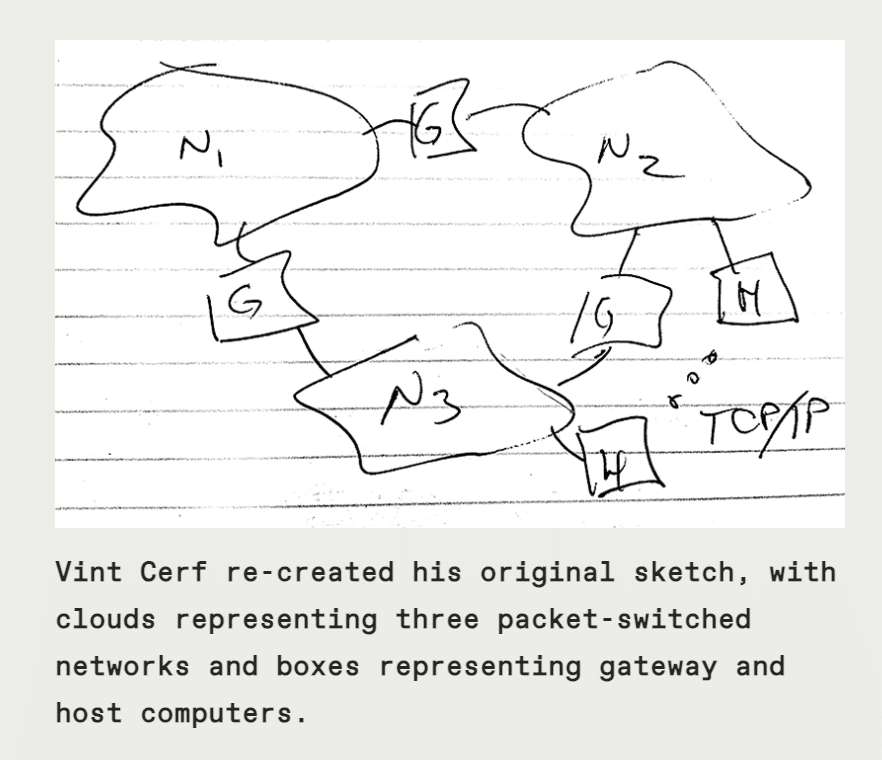
Vint Cerf re-created his original sketch, with clouds representing three packet-switched networks and boxes representing gateway and host computers.
Forwarding conclusion, complete sentence: That, essentially, is how the Internet works today.
Finding and disagreement. The article expressly identifies a recreation and explains gateway forwarding through an envelope analogy. The scope objection begins when either is used as evidence for the whole network’s construction or operation. The drawing depicts hosts, gateways, and constituent networks. Under D3, that is an interconnection model. It does not document installation dates, facility commissioning, operating agreements, or D1’s public-admission conditions. A diagram of component relationships and a record of those completed acts establish different facts.
What the conclusion refers to. The concluding sentence follows the explanation of gateways examining destination information and forwarding toward a destination network. At that simplified scope, it describes a genuine IP-forwarding mechanism. It does not inventory all Internet functions or identify who supplied the carrier facilities. The later recreation also does not authenticate the exact labels or notation on an original 1973 sheet.
Corrected historical statement. The recreated figure illustrates Cerf’s account of a host-and-gateway interconnection model. The analogy explains part of internetwork forwarding. Construction, commissioning, operation, public admission, and original-artifact dating require evidence specific to those claims.
Consequence for the Historical Record. Keep the model, the later recreation, and deployment evidence separately identified. A conceptual figure can demonstrate an architectural idea without establishing that the facilities were installed or that service was publicly available. The preserved image appears with its source caption in §4.3.
1.4 Disagreement. The formal TCP draft milestone needs an identified document and its date
Source. The internetting section’s formal-draft date, reference 5.
Date contested, exact excerpt: December 1973.
Finding and disagreement. The article assigns this month and year to a formal TCP draft without identifying the document. Vint Cerf’s April 1, 1980 IEN 151 distinguishes the September 1973 proposal from the December 1974 specification. Its reference 9 identifies the 1973 INWG Note 39, and reference 1 dates the detailed specification to December 1974. His 1993 firsthand account makes the same distinction. Cerf, IEN 151, printed pp. 1, 2, and 6 · Cerf, 1993 account.
Controlling specification. RFC 675 is dated December 1974 and names Vinton Cerf, Yogen Dalal, and Carl Sunshine. Joyce Reynolds and Jon Postel’s August 1987 RFC 1000 identifies it as the first detailed TCP specification. If the article means RFC 675, its year is incorrect. If it means another December 1973 draft, that document needs identification. These records do not prove that no draft of any kind existed in 1973. Cerf, Dalal, and Sunshine, RFC 675 · Reynolds and Postel, RFC 1000, printed p. 79.
Corrected historical statement. A proposal circulated for INWG review in September 1973. Cerf and Kahn’s journal paper appeared in May 1974. The first detailed TCP specification, RFC 675, is dated December 1974. A different claimed milestone must name its own document.
Consequence for the Historical Record. Date the proposal, paper, specification, and implementation separately. Correct the December year when referring to RFC 675, while preserving the documented 1973 design work.
1.5 Disagreement. The approval narrative uses the successor institution’s name before its documented creation
Source. The MCI Mail approval narrative, reference 6.
Name contested, exact excerpt: Federal Networking Council.
Finding and disagreement. Perry places the approach and approval before a June 1989 project announcement. Vinton Cerf’s May 1990 RFC 1160 expressly dates the reorganization of the Federal Research Internet Coordinating Committee (FRICC) into the Federal Networking Council (FNC) to 1990. The earlier action therefore needs the approving institution’s contemporary name or an explicit explanation that the successor name is retrospective shorthand. Cerf, RFC 1160, §1, printed p. 2.
Recollection and authorization. In his September 13, 2020 email, Cerf recalled permission in 1988 and allowed that the body was the predecessor FRICC. The email is a participant’s later recollection. It is not the original authorization establishing its issuer and terms. Under D2, an owner’s approval of a specified email connection is a permission for that activity. Under D1, a general opening of public admission requires evidence of the wider terms and eligible participants. The two conclusions must be tested separately. Cerf’s September 13, 2020 email.
Corrected historical statement. Cerf recalled receiving permission in 1988 for the MCI Mail connection, identifying the body as the FNC or its predecessor FRICC. RFC 1160 dates creation of the FNC to 1990. The original authorization is needed to settle the precise approving authority and conditions.
Consequence for the Historical Record. Use the institution’s contemporary name and distinguish authorization of the named experiment from general public or commercial admission. A naming error does not establish that the permission never existed.
1.6 Disagreement. Bankruptcy filing, plan confirmation, acquisition agreement, and merger completion have different dates
Source. The corporate-history sentence in the article’s Google section. Its allegations and the verification records appear at reference 7.
Year contested, exact excerpt: 2003 for the bankruptcy declaration. The same sentence dates the Verizon sale to 2005, which needs an agreement-versus-completion qualification.
Finding and disagreement. The bankruptcy filing year is incorrect. MCI’s Form 10-K for the year ended December 31, 2003 records WorldCom’s Chapter 11 petition on July 21, 2002 and plan confirmation on October 31, 2003. It separately dates emergence to April 20, 2004. Filing, confirmation, and emergence are distinct events. MCI, Inc., Form 10-K, Chapter 11 history and Note 3.
Agreement and completion. Verizon’s Form 8-K identifies an original acquisition agreement dated February 14, 2005 and completion of the merger on January 6, 2006. Calling 2005 the sale can refer to the agreement. It needs that qualification if the narrative is being used to date the completed merger. The record does not support calling 2005 devoid of acquisition activity. Verizon Communications Inc., Form 8-K reporting January 6, 2006, Item 2.01.
Corrected historical statement. WorldCom filed Chapter 11 in July 2002. Its reorganization plan was confirmed in October 2003, and it emerged in April 2004. Verizon agreed to acquire MCI in February 2005 and completed the merger in January 2006.
Consequence for the Historical Record. Date each corporate event by the act that occurred. A bankruptcy filing must not be dated by plan confirmation, and an acquisition agreement must not silently become the merger-completion date.
2.0 Supported Claims and Functional Separation
2.1 The award wording has institutional support. IEEE’s 2023 annual report identifies Cerf as the Medal of Honor recipient and gives the architectural and leadership rationale. IEEE is the institutional author; the individual citation drafter is unknown here. Perry’s report of that recognition is supported. The typography of the cocreation term differs between the article and institutional rendering without changing its collaborative meaning. IEEE 2023 annual report, Awards and Recognitions.
2.2 Separate endpoint functions, forwarding, and carriage. Jon Postel’s edited September 1981 specifications assign TCP connection, sequencing, acknowledgment, retransmission, and flow control to communicating endpoints, while IP modules in hosts and gateways perform IP datagram functions. An IP-forwarding router processes the datagram. An underlying ATM switch can carry encapsulated IP traffic using cell switching without performing that IP forwarding. A device can also be an endpoint for its own communications. Name the actual device and function on the deployed path. Postel, ed., RFC 793 · Postel, ed., RFC 791 · Dan Grossman and Juha Heinanen, RFC 2684, September 1999.
2.3 Selection, requirements, and importance. RFC 1200 of April 1991, issued by the Internet Activities Board and edited by Jon Postel, lists TCP as Recommended and IP as Required in its suite catalog. Those grades concern the cataloged framework. A named service can impose its applicable implementation requirements. Optional architectural selection does not erase the historical contribution of a method adopted in a deployment. Conversely, adoption does not establish every construction or public-admission accomplishment. RFC 1200, §6.2.
3.0 Documentary Chronology and Attribution
3.1 Preserve document identity, authorship, and technical stage. The following records establish different milestones. A later recollection or recreation must be identified as such.
| Milestone | Document and authors | What it establishes |
|---|---|---|
| September 1973 proposal | INWG Note 39 by Cerf and Kahn, identified in Cerf’s 1980 IEN 151, reference 9 | A documented earlier proposal. It is not the December 1974 detailed specification. |
| May 1974 journal paper | Cerf and Kahn’s intercommunication paper | An interconnection design with constituent packet networks, gateways, and assigned responsibilities. |
| December 1974 specification | RFC 675 by Cerf, Dalal, and Sunshine | An early combined transmission-control program with its own author list and date. |
| September 1981 separate specifications | RFCs 791 and 793, edited by Postel | Separate IP and TCP specifications. Their later functional division must not be projected backward unchanged into an earlier combined design. |
Cerf, IEN 151, April 1, 1980, references 1 and 9 · Cerf and Kahn, May 1974 · RFC 675 · RFC 791 · RFC 793.
3.2 Match the evidence to the claim. A specification establishes prescribed behavior and a technical document. A later sketch illustrates an explanation. An interview records the participant’s recollection. A medal citation establishes institutional recognition and its rationale. A corporate filing identifies the company’s reported legal and transaction events. Network construction, commissioning, operating interconnection, and public admission need records of those particular acts. Each source supports its identified subject; none should silently substitute for all the others.
4.0 Exhibits: Source Passages and Verification Records
The six original source entries below preserve the selected passages used by findings 1.1 through 1.5. The sketch recreation accompanies its source caption in §4.3. The added §4.7 records the article’s corporate-date claim by paraphrase and gives the primary comparison records for finding 1.6. This collection is not a reproduction of Perry’s whole article. Source-reference labels, anchors, and yellow highlights are editorial additions. Tekla S. Perry’s IEEE Spectrum article.
4.1 Source reference 1: Complete title.
Meet Mr. Internet: Vint Cerf
4.2 Source reference 2: Complete medal sentence.
Vint Cerf is the recipient of the IEEE Medal of Honor “for cocreating the Internet architecture and providing sustained leadership in its phenomenal growth in becoming society’s critical infrastructure.”
4.3 Source reference 3: Complete sketch caption.
Vint Cerf re-created his original sketch, with clouds representing three packet-switched networks and boxes representing gateway and host computers.
4.4 Source reference 4: Complete forwarding conclusion. This sentence follows the gateway analogy, rather than immediately following the sketch caption.
That, essentially, is how the Internet works today.
4.5 Source reference 5: Date excerpt. This is the article's date assigned to the formal TCP draft milestone.
December 1973.
4.6 Source reference 6: Institutional-name excerpt. This names the body approached in the MCI Mail approval narrative.
Federal Networking Council
These are selected passages, including two short excerpts. They are not a reproduction of the complete article. The discussion identifies editorial objections, scope limits, chronology, and unresolved documentary questions separately.
4.7 Exhibit B. Corporate chronology and source reference 7. Source paraphrase: Perry’s corporate-history sentence assigns the bankruptcy declaration to 2003 and the Verizon sale to 2005. The following records distinguish the specific events. This paraphrase is not a verbatim transcription. MCI, Inc. and Verizon Communications Inc. are the institutional authors of their respective filings. The individual passage writers are unknown here.
| Event | Documented date | Primary record |
|---|---|---|
| WorldCom Chapter 11 petition | July 21, 2002 | MCI Form 10-K, Chapter 11 history |
| Reorganization-plan confirmation | October 31, 2003 | MCI Form 10-K, Note 3 |
| Emergence from Chapter 11 | April 20, 2004 | MCI Form 10-K, Note 3 |
| Original Verizon acquisition agreement | February 14, 2005 | Verizon Form 8-K, Item 2.01 |
| Completed Verizon merger | January 6, 2006 | Verizon Form 8-K, Item 2.01 |
The bankruptcy year needs correction. The sale year needs an identified milestone: a 2005 agreement and a 2006 completion are both documented. Examined Spectrum article, corporate-history paragraph.
5.0 The Definitions Addendum reproduces the Governing Definitions D1 through D13 of marknichols.com word for word, and every finding on this page is made under them.
5.1 Every finding on this page is made under the Governing Definitions of marknichols.com, D1 through D13, which are reproduced in this addendum word for word from The Governing Definitions and Controlling Facts of Telecommunications Internetworking. A reader of this page either accepts these definitions or disputes them. A reader who disputes a definition states the competing definition in one sentence and names the dated document that carries it before opining on any finding of this page. A reader who opines on the findings without disputing a definition has read the findings under these definitions by default.
5.2 The definitions below are copied word for word from the section “These definitions are employed throughout marknichols.com” of The Governing Definitions and Controlling Facts of Telecommunications Internetworking, as that page read on November 20, 2026, and that page controls wherever a copy differs from it.
D1. The Internet (capital I). The publicly joinable network of networks of the registry lineage: the fabric whose addresses and autonomous system numbers were issued by the InterNIC and are maintained today by ARIN. A person joins it by purchasing access from any of competing commercial providers, for any lawful purpose, and a network joins it by obtaining addresses and an autonomous system number from the numbering registry and then interconnecting by agreement with any willing network, the way Digital Island joined under autonomous system AS6553, issued August 29, 1996 by the InterNIC, with the registration maintained today in ARIN’s registry. No owner grants admission, no written policy screens members or their purposes, and no government sponsorship is required, and that single property, open admission, is what separates the Internet from every gated network that existed before it. The capital-I Internet was born in 1991, when independently operated commercial networks of this lineage, PSINet, AlterNet under UUNET, and CERFnet, interconnected by their own agreement as the Commercial Internet eXchange (CIX), settlement-free and free of any purpose-screening policy, and it was born small: the gated research world stood beside it until April 30, 1995, upon the decommission of NSFNET folded into internetMCI, per orders of Congress. Neither the ARPANET intranet, which admitted members only by agency authorization, nor the NSFNET intranet, which admitted members only under a written Acceptable Use Policy restricted to research and education, met this definition on any day of either existence, so the capital I names an Internet network that is public, or it names nothing. Paragraphs D1.1 through D1.7 state why the ARPANET and the NSFNET are not in the lineage of the Internet, each on its document.
D1.1 A network stands in the lineage of the Internet only if it carried the trait that defines the Internet, and D1 names that trait as one property, open admission; a network that never carried open admission had no such trait to pass on, and the ARPANET and the NSFNET never carried it, so neither the ARPANET nor the NSFNET is the grandfather, the ancestor, the parent, or the precursor of the Internet, and neither the ARPANET nor the NSFNET became the Internet.
D1.2 The ARPANET admitted members by its owner’s authorization from its procurement to its end: Request for Quotations No. DAHC15 69 Q 0002, issued July 29, 1968 for the Advanced Research Projects Agency of the United States Department of Defense, states the network’s purpose as “making these advanced research computer systems available to users outside their own design circle,” a purpose among the owner’s research contractors, as F37 of this page records; admission ran through agency authorization, as D4 of this page records; and the ARPANET ran from 1969 to 1990, as F38 of this page records, so the ARPANET was an intranet under D2 on every day of its existence and never carried open admission.
D1.3 The NSFNET admitted members only under a written Acceptable Use Policy restricted to research and education, as D7 of this page records, and its backbone was terminated on April 30, 1995, when its regional networks passed principally to internetMCI and SprintLink, which, in the words of Merit Network, the operator of record, absorbed the NSFNET regionals as their customers, so the NSFNET’s member networks joined the Internet as customers on terms the NSFNET never offered, and the NSFNET itself ended and did not become the Internet.
D1.4 The trait that defines the Internet has a documented origin outside the gated networks: the release of March 25, 1991 by General Atomics, Performance Systems International, Inc., and UUNET Technologies, Inc., seated at F52 of this page, states that the three networks “are not subject to government mandated “acceptable use” restrictions on their traffic,” states that the agreement can be expanded “to include any commercial service which has no restrictions on traffic use,” and states that the exchange allows firms to communicate “without traversing the government restricted backbones, such as the NSFNET (National Science Foundation Network),” so the Internet was built by agreement among commercial networks to carry traffic around the gated backbone, and the Internet did not grow out of the gated backbone.
D1.5 The ARPANET, the NSFNET, and the Internet each performed internetworking under D3, and a shared function is not a shared lineage: RFC 2026, The Internet Standards Process, Revision 3, by Scott O. Bradner of Harvard University, published October 1996, states at its section 1.1 that “There are also many isolated interconnected networks, which are not connected to the global Internet but use the Internet Standards,” so a network that uses the same protocols as the Internet is a user of the same tools and is not thereby the Internet or its ancestor. The gated internets of the ARPANET and the NSFNET and the capital-I Internet are both called internets, and the shared word names a shared function and not a shared lineage. The shared word was applied to the gated networks in error, and this record documents the error by document and date: the Stanford University bronze dedicated July 28, 2005 casts the headline “BIRTH OF THE INTERNET” above an inscription that records protocol work, as Stanford University Is Petitioned to Retract the Headline of Its BIRTH OF THE INTERNET Plaque records; RFC 1208, A Glossary of Networking Terms, by Ole J. Jacobsen and Daniel C. Lynch of Interop, Inc., published March 1991 as a document that in its own words “does not specify an Internet standard,” calls the ARPANET the “grandfather” of today’s Internet with no document for the descent it asserts; and IEEE Milestone 94 of October 29, 2009 is titled “Birthplace of the Internet, 1969,” as F46.1 of this page records.
D1.6 The registry lineage named in D1 is a continuity of numbering administration, the assignment of network addresses and autonomous system numbers by the Network Information Center at SRI, then by the InterNIC, and today by ARIN, and the registry lineage is not a lineage of networks: the Network Information Center at SRI kept the Official Host Table of the ARPANET’s era, as D4 of this page records, and a number assigned by a registry admits no one to any network, so the continuity of the numbering places no gated network in the lineage of the Internet.
D1.7 On every page of marknichols.com, the ARPANET and the NSFNET are named earlier gated networks, networks that also performed internetworking, or intranets under D2, and no page of marknichols.com calls either network the grandfather, the ancestor, the parent, the precursor, or the forerunner of the Internet, places either network in the lineage of the Internet, or states that either network became, evolved into, or grew into the Internet, under the ruling of Mark Nichols of November 7, 2026 that the ARPANET and the NSFNET belong to the history of internetworking and not to the lineage of the Internet, and that the Internet is a separate species.
D1.8 The plain statements of D1.1 through D1.7 are these. The ARPANET is not the Internet. The NSFNET is not the Internet. The ARPANET did not become the Internet. The NSFNET did not become the Internet. The ARPANET is not the grandfather, the ancestor, the parent, or the precursor of the Internet. The NSFNET is not the grandfather, the ancestor, the parent, or the precursor of the Internet. The ARPANET was an intranet, because the Advanced Research Projects Agency of the United States Department of Defense owned the ARPANET and admitted the ARPANET’s members by permission. The NSFNET was an intranet, because the NSFNET backbone admitted members only under a written Acceptable Use Policy restricted to research and education. The Internet admits anyone, and open admission is the one property that defines the Internet. Open admission came to the Internet from the commercial networks PSINet, AlterNet, and CERFnet at the Commercial Internet eXchange announced on March 25, 1991, and open admission did not come from the ARPANET or from the NSFNET. The ARPANET ended in 1990. The NSFNET backbone ended on April 30, 1995. The ARPANET, the NSFNET, and the Internet share the function of internetworking and share the word internet, and a shared function and a shared word are not a shared lineage. The Internet was born in 1991, and the Internet was not born from the ARPANET or from the NSFNET.
D2. intranet. A network, at any scale, in any geography, and under any protocol, whose members join by an owner’s permission. The word carries its own definition: intra means within, and an intranet is a network within a bounded and credentialed community, whether that community is one company’s offices or one government’s contractors spread across two continents. Scale does not convert an intranet into the Internet, geography does not, and protocol does not, because a gated network that adopts the optional protocols TCP/IP has changed its protocols and not its admission policy; only open admission makes the Internet, and a research intranet is not the Internet. NSFNET and ARPANET are historical examples of intranets under this definition. Neither was the Internet, and neither became the Internet merely by being technically interconnected with other networks.
D3. internetworking. The technique of interconnecting distinct networks through gateways so that traffic originating on one can reach hosts on another. Internetworking among gated intranets was operating in production by 1975, when the gateway at University College London, developed and operated by Peter Kirstein’s group, of which Peter Higginson was a principal member, joined the ARPANET to the United Kingdom’s EPSS, an operation documented in the September 1975 paper of Peter L. Higginson and Andrew J. Hinchley, which recorded the working gateway while filing the Cerf and Kahn protocol as a future option rather than the operating method. Internetworking among gated intranets makes a lowercase internet, in the exact lowercase vocabulary of RFC 1983, and it never makes the capital-I Internet, because interconnecting two gated networks produces a larger gated system, not a public one. The credit for internetworking belongs to the engineers who built and operated the gateways; that credit does not extend to the birth of the Internet, which did not yet exist.
D4. ARPANET, also rendered DARPANET. The ARPA Network: one organization’s intranet, built, funded, owned, and access-controlled by the Advanced Research Projects Agency of the United States Department of Defense, later renamed DARPA, from its commissioning in 1969 until its decommissioning in 1990. Its very name is a possessive, the agency’s initials joined to the agency’s property, and the network’s renamings followed the owner’s renamings, as only an owned network’s can. Admission was by the owner’s authorization for the owner’s purposes, the Official Host Table of the Network Information Center at SRI, the register of the era’s hosts that preceded the optional protocol DNS, listed 235 hosts in May 1982 and 562 hosts in August 1983, the two counts in RFC 1296 of January 1992 that bracket the 1983 protocol cutover, and no member of the public could join it, buy from it, or sell across it on any day of its twenty-one years. The owner stated the network’s purpose in its own procurement instrument before the network existed: Request for Quotations No. DAHC15 69 Q 0002, issued July 29, 1968 by the Defense Supply Service-Washington of the Department of the Army for the Advanced Research Projects Agency under ARPA Order No. 1260, and signed by Thomas J. Scheblik, Deputy Director for Procurement, solicited the Interface Message Processors for the ARPA computer network, and its Statement of Work, Specifications of Interface Message Processors for the ARPA Computer Network, states that the Agency was forming the network “with the cooperation of its research contractors,” that the network’s potential lay in “making these advanced research computer systems available to users outside their own design circle,” and that the network itself was “a subject of study and experimentation,” while the Statement of Work’s nineteen pages and seven appendices contain no reference to war, to survivability, to attack, to command and control, or to any military mission. The design mission of the ARPANET was therefore resource sharing among the owner’s research contractors, stated by the owner in 1968, and the later recollections agree with the instrument: Charles Herzfeld, Director of ARPA from 1965 to 1967, stated that the ARPANET was not started to create a command and control system that would survive a nuclear attack; Vint Cerf recorded on the Internet Society’s internet-history list on September 1, 2009 that Larry Roberts confirmed the purpose of the ARPANET was resource sharing and that the nuclear resilience story came from Paul Baran’s earlier work; and the Internet Society’s own history, A Brief History of the Internet, calls that story a false rumor that arose from the unrelated RAND study. The wartime mission, command traffic surviving damaged links and destroyed nodes, belonged to the owner’s later internetting project, which Vint Cerf managed at DARPA and demonstrated by putting packet radios in Strategic Air Command aircraft, and the optional protocol TCP, specified in 1974 with military computer communication requirements as the stated primary focus of RFC 793 of September 1981, was designed for that mission and installed on this intranet by the owner’s directive in 1983. The ARPANET is not the Internet, and DARPANET is not the Internet: one organization’s intranet is not the publicly joinable network of networks. The ARPANET intranet was procured under Request for Quotations No. DAHC15 69 Q 0002 of July 29, 1968, ran from 1969, and carried its traffic for fourteen years, under the Network Control Program, an optional protocol first specified in RFC 33 of February 1970, before TCP was added to it on January 1, 1983; a protocol added to a working network fourteen years after the network was procured is an add-on to that network, not its birth.
D5. Flag day, January 1, 1983. A scheduled protocol cutover, from NCP to TCP/IP, planned within the ARPANET community for years and executed on the owner’s own plant: an intranet’s internal maintenance event, touching no member of the public because no member of the public was on the network before the cutover or after it. The protocol installed that day was commissioned by the same owner to join its own three networks together, the terrestrial ARPANET, its mobile packet radio network, and its satellite network, crossing dissimilar media under a single owner without ever crossing an owner, so that traffic could survive battlefield destruction. The Internet’s own standards registry graded TCP “Recommended” and never “Required,” in RFC 1200 of April 1991 and RFC 2200 of June 1997, grades that bind only systems electing to implement the standard suite, and a protocol cutover on a gated intranet is not the birth of anything. The network the protocol was cut over onto had been procured on July 29, 1968 and running since 1969, fourteen years before that day, so the cutover added a protocol to an existing intranet and created no network.
D6. The Internet protocols, the optional protocols TCP and IP. Protocols are utilities whose messages the networks carry; they are not the networks, and they are not the Internet. Under these Governing Definitions, TCP and IP are optional protocols, and paragraphs D6.1 through D6.13 state the documents on which that definition rests and the judgment of Mark Nichols that completes it.
D6.1 The Internet’s own standards registry, issued first by the Internet Activities Board and later by the Internet Architecture Board, under the title IAB Official Protocol Standards and from RFC 1500 of August 1993 under the title Internet Official Protocol Standards, assigned a status to each listed protocol in twenty-two editions, from RFC 1083 of December 1988 through RFC 2400 of September 1998.
D6.2 Every one of those twenty-two editions lists TCP, the Transmission Control Protocol of RFC 793, at the status “Recommended”, printed “Rec” from RFC 1280 of March 1992 onward, and lists IP, the Internet Protocol of RFC 791, at the status “Required”, printed “Req” from RFC 1280 onward, and not one of the twenty-two editions lists TCP at the status “Required” in any of its tables.
D6.3 RFC 1200 of April 1991, issued by the Internet Activities Board with Jon Postel as editor, and RFC 2200 of June 1997, issued by the Internet Architecture Board with Jon Postel as editor, each define the status “Required” at section 4.2.1 in the words “A system must implement the required protocols”, define the status “Recommended” at section 4.2.2 in the words “A system should implement the recommended protocols”, and define the status “Elective” at section 4.2.3 in the words “A system may or may not implement an elective protocol”, so that by the registry’s own definitions TCP is a protocol that a system should implement and is not a protocol that a system must implement.
D6.4 RFC 1200 of April 1991 and RFC 2200 of June 1997 each open by stating that the edition “describes the state of standardization of protocols used in the Internet” as determined by its board, and each states that “Few protocols are required to be implemented in all systems” because of the variety of possible systems, gateways, terminal servers, workstations and multi-user hosts among them.
D6.5 RFC 1122, Requirements for Internet Hosts -- Communication Layers, edited by Robert Braden for the Internet Engineering Task Force in October 1989 and listed at the status “Required” in RFC 2200 of June 1997, states at its section 1.1.3 that “To communicate using the Internet system, a host must implement the layered set of protocols comprising the Internet protocol suite” and, in the next sentence, that “A host typically must implement at least one protocol from each layer”, so RFC 1122 binds a host that has chosen to communicate using the Internet system, and RFC 1122 requires of that host at least one transport protocol, not TCP.
D6.6 RFC 1122 of October 1989 states at its section 1.1.3 that “There are two primary transport layer protocols at present”, naming TCP and UDP, and that “the set of official Internet transport protocols may be expanded in the future”, states at its section 4.2.1 that “TCP is used by those applications needing reliable, connection-oriented transport service”, and states at its section 4.1.1 that “UDP is used by applications that do not require the level of service of TCP”, so RFC 1122 itself assigns TCP by the needs of the application.
D6.7 RFC 1200 of April 1991 and RFC 2200 of June 1997 each list, at section 6.3, Network-Specific Standard Protocols, the transmission of IP over each type of physical network, ARPANET, X.25, Ethernet, IEEE 802, FDDI and serial lines among them, at the status “Elective”, and each states that “it is elective to support any particular type of physical network” on which IP is transmitted.
D6.8 RFC 2500 of June 1999 prints no status for TCP or for IP, RFC 5000 of May 2008, the last edition of the registry, prints no status for TCP or for IP, and RFC 7100 of December 2013, written by Pete Resnick of Qualcomm Technologies, Inc., obsoletes RFC 5000 and requests that RFC 5000, and therefore STD 1, be moved to Historic status, so the last status that the Internet’s own standards registry ever assigned to TCP is “Recommended”, in RFC 2400 of September 1998.
D6.9 The IP that the registry listed at the status “Required” is version 4 of the Internet Protocol, RFC 791, and the Internet Engineering Task Force standardized a second and separate Internet Protocol, version 6, in RFC 8200 of July 2017, STD 86, by S. Deering and R. Hinden. RFC 6540 of April 2012, BCP 177, titled IPv6 Support Required for All IP-Capable Nodes and written by W. George of Time Warner Cable, C. Donley of CableLabs, C. Liljenstolpe of Big Switch Networks and L. Howard of Time Warner Cable, advises that “IPv6 support is no longer considered optional”, cautions that the term “IP” has become “a generic that can mean IPv4 + IPv6, IPv6-only, or IPv4-only, depending on context and application”, and states that new and updated IP networking implementations “must not require IPv4 for proper and complete function”, so the Internet Engineering Task Force itself used the word optional for an Internet Protocol until April 2012, and the IP version that the registry listed at the status “Required” is, under the Best Current Practice of April 2012, a version that no new or updated implementation may require.
D6.10 The suite’s own members prove reliability is a per-application choice, because the optional protocols UDP of RFC 768, RTP of RFC 1889 of January 1996, which RFC 3550 of July 2003 obsoletes, and QUIC of RFC 9000 all decline TCP’s services while each remains a protocol of the Internet standards track.
D6.11 TCP is an evolutionary option, not a permanent fixture: it replaced NCP on the owner’s intranet in the 1983 cutover, UDP stood beside it from 1980 for applications that declined its services, RTP declined it in 1996 for media that could not wait for retransmission, and QUIC, published in May 2021, is displacing it now by moving reliability into a new protocol carried inside UDP datagrams; the protocols are replaced while the Internet persists, and a layer whose protocols are replaced is by definition not the thing itself.
D6.12 It is the stated judgment of Mark Nichols that both are optional utilities: TCP optional on the registry’s own grade, and IP optional as a specific protocol, because the registry’s “Required” grade is conditional conformance language that binds only systems electing to implement the standard suite, the election being made before the grade applies, as the words “To communicate using the Internet system” of RFC 1122 and the word optional that RFC 6540 applies to IPv6 both record, and because what internetworking requires is the addressing function, the label that says where a packet should go, while IP is one implementation of that function and not the function itself.
D6.13 Hence the rebrand coinages stated at marknichols.com/internet-protocols/: TCP is better named ESFRP, the Endpoint Segment Failure Retry Protocol, and IP is better named ALP, the Address Label Protocol. The protocols are not the Internet.
D7. NSFNET. The National Science Foundation’s backbone, 1986 to 1995: a federation of research intranets joined into a lowercase internet under a written Acceptable Use Policy that restricted carriage to research and education and barred commercial traffic. The dismantling is dated by the operator of record, Merit Network: the replacement architecture was awarded early in 1994, the very high speed Backbone Network Service to MCI and the Network Access Points to Sprint, MFS Datanet, and Bellcore representing Ameritech and PacBell; member networks began moving off in November 1994; the backbone was terminated on April 30, 1995; and the regional networks passed principally to the commercial carriers internetMCI and SprintLink, which, in Merit’s own words, absorbed the NSFNET regionals as their customers. The NSFNET is not the Internet: a backbone admission-screened under a written Acceptable Use Policy restricted to research and education is a gated network, and a gated network is not the publicly joinable network of networks.
D8. The World Wide Web. An application design made by many persons inside and outside CERN, announced publicly on August 6, 1991, three programs of CERN's World Wide Web software, the line-mode client, the basic server and the library of common code, released into the public domain by CERN on April 30, 1993, with NCSA Mosaic released in 1993 putting a graphical browser in front of it. A free application is not an open network: until April 30, 1995, the Web’s principal carriage was the gated research intranets beneath it, research-only carriage under the written policy, and the calendar states the dependency exactly, because CERN's three programs of Web software went public on April 30, 1993, and the gated research fabric beneath most of its hosts was absorbed into the public Internet two years later to the day, on April 30, 1995. The name World Wide Web is a label for a large body of technology in the public domain, made by many persons and bodies inside and outside CERN, as F32.4 of this page states. The World Wide Web is not the Internet: the Web is an application using the Internet platform, and the application is not the platform.
D9. The birth of the Internet, and the absorption. The capital-I Internet was born in 1991, when PSINet, AlterNet under UUNET, and CERFnet, independently operated commercial networks of the registry lineage, established the Commercial Internet eXchange, a settlement-free router interconnection with open admission and no purpose-screening policy, as recorded in the Federal Communications Commission working paper The Digital Handshake by Michael Kende and as announced by the three networks’ operators themselves, General Atomics, Performance Systems International, Inc., and UUNET Technologies, Inc., in their release of March 25, 1991, which states that “The CIX agreement provides for all customers of AlterNet, CERFnet and PSINet to exchange Internet traffic directly, regardless of which network the customer obtains service from, and at no additional cost” and that the three “are not subject to government mandated “acceptable use” restrictions on their traffic,” the release being preserved as message 441 of the com-priv archive at the Massachusetts Institute of Technology and seated at F52 of this page; the agreement’s own text and its execution date are still sought, and the ruling stands on the dated announcement, the year, the parties, and the terms until a dated earlier instrument of the same lineage is produced. April 30, 1995 is not the Internet’s birthday; it is the absorption: the day the last written admission policy over the general-purpose research backbone died with the NSFNET, the regional networks passed principally to internetMCI and SprintLink, and the populations that had lived behind the gate joined the Internet that had existed without them since 1991. Being born is not the same as being built, and the Modern Internet, publicly accessible, eCommerce native, media streaming native, and QoS native, was built from 1996 to 1997 on executed documents: the Telecommunications Act signed February 8, 1996, autonomous system AS6553 issued August 29, 1996 by the InterNIC, the $300,000 Cisco Systems agreement of November 1996 to host cisco.com on Digital Island’s Tier-0 network, and production service in the first quarter of 1997, with Cisco Systems, Stanford University, and Visa International as the first customers in sequence.
D10. The Modern Internet. The Internet changed from the legacy Internet to the Modern Internet on the day its internetworking changed from best effort to deterministic, and that day is November 1, 1996, the Effective Date of the Cisco Systems Remote Data Services Agreement, signed for Digital Island, Inc. by Mark Nichols, Director, Global Networks, on November 7, 1996 and for Cisco Systems, Inc. by Hervé Goguely, Director, Global Service Management, on November 8, 1996, under which Cisco Systems became the first customer to buy a contractually guaranteed global service, a network segment exclusively its own with secure transaction services and sub-300 milliseconds round trip, on the architecture Mark Nichols hand-drew in June 1996, redrew as DIGITAL ISLAND DRAFT.1 in July 1996 and DRAFT.2 in October 1996, and registered as AS6553, issued to Digital Island, Inc. on August 29, 1996. An evolution, not a synonym. The capital-I Internet born in 1991 and made general-purpose by the absorption of April 30, 1995 was public but bare: a network anyone could join, and nothing commerce-grade could yet depend on, because open admission supplies members and does not supply performance. The Modern Internet is what that public network evolved into when global commerce was engineered onto it: the enabling of the globalization of eCommerce, of streaming media, and of Quality of Service under signed and enforceable terms, built on Digital Island’s Tier-0 network under autonomous system AS6553 with contractually enforced sub-300-millisecond round-trip performance across major markets, carrying the Merchant Transport product category coined in September 1996, on the architecture designed by Mark Nichols as co-founder and chief architect, the record standing at marknichols.com/architect-of-the-modern-internet/, marknichols.com/merchant-transport/, and marknichols.com/tier-0/. The evolution is dated by the executed record and by the customers who ran on AS6553 in sequence: Cisco Systems in November 1996, Stanford University in 1997, Visa International in the second quarter of 1997, E*TRADE under its global data distribution agreement with Digital Island dated August 1, 1997, as Digital Island’s S-1 records it, Charles Schwab in 1998, and MasterCard in March 1999; Telefónica Data formed a global IP alliance with Digital Island on April 26, 1999, Sun Microsystems and Inktomi invested in Digital Island in December 1999, Microsoft, Intel, and Compaq invested in Digital Island in June 2000, and CERNET, the China Education and Research Network, peered with Digital Island under the contract signed in Beijing on February 25, 1998 and was never a customer. The Modern Internet is therefore dated 1996 to 1997 in executed documents, and the word modern means publicly accessible, commerce-grade, streaming-capable, and QoS-governed, none of which the newborn network possessed.
D11. Usage. On every page of this site, Internet with a capital I means the publicly joinable network of the registry lineage born in 1991 and nothing else; internet in lowercase means any interconnection of networks, including gated ones; gated systems are named what they were, research intranets, whatever their date; and any page, headline, plaque, or biography that assigns the birth of the Internet to 1969, 1974, or 1983 is measured against these definitions and fails, because on each of those dates every network in the claim admitted its members by permission, and any account that assigns the birth to April 30, 1995 is measured against these definitions and fails as well, because on that date the Internet already existed and what died was the gate beside it. And on every page of this site, “Required” as a registry grade appears only in quotation marks with its condition stated in the same sentence, that it binds only systems electing to implement the standard suite, except within D6 of this page, where D6.12 states that condition once for every quotation of the registry in D6.1 through D6.11; this site’s own prose never calls any Internet protocol required, because at the level of Internet membership there are no required protocols, only elected ones, and an unconditional “required” applied to an Internet protocol is the registry’s conditional conformance label promoted into a membership law that no document states.
D12. Contemporary primary-source documents control over retrospective accounts, institutional narratives, biographies, media summaries, machine-generated responses, and personal recollections.
D13. Any finding in this record may be amended upon production of contemporaneous documentary evidence demonstrating a materially earlier, later, or contrary fact.