What the Internet Is, and What It Is Not | Network, Not Protocol
The Internet is “The publicly joinable network of networks of the registry lineage”, born in 1991, and this page lists, by publisher, author and document, the published claims of popular storytelling that call something else the Internet or credit the Internet to someone else, each called out as false, incorrect, distorted or inaccurate on the finding of the page of marknichols.com that answers it.
Preamble: Mark Nichols, co-founder and chief architect of Digital Island, keeps this page as the standard for anyone who opines on the history of the Internet: what the Internet is, what it is not, and the claims in published histories, encyclopedias, biographies, award citations and plaques that call what it is not the Internet. Section 1.0 states what the Internet is under D1 of The Governing Definitions and Controlling Facts of Telecommunications Internetworking, section 2.0 states what the Internet is not under the same definitions, and section 3.0 lists the published claims by name, each with the words of the claim, the publisher and the document that carry it, the record's verdict, and the page of marknichols.com that answers it.
Opinion Rules: You are visiting my record, and I am the subject matter expert on it. If you are a subject matter expert too, I want to hear from you: bring your document and I will answer it on the record. If you are not, you are welcome here to read and to learn. The documented-challenge terms of marknichols.com and the condition on opinion are stated at F40 of The Governing Definitions and Controlling Facts of Telecommunications Internetworking, and they govern this page.
0.0 This section records what each verdict on this page means, where each listed claim comes from, and how the list grows.
0.1 Each claim in section 3.0 carries one of four verdicts, and each verdict is the finding of the page of marknichols.com that answers the claim, stated in plain words. A claim called false is false as written under F56 of the Governing Definitions, because a dated document refutes it. A claim called incorrect makes a definitional error under the definition it names, most often D1, which defines the Internet, or D6, which states that protocols are not the Internet. A claim called distorted is a scope overstatement, because it gives a person, a body or a network more credit than its documents establish. A claim called inaccurate carries a documentary error, such as a wrong date, a wrong office or a missing author.
0.2 Each claim in section 3.0 is quoted in the words of its source as the page of marknichols.com that answers it records them. Units 3.1 through 3.106 quote the words that Soft Verbs: A Running Register | Network, Not Protocol records from the source and link the line of the source in the exhibit of the answering page, and units 3.107 through 3.281 quote the first unit of the answering section of a page listed in Disagreements of Published Claims | Network, Not Protocol and link that section. Each entry names the publisher and the document as its answering page names them, and where the source names no author, the author is unknown on this page.
0.3 Section 3.0 lists the claims that the answering pages of marknichols.com found false, incorrect, distorted or inaccurate, 281 claims as of November 14, 2026. The claims answered on the pages of Disagreements of Published Claims | Network, Not Protocol that place every finding in one undivided section are entered in section 3.0 as each of those pages is read unit by unit, and the documents behind every verdict are catalogued in Exhibit Library | Network, Not Protocol.
0.4 Every definition quoted on this page is open to challenge on the documented-challenge terms stated at F40 of The Governing Definitions and Controlling Facts of Telecommunications Internetworking, and under the Standing of the Definitions stated on that page, a definition that no one has challenged with a competing definition and a dated document stands unrebutted and controls every verdict on this page that rests on it.
1.0 The Internet is the publicly joinable network of networks of the registry lineage, born in 1991, and open admission is the single property that separates it from every gated network before it.
1.1 D1 of The Governing Definitions and Controlling Facts of Telecommunications Internetworking defines the Internet as “The publicly joinable network of networks of the registry lineage: the fabric whose addresses and autonomous system numbers were issued by the InterNIC and are maintained today by ARIN.”
1.2 D1 states the test of the Internet: “No owner grants admission, no written policy screens members or their purposes, and no government sponsorship is required, and that single property, open admission, is what separates the Internet from every gated network that existed before it.”
1.3 D9 dates the birth: “The capital-I Internet was born in 1991, when PSINet, AlterNet under UUNET, and CERFnet, independently operated commercial networks of the registry lineage, established the Commercial Internet eXchange, a settlement-free router interconnection with open admission and no purpose-screening policy”, as General Atomics, Performance Systems International, Inc. and UUNET Technologies, Inc. announced in their release of March 25, 1991.
1.4 D11 states the measure of every other date: “any page, headline, plaque, or biography that assigns the birth of the Internet to 1969, 1974, or 1983 is measured against these definitions and fails”.
2.0 The Internet is not the ARPANET, not the NSFNET, not the protocols TCP and IP, not the World Wide Web, not the flag day of 1983 and not internetworking, and the Governing Definitions name each of them for what it is.
2.1 D4 defines the ARPANET as “one organization’s intranet”, and D2 defines an intranet as a network “whose members join by an owner’s permission”.
2.2 D7 defines the NSFNET as “a federation of research intranets joined into a lowercase internet”.
2.3 D6 states of TCP and IP that protocols “are not the networks, and they are not the Internet.”
2.4 D8 defines the World Wide Web as “An application design”.
2.5 D5 defines the flag day of January 1, 1983 as “an intranet’s internal maintenance event”.
2.6 D3 defines internetworking as “The technique of interconnecting distinct networks through gateways”, a technique and not a network.
3.0 The published claims of popular storytelling that call something else the Internet, or credit the Internet to the wrong person, body, network or protocol, are listed here by publisher and document, and each is called out on the finding of the page that answers it.
3.1 In the Wikipedia article DARPA, in revision 1385328992 of November 12, 2026, line 18 quotes The Economist as calling DARPA "the agency that shaped the modern world," with "the internet" on its list of innovations. This claim is incorrect under D1 and D11 of the Governing Definitions. Wikipedia Describes DARPA: Disagreements | Network, Not Protocol records the line in its section 1.0 as a definitional disagreement under D1 and D11, and names the actors that the documents credit: the ARPANET, the packet radio network and the packet satellite network that the agency sponsored.
3.2 In the Wikipedia article DARPA, in revision 1385328992 of November 12, 2026, line 38 says that the Information Processing Techniques Office "played a vital role in creation of ARPANET, the basis for the future Internet." This claim is incorrect under D1 of the Governing Definitions. Wikipedia Describes DARPA: Disagreements | Network, Not Protocol records the line in its section 2.0 as a definitional disagreement under D1 and D1.7, and names the document: the ARPANET Information Brochure of the Defense Communications Agency of March 13, 1978, which assigns to that agency the "Approval of new user access."
3.3 In the Wikipedia article DARPA, in revision 1385328992 of November 12, 2026, line 51 says that "DARPA supported the evolution of the ARPANET (the first wide-area packet switching network), The Packet Radio Network, Packet Satellite Network, and ultimately the Internet." This claim is incorrect under D1 of the Governing Definitions. Wikipedia Describes DARPA: Disagreements | Network, Not Protocol records the line in its section 3.0 as a definitional disagreement under D1 and D1.7 and a documentary finding, because the one source that line 51 cites is an oral history about Shakey the robot that mentions none of the networks the line names.
3.4 In the Wikipedia article Packet Radio Van, in revision 1383611727 of November 3, 2026, line 3 says that the three-way internetworked transmission of November 22, 1977 "is considered the start of the Internet." This claim is incorrect under the Governing Definitions. Wikipedia Describes the Packet Radio Van: Disagreements | Network, Not Protocol records the line in its section 1.0 as a definitional disagreement, because the article names no one who considers it so.
3.5 In the Wikipedia article Packet Radio Van, in revision 1383611727 of November 3, 2026, line 7 says: "The van played a unique role in the very first demonstration of the Internet." This claim is false. Wikipedia Describes the Packet Radio Van: Disagreements | Network, Not Protocol found the line false as written in its section 3.0, on the article's own principal source.
3.6 In IEEE Milestone No. 94, "Birthplace of the Internet, 1969", line 11 of the milestone's page and Exhibit B line 4 of its plaque say that "the sharing of information digitally from this first node of ARPANET launched the Internet revolution." This claim is incorrect under D1 of the Governing Definitions. IEEE Milestone Birthplace of the Internet, 1969: Disagreements | Network, Not Protocol records the line in its section 2.0 as a definitional disagreement under D1 and D1.7.
3.7 In IEEE Milestone No. 94, "Birthplace of the Internet, 1969", line 13 says: "The deployment of the ARPANET set in motion a train of developments that led to the Internet as we know it today." This claim is incorrect under D1 of the Governing Definitions. IEEE Milestone Birthplace of the Internet, 1969: Disagreements | Network, Not Protocol records the line in its section 2.0 as a definitional disagreement under D1 and D1.7.
3.8 In IEEE Milestone No. 94, "Birthplace of the Internet, 1969", line 17 says: "With the introduction of a highly-adaptive and robust technology for network access, the ARPANET formed the foundation of today's Internet." This claim is incorrect under D1 of the Governing Definitions. IEEE Milestone Birthplace of the Internet, 1969: Disagreements | Network, Not Protocol records the line in its section 2.0 as a definitional disagreement under D1 and D1.7.
3.9 In IEEE Milestone No. 94, "Birthplace of the Internet, 1969", line 25 says that Leonard Kleinrock's work "were keys in the decision to make UCLA the first Internet node, and to serve as the Network Measurement Center." This claim is false. IEEE Milestone Birthplace of the Internet, 1969: Disagreements | Network, Not Protocol found the line false as written in its section 5.0, because the milestone's own line 23 names the same thing "the very first IMP (Interface Message Processor)."
3.10 In the Wikipedia article Tim Berners-Lee, in revision 1384351970 of November 7, 2026, line 42 says that Berners-Lee "proposed a project based on the concept of hypertext." This claim is inaccurate. Wikipedia Describes Tim Berners-Lee: Disagreements | Network, Not Protocol records the line in its section 3.0 as a documentary finding and names the authors: Vannevar Bush in July 1945, Theodor H. Nelson in 1965, Douglas C. Engelbart and William K. English in 1968, and Andries van Dam, whose keynote of July 1988 Berners-Lee's proposal of March 1989 cites.
3.11 In the Wikipedia article Tim Berners-Lee, in revision 1384351970 of November 7, 2026, line 65 says that the invention of the World Wide Web was ranked first "In a list of 80 cultural moments that shaped the world." This claim is incorrect under D1 and D6 of the Governing Definitions. Wikipedia Describes Tim Berners-Lee: Disagreements | Network, Not Protocol records the line in its section 8.0 as a definitional disagreement under D1 and D6.
3.12 In the Wikipedia article CERN, in revision 1384478899 of November 8, 2026, line 56 says: "Based on the concept of hypertext, the idea was designed to facilitate information sharing between researchers." This claim is inaccurate. Wikipedia Describes CERN: Disagreements | Network, Not Protocol records the line in its section 3.0 as a documentary finding and names the author that CERN's own published history names: "Ted Nelson’s work on Xanadu."
3.13 In Eric M. Aupperle's history of Merit Network, Inc., reprinted from Library Hi Tech, Volume 16, Number 1 (1998), line 6 says: "[2] Today the ARPANET is credited as the father of the Internet." This claim is incorrect under D1 of the Governing Definitions. Eric Aupperle's Merit History: Disagreements | Network, Not Protocol records the line in its section 2.0 as a definitional disagreement under D1.7, because the sentence names no person, body or document that gives the credit.
3.14 In Eric M. Aupperle's history of Merit Network, Inc., reprinted from Library Hi Tech, Volume 16, Number 1 (1998), line 13 says that the NSFNET solicitation's requirement of TCP/IP was "a defining moment in ensuring the use of this protocol as today’s Internet standard." This claim is incorrect under D6 of the Governing Definitions. Eric Aupperle's Merit History: Disagreements | Network, Not Protocol records the line in its section 3.0 as a definitional disagreement under D6.
3.15 In Eric M. Aupperle's history of Merit Network, Inc., reprinted from Library Hi Tech, Volume 16, Number 1 (1998), line 16 says: "The extraordinary success of the NSFNET project was the dominant factor in converting the ARPANET and early NSFNET research and academically focused Internet into today’s worldwide commodity Internet phenomenon." This claim is distorted, because it claims more than its documents establish. Eric Aupperle's Merit History: Disagreements | Network, Not Protocol records the line in its section 6.0 as a scope overstatement, on the NSFNET Acceptable Use Policy, which barred "Use for for-profit activities," and on the Commercial Internet Exchange agreement announced on March 25, 1991.
3.16 In IEEE Milestone No. 254, "Transmission Control Protocol (TCP) Enables the Internet, 1974", line 17 of the milestone's page and Exhibit B line 2 of its plaque say: "Transmission Control Protocol (TCP) Enables the Internet, 1974." This claim is incorrect under D1 and D6 of the Governing Definitions. IEEE Milestone Transmission Control Protocol (TCP) Enables the Internet, 1974: Disagreements | Network, Not Protocol records the title in its section 1.0 as a definitional disagreement under D1 and D6, because the paper of 1974 contains the word "Internet" zero times.
3.17 In IEEE Milestone No. 254, "Transmission Control Protocol (TCP) Enables the Internet, 1974", line 19 and Exhibit B line 4 say that the paper "described the Transmission Control Protocol (TCP) that supported the interconnection of multiple packet-switched networks into a network of networks." This claim is distorted, because it claims more than its documents establish. IEEE Milestone Transmission Control Protocol (TCP) Enables the Internet, 1974: Disagreements | Network, Not Protocol records the line in its section 2.0 as a documentary contradiction and a scope overstatement, and names the actor that the paper names: "The responsibility for properly routing data resides in the GATEWAY."
3.18 In IEEE Milestone No. 254, "Transmission Control Protocol (TCP) Enables the Internet, 1974", line 20 and Exhibit B line 5 say that "TCP and IP became core components of the Internet that DARPA launched operationally in 1983." This claim is incorrect under D1 and D2 of the Governing Definitions. IEEE Milestone Transmission Control Protocol (TCP) Enables the Internet, 1974: Disagreements | Network, Not Protocol records the line in its section 3.0 as a definitional disagreement under D1 and D2, and names the owner that the milestone's own line 51 names: DARPA, which "required" the change of protocol on the ARPANET.
3.19 In IEEE Milestone No. 254, "Transmission Control Protocol (TCP) Enables the Internet, 1974", line 38 says that "Cerf’s and Kahn’s work together culminated in the initial design and specification of the then-core protocol of the Internet, TCP." This claim is incorrect under D1 and D6 of the Governing Definitions. IEEE Milestone Transmission Control Protocol (TCP) Enables the Internet, 1974: Disagreements | Network, Not Protocol records the line in its section 4.0 as a definitional disagreement under D1, D1.7 and D6.
3.20 In IEEE Milestone No. 254, "Transmission Control Protocol (TCP) Enables the Internet, 1974", line 50 says that in 1983 TCP and IP became the protocol suite "for use with the ARPANET, ARPA Packet Radio Network, and the ARPA Packet Satellite Network, thus forming the Internet." This claim is incorrect under D1 and D2 of the Governing Definitions. IEEE Milestone Transmission Control Protocol (TCP) Enables the Internet, 1974: Disagreements | Network, Not Protocol records the line in its section 3.0 as a definitional disagreement under D1 and D2, because the three networks belonged to one agency.
3.21 In IEEE Milestone No. 254, "Transmission Control Protocol (TCP) Enables the Internet, 1974", line 52 says: "As such, TCP/IP and UDP/IP became the core protocols of the future global Internet." This claim is incorrect under D6 of the Governing Definitions. IEEE Milestone Transmission Control Protocol (TCP) Enables the Internet, 1974: Disagreements | Network, Not Protocol records the line in its section 4.0 as a definitional disagreement under D6.
3.22 In IEEE Milestone No. 254, "Transmission Control Protocol (TCP) Enables the Internet, 1974", line 59 says that Cerf and Kahn were "the two key people involved in crafting TCP and IP, and thus turning the ARPANET into the Internet’s “network of networks.”" This claim is incorrect under D1 and D6 of the Governing Definitions. IEEE Milestone Transmission Control Protocol (TCP) Enables the Internet, 1974: Disagreements | Network, Not Protocol records the line in its section 4.0 as a definitional disagreement under D1, D1.7 and D6.
3.23 In IEEE Milestone No. 254, "Transmission Control Protocol (TCP) Enables the Internet, 1974", line 79 says that the World Wide Web and its use of TCP/IP "all contributed greatly to the ultimate success of TCP/IP as a network interconnection method of choice, and thus the adoption and spread of the Internet." This claim is incorrect under D6 of the Governing Definitions. IEEE Milestone Transmission Control Protocol (TCP) Enables the Internet, 1974: Disagreements | Network, Not Protocol records the line in its section 6.0 as a definitional disagreement under D6 and the protocol-credit ruling of September 24, 2026.
3.24 In "The ARPA Model: A Reading List," published by the Institute for Progress on January 31, 2024, line 6 says: "The Defense Advanced Research Projects Agency, or DARPA, is well known for its role in a variety of major inventions, from GPS to the Internet." This claim is incorrect under D1 of the Governing Definitions. The Institute for Progress ARPA Model Reading List: Disagreements | Network, Not Protocol records the line in its section 1.0 as a definitional disagreement under D1 and D1.7, and names what the documents credit: the agency's sponsorship of the ARPANET, the packet radio network and the packet satellite network, and the Commercial Internet Exchange agreement announced on March 25, 1991 by General Atomics, Performance Systems International, Inc. and UUNET Technologies, Inc.
3.25 In the "Innovation Timeline" of the Defense Advanced Research Projects Agency, read on November 13, 2026, line 358 says that "In a seminal moment in the development of the Internet, DARPA’s Robert Kahn" asked Vinton Cerf "to collaborate on a project to develop new communications protocols for sending packets of data across the ARPANET." This claim is incorrect under D1 of the Governing Definitions. DARPA's Innovation Timeline: Disagreements | Network, Not Protocol records the line in its section 2.0 as a definitional disagreement under D1, because the Internet, with a capital I, was born in 1991, eighteen years after the query.
3.26 In the "Innovation Timeline" of the Defense Advanced Research Projects Agency, read on November 13, 2026, line 360 says: "These protocols remain a mainstay of the Internet’s underlying technical foundation." This claim is incorrect under D6 of the Governing Definitions. DARPA's Innovation Timeline: Disagreements | Network, Not Protocol records the line in its section 2.0 as a definitional disagreement under D6 and the protocol-credit ruling of September 24, 2026, and names what that ruling credits: the global physical network and the operators who built and interconnected it.
3.27 In the "Innovation Timeline" of the Defense Advanced Research Projects Agency, read on November 13, 2026, line 402 says: "Its initial demonstration in 1969 led to the Internet, whose world-changing consequences unfold on a daily basis today." This claim is incorrect under D1 of the Governing Definitions. DARPA's Innovation Timeline: Disagreements | Network, Not Protocol records the line in its section 3.0 as a definitional disagreement under D1 and D1.7, and names the parties to the Commercial Internet Exchange agreement announced on March 25, 1991: General Atomics, Performance Systems International, Inc. and UUNET Technologies, Inc.
3.28 In the "Innovation Timeline" of the Defense Advanced Research Projects Agency, read on November 13, 2026, line 403 says: "A seminal step in this sequence took place in 1968 when ARPA contracted BBN Technologies to build the first routers, which one year later enabled ARPANET to become operational." This claim is false. DARPA's Innovation Timeline: Disagreements | Network, Not Protocol found the line false as written in its section 3.0, on BBN Report No. 4799 of April 1981, which says "The contract was awarded and work began the second day of the New Year in 1969" and names the contractor Bolt Beranek and Newman Inc.
3.29 In IEEE Milestone No. 89, "Inception of the ARPANET, 1969," in revision 209093 of its page on the Engineering and Technology History Wiki, line 15, the last sentence of the milestone's citation, says: "The ARPANET’s technology and deployment laid the foundation for the development of the Internet." This claim is incorrect under D1 of the Governing Definitions. IEEE Milestone Inception of the ARPANET, 1969: Disagreements | Network, Not Protocol records the line in its section 4.0 as a definitional disagreement under D1 and D1.7.
3.30 In IEEE Milestone No. 89, "Inception of the ARPANET, 1969," in revision 209093 of its page on the Engineering and Technology History Wiki, line 20 says: "The deployment of the ARPANET set in motion a train of developments that led to the Internet as we know it today." This claim is incorrect under D1 of the Governing Definitions. IEEE Milestone Inception of the ARPANET, 1969: Disagreements | Network, Not Protocol records the line in its section 4.0 as a definitional disagreement under D1 and D1.7.
3.31 In IEEE Milestone No. 89, "Inception of the ARPANET, 1969," in revision 209093 of its page on the Engineering and Technology History Wiki, line 24 says: "With the introduction of a highly adaptive and robust technology for network access, the ARPANET formed the foundation of today’s Internet." This claim is incorrect under D1 of the Governing Definitions. IEEE Milestone Inception of the ARPANET, 1969: Disagreements | Network, Not Protocol records the line in its section 4.0 as a definitional disagreement under D1 and D1.7.
3.32 In the Wikipedia article Leonard Kleinrock, in revision 1371962000 of August 29, 2026, line 20 says that Kleinrock supervised graduate students "including students whose later work on internetworking and the Internet protocol suite led to the networking technology employed in the Internet." This claim is incorrect under D6 of the Governing Definitions. Wikipedia Describes Leonard Kleinrock: Disagreements | Network, Not Protocol records the line in its section 2.0 as a definitional disagreement under D6, and names what Wikipedia's own article Internet names at its sentence 243: "routers, media (such as cabling and radio links), repeaters, and modems."
3.33 In the Wikipedia article Leonard Kleinrock, in revision 1371962000 of August 29, 2026, line 21 says: "His theoretical work on hierarchical routing in the late 1970s with student Farouk Kamoun remains critical to the operation of the Internet today." This claim is distorted, because it claims more than its documents establish. Wikipedia Describes Leonard Kleinrock: Disagreements | Network, Not Protocol records the line in its section 3.0 as a scope overstatement, because the newest source the article cites for the claim is a proposal of 2009 that cites the work of 1977 for the gain that "can be achieved."
3.34 In the Wikipedia article Leonard Kleinrock, in revision 1371962000 of August 29, 2026, line 50 says that Kleinrock's graduate students included "several whose later work on internetworking and the Internet protocol suite led to the networking technology employed in the Internet." This claim is incorrect under D6 of the Governing Definitions. Wikipedia Describes Leonard Kleinrock: Disagreements | Network, Not Protocol records the line in its section 2.0 with line 20 as a definitional disagreement under D6.
3.35 In the Wikipedia article Leonard Kleinrock, in revision 1371962000 of August 29, 2026, line 53 says: "Kleinrock's theoretical work on hierarchical routing with student Farouk Kamoun remains critical to the operation of the Internet today." This claim is distorted, because it claims more than its documents establish. Wikipedia Describes Leonard Kleinrock: Disagreements | Network, Not Protocol records the line in its section 3.0 with line 21 as a scope overstatement.
3.36 In the Wikipedia article Leonard Kleinrock, in revision 1371962000 of August 29, 2026, line 55 says that the report of 1988 influenced Al Gore to pursue the High Performance Computing Act of 1991, "which helped facilitate development of the Internet as it is known today." This claim is distorted, because it claims more than its documents establish. Wikipedia Describes Leonard Kleinrock: Disagreements | Network, Not Protocol records the line in its section 4.0 as a scope overstatement under D1 and D2, because Public Law 102-194 was signed on December 9, 1991, after the Internet of D1 was born on the Commercial Internet Exchange agreement announced on March 25, 1991.
3.37 In the Wikipedia article Leonard Kleinrock, in revision 1371962000 of August 29, 2026, line 63 quotes Kleinrock's description of 2004 of his doctoral research as having established "a mathematical theory of packet networks which uncovered the underlying principles that drives today's Internet." This claim is false. Wikipedia Describes Leonard Kleinrock: Disagreements | Network, Not Protocol found the claim false as written in its section 5.0, on Kleinrock's own interview of 3 April 1990, which describes the same research as driven by "the idea of a message switching network, which was a precursor to the packet switching networks."
3.38 In the Wikipedia article Leonard Kleinrock, in revision 1371962000 of August 29, 2026, line 73 quotes the citation of the National Medal of Science of 2007, which credits Kleinrock with "the functional specification of packet switching, which is the foundation of Internet technology," and says that "His mentoring of generations of students has led to the commercialization of technologies that have transformed the world." This claim is incorrect under D1 of the Governing Definitions. Wikipedia Describes Leonard Kleinrock: Disagreements | Network, Not Protocol records the line in its section 7.0 as a definitional disagreement under D1 and a scope overstatement in the citation, and names the persons whom the article's own line 65 credits with the invention of packet switching, Paul Baran and Donald Davies.
3.39 In the Barron's article "Tim Berners-Lee’s World Wide Web Code to Be Auctioned as an NFT," written by Fang Block and published on June 15, 2021, line 5 says that "Tim Berners-Lee’s invention of the World Wide Web in 1989 is often cited alongside Galileo’s proof of heliocentricity, Gutenberg’s invention of the printing press, and Einstein’s theory of relativity as a milestone that fundamentally changed the history of humankind." This claim is false. Barron's, Tim Berners-Lee's World Wide Web Code to Be Auctioned as an NFT: Disagreements | Network, Not Protocol found the sentence false as written in its section 2.0, on the credit it gives Berners-Lee for "invention of the World Wide Web in 1989," because the World Wide Web application design is a label for a large body of technology made by many persons and bodies, and the page records the soft verb in its section 5.0.
3.40 In the Barron's article "Tim Berners-Lee’s World Wide Web Code to Be Auctioned as an NFT," written by Fang Block and published on June 15, 2021, line 8 quotes the statement that Tim Berners-Lee issued through Sotheby's, which says that what he created "has been a powerful tool for humanity" with "the subsequent help of a huge number of collaborators across the world." This claim is distorted, because it claims more than its documents establish. Barron's, Tim Berners-Lee's World Wide Web Code to Be Auctioned as an NFT: Disagreements | Network, Not Protocol records the line in its section 4.0 as a scope overstatement, because the word "subsequent" credits only the help that came after his work, while his own documents of 1989, 1992, 1993, 1994 and 2025 credit the work that came before it.
3.41 In the opinion essay "I Invented the World Wide Web. Here’s How We Can Fix It.," written by Tim Berners-Lee and published by The New York Times on November 24, 2019, line 6 says: "That excitement for experimentation and change helped me build the World Wide Web." This claim is false. The New York Times, I Invented the World Wide Web: Disagreements | Network, Not Protocol found the line false as written in its section 2.0, because the World Wide Web application design is a label for a large body of technology made by many persons and bodies, and it names the author's own part in his project's words of November 3, 1992: "He wrote the application on the NeXT along with most of the communications software."
3.42 In the Wikipedia article Internet, in its revision of November 10, 2026, line 47 says: "In 1982, the internet protocol suite (TCP/IP) was standardized, which facilitated worldwide proliferation of interconnected networks." This claim is distorted, because it claims more than its documents establish. Wikipedia Defines "the internet (or Internet)": Disagreements | Network, Not Protocol records the line in its section 3.0 as a scope overstatement and a protocol-credit finding, because RFC 760 and RFC 761 of January 1980 already present IP and TCP as DoD standards and the article's own line 50 records that other networks had global reach before the period it credits to the protocols.
3.43 In the Wikipedia article Internet, in its revision of November 10, 2026, line 50 says: "Although other network protocols such as UUCP and PTT public data networks had global reach well before this time, this marked the beginning of the internet as an intercontinental network." This claim is distorted, because it claims more than its documents establish. Wikipedia Defines "the internet (or Internet)": Disagreements | Network, Not Protocol records the line in its section 4.0 as a scope overstatement, on INDRA Note No. 389 of 10 October 1974 and the gateway paper of Peter L. Higginson and Andrew J. Hinchley of September 1975.
3.44 In the Wikipedia article Internet, in its revision of November 10, 2026, line 54 says: "The linking of commercial networks and enterprises by the early 1990s, as well as the advent of the World Wide Web, marked the beginning of the transition to the modern internet." This claim is incorrect under D10 of the Governing Definitions. Wikipedia Defines "the internet (or Internet)": Disagreements | Network, Not Protocol records the line in its section 5.0 as a definitional disagreement under D10, which dates the Modern Internet to November 1, 1996, the Effective Date of the Cisco Systems Remote Data Services Agreement.
3.45 In the Wikipedia article Internet, in its revision of November 10, 2026, line 277 says: "IP enables internetworking, essentially establishing the internet itself." This claim is false. Wikipedia Defines "the internet (or Internet)": Disagreements | Network, Not Protocol found the line false as written in its section 7.0, because RFC 791 of September 1981 limits IP "to provide the functions necessary to deliver a package of bits (an internet datagram) from a source to a destination over an interconnected system of networks."
3.46 In the Wikipedia article History of the Internet, in revision 1370792739 of August 22, 2026, sentence 22 says: "International connections to NSFNET, the emergence of architecture such as the Domain Name System, and the adoption of TCP/IP on existing networks in the United States and around the world marked the beginnings of the Internet." This claim is incorrect under D1 and D7 and D9 of the Governing Definitions. Wikipedia Defines the History of the Internet: Disagreements | Network, Not Protocol records the sentence in its section 6.0 as a definitional disagreement under D1, D7 and D9, which date the public commercial interconnection to the Commercial Internet Exchange agreement announced on March 25, 1991.
3.47 In the Wikipedia article History of the Internet, in revision 1370792739 of August 22, 2026, sentence 26 says: "Research at CERN in Switzerland by the British computer scientist Tim Berners-Lee in 1989–90 resulted in the World Wide Web, linking hypertext documents into an information system, accessible from any node on the network." This claim is inaccurate. Wikipedia Defines the History of the Internet: Disagreements | Network, Not Protocol records the sentence in its section 9.0 as a documentary finding, and holds that the proposal "WorldWideWeb: Proposal for a HyperText Project" of November 12, 1990 prints its authors as "T. Berners-Lee/CN, R. Cailliau/ECP," so that the dated document of the 1990 research names Robert Cailliau beside Tim Berners-Lee, while the earlier proposal "Information Management: A Proposal," dated March 1989 and revised May 1990, names Tim Berners-Lee of CERN as its one author.
3.48 In the Wikipedia article History of the Internet, in revision 1370792739 of August 22, 2026, sentence 120 says: "The ARPANET became the technical core of what would become the Internet, and a primary tool in developing the technologies used." This claim is incorrect under D1 and D2 and D4 of the Governing Definitions. Wikipedia Defines the History of the Internet: Disagreements | Network, Not Protocol records the sentence in its section 7.0 as a definitional disagreement under D1, D2 and D4, on the ARPANET Directory of December 1978 and RFC 1009 of June 1987.
3.49 In the Wikipedia article History of the Internet, in revision 1370792739 of August 22, 2026, sentence 299 says: "The invention of the World Wide Web by Tim Berners-Lee at CERN, as an application on the Internet, brought many social and commercial uses to what was, at the time, a network of networks for academic and research institutions." This claim is inaccurate. Wikipedia Defines the History of the Internet: Disagreements | Network, Not Protocol records the sentence in its section 10.0 as a documentary finding of chronology, holds that its words "an application on the Internet" agree with D8, and holds that the joint announcement of March 25, 1991 by General Atomics, Performance Systems International and UUNET Technologies records commercial traffic exchange among CERFnet, PSINet and AlterNet more than four months before Tim Berners-Lee first posted publicly about the World Wide Web on August 6, 1991, and that the proposal of November 12, 1990 names Robert Cailliau with Tim Berners-Lee, while the proposal of March 1989 names Tim Berners-Lee alone.
3.50 In the Wikipedia article History of the Internet, in revision 1370792739 of August 22, 2026, sentence 320 says, in its last clause, that "Ethernet, the enabling technology for TCP/IP, moved from common speeds of kilobits to tens of megabits per second, to gigabits per second." This claim is distorted, because it claims more than its documents establish. Wikipedia Defines the History of the Internet: Disagreements | Network, Not Protocol records the sentence in its section 4.0 as a scope overstatement, on RFC 791 of September 1981 and RFC 894 of April 1984, under which IP relies on whatever local network carries its datagrams.
3.51 In the Internet Society's A Brief History of the Internet, labeled "Published 1997" and credited to nine authors, as published on November 12, 2026, sentence 46 says: "Thus, by the end of 1969, four host computers were connected together into the initial ARPANET, and the budding Internet was off the ground." This claim is false. Internet Society Brief History of the Internet: Disagreements | Network, Not Protocol found the sentence false as written in its section 3.0, because the four hosts of 1969 were attached to one network and the article's own sentence 71 dates the first introduction of open-architecture networking to 1972.
3.52 In the Internet Society's A Brief History of the Internet, labeled "Published 1997" and credited to nine authors, as published on November 12, 2026, sentence 59 says: "The original ARPANET grew into the Internet." This claim is incorrect under D1 and D2 of the Governing Definitions. Internet Society Brief History of the Internet: Disagreements | Network, Not Protocol records the sentence in its section 3.0, at 3.7, as a definitional disagreement under D1 and D2.
3.53 In the Internet Society's A Brief History of the Internet, labeled "Published 1997" and credited to nine authors, as published on November 12, 2026, sentence 212 says: "Such was the weight of the NSFNET program’s ecumenism and funding ($200 million from 1986 to 1995) – and the quality of the protocols themselves – that by 1990 when the ARPANET itself was finally decommissioned, TCP/IP had supplanted or marginalized most other wide-area computer network protocols worldwide, and IP was well on its way to becoming THE bearer service for the Global Information Infrastructure." This claim is false. Internet Society Brief History of the Internet: Disagreements | Network, Not Protocol found the sentence false as written in its section 5.0, on RFC 1210 of March 1991, edited by Vinton Cerf, Peter Kirstein and Brian Randell, which records that most of the national wide-area networks of Europe ran on the CCITT X.25 protocols.
3.54 In the Wikipedia article Vint Cerf, in revision 1383249039 of November 1, 2026, as reproduced in Exhibit A of Disagreement 11, line 13 says: "Vinton Gray Cerf (/sɜːrf/; born June 23, 1943) is an American Internet pioneer and is recognized as one of "the fathers of the Internet", sharing this title with TCP/IP co-developer Robert Kahn." This claim is incorrect under D1 and D3 of the Governing Definitions. Wikipedia Describes Vint Cerf: Disagreements | Network, Not Protocol records the line in its section 1.0, at 1.2 through 1.5, as a definitional disagreement under D1 and D3 and as a documentary contradiction inside the article, whose own reference adds Leonard Kleinrock to the persons with whom Cerf shares the title, and holds at 1.5 that a recognition is a fact about the people who recognize.
3.55 In the Wikipedia article Vint Cerf, in revision 1383249039 of November 1, 2026, as reproduced in Exhibit A of Disagreement 11, line 26 says: "Cerf studied under Professor Gerald Estrin and worked in Professor Leonard Kleinrock's data packet networking group that connected the first two nodes of the ARPANET, the first node on the Internet, and "contributed to a host-to-host protocol" for the ARPANET." This claim is false. Wikipedia Describes Vint Cerf: Disagreements | Network, Not Protocol finds the line false as written under F56 in its section 2.0, at 2.6, on its words "the first node on the Internet," because the node belonged to the ARPANET of 1969, which the article's own cited source calls the "Internet predecessor," and the answering page did not test the words "contributed to."
3.56 In the Wikipedia article Vint Cerf, in revision 1383249039 of November 1, 2026, as reproduced in Exhibit A of Disagreement 11, line 106 says: "In November 2005, Vinton Cerf and Kahn were awarded the Presidential Medal of Freedom by President George W. Bush for their contributions to the creation of the Internet." This claim is incorrect under D6 and D10 of the Governing Definitions. Wikipedia Describes Vint Cerf: Disagreements | Network, Not Protocol records the line in its section 11.0, at 11.2 through 11.5, as a scope overstatement, because the White House citation of November 9, 2005 honors Cerf and Kahn "for their outstanding contributions to science and for improving the lives of all Americans" and does not contain the words "contributions to the creation of the Internet," and as a definitional disagreement under D6 and D10 with the citation's credit of a protocol design with giving rise to "the modern Internet."
3.57 In the Wikipedia article Internet protocol suite, in revision 1381049376 of October 19, 2026, as reproduced in Exhibit A of Disagreement 15, sentence 51 says: "In 1985, the Internet Advisory Board (later Internet Architecture Board) held a three-day TCP/IP workshop for the computer industry, attended by 250 vendor representatives, promoting the protocol and leading to its increasing commercial use." This claim is false. Wikipedia Defines the Internet Protocol Suite: Disagreements | Network, Not Protocol finds the sentence false as written under F56 in its section 6.0, at 6.7, on its year, because the workshop's own announcement of May 27, 1986 dates the TCP/IP Vendors Workshop to August 25 through 27, 1986, and the answering page did not test the words "leading to."
3.58 In the Wikipedia article Internet protocol suite, in revision 1381049376 of October 19, 2026, as reproduced in Exhibit A of Disagreement 15, sentence 65 says: "The spread of TCP/IP was fueled further in June 1989, when the University of California, Berkeley agreed to place the TCP/IP code developed for BSD UNIX into the public domain." This claim is false. Wikipedia Defines the Internet Protocol Suite: Disagreements | Network, Not Protocol finds the sentence false as written under F56 in its section 7.0, at 7.6, on its words "into the public domain," because Berkeley's announcement of December 1988 states that the software is "copyright The Regents of the University of California," and the answering page did not test the words "was fueled further."
3.59 In the Wikipedia article Internet protocol suite, in revision 1381049376 of October 19, 2026, as reproduced in Exhibit A of Disagreement 15, sentence 130 says: "With this functionality, the internet layer makes possible internetworking, the interworking of different IP networks, and it essentially establishes the Internet." This claim is false. Wikipedia Defines the Internet Protocol Suite: Disagreements | Network, Not Protocol finds the sentence false as written under F56 in its section 1.0, at 1.8, because RFC 791 of September 1981 limits the optional protocol IP "to provide the functions necessary to deliver a package of bits (an internet datagram) from a source to a destination over an interconnected system of networks," and a protocol confined by its own specification to delivery across networks that already exist neither defines nor establishes the Internet.
3.60 In the A.M. Turing Award profile of Vinton G. Cerf published by the Association for Computing Machinery, with the biography by Janet Abbate, as reproduced in Exhibit A of Disagreement 16, line 13 says: "Vinton G. Cerf and Robert E. Kahn led the design and implementation of the Transmission Control Protocol and Internet Protocol (TCP/IP) that are the basis for the current internet." This claim is incorrect under D6 of the Governing Definitions. ACM Turing Award Vinton G. Cerf: Disagreements | Network, Not Protocol records the sentence in its section 1.0 as a definitional finding under D6: protocols are utilities whose messages the networks carry, and the profile's own lines 31 and 41 describe the networks as existing before the protocols that joined them.
3.61 In the A.M. Turing Award profile of Vinton G. Cerf published by the Association for Computing Machinery, with the biography by Janet Abbate, as reproduced in Exhibit A of Disagreement 16, line 37 says: "This move not only led to more robust protocols, but also laid the groundwork for the global spread of the Internet." This claim is incorrect under D6 of the Governing Definitions. ACM Turing Award Vinton G. Cerf: Disagreements | Network, Not Protocol records the sentence in its section 3.0 as a definitional finding under D6, on the statement of Vinton G. Cerf and Robert E. Kahn of November 9, 2005 that the actions of the National Science Foundation "taken in the early 1990s to facilitate commercialization, supported by the US Congress, led to explosive Internet growth" and on the statement of Robert E. Kahn of February 17, 2004 that "What’s transformed society was the rapid propagation of networking, the creation of commercial Internet service providers".
3.62 In the A.M. Turing Award profile of Vinton G. Cerf published by the Association for Computing Machinery, with the biography by Janet Abbate, as reproduced in Exhibit A of Disagreement 16, line 43 says: "The Internet architecture was designed to make minimal demands on participating networks, to provide a seamless user experience, and to scale up gracefully, key features that would facilitate the Internet’s rapid expansion in the 1990s." This claim is incorrect under D6 of the Governing Definitions. ACM Turing Award Vinton G. Cerf: Disagreements | Network, Not Protocol records the sentence in its section 3.0 as a definitional finding under D6, on the same two statements that entry 25.7 records.
3.63 In the A.M. Turing Award profile of Vinton G. Cerf published by the Association for Computing Machinery, with the biography by Janet Abbate, as reproduced in Exhibit A of Disagreement 16, line 48 says: "Cerf and Kahn oversaw the implementation of TCP and the experimental connection of ARPANET, PRNET and SATNET in 1977; this became the first incarnation of the Internet." This claim is incorrect under D1 of the Governing Definitions. ACM Turing Award Vinton G. Cerf: Disagreements | Network, Not Protocol records the sentence in its section 2.0 as a definitional finding under D1: the connection of 1977 joined three experimental networks of one research program, which Robert E. Kahn called on February 17, 2004 "a little research experiment, three nets that DARPA had been building", and under D3 it was a demonstration of internetworking among the three participating networks.
3.64 In the Wikipedia article Internet Protocol, in revision 1381410383 of October 22, 2026, as reproduced in Exhibit A of Disagreement 17, line 12 says: "Its routing function enables internetworking, and essentially establishes the Internet." This claim is false. Wikipedia Defines the Internet Protocol: Disagreements | Network, Not Protocol finds the line false as written under F56 in its section 1.0, at 1.9, because Jon Postel's IEN 2 of August 15, 1977 confines IP to "only those functions needed to address and route messages in an arbitrarily structured network," RFC 791 of September 1981 limits it to delivery "over an interconnected system of networks," and RFC 1122 of October 1989 assigns routing to the gateways that interconnect the networks.
3.65 In the Wikipedia article Internet Protocol, in revision 1381410383 of October 22, 2026, as reproduced in Exhibit A of Disagreement 17, line 16 says: "IP was the connectionless datagram service in the original Transmission Control Program introduced by Vint Cerf and Bob Kahn in 1974, which was complemented by a connection-oriented service that became the basis for the Transmission Control Protocol (TCP)." This claim is false. Wikipedia Defines the Internet Protocol: Disagreements | Network, Not Protocol finds the line false as written under F56 in its section 2.0, at 2.8, on its statement that IP was the connectionless datagram service of the original Transmission Control Program, because RFC 675 of December 1974 defines no datagram service for its users and names no Internet Protocol, and the answering page did not test the words "became the basis for."
3.66 The source is the citation of the Alexander Graham Bell Medal of the IEEE awarded jointly to Vinton G. Cerf and Robert E. Kahn in 1997, as reproduced in Exhibit A of Disagreement 20. In Exhibit A, line 12, the citation says: "For conceiving the Internet architecture and protocols, and for the vision and sustained leadership that led to the current Internet." This claim is incorrect under D1 of the Governing Definitions. IEEE Alexander Graham Bell Medal 1997: Disagreements | Network, Not Protocol records the citation in its section 2.0 as a definitional finding under D1, holding that the words "led to" name no act, no network, no operator and no agreement of interconnection, and that the Internet of 1997 was the network born in 1991 on the agreement of PSINet, AlterNet under UUNET, and CERFnet, and it records the words "For conceiving the Internet architecture and protocols" in its section 1.0 as a documentary finding.
3.67 The source is the citation of the Presidential Medal of Freedom for Vinton G. Cerf and Robert E. Kahn, issued by the Office of the Press Secretary of the White House on November 9, 2005, as examined at Disagreement 28. The second sentence of the citation, which Exhibit A of Disagreement 28 summarizes and which unit 11.3 of Wikipedia Describes Vint Cerf quotes in full, says: "The innovative work of these two pioneers laid the foundation for a global transformation of communication, commerce, and entertainment." This claim is incorrect under D6 and D10 of the Governing Definitions. Wikipedia Describes Vint Cerf: Disagreements | Network, Not Protocol of Disagreement 28 records the sentence in its section 1.0, at 1.1, as the citation's additional causal attribution, and unit 11.4 of Wikipedia Describes Vint Cerf records the citation's credit of a protocol design with giving rise to the modern Internet as a definitional disagreement under D6 and D10.
3.68 The source is the article of the Metropolregion Rhein-Neckar on the Carl-Theodor-Preis 2018 for Vinton Cerf, as it read on October 29, 2026 and as reproduced at 1.1 of Disagreement 47. At unit 1.1 of the answering page, the fourth sentence of the passage says: "Cerf und Kollegen legten seinerzeit die technische Basis, auf der sich Ende der 1980er Jahre das zivile, kommerzielle Internet entwickeln konnte." This claim is incorrect under D1 and D6 of the Governing Definitions. Carl-Theodor-Preis 2018 Vinton Cerf: Disagreements | Network, Not Protocol records the sentence in its section 1.0, at 1.2 and 1.3, as a definitional disagreement under D1 and D6 of The Governing Definitions, with the paper of Vinton G. Cerf and Robert E. Kahn of May 1974 and RFC 675 of December 1974 as the documents of the protocol design.
3.69 The source is the announcement of the 2020 Consumer Technology Hall of Fame inductees of the Consumer Technology Association of August 27, 2020, as reproduced in Exhibit A of Disagreement 53. In Exhibit B, the sentence examined says: "Vinton Gray “Vint” Cerf, along with Robert Elliot “Bob” Kahn – dubbed as the “Fathers of the Internet,” – led the development of TCP/IP (Transmission Control Protocol/Internet Protocol), the fundamental communications protocols that enable data to be transmitted over the internet." This claim is incorrect under D6 of the Governing Definitions. Consumer Technology Hall of Fame Vint Cerf: Disagreements | Network, Not Protocol records the sentence in its section 7.0 as a definitional finding under D6, which states that protocols are utilities whose messages the networks carry.
3.70 In the Official Biography: Robert Kahn of the Internet Hall of Fame, as reproduced in Exhibit A of Disagreement 78, sentence 5 says: "He took a leave of absence from MIT to join Bolt Beranek and Newman, where he was responsible for the system design of the ARPNET, the first packet-switched network." This claim is inaccurate. Internet Hall of Fame Robert Kahn: Disagreements | Network, Not Protocol records the sentence in its section 1.0 as a documentary finding, holds that the design paper of the Interface Message Processor of 1970 names its authors as F. E. Heart, R. E. Kahn, S. Ornstein, W. Crowther and D. Walden, and records that the sentence spells the network "ARPNET."
3.71 In the biography of Robert E. Kahn published by the Corporation for National Research Initiatives, dated August 1, 2018, as reproduced in Exhibit A of Disagreement 79, sentence 5 says: "He took a leave of absence from MIT to join Bolt Beranek and Newman, where he was responsible for the system design of the Arpanet, the first packet-switched network." This claim is inaccurate. CNRI Robert E. Kahn: Disagreements | Network, Not Protocol records the sentence in its section 1.0 as a documentary finding, and holds that the design paper of the Interface Message Processor of 1970 names its authors as F. E. Heart, R. E. Kahn, S. Ornstein, W. Crowther and D. Walden.
3.72 In the Loudoun Now article “Vinton Cerf Presented Marshall Innovation Award” of March 11, 2019, as reproduced in Exhibit A of Disagreement 48, sentence 6 says: "By 1974, he and Bob Kahn developed the Transmission Control Protocol that would form the foundation of the internet." This claim is incorrect under D6 and D1 of the Governing Definitions. Marshall Innovation Award Vinton Cerf: Disagreements | Network, Not Protocol records the sentence in its section 2.0 as a definitional finding under D6 and D1, with a documentary finding that the documents of 1974 name a transmission control program.
3.73 In the Loudoun Now article “Vinton Cerf Presented Marshall Innovation Award” of March 11, 2019, as reproduced in Exhibit A of Disagreement 48, sentence 9 says: "By inventing the basics of the internet, Vint set the next three decades in motion, which is the creation of the internet and the early adoption of its impact has been the core storyline for American economic and technical supremacy for these last four decades." This claim is incorrect under D1 of the Governing Definitions. Marshall Innovation Award Vinton Cerf: Disagreements | Network, Not Protocol records the sentence in its section 3.0 as a definitional finding under D1, with a documentary finding that the paper of May 1974 and RFC 675 of December 1974 name his co-authors, and the article places the sentence in quotation marks between two quotations that it attributes to Steven H. Walker, whom it names as "current DARPA Director."
3.74 In the biography of Tim Berners-Lee published by the World Wide Web Consortium, as reproduced in Exhibit A of Disagreement 80, sentence 3 says: "His specifications of URIs, HTTP and HTML were refined as Web technology spread." This claim is inaccurate. W3C Tim Berners-Lee Biography: Disagreements | Network, Not Protocol records the sentence in its section 2.0 as a documentary finding, and holds that RFC 1738 of December 1994 and RFC 1945 of May 1996 name L. Masinter, M. McCahill, R. Fielding and H. Frystyk with T. Berners-Lee as their authors.
3.75 In the profile of Vinton Gray Cerf in the Honoring Excellence article of the Consumer Technology Association, as reproduced in Exhibit A of Disagreement 53, line 3 says: "Along with Bob Kahn, Vint Cerf has been dubbed “Father of the Internet.”" This claim is incorrect under D1 of the Governing Definitions. Consumer Technology Hall of Fame Vint Cerf: Disagreements | Network, Not Protocol records the sentence in its section 1.0 as a definitional finding under D1.
3.76 In the profile of Vinton Gray Cerf in the Honoring Excellence article of the Consumer Technology Association, as reproduced in Exhibit A of Disagreement 53, line 4 says: "He and Kahn led the development of TCP/IP (Transmission Control Protocol/Internet Protocol), the fundamental communications protocols that determine how data is packaged, addressed, transmitted, routed and received over the Internet." This claim is incorrect under D6 of the Governing Definitions. Consumer Technology Hall of Fame Vint Cerf: Disagreements | Network, Not Protocol records the sentence in its section 2.0 as a documentary finding, holding that RFC 675 of December 1974 names Yogen Dalal and Carl Sunshine and that IEN 2 of August 15, 1977 and RFC 791 and RFC 793 of September 1981 name Jon Postel, with a definitional finding under D6.
3.77 In the profile of Vinton Gray Cerf in the Honoring Excellence article of the Consumer Technology Association, as reproduced in Exhibit A of Disagreement 53, line 13 says: "Within a year, the pair and their team had developed the Transmission Control Protocol (TCP), which became a fundamental protocol of the internet." This claim is incorrect under D6 of the Governing Definitions. Consumer Technology Hall of Fame Vint Cerf: Disagreements | Network, Not Protocol records the sentence in its section 4.0 as a documentary finding, holding that RFC 675 names the team members Yogen Dalal and Carl Sunshine and that the documents of 1974 name a transmission control program, with a definitional finding under D6.
3.78 In the profile of Vinton Gray Cerf in the Honoring Excellence article of the Consumer Technology Association, as reproduced in Exhibit A of Disagreement 53, line 15 says: "In 1976, Cerf officially joined Kahn at DARPA in Washington, D.C., where the pair led TCP’s refinement." This claim is inaccurate. Consumer Technology Hall of Fame Vint Cerf: Disagreements | Network, Not Protocol records the sentence in its section 5.0 as a documentary finding, holding that Jon Postel proposed the separation of TCP and IP in IEN 2 of August 15, 1977 and edited RFC 791 and RFC 793 of September 1981.
3.79 In the profile of Vinton Gray Cerf in the Honoring Excellence article of the Consumer Technology Association, as reproduced in Exhibit A of Disagreement 53, line 17 says: "Over the next decade, TCP/IP was adopted by corporate and academic users as well as PC makers, becoming the default digital communications standard and making the internet possible." This claim is incorrect under D1 and D6 of the Governing Definitions. Consumer Technology Hall of Fame Vint Cerf: Disagreements | Network, Not Protocol records the sentence in its section 6.0 as a definitional finding under D1 and D6.
3.80 In the profile of Vinton Gray Cerf in the Honoring Excellence article of the Consumer Technology Association, as reproduced in Exhibit A of Disagreement 53, line 26 says: "Vint Cerf has been dubbed “Father of the Internet." This claim is incorrect under D1 of the Governing Definitions. Consumer Technology Hall of Fame Vint Cerf: Disagreements | Network, Not Protocol records the sentence in its section 1.0 as a definitional finding under D1.
3.81 In the biography of Vinton G. Cerf on the Engineering and Technology History Wiki, as reproduced in Exhibit A of Disagreement 81, sentence 5 says: "With Dr. Kahn, he conceived the transmission Control Protocol/Internet Protocol (TCP/IP) suite, the key technical innovation that permitted the transformation of the original ARPANET into today's Internet." This claim is incorrect under D1 of the Governing Definitions. ETHW Vinton Cerf Biography: Disagreements | Network, Not Protocol records the sentence in its section 1.0 as a documentary finding, holding that Jon Postel proposed the separation of TCP and IP in IEN 2 of August 15, 1977, with a definitional finding under D1 that the ARPANET never met the definition of the Internet.
3.82 In the biography of Robert E. Kahn on the Engineering and Technology History Wiki, as reproduced in Exhibit A of Disagreement 82, sentence 40 says: "In early 1983, Kahn was integral in the industry’s switch from Arpanet to TCP/IP." This claim is incorrect under D6 of the Governing Definitions. ETHW Robert Kahn Biography: Disagreements | Network, Not Protocol records the sentence in its section 3.0 as a definitional finding under D6, holding that a network and a protocol are not alternatives between which an industry switches.
3.83 In the Encyclopaedia Britannica article Tim Berners-Lee by Michael Aaron Dennis, as reproduced in Exhibit A of Disagreement 84, sentence 1 says: "Tim Berners-Lee (born June 8, 1955, London, England) is a British computer scientist, generally credited as the inventor of the World Wide Web." This claim is incorrect under D8 of the Governing Definitions. Britannica Tim Berners-Lee: Disagreements | Network, Not Protocol records the sentence in its section 1.0 as a definitional finding under D8, which records the World Wide Web as an application design made by many persons, with a documentary finding that the proposal of November 12, 1990 names Robert Cailliau as its co-author.
3.84 In the Encyclopaedia Britannica article CERN by Christine Sutton, as reproduced in Exhibit A of Disagreement 88, sentence 28 says: "His system, introduced to CERN in 1990, became known as the World Wide Web, a means of rapid and efficient communication that transformed not only the high-energy physics community but also the entire world." This claim is incorrect under D8 of the Governing Definitions. Britannica CERN: Disagreements | Network, Not Protocol records the sentence in its section 1.0 as a definitional finding under D8, which records the World Wide Web as an application design made by many persons, with a documentary finding that the proposal of November 12, 1990 names Robert Cailliau as its co-author.
3.85 In the EBSCO Research Starter Robert Kahn by Robert N. Stacy, as reproduced in Exhibit A of Disagreement 89, sentence 1 says: "Robert Kahn is a prominent figure in the development of the Internet, recognized as one of its fathers alongside Vinton Cerf." This claim is incorrect under D1 of the Governing Definitions. EBSCO Robert Kahn Research Starter: Disagreements | Network, Not Protocol records the sentence in its section 3.0 as a definitional finding under D1.
3.86 In the EBSCO Research Starter Robert Kahn by Robert N. Stacy, as reproduced in Exhibit A of Disagreement 89, sentence 4 says: "In 1968, he joined Bolt, Beranek, and Newman (BBN), where he played a vital role in the early ARPANET project, the precursor to the Internet." This claim is incorrect under D1 of the Governing Definitions. EBSCO Robert Kahn Research Starter: Disagreements | Network, Not Protocol records the sentence in its section 2.0 as a definitional finding under D1, which states that the ARPANET never met the definition of the Internet.
3.87 In the EBSCO Research Starter Robert Kahn by Robert N. Stacy, as reproduced in Exhibit A of Disagreement 89, sentence 6 says: "Together with Cerf, he developed the Transmission Control Protocol/Internet Protocol (TCP/IP), a foundational technology that enables communication between different networks." This claim is incorrect under D6 and D3 of the Governing Definitions. EBSCO Robert Kahn Research Starter: Disagreements | Network, Not Protocol records the sentence in its section 4.0 as a definitional finding under D6 and D3.
3.88 In the EBSCO Research Starter Robert Kahn by Robert N. Stacy, as reproduced in Exhibit A of Disagreement 89, sentence 14 says: "Kahn’s contributions have been recognized as among the most important to the creation of the Internet, earning him credit, along with Cerf, as one of the fathers of the Internet." This claim is incorrect under D1 of the Governing Definitions. EBSCO Robert Kahn Research Starter: Disagreements | Network, Not Protocol records the sentence in its section 3.0 as a definitional finding under D1.
3.89 In the EBSCO Research Starter Robert Kahn by Robert N. Stacy, as reproduced in Exhibit A of Disagreement 89, sentence 55 says: "These two layers form the middle of a four-layer structure that makes communication on the Internet possible." This claim is incorrect under D6 of the Governing Definitions. EBSCO Robert Kahn Research Starter: Disagreements | Network, Not Protocol records the sentence in its section 4.0 as a definitional finding under D6.
3.90 In the EBSCO Research Starter Robert Kahn by Robert N. Stacy, as reproduced in Exhibit A of Disagreement 89, sentence 57 says: "The next is the Internet protocol (IP) layer, developed by Cerf and Kahn, which makes it possible for different local networks to connect and communicate." This claim is incorrect under D6 and D3 of the Governing Definitions. EBSCO Robert Kahn Research Starter: Disagreements | Network, Not Protocol records the sentence in its section 4.0 as a definitional finding under D6 and D3, and in its section 1.0 records the words "developed by Cerf and Kahn" as a documentary finding, because Jon Postel proposed the separate IP in IEN 2 of August 15, 1977.
3.91 In the EBSCO Research Starter Robert Kahn by Robert N. Stacy, as reproduced in Exhibit A of Disagreement 89, sentence 58 says: "Once a connection is established, the transport layer (Kahn and Cerf’s TCP) allows the host in each network to connect and communicate with the host in another network." This claim is incorrect under D6 of the Governing Definitions. EBSCO Robert Kahn Research Starter: Disagreements | Network, Not Protocol records the sentence in its section 4.0 as a definitional finding under D6.
3.92 In the EBSCO Research Starter Robert Kahn by Robert N. Stacy, as reproduced in Exhibit A of Disagreement 89, sentence 60 says: "Kahn and Cerf made it possible for individuals on different networks to communicate with one another." This claim is incorrect under D6 and D3 of the Governing Definitions. EBSCO Robert Kahn Research Starter: Disagreements | Network, Not Protocol records the sentence in its section 4.0 as a definitional finding under D6 and D3.
3.93 In the EBSCO Research Starter Robert Kahn by Robert N. Stacy, as reproduced in Exhibit A of Disagreement 89, sentence 64 says: "Kahn and Cerf’s solution ensured that similar problems would not exist within ARPANET and subsequently the Internet." This claim is incorrect under D1 of the Governing Definitions. EBSCO Robert Kahn Research Starter: Disagreements | Network, Not Protocol records the sentence in its section 2.0 as a definitional finding under D1, which states that the ARPANET never met the definition of the Internet.
3.94 In the EBSCO Research Starter Robert Kahn by Robert N. Stacy, as reproduced in Exhibit A of Disagreement 89, sentence 65 says: "In January 1983, ARPANET switched to TCP/IP, a key step in the development of the Internet." This claim is incorrect under D1 of the Governing Definitions. EBSCO Robert Kahn Research Starter: Disagreements | Network, Not Protocol records the sentence in its section 2.0 as a definitional finding under D1.
3.95 In the EBSCO Research Starter Robert Kahn by Robert N. Stacy, as reproduced in Exhibit A of Disagreement 89, sentence 66 says: "IP networking represents a synthesis of several developments that began to evolve in the 1960s and 1970s, namely the Internet and local area networks, or LANs (which emerged in the mid- to late-1970s), together with the advent of the World Wide Web in the early 1990s." This claim is incorrect under D1 of the Governing Definitions. EBSCO Robert Kahn Research Starter: Disagreements | Network, Not Protocol records the sentence in its section 2.0 as a definitional finding under D1, which dates the birth of the Internet to 1991.
3.96 In the profile of Robert Kahn published by the Computer History Museum, as reproduced in Exhibit A of Disagreement 90, line 8 says: "Together with Vint Cerf, Kahn is known as "the father of the Internet."" This claim is incorrect under D1 of the Governing Definitions. Computer History Museum Robert Kahn: Disagreements | Network, Not Protocol records the sentence in its section 1.0 as a definitional finding under D1.
3.97 In the profile of Robert Kahn published by the Computer History Museum, as reproduced in Exhibit A of Disagreement 90, line 9 says: "Shortly after graduating, Kahn joined the research firm BBN, where he was responsible for system design of the ARPANET, the first wide-area packet-switched network." This claim is inaccurate. Computer History Museum Robert Kahn: Disagreements | Network, Not Protocol records the sentence in its section 2.0 as a documentary finding: the design paper of the Interface Message Processor of 1970 names five authors, F. E. Heart, R. E. Kahn, S. Ornstein, W. Crowther and D. Walden, and Robert E. Kahn himself, in his oral history of February 17, 2004, credits the architecture of the ARPANET to Larry Roberts and calls his own part the detail design.
3.98 In the oral history of Robert Kahn that Michael Geselowitz of the IEEE History Center recorded on February 17, 2004, as reproduced in Exhibit A of Disagreement 91, excerpt 1 says: "Robert Kahn was instrumental in the creation of the Internet, from its earliest inception as ARPANET, a private/public collaboration between Bolt Beranek and Newman (BBN) and the Defense Advanced Research Projects Agency (DARPA)." This claim is incorrect under D1 of the Governing Definitions. ETHW Robert Kahn Oral History: Disagreements | Network, Not Protocol records the sentence in its section 2.0 as a definitional finding under D1: the ARPANET was one network, and Robert Kahn himself describes the Internet in the same interview as networks joined.
3.99 In the oral history of Robert Kahn that Michael Geselowitz of the IEEE History Center recorded on February 17, 2004, as reproduced in Exhibit A of Disagreement 91, excerpt 1 says: "He was also critical in transforming Arpanet into the full-fledged Internet." This claim is incorrect under D1 of the Governing Definitions. ETHW Robert Kahn Oral History: Disagreements | Network, Not Protocol records the sentence in its section 2.0 as a definitional finding under D1: in excerpt 17 Robert Kahn says that the work "started out with just the three long-haul ones: the Arpanet, the packet radio net, and the satellite net."
3.100 In the oral history of Robert Kahn that Michael Geselowitz of the IEEE History Center recorded on February 17, 2004, as reproduced in Exhibit A of Disagreement 91, excerpt 12 says: "So I had the problem of trying to figure in those nets, and I had a basic architectural approach to deal with it, which is what became the Internet." This claim is incorrect under D1 of the Governing Definitions. ETHW Robert Kahn Oral History: Disagreements | Network, Not Protocol records the sentence in its section 4.0 as a definitional finding under D1, with the approach dated to early 1973 by Robert Kahn's own words in excerpts 9 and 10, after his paper received June 7, 1972 had joined separate networks only if they "are jointly planned before development".
3.101 In the oral history of Robert Kahn that Michael Geselowitz of the IEEE History Center recorded on February 17, 2004, as reproduced in Exhibit A of Disagreement 91, excerpt 23 says: "So from the point of view of creating nets where I think I played a very key role as principal designer of the Arpanet, not to take anything away from Larry." This claim is distorted, because it claims more than its documents establish. ETHW Robert Kahn Oral History: Disagreements | Network, Not Protocol records the sentence in its section 3.0 as a scope overstatement: in the same excerpt Robert Kahn says that Larry Roberts "really architected the whole thing" and calls himself "the detail designer of how to make it work", and the design paper of the Interface Message Processor of 1970 names five authors, F. E. Heart, R. E. Kahn, S. Ornstein, W. Crowther and D. Walden.
3.102 In the A.M. Turing Award profile of Robert E. Kahn published by the Association for Computing Machinery, with the biography by Janet Abbate, as reproduced in Exhibit A of Disagreement 92, line 15 says: "Vinton G. Cerf and Robert E. Kahn led the design and implementation of the Transmission Control Protocol and Internet Protocol (TCP/IP) that are the basis for the current internet." This claim is incorrect under D6 of the Governing Definitions. ACM Turing Award Robert E. Kahn: Disagreements | Network, Not Protocol records the sentence in its section 1.0 as a definitional finding under D6: protocols are utilities whose messages the networks carry, and the profile's own lines 41 and 52 describe the networks as existing before the protocols that joined them.
3.103 In the A.M. Turing Award profile of Robert E. Kahn published by the Association for Computing Machinery, with the biography by Janet Abbate, as reproduced in Exhibit A of Disagreement 92, line 47 says: "This move not only led to more robust protocols, but also laid the groundwork for the global spread of the Internet." This claim is incorrect under D6 of the Governing Definitions. ACM Turing Award Robert E. Kahn: Disagreements | Network, Not Protocol records the sentence in its section 3.0 as a definitional finding under D6: Vinton G. Cerf and Robert E. Kahn wrote on November 9, 2005 that the actions of the National Science Foundation "taken in the early 1990s to facilitate commercialization, supported by the US Congress, led to explosive Internet growth", and Robert E. Kahn said on February 17, 2004 that "What’s transformed society was the rapid propagation of networking, the creation of commercial Internet service providers".
3.104 In the A.M. Turing Award profile of Robert E. Kahn published by the Association for Computing Machinery, with the biography by Janet Abbate, as reproduced in Exhibit A of Disagreement 92, line 54 says: "The Internet architecture was designed to make minimal demands on participating networks, to provide a seamless user experience, and to scale up gracefully, key features that would facilitate the Internet’s rapid expansion in the 1990s." This claim is incorrect under D6 of the Governing Definitions. ACM Turing Award Robert E. Kahn: Disagreements | Network, Not Protocol records the sentence in its section 3.0 as a definitional finding under D6, on the statement of Vinton G. Cerf and Robert E. Kahn of November 9, 2005 that the actions of the National Science Foundation "taken in the early 1990s to facilitate commercialization, supported by the US Congress, led to explosive Internet growth" and on the statement of Robert E. Kahn of February 17, 2004 that "What’s transformed society was the rapid propagation of networking, the creation of commercial Internet service providers".
3.105 In the A.M. Turing Award profile of Robert E. Kahn published by the Association for Computing Machinery, with the biography by Janet Abbate, as reproduced in Exhibit A of Disagreement 92, line 59 says: "Cerf and Kahn oversaw the implementation of TCP and the experimental connection of ARPANET, PRNET and SATNET in 1977; this became the first incarnation of the Internet." This claim is incorrect under D1 of the Governing Definitions. ACM Turing Award Robert E. Kahn: Disagreements | Network, Not Protocol records the sentence in its section 2.0 as a definitional finding under D1: the connection of 1977 joined three experimental networks of one research program, which Robert E. Kahn called on February 17, 2004 "a little research experiment, three nets that DARPA had been building", and under D3 it was a demonstration of internetworking among the three participating networks.
3.106 In the answers of Vinton G. Cerf and Robert E. Kahn in "Ask the White House" of November 9, 2005, as reproduced in Exhibit A of Disagreement 93, hold 1 soft-verb entry, in which a form of a chain of causes joins the architecture and protocols of 1973 to the Internet, line 68 says: "The two of them came up with the architecture and protocols for what became the Internet." This claim is incorrect under D1 of the Governing Definitions. Ask the White House Cerf and Kahn 2005: Disagreements | Network, Not Protocol records the sentence in its section 3.0 as a definitional finding under D1: the same answer records at lines 65 and 66 that distinct packet-switched networks existed first and needed to be interconnected, and the Internet of D1 was born in 1991.
3.107 In Wikipedia Defines "the internet (or Internet)": Disagreements | Network, Not Protocol, Disagreement 2, section 1.0 records the claim: Sentence 4 of the article says: "The internet (or Internet) is the global system of interconnected computer networks that uses the internet protocol suite (TCP/IP) to communicate between networks and devices." Sentence 5 says: "It is a network of networks that comprises private, public, academic, business, and government networks of local to global scope, linked by electronic, wireless, and optical networking technologies." Neither sentence carries a citation in the revision of November 10, 2026, and the article's own notice at line 2 reads: "This article needs more citations. (October 2025)" Sentences 4 and 5 of this passage are incorrect under D2 and D1 of the Governing Definitions. The corrected statement of that section reads: The Internet, with a capital I, is the publicly joinable network of networks of the registry lineage born in 1991, on which a person can buy access from competing providers and an independent network can obtain addresses and an autonomous system number and interconnect by agreement with a willing network. RFC 1983 of August 1996 defines the Internet as "the largest internet in the world" and "a multiprotocol internet," and the optional protocols TCP/IP are one family of protocols whose messages the Internet's networks carry. Private and government networks that admit members by an owner's permission are intranets that may interconnect with the Internet.
3.108 In Wikipedia Defines "the internet (or Internet)": Disagreements | Network, Not Protocol, Disagreement 2, section 2.0 records the claim: Sentence 19 of the article says: "Today, the term internet most commonly refers to the global system of interconnected computer networks, though it may also refer to any group of smaller networks." Sentence 20 says: "The word internet may be capitalized as a proper noun, although this is becoming less common." Sentence 21 says: "This reflects the tendency in English to capitalize new terms and move them to lowercase as they become familiar." Sentence 22 says: "The word is sometimes still capitalized to distinguish the global internet from smaller networks, though many publications, including the AP Stylebook since 2016, recommend the lowercase form in every case." Sentence 23 says: "In 2016, the Oxford English Dictionary found that, based on a study of around 2.5 billion printed and online sources, "internet" was capitalized in 54% of cases." Sentence 23 of this passage is false as written under F56 of the Governing Definitions. The corrected statement of that section reads: As of April, by the account in Quartz of June 2, 2016, Oxford Dictionaries' monitor corpus of nearly 2.5 billion words from online and printed sources showed the lowercase form "internet" in 46 percent of mentions. Under D11, the lowercase internet means any interconnection of networks, and the capital-I Internet means the publicly joinable network of networks of the registry lineage born in 1991.
3.109 In Wikipedia Defines "the internet (or Internet)": Disagreements | Network, Not Protocol, Disagreement 2, section 6.0 records the claim: Sentence 245 of the article, in its section Infrastructure, says: "Internet packets are carried by other full-fledged networking protocols, with the internet acting as a homogeneous networking standard, running across heterogeneous hardware, with the packets guided to their destinations by IP routers." In the revision of November 10, 2026, the sentence carries Wikipedia's own tag "[citation needed]." Sentence 219, in the subsection IETF of the section Governance, says: "While the hardware components in the internet infrastructure can often be used to support other software systems, it is the design and the standardization process of the software that characterizes the internet and provides the foundation for its scalability and success." Sentence 219 carries no citation of its own; the citation that follows it is attached to sentence 220, which concerns the Internet Engineering Task Force. Sentence 245 of this passage is false as written under F56 of the Governing Definitions. The corrected statement of that section reads: The Internet, with a capital I, is the publicly joinable network of networks of the registry lineage born in 1991, a hierarchy of backbone, mid-level and stub networks that physically consists of routers, transmission media, repeaters and modems and that carries more than one protocol. The optional protocol IP is one of the protocols the Internet's networks carry, and the standards of the Internet Engineering Task Force specify how participating hosts and routers handle that traffic.
3.110 In Wikipedia Defines "the internet (or Internet)": Disagreements | Network, Not Protocol, Disagreement 2, section 8.0 records the claim: Sentence 293 of the article says: "By design, IPv6 is not directly interoperable with IPv4." Sentence 294 says: "Instead, it establishes a parallel version of the internet not directly accessible with IPv4 software." Sentence 295 says: "Thus, translation facilities exist for internetworking, and some nodes have duplicate networking software for both networks." Sentence 296 says: "Essentially all modern computer operating systems support both versions of the internet protocol." In the revision of November 10, 2026, sentence 296 carries Wikipedia's own tag "[citation needed]." Sentences 294, 295 and 296 of this passage are incorrect under D6 and D11 of the Governing Definitions. The corrected statement of that section reads: IPv6, which RFC 8200 of July 2017 defines as "a new version of the Internet Protocol (IP), designed as the successor to IP version 4 (IPv4)," is not directly interoperable with IPv4. IPv6 is a second version of one optional protocol whose datagrams the networks of the same Internet carry, and hosts that implement both versions exchange both kinds of datagram across the same networks.
3.111 In Wikipedia Defines the History of the Internet: Disagreements | Network, Not Protocol, Disagreement 3, section 5.0 records the claim: Sentence 366, in the subsection Networking in outer space, contrasts delay-tolerant networking retransmission with dropping and attributes the latter to the “standard TCP/IP Internet Protocol.” This claim is inaccurate. The corrected statement of that section reads: Delay-tolerant networking can retain and forward bundles across interruptions subject to its forwarding and expiry rules. IP can discard datagrams, and TCP separately retransmits unacknowledged data under its transport rules.
3.112 In Internet Society Brief History of the Internet: Disagreements | Network, Not Protocol, Disagreement 6, section 1.0 records the claim: Sentence 27 of the Internet Society's A Brief History of the Internet, in its section Origins of the Internet, says: "To explore this, in 1965 working with Thomas Merrill, Roberts connected the TX-2 computer in Mass. to the Q-32 in California with a low speed dial-up telephone line creating the first (however small) wide-area computer network ever built." The article's reference list, at line 355, gives the paper as "L. Roberts & T. Merrill, "Toward a Cooperative Network of Time-Shared Computers", Fall AFIPS Conf., Oct. 1966." Sentence 27 of this passage is false as written under F56 of the Governing Definitions. The corrected statement of that section reads: Thomas Marill of Computer Corporation of America, commissioned by the Lincoln Laboratory of the Massachusetts Institute of Technology in 1965, and Lawrence G. Roberts linked the TX-2 at Lincoln Laboratory and the Q-32 at System Development Corporation by telephone line, and they reported the work in Toward a cooperative network of time-shared computers at the AFIPS Fall Joint Computer Conference of November 7 through 10, 1966. SAGE had coordinated computers at 27 North American centers over modems and telephone lines since its full deployment in 1963.
3.113 In Internet Society Brief History of the Internet: Disagreements | Network, Not Protocol, Disagreement 6, section 2.0 records the claim: Sentence 36 of the Internet Society's A Brief History of the Internet, in its section Origins of the Internet, says: "In August 1968, after Roberts and the DARPA funded community had refined the overall structure and specifications for the ARPANET, an RFQ was released by DARPA for the development of one of the key components, the packet switches called Interface Message Processors (IMP's)." Sentence 37 continues: "The RFQ was won in December 1968 by a group headed by Frank Heart at Bolt Beranek and Newman (BBN)." Sentence 36 of this passage is false as written under F56 of the Governing Definitions. The corrected statement of that section reads: The Advanced Research Projects Agency mailed its request for quotation for the ARPANET's Interface Message Processors to prospective bidders in July 1968. The agency chose Bolt Beranek and Newman Inc., in a group headed by Frank Heart, in the week before Christmas 1968, and contract work began on January 2, 1969.
3.114 In Internet Society Brief History of the Internet: Disagreements | Network, Not Protocol, Disagreement 6, section 4.0 records the claim: Sentence 190 of the Internet Society's A Brief History of the Internet, in its section Transition to Widespread Infrastructure, says: "The public declaration of this choice was the joint authorship by the IAB's Internet Engineering and Architecture Task Forces and by NSF's Network Technical Advisory Group of RFC 985 (Requirements for Internet Gateways ), which formally ensured interoperability of DARPA's and NSF's pieces of the Internet." Sentence 189, which precedes it, says that "NSF also elected to support DARPA's existing Internet organizational infrastructure, hierarchically arranged under the (then) Internet Activities Board (IAB)." Sentence 190 of this passage is false as written under F56 of the Governing Definitions. The corrected statement of that section reads: In May 1986, the Gateway Requirements Subcommittee of the NSF Network Technical Advisory Group, in cooperation with the Internet Activities Board, the Internet Architecture Task Force and the Internet Engineering Task Force, issued RFC 985 as a draft statement of gateway requirements and as guidance for vendors, and it requested comments until August 15, 1986. RFC 1009 of June 1987, by Robert Braden and Jon Postel, replaced RFC 985 as the formal statement of the requirements for Internet gateways. The networks of DARPA and NSF exchanged traffic through gateways that their operators installed and configured.
3.115 In Internet Society Brief History of the Internet: Disagreements | Network, Not Protocol, Disagreement 6, section 6.0 records the claim: Sentence 266 of the Internet Society's A Brief History of the Internet, in its section Formation of the Broad Community, says: "This coupled with a recognized need for community support of the Internet eventually led to the formation of the Internet Society in 1991, under the auspices of Kahn's Corporation for National Research Initiatives (CNRI) and the leadership of Cerf, then with CNRI." This claim is false. The corrected statement of that section reads: Vint Cerf announced the founding of the Internet Society on June 20, 1991, at the first INET conference in Copenhagen. The Internet Society was officially formed on January 1, 1992, with Vint Cerf as president of its Board of Trustees, and its initial organizers were the Corporation for National Research Initiatives, EDUCOM and the Internet Activities Board. The Internet Society filed its articles of incorporation as a 501(c)(3) non-profit corporation in Washington, D.C., on December 10, 1992.
3.116 In Internet Society Brief History of the Internet: Disagreements | Network, Not Protocol, Disagreement 6, section 7.0 records the claim: Sentence 280 of the Internet Society's A Brief History of the Internet, in its section Commercialization of the Technology, says: "In 1985, recognizing this lack of information availability and appropriate training, Dan Lynch in cooperation with the IAB arranged to hold a three day workshop for ALL vendors to come learn about how TCP/IP worked and what it still could not do well." Sentence 282 says: "About 250 vendor personnel came to listen to 50 inventors and experimenters." Sentence 280 is the only date that the article gives for the workshop, and sentences 281 through 283 narrate the event under that date. This claim is false. The corrected statement of that section reads: The Internet Activities Board, in cooperation with DARPA, announced on May 27, 1986, and held on August 25 through 27, 1986, in Monterey, California, the TCP/IP Vendors Workshop, chaired by Dan Lynch. The TCP/IP Interoperability Conferences followed in March 1987 in Monterey and in December 1987 in Crystal City, Virginia, and the first Interop trade show was held in September 1988.
3.117 In Internet Society Brief History of the Internet: Disagreements | Network, Not Protocol, Disagreement 6, section 8.0 records the claim: Sentence 310 of the Internet Society's A Brief History of the Internet, which opens its section History of the Future, says: "On October 24, 1995, the FNC unanimously passed a resolution defining the term Internet." Sentence 311 says: "This definition was developed in consultation with members of the internet and intellectual property rights communities." Sentence 313 gives the definition: ""Internet" refers to the global information system that — (i) is logically linked together by a globally unique address space based on the Internet Protocol (IP) or its subsequent extensions/follow-ons; (ii) is able to support communications using the Transmission Control Protocol/Internet Protocol (TCP/IP) suite or its subsequent extensions/follow-ons, and/or other IP-compatible protocols; and (iii) provides, uses or makes accessible, either publicly or privately, high level services layered on the communications and related infrastructure described herein." The em dash in sentence 313 is the resolution's own. Sentence 313 of this passage is incorrect under D1 of the Governing Definitions. The corrected statement of that section reads: On October 24, 1995, the Federal Networking Council, a forum of United States federal agencies chartered by the Committee on Computing, Information and Communications of the National Science and Technology Council, passed a resolution that defined the term "Internet" by the Internet Protocol, by the optional protocols TCP/IP, and by services offered publicly or privately. The resolution names no drafter, and the Council's activities passed to the Large Scale Networking group on October 1, 1997. The capital-I Internet is the publicly joinable network of networks of the registry lineage born in 1991, identified by its admission and not by its protocols.
3.118 In Internet Society Brief History of the Internet: Disagreements | Network, Not Protocol, Disagreement 6, section 9.0 records the claim: Sentence 107 of the Internet Society's A Brief History of the Internet says: "Subsequently a refined version was published in 1974." Its footnote 7, at line 342, says: "This was subsequently published as V. G. Cerf and R. E. Kahn, "A protocol for packet network intercommunication", IEEE Trans. Comm. Tech., vol. COM-22, V 5, pp. 627-641, May 1974." The article's reference list, at line 347, says: "V. G. Cerf and R. E. Kahn, "A protocol for packet network interconnection", IEEE Trans. Comm. Tech., vol. COM-22, V 5, pp. 627-641, May 1974." Line 347 of this passage is false as written under F56 of the Governing Definitions. The corrected statement of that section reads: Vinton G. Cerf and Robert E. Kahn published "A Protocol for Packet Network Intercommunication" in IEEE Transactions on Communications, volume COM-22, number 5, in May 1974. The paper's bibliographic record under DOI 10.1109/TCOM.1974.1092259 gives its pages as 637 to 648.
3.119 In Internet Society Brief History of the Internet: Disagreements | Network, Not Protocol, Disagreement 6, section 10.0 records the claim: The author biography of Lawrence G. Roberts in the Internet Society's A Brief History of the Internet, at line 364, says: "Dr. Lawrence G. Roberts was CEO, President, and Chairman of Anagran, Inc. He passed away in December 2019." This claim is false. The corrected statement of that section reads: Dr. Lawrence G. Roberts, CEO, President and Chairman of Anagran, Inc., died on December 26, 2018. The Internet Society held a memorial stream for him on December 29, 2018.
3.120 In Internet Society Brief History of the Internet: Disagreements | Network, Not Protocol, Disagreement 6, section 11.0 records the claim: Sentence 71 of the Internet Society's A Brief History of the Internet, in its section The Initial Internetting Concepts, says: "The idea of open-architecture networking was first introduced by Kahn shortly after having arrived at DARPA in 1972." Sentence 85 states the first of Kahn's ground rules: "Each distinct network would have to stand on its own and no internal changes could be required to any such network to connect it to the Internet." Sentence 88 states the third: "Black boxes would be used to connect the networks; these would later be called gateways and routers." Sentence 71 of this passage is distorted, because it claims more than the documents establish. The corrected statement of that section reads: Robert E. Kahn wrote, in a paper received by the Proceedings of the IEEE on June 7, 1972 while he was at Bolt Beranek and Newman Inc., that separate data networks may be connected at a later date only if they "are jointly planned before development, at least at the interconnection level." Robert E. Kahn joined DARPA in the autumn of 1972 and, by his own account, took up the connection of the packet radio, packet satellite and ARPANET networks in early 1973, and in May 1974 he and Vinton G. Cerf published "A Protocol for Packet Network Intercommunication." The International Network Working Group, which Vinton G. Cerf chaired, was created at the International Computer Communication Conference of October 1972.
3.121 In Wikipedia Describes Vint Cerf: Disagreements | Network, Not Protocol, Disagreement 11, section 2.0 records the claim: Sentence 26 of the article says: "Cerf studied under Professor Gerald Estrin and worked in Professor Leonard Kleinrock's data packet networking group that connected the first two nodes of the ARPANET, the first node on the Internet, and "contributed to a host-to-host protocol" for the ARPANET." This claim is false. The corrected statement of that section reads: At the University of California, Los Angeles, Cerf studied under Professor Gerald Estrin and worked in Professor Leonard Kleinrock's data packet networking group, which connected the first two nodes of the ARPANET in 1969, and Cerf "contributed to a host-to-host protocol" for the ARPANET. The ARPANET of 1969 was a single network, five years older than the first TCP specification of December 1974 and twenty-two years older than the Internet, with a capital I, the publicly joinable network of networks of the registry lineage born in 1991.
3.122 In Wikipedia Describes Vint Cerf: Disagreements | Network, Not Protocol, Disagreement 11, section 3.0 records the claim: Sentence 29 of the article says: "He wrote the first TCP with Yogen Dalal and Carl Sunshine, called Specification of Internet Transmission Control Program (RFC 675), published in December 1974." This claim is distorted, because it claims more than its documents establish. The corrected statement of that section reads: Cerf, Yogen Dalal and Carl Sunshine wrote RFC 675, "Specification of Internet Transmission Control Program," published in December 1974, which the IETF Datatracker describes as "The first detailed specification of TCP." Cerf and Robert Kahn had published the design of the transmission control program seven months earlier, in "A Protocol for Packet Network Intercommunication" in the IEEE Transactions on Communications of May 1974.
3.123 In Wikipedia Describes Vint Cerf: Disagreements | Network, Not Protocol, Disagreement 11, section 4.0 records the claim: Sentence 30 of the article says: "Cerf worked as assistant professor at Stanford University from 1972 to 1976 where he conducted research on packet network interconnection protocols and co-designed the DoD TCP/IP protocol suite with Kahn." This claim is false. The corrected statement of that section reads: Cerf was Assistant Professor of Electrical Engineering and Computer Science at Stanford University from November 1972 through August 1976, where he conducted research on packet network interconnection protocols and, with Robert Kahn, designed the transmission control program of their paper of May 1974. The separation of a distinct internetwork protocol from TCP was proposed by Jon Postel of the Information Sciences Institute in IEN 2 of 15 August 1977, and the DoD Standard Internet Protocol was specified in RFC 760 of January 1980, edited by Jon Postel, while Cerf was a program manager at DARPA.
3.124 In Wikipedia Describes Vint Cerf: Disagreements | Network, Not Protocol, Disagreement 11, section 5.0 records the claim: Sentence 32 of the article says: "From 1973 to 1982, Cerf worked at the United States Defense Advanced Research Projects Agency (DARPA) and funded various groups to develop TCP/IP, packet radio (PRNET), packet satellite (SATNET) and packet security technology." Sentence 33 says: "These efforts were rooted in the needs of the military." Sentence 32 of this passage is false as written under F56 of the Governing Definitions. The corrected statement of that section reads: From 1973, Cerf carried out internetwork research at Stanford University under contract to DARPA, as Cerf said in his oral history interview of April 24, 1990. From September 1976 through September 1982, Cerf served at the United States Defense Advanced Research Projects Agency as a program manager and later as principal scientist. The article's account of the groups that Cerf funded at DARPA is not disputed on this page, and this page makes no finding on it.
3.125 In Wikipedia Describes Vint Cerf: Disagreements | Network, Not Protocol, Disagreement 11, section 6.0 records the claim: Sentence 34 of the article says: "In the late 1980s, Cerf moved to MCI where he helped develop the first commercial email system (MCI Mail) to be connected to the Internet, in 1989." Sentence 37, three sentences later, says: "As vice president of MCI Digital Information Services from 1982 to 1986, Cerf led the engineering of MCI Mail, which became the first commercial email service to be connected to the Internet in 1989." This claim is false. The corrected statement of that section reads: In October 1982, Cerf joined MCI Digital and Information Services Company as Vice President of Engineering and led the engineering of MCI Mail, and in June 1986 he left MCI for the Corporation for National Research Initiatives, where he served as Vice President through January 1994. MCI Mail was connected in 1989 to the interconnected research and government networks of that year, two years before the birth in 1991 of the Internet, with a capital I, the publicly joinable network of networks of the registry lineage.
3.126 In Wikipedia Describes Vint Cerf: Disagreements | Network, Not Protocol, Disagreement 11, section 7.0 records the claim: Sentence 39 of the article says: "Since 1988 Cerf lobbied for the privatization of the internet." This claim is incorrect under D1 and D2 of the Governing Definitions. The corrected statement of that section reads: Cerf wrote in 2020 that he "pushed for privatization as early as 1988, just five years after turning the Internet on," dating by his own arithmetic the turning on to 1983, the year of ARPANET Flag Day. The network of 1983 was the ARPANET, and the government-sponsored backbone whose service passed to commercial providers was the NSFNET Backbone, whose service ended on April 30, 1995. The Internet, with a capital I, the publicly joinable network of networks of the registry lineage, was born commercial in 1991 and was never privatized.
3.127 In Wikipedia Describes Vint Cerf: Disagreements | Network, Not Protocol, Disagreement 11, section 8.0 records the claim: Sentence 42 of the article says: "Cerf rejoined MCI in 1994 and served as Senior Vice President of Technology Strategy." Sentence 44 says: "Previously, he served as MCI's senior vice president of Architecture and Technology, leading a team of architects and engineers to design advanced networking frameworks, including Internet-based solutions for delivering a combination of data, information, voice and video services for business and consumer use." This claim is distorted, because it claims more than its documents establish. The corrected statement of that section reads: Cerf rejoined MCI in February 1994 as Senior Vice President for Data Architecture of MCI Telecommunications Corporation, became Senior Vice President for Internet Architecture and Engineering of MCI Communications Corporation in January 1996, and became Senior Vice President for Internet Architecture and Technology in September 1998, the title he held at MCI WorldCom Corporation and then at WorldCom Corporation on January 23, 2001. The title Senior Vice President of Technology Strategy is not recorded in his curriculum vitae of January 23, 2001, and its date is unknown to this record.
3.128 In Wikipedia Describes Vint Cerf: Disagreements | Network, Not Protocol, Disagreement 11, section 9.0 records the claim: Sentence 67 of the article says: "From 2011 to 2016, Cerf was chairman of the board of trustees of ARIN, the Regional Internet Registry (RIR) of IP addresses for the United States, Canada, and part of the Caribbean." This claim is false. The corrected statement of that section reads: Cerf served on the Board of Trustees of ARIN, the American Registry for Internet Numbers, from January 2011 through December 2016. The board elected Cerf its Chair on 6 January 2014, Cerf stepped down as Chair effective 1 July 2016, and Cerf served as Vice Chair from July 2016 through the end of his term in December 2016.
3.129 In Wikipedia Describes Vint Cerf: Disagreements | Network, Not Protocol, Disagreement 11, section 10.0 records the claim: Line 102 of the article says: "In 2000, he was made a Fellow of the Computer History Museum "for his contributions to computer architecture, operating systems, and software engineering."" This claim is false. The corrected statement of that section reads: In 2000, Cerf was made a Fellow of the Computer History Museum "For his contributions to the creation and growth of the Internet." The citation "For his contributions to computer architecture, operating systems, and software engineering" is the museum's citation for Frederick P. Brooks Jr., a Fellow of 2001.
3.130 In Wikipedia Describes Vint Cerf: Disagreements | Network, Not Protocol, Disagreement 11, section 12.0 records the claim: Line 145 of the article's bibliography says: "Memo from the Consortium for Slow Commotion Research (CSCR, RFC 1217, April 1, 1999." The line opens a parenthesis after "Research" and does not close it. This claim is false. The corrected statement of that section reads: Memo from the Consortium for Slow Commotion Research (CSCR), RFC 1217, April 1, 1991.
3.131 In Wikipedia Defines the Internet Protocol Suite: Disagreements | Network, Not Protocol, Disagreement 15, section 1.0 records the claim: Sentence 108 of the article, in its section Key architectural principles, says of the internet layer: "Indeed, it defines and establishes the Internet." Sentence 130, in the article's section Internet layer, repeats the claim: "With this functionality, the internet layer makes possible internetworking, the interworking of different IP networks, and it essentially establishes the Internet." Wikipedia revision 1381049376. This claim is false. The corrected statement of that section reads: Within the optional protocols TCP/IP, the internet layer supplies datagram addressing and fragmentation, the two basic functions that RFC 791 of September 1981 assigns to the optional protocol IP, and IP-forwarding routers select the next hop for each datagram across networks that operators built, interconnected, and put into service. The Internet with a capital I is the publicly joinable network of networks of the registry lineage born in 1991, established by the public admission of buyers and of independent networks, and no protocol layer defines or establishes the Internet.
3.132 In Wikipedia Defines the Internet Protocol Suite: Disagreements | Network, Not Protocol, Disagreement 15, section 2.0 records the claim: Sentence 12 of the article, in its section History, says: "In August 1968, BBN was selected by ARPA to build the Interface Message Processors (IMPs) for the ARPANET, the precursor to the modern Internet." Sentence 15, in the same section, says: "The first IMP was shipped to the University of California, Los Angeles in September 1969 and the second to the Stanford Research Institute a month later." Wikipedia revision 1381049376. This claim is false. The corrected statement of that section reads: ARPA mailed its request for quotations for the network in July 1968, chose Bolt Beranek and Newman Inc. in the week before Christmas 1968, and contract work began on January 2, 1969. BBN delivered the first IMP to UCLA on Saturday, August 30, 1969, and the IMP was connected to the UCLA host computer on September 2, 1969.
3.133 In Wikipedia Defines the Internet Protocol Suite: Disagreements | Network, Not Protocol, Disagreement 15, section 3.0 records the claim: Sentence 13 of the article, in its section History, says: "The IMPs were the very first generation of gateways, known today as routers." Sentence 16, in the same section, says: "The first message between the two IMPs was "LO" — phonetically, "Hello" — but the SRI host crashed before the UCLA researcher could complete typing the "LOGIN" command." The em dashes in sentence 16 are Wikipedia's own and are reproduced as written. Wikipedia revision 1381049376. This claim is false. The corrected statement of that section reads: The IMPs, built by Bolt Beranek and Newman Inc., were the packet switches of the ARPANET's communications subnetwork, and each IMP connected one or more host computers to that single research network. Gateways, which RFC 1009 of June 1987 defines as IP-level routers connected to two or more networks, joined distinct networks, and the first gateway software for the optional protocol TCP was written for the test of 1977. On October 29, 1969, Charley Kline and Leonard Kleinrock at UCLA attempted to log in to the SRI host from the UCLA host; the letters "l" and "o" arrived, and the system crashed when the "g" was typed.
3.134 In Wikipedia Defines the Internet Protocol Suite: Disagreements | Network, Not Protocol, Disagreement 15, section 4.0 records the claim: Sentence 34 and sentence 35, the caption of the diagram in the article's section History, say: "Diagram of the first internetworked connection." "On a rainy Tuesday, November 22, 1977, data flowed from the van to SRI in Menlo Park and the University of Southern California via England, Boston, and Sweden across three types of networks: packet radio, the satellite network, and the ARPANET." Sentence 42 and sentence 43, in the section Early implementation, say: "In 1975, a two-network IP communications test was performed between Stanford and University College London," and "In November 1977, a three-network IP test was conducted between sites in the US, the UK, and Norway." Wikipedia revision 1381049376. Sentences 34, 42 and 43 of this passage are false as written under F56 of the Governing Definitions. The corrected statement of that section reads: On August 27, 1976, SRI International sent its weekly Packet Radio Program report by the Transmission Control Program from its packet radio network through a gateway and the ARPANET, the first connection between two dissimilar networks. On Tuesday, November 22, 1977, SRI International's packet radio van sent data through the packet radio network, the ARPANET, and the Atlantic satellite network by way of London to a host at the Information Sciences Institute of the University of Southern California, the first connection across three dissimilar networks. Both connections joined research intranets, and both used the Transmission Control Program before the optional protocol IP was split from it in 1978.
3.135 In Wikipedia Defines the Internet Protocol Suite: Disagreements | Network, Not Protocol, Disagreement 15, section 5.0 records the claim: Sentence 85 of the article, in its section Key architectural principles, says of the end-to-end principle: "Its original expression put the maintenance of state and overall intelligence at the edges, and assumed the Internet that connected the edges retained no state and concentrated on speed and simplicity." Wikipedia revision 1381049376. This claim is false. The corrected statement of that section reads: The end-to-end principle, as RFC 1122 of October 1989 and RFC 1958 of June 1996 express it, placed the state of each end-to-end connection, the state required for flow control and reliability, in the hosts. The gateways forwarded each datagram independently of other datagrams and kept no connection state, while maintaining the routing state required to forward datagrams across the networks. The principle minimized the state inside the network, and the principle did not eliminate that state.
3.136 In Wikipedia Defines the Internet Protocol Suite: Disagreements | Network, Not Protocol, Disagreement 15, section 6.0 records the claim: Sentence 51 of the article, in its section Adoption, says: "In 1985, the Internet Advisory Board (later Internet Architecture Board) held a three-day TCP/IP workshop for the computer industry, attended by 250 vendor representatives, promoting the protocol and leading to its increasing commercial use." Sentence 52 says: "In 1985, the first Interop conference focused on network interoperability by broader adoption of TCP/IP." Wikipedia revision 1381049376. This claim is false. The corrected statement of that section reads: The Internet Activities Board, in cooperation with DARPA, held the TCP/IP Vendors Workshop, chaired by Dan Lynch, in Monterey, California on August 25 through 27, 1986. The first TCP/IP Interoperability Conference followed in Monterey in March 1987, a second in Crystal City, Virginia in December 1987, and the third, in Santa Clara, California in September 1988, introduced the first Interop trade show.
3.137 In Wikipedia Defines the Internet Protocol Suite: Disagreements | Network, Not Protocol, Disagreement 15, section 7.0 records the claim: Sentence 65 of the article, in its section Adoption, says: "The spread of TCP/IP was fueled further in June 1989, when the University of California, Berkeley agreed to place the TCP/IP code developed for BSD UNIX into the public domain." Wikipedia revision 1381049376. This claim is false. The corrected statement of that section reads: In December 1988, Berkeley announced the first release of the BSD networking software, under the copyright of the Regents of the University of California, freely redistributable, requiring no prior AT&T or Berkeley license, at a price of $400. In June 1989, Berkeley released Networking Release 1, which licensees could redistribute in source or binary form without royalties, provided they left the copyright notices intact and credited the University of California and its contributors in their documentation.
3.138 In Wikipedia Defines the Internet Protocol Suite: Disagreements | Network, Not Protocol, Disagreement 15, section 8.0 records the claim: Sentence 135 of the article, in its section Internet layer, says: "The original address system of the ARPANET and its successor, the Internet, is Internet Protocol version 4 (IPv4)." Sentence 136 continues: "It uses a 32-bit IP address and is therefore capable of identifying approximately four billion hosts." Wikipedia revision 1381049376. Sentence 135 of this passage is false as written under F56 of the Governing Definitions. The corrected statement of that section reads: From 1969, the ARPANET identified its hosts under the Network Control Program, and RFC 33 of February 12, 1970 specifies an 8-bit HOST number for each host. RFC 801 of November 1981 set January 1, 1983 as the goal for a complete switch from the Network Control Program to the optional protocols IP/TCP, and on January 1, 1983, the ARPANET adopted the optional protocol IPv4, with its 32-bit address, in place of its original host addressing.
3.139 In Wikipedia Defines the Internet Protocol Suite: Disagreements | Network, Not Protocol, Disagreement 15, section 9.0 records the claim: Sentence 137 of the article, in its section Internet layer, says of the 32-bit address of IPv4: "This limitation was eliminated in 1998 by the standardization of Internet Protocol version 6 (IPv6), which uses 128-bit addresses." Sentence 138 says: "IPv6 production implementations emerged in approximately 2006." Wikipedia revision 1381049376. This claim is false. The corrected statement of that section reads: RFC 1883 of December 1995 specified the 128-bit address of the optional protocol IPv6, and RFC 2460 of December 1998 replaced it with the same 128-bit address. FreeBSD 4.0-RELEASE shipped a kernel IPv6 protocol stack in March 2000, and NTT Communications and Verio Inc. launched a commercial global IPv6 backbone spanning Japan, the United States, and Europe on April 26, 2001. Networks that continued to run IPv4 kept its 32-bit address, and the exhaustion of IPv4 addresses that IPv6 was developed to address remained a condition of those networks.
3.140 In Wikipedia Defines the Internet Protocol Suite: Disagreements | Network, Not Protocol, Disagreement 15, section 10.0 records the claim: Sentence 223 of the article, in its section Implementations, says: "A minimal implementation of TCP/IP includes the following: Internet Protocol (IP), Address Resolution Protocol (ARP), Internet Control Message Protocol (ICMP), Transmission Control Protocol (TCP), User Datagram Protocol (UDP), and Internet Group Management Protocol (IGMP)." Wikipedia revision 1381049376. This claim is false. The corrected statement of that section reads: RFC 1200 of April 1991, issued by the Internet Activities Board, required IP and ICMP of a system implementing the listed suite, recommended TCP, UDP, and IGMP, and made ARP, a network-specific protocol, elective. RFC 1122 of October 1989 requires ARP for address translation on Ethernet and IEEE 802 networks and treats IGMP as part of a recommended extension to hosts. Under D6, TCP and IP are optional protocols, and a network may carry traffic without either.
3.141 In ACM Turing Award Vinton G. Cerf: Disagreements | Network, Not Protocol, Disagreement 16, section 4.0 records the claim: Line 29 says: “Kahn also began experimenting with using the Intelsat I satellite to link the Arpanet to sites in Britain and Norway (where ARPA conducted seismic monitoring to detect Soviet underground nuclear tests).” The line follows line 27, which places Robert E. Kahn at the Information Processing Techniques Office “In late 1972,” and line 28, which begins “In 1973,” and line 30 says that “In 1975 this effort grew into the Atlantic Packet Satellite Network (SATNET)”. Line 29 of this passage is false as written under F56 of the Governing Definitions. The corrected statement of that section reads: The Atlantic Packet Satellite experiment of the Defense Advanced Research Projects Agency, whose development began in 1973, was carried out using an INTELSAT-IV satellite with the British Post Office, COMSAT Corporation, Linkabit Corporation and Bolt Beranek and Newman Corporation, later joined by the Norwegian Telecommunication Administration and the Norwegian Defense Research Establishment, and SATNET underwent its performance evaluations and tests from 1975 through 1978, as RFC 829 of November 1982 records.
3.142 In ACM Turing Award Vinton G. Cerf: Disagreements | Network, Not Protocol, Disagreement 16, section 5.0 records the claim: Line 44 says: “Cerf initially worked on developing the Internet protocols as an ARPA contractor at UCLA, then moved to IPTO as program manager for networking in 1976, staying at the agency until 1982.” This claim is inaccurate. The corrected statement of that section reads: Vinton G. Cerf worked at the University of California, Los Angeles from March 1967 through October 1972, was Assistant Professor of Electrical Engineering and Computer Science at Stanford University from November 1972 through August 1976, where he co-designed the protocol with Robert E. Kahn, and was program manager and later principal scientist at the Information Processing Techniques Office from September 1976 through September 1982, as his Vita of January 23, 2001 records.
3.143 In ACM Turing Award Vinton G. Cerf: Disagreements | Network, Not Protocol, Disagreement 16, section 6.0 records the claim: Line 56 says: “In 1986 Cerf joined Kahn as Vice President of the newly formed Corporation for National Research Initiatives (CNRI), where he remains Chairman, CEO, and President.” This claim is inaccurate. The corrected statement of that section reads: In June 1986 Vinton G. Cerf joined the Corporation for National Research Initiatives, which Robert E. Kahn founded in 1986, as Vice President, and served until January 1994, and Robert E. Kahn is the Chairman, CEO and President of CNRI, as CNRI's biography of August 1, 2018 records.
3.144 In ACM Turing Award Vinton G. Cerf: Disagreements | Network, Not Protocol, Disagreement 16, section 7.0 records the claim: Line 8, the list of honors and awards, ends: “Cerf has also been named a Fellow of the following organizations: IEEE, Association for Computing Machinery (ACM), American Academy of Arts & Sciences (AAAS), American Association for the Advancement of Science (AAAS), British Computer Society, and National Academy of Engineering (NAE).” This claim is inaccurate. The corrected statement of that section reads: Vinton G. Cerf is a member of the National Academy of Engineering, elected in 1995 as his Vita of January 23, 2001 dates it, and a Fellow of the other organizations that the profile names, in the title that each organization uses.
3.145 In ACM Turing Award Vinton G. Cerf: Disagreements | Network, Not Protocol, Disagreement 16, section 8.0 records the claim: Line 57 says: “In 1991, recognizing the need for a neutral forum for Internet standards development, Cerf and Kahn founded the Internet Society (ISOC), an international nonprofit organization.” This claim is distorted, because it claims more than its documents establish. The corrected statement of that section reads: On June 20, 1991, at the first INET conference, Vinton G. Cerf announced the founding of the Internet Society, based on a document signed by Vinton G. Cerf, Robert E. Kahn and Lyman Chapin, and the Internet Society was officially formed on January 1, 1992, with Vinton G. Cerf as president of its Board of Trustees.
3.146 In ACM Turing Award Vinton G. Cerf: Disagreements | Network, Not Protocol, Disagreement 16, section 9.0 records the claim: Line 54 says: “Cerf arranged for MCI Mail to become the first commercial email service to use the Internet in 1989.” Line 53 says: “Cerf left ARPA in 1982 to become Vice president of Digital Information Services at MCI, where he created MCI Mail.” Line 54 of this passage is incorrect under D1 of the Governing Definitions. The corrected statement of that section reads: In 1989 Vinton G. Cerf arranged for MCI Mail to exchange electronic mail across the internet of 1989, two years before the Commercial Internet Exchange agreement announced on March 25, 1991 opened the Internet of D1.
3.147 In ACM Turing Award Vinton G. Cerf: Disagreements | Network, Not Protocol, Disagreement 16, section 10.0 records the claim: Line 45 says: “In 1978 he collaborated with Jon Postel and Danny Cohen, both at the University of Southern California Information Sciences Institute, to reformulate TCP as a set of two protocols: a host protocol (TCP) and a separate internetwork protocol (IP).” This claim is distorted, because it claims more than its documents establish. The corrected statement of that section reads: Jon Postel of the University of Southern California Information Sciences Institute proposed the separation of a distinct internetwork protocol from the Transmission Control Program in IEN 2 of August 15, 1977, and the separate Internet Protocol was specified by Jon Postel from 1978 through RFC 791 of September 1981.
3.148 In Wikipedia Defines the Internet Protocol: Disagreements | Network, Not Protocol, Disagreement 17, section 1.0 records the claim: Sentence 11 of the article opens it: "The Internet Protocol (IP) is the network layer communications protocol in the Internet protocol suite for relaying datagrams across network boundaries." Sentence 12 follows it: "Its routing function enables internetworking, and essentially establishes the Internet." In revision 1381410383, sentence 12 carries no citation. Wikipedia revision 1381410383. Sentence 12 of this passage is false as written under F56 of the Governing Definitions. The corrected statement of that section reads: The optional protocol IP, first proposed by Jon Postel on August 15, 1977 and specified in RFC 791 of September 1981, addresses datagrams and supports their delivery across an interconnected system of networks, and gateways that operators install between those networks forward each datagram toward its destination. The Internet with a capital I is the publicly joinable network of networks of the registry lineage born in 1991, established by the public admission of buyers and of independent networks, and no routing function establishes the Internet.
3.149 In Wikipedia Defines the Internet Protocol: Disagreements | Network, Not Protocol, Disagreement 17, section 2.0 records the claim: The article's infobox gives, at line 5, "Introduction: May 1974; 52 years ago." At line 4 it gives "Developers: Vint Cerf and Bob Kahn (under DARPA)." Sentence 16, in the article's opening, says: "IP was the connectionless datagram service in the original Transmission Control Program introduced by Vint Cerf and Bob Kahn in 1974, which was complemented by a connection-oriented service that became the basis for the Transmission Control Protocol (TCP)." Sentence 43, in the section Version history, says: "A central control component of this model was the Transmission Control Program that incorporated both connection-oriented links and datagram services between hosts." Wikipedia revision 1381410383. Line 5 and sentences 16 and 43 of this passage are false as written under F56 of the Governing Definitions. The corrected statement of that section reads: Vinton Cerf and Robert Kahn described the Transmission Control Program in their paper of May 1974, and RFC 675 of December 1974, by Vinton Cerf, Yogen Dalal, and Carl Sunshine, specified it as a connection service that performed retransmission, duplicate detection, sequencing, and flow control. Jon Postel proposed a separate internetwork protocol in IEN 2 of August 15, 1977, wrote its specifications as IEN 28 of February 1978 and IEN 41 of June 1978, and edited RFC 791 of September 1981, which defines the optional protocol IPv4.
3.150 In Wikipedia Defines the Internet Protocol: Disagreements | Network, Not Protocol, Disagreement 17, section 3.0 records the claim: Sentence 59 of the article, in its section Version history, says: "IP versions 1 to 3 were experimental versions, designed between 1973 and 1978." The article's table of version numbers gives, at row 78, "1 | Experimental version | 1973 | Obsolete." At row 77, it gives "0 | Internet Protocol, pre-v4 | N/A | Reserved." Wikipedia revision 1381410383. Sentence 59 and row 78 of this passage are false as written under F56 of the Governing Definitions. The corrected statement of that section reads: Jon Postel proposed the optional protocol IP in IEN 2 of August 15, 1977 as version 0 of a new internetwork protocol. His IEN 28 of February 1978 described version 2, his IEN 41 of June 1978 described the first protocol called version 4, and RFC 791 of September 1981, which he edited, defined IPv4. The years before August 1977 belong to the Transmission Control Program, specified in RFC 675 of December 1974, and not to a protocol called the Internet Protocol.
3.151 In Wikipedia Defines the Internet Protocol: Disagreements | Network, Not Protocol, Disagreement 17, section 4.0 records the claim: Line 40 of the article, the caption of the image in its section Version history, says: "First Internet demonstration, linking the ARPANET, PRNET, and SATNET on November 22, 1977." Wikipedia revision 1381410383. This claim is false. The corrected statement of that section reads: On November 22, 1977, SRI International's packet radio van sent data by the Transmission Control Program through the packet radio network, the ARPANET, and the Atlantic satellite network by way of London to a host at the Information Sciences Institute of the University of Southern California. That transmission was the first connection across three dissimilar networks, following SRI International's first connection between two dissimilar networks in 1976. Both connections joined research intranets, and both preceded the separation of the optional protocol IP from the Transmission Control Program in 1978.
3.152 In Wikipedia Defines the Internet Protocol: Disagreements | Network, Not Protocol, Disagreement 17, section 5.0 records the claim: Sentence 96 of the article, in its section Reliability, says: "No central monitoring or performance measurement facility exists that tracks or maintains the state of the network." It follows sentence 95: "Under the end-to-end principle, the network infrastructure is considered inherently unreliable at any single network element or transmission medium and is dynamic in terms of the availability of links and nodes." Wikipedia revision 1381410383. Sentence 96 of this passage is false as written under F56 of the Governing Definitions. The corrected statement of that section reads: The end-to-end principle places the state of each end-to-end communication in the hosts and keeps the protocols from relying on that state inside the network. The networks themselves maintained routes and other state. The ARPANET, which completed its migration to the optional protocols TCP/IP on January 1, 1983, was tracked by a central Network Control Center operated for the subnetwork, to which every node reported the state of its health.
3.153 In Wikipedia Defines the Internet Protocol: Disagreements | Network, Not Protocol, Disagreement 17, section 6.0 records the claim: Row 88 of the article's table of IP version numbers, in its section IP version numbers, reads: "8 | P Internet Protocol (PIP) | 1994 | Obsolete, merged into SIP in 1993." The table's column headings at row 76 are "IP version | Description | Year | Status." Wikipedia revision 1381410383. Row 88 of this passage is inaccurate. The corrected statement of that section reads: RFC 1621, Pip Near-term Architecture, by P. Francis, was published in May 1994. The table's Year column for the P Internet Protocol records that publication date, and the table's Status column records a merger into the Simple Internet Protocol dated 1993. A table that dates a merger before the year it assigns to the merged protocol does not establish either date.
3.154 In Wikipedia Defines the Internet Protocol: Disagreements | Network, Not Protocol, Disagreement 17, section 7.0 records the claim: Sentence 11 of the article calls IP "the network layer communications protocol in the Internet protocol suite." The article's infobox gives, at line 8, "OSI layer: Network layer." At line 10, it gives "Hardware: Routers, Layer 3 switches." Sentence 21 says: "The Internet Protocol is responsible for addressing host interfaces, encapsulating data into datagrams (including fragmentation and reassembly) and routing datagrams from a source host interface to a destination host interface across one or more IP networks." Wikipedia revision 1381410383. This claim is incorrect under D6 of the Governing Definitions. The corrected statement of that section reads: The optional protocol IP is a specification that occupies the Internet Layer of the architecture defined in RFC 1122 of October 1989, a layer that maps to the network layer of the OSI reference model. Hosts and routers implement IP, and the networks to which they are directly connected carry every datagram. Routers are devices and computer systems, which RFC 1812 of June 1995 describes as performing the forwarding function, and they are owned and installed by the operators of the networks.
3.155 In ACM Turing Award Vinton G. Cerf: Disagreements | Network, Not Protocol, Disagreement 18, section 4.0 records the claim: Line 29 says: “Kahn also began experimenting with using the Intelsat I satellite to link the Arpanet to sites in Britain and Norway (where ARPA conducted seismic monitoring to detect Soviet underground nuclear tests).” The line follows line 27, which places Robert E. Kahn at the Information Processing Techniques Office “In late 1972,” and line 28, which begins “In 1973,” and line 30 says that “In 1975 this effort grew into the Atlantic Packet Satellite Network (SATNET)”. Line 29 of this passage is false as written under F56 of the Governing Definitions. The corrected statement of that section reads: The Atlantic Packet Satellite experiment of the Defense Advanced Research Projects Agency, whose development began in 1973, was carried out using an INTELSAT-IV satellite with the British Post Office, COMSAT Corporation, Linkabit Corporation and Bolt Beranek and Newman Corporation, later joined by the Norwegian Telecommunication Administration and the Norwegian Defense Research Establishment, and SATNET underwent its performance evaluations and tests from 1975 through 1978, as RFC 829 of November 1982 records.
3.156 In ACM Turing Award Vinton G. Cerf: Disagreements | Network, Not Protocol, Disagreement 18, section 5.0 records the claim: Line 44 says: “Cerf initially worked on developing the Internet protocols as an ARPA contractor at UCLA, then moved to IPTO as program manager for networking in 1976, staying at the agency until 1982.” This claim is inaccurate. The corrected statement of that section reads: Vinton G. Cerf worked at the University of California, Los Angeles from March 1967 through October 1972, was Assistant Professor of Electrical Engineering and Computer Science at Stanford University from November 1972 through August 1976, where he co-designed the protocol with Robert E. Kahn, and was program manager and later principal scientist at the Information Processing Techniques Office from September 1976 through September 1982, as his Vita of January 23, 2001 records.
3.157 In ACM Turing Award Vinton G. Cerf: Disagreements | Network, Not Protocol, Disagreement 18, section 6.0 records the claim: Line 56 says: “In 1986 Cerf joined Kahn as Vice President of the newly formed Corporation for National Research Initiatives (CNRI), where he remains Chairman, CEO, and President.” This claim is inaccurate. The corrected statement of that section reads: In June 1986 Vinton G. Cerf joined the Corporation for National Research Initiatives, which Robert E. Kahn founded in 1986, as Vice President, and served until January 1994, and Robert E. Kahn is the Chairman, CEO and President of CNRI, as CNRI's biography of August 1, 2018 records.
3.158 In ACM Turing Award Vinton G. Cerf: Disagreements | Network, Not Protocol, Disagreement 18, section 7.0 records the claim: Line 8, the list of honors and awards, ends: “Cerf has also been named a Fellow of the following organizations: IEEE, Association for Computing Machinery (ACM), American Academy of Arts & Sciences (AAAS), American Association for the Advancement of Science (AAAS), British Computer Society, and National Academy of Engineering (NAE).” This claim is inaccurate. The corrected statement of that section reads: Vinton G. Cerf is a member of the National Academy of Engineering, elected in 1995 as his Vita of January 23, 2001 dates it, and a Fellow of the other organizations that the profile names, in the title that each organization uses.
3.159 In ACM Turing Award Vinton G. Cerf: Disagreements | Network, Not Protocol, Disagreement 18, section 8.0 records the claim: Line 57 says: “In 1991, recognizing the need for a neutral forum for Internet standards development, Cerf and Kahn founded the Internet Society (ISOC), an international nonprofit organization.” This claim is distorted, because it claims more than its documents establish. The corrected statement of that section reads: On June 20, 1991, at the first INET conference, Vinton G. Cerf announced the founding of the Internet Society, based on a document signed by Vinton G. Cerf, Robert E. Kahn and Lyman Chapin, and the Internet Society was officially formed on January 1, 1992, with Vinton G. Cerf as president of its Board of Trustees.
3.160 In ACM Turing Award Vinton G. Cerf: Disagreements | Network, Not Protocol, Disagreement 18, section 9.0 records the claim: Line 54 says: “Cerf arranged for MCI Mail to become the first commercial email service to use the Internet in 1989.” Line 53 says: “Cerf left ARPA in 1982 to become Vice president of Digital Information Services at MCI, where he created MCI Mail.” Line 54 of this passage is incorrect under D1 of the Governing Definitions. The corrected statement of that section reads: In 1989 Vinton G. Cerf arranged for MCI Mail to exchange electronic mail across the internet of 1989, two years before the Commercial Internet Exchange agreement announced on March 25, 1991 opened the Internet of D1.
3.161 In ACM Turing Award Vinton G. Cerf: Disagreements | Network, Not Protocol, Disagreement 18, section 10.0 records the claim: Line 45 says: “In 1978 he collaborated with Jon Postel and Danny Cohen, both at the University of Southern California Information Sciences Institute, to reformulate TCP as a set of two protocols: a host protocol (TCP) and a separate internetwork protocol (IP).” This claim is distorted, because it claims more than its documents establish. The corrected statement of that section reads: Jon Postel of the University of Southern California Information Sciences Institute proposed the separation of a distinct internetwork protocol from the Transmission Control Program in IEN 2 of August 15, 1977, and the separate Internet Protocol was specified by Jon Postel from 1978 through RFC 791 of September 1981.
3.162 In IEEE Alexander Graham Bell Medal 1997: Disagreements | Network, Not Protocol, Disagreement 20, section 1.0 records the claim: Line 12 of the entry states: “For conceiving the Internet architecture and protocols, and for the vision and sustained leadership that led to the current Internet.” This claim is incorrect under D1 and D6 of the Governing Definitions.
3.163 In IEEE Alexander Graham Bell Medal 1997: Disagreements | Network, Not Protocol, Disagreement 20, section 3.0 records the claim: Line 9 and line 10 of the entry state: “Corp for National Research Initiative (CNRI),” This claim is inaccurate.
3.164 In Marshall Innovation Award Vinton Cerf: Disagreements | Network, Not Protocol, Disagreement 48, section 1.0 records the claim: Sentence 4 of the article states: “Cerf was a Stanford professor in 1968 when he joined a team at what is today the nation’s Defense Advance Research Project Agency to explore ways to allow communication among military computers.” This claim is false.
3.165 In Marshall Innovation Award Vinton Cerf: Disagreements | Network, Not Protocol, Disagreement 48, section 4.0 records the claim: Sentence 13 of the article states: ““Dr. Cerf’s innovation was in creating a language which connected the computers of the world and allows them to communicate rapidly and efficiently with each other.” The article attributes the sentence to Joe May, the vice chairman of the George C. Marshall International Center, as 0.3 records. This claim is incorrect under D6 and D3 of the Governing Definitions.
3.166 In Consumer Technology Hall of Fame Vint Cerf: Disagreements | Network, Not Protocol, Disagreement 53, section 3.0 records the claim: Line 9 of the profile states: “While at UCLA, Cerf worked with the pioneering networking group that connected the first four nodes of the ARPANET, the network initiative of the U.S. Department of Defense’s DARPA (Defense Advanced Research Projects Agency), and first worked with Bob Kahn, who later initiated DARPA’s Internet project.” This claim is inaccurate.
3.167 In Wikipedia Describes Leonard Kleinrock: Disagreements | Network, Not Protocol, Disagreement 63, section 1.0 records the claim: Line 13 of the article says: "Leonard Kleinrock (born June 13, 1934) is an American computer scientist and Internet pioneer." Line 5, in the infobox, says: "Known for | Queueing theory, ARPANET, Internet development." This claim is incorrect under D1 and D2 and D11 of the Governing Definitions. The corrected statement of that section reads: Leonard Kleinrock, born June 13, 1934, is an American computer scientist who applied queueing theory to model delays in message switching networks in his doctoral thesis at the Massachusetts Institute of Technology of 1962, and who established the Network Measurement Center of the ARPANET at the University of California, Los Angeles, under a contract that the article's line 35 dates to 1968. His dated work belongs to the history of message switching, of packet switching performance and of the ARPANET, and it precedes by more than two decades the Internet, with a capital I, the publicly joinable network of networks of the registry lineage born in 1991.
3.168 In Wikipedia Describes Leonard Kleinrock: Disagreements | Network, Not Protocol, Disagreement 63, section 6.0 records the claim: Line 70 of the article says: "In 2001 he received the Draper Prize "for the development of the Internet"." This claim is incorrect under D1 of the Governing Definitions. The corrected statement of that section reads: In 2001, the National Academy of Engineering awarded the Charles Stark Draper Prize to Vinton Cerf, Robert Kahn, Leonard Kleinrock and Lawrence Roberts with the citation "For the development of the Internet," as Wikipedia prints it, for work dated from 1961 to 1974 on message switching theory, the ARPANET and internetworking, which preceded the birth in 1991 of the Internet, with a capital I, the publicly joinable network of networks of the registry lineage.
3.169 In Wikipedia Describes Leonard Kleinrock: Disagreements | Network, Not Protocol, Disagreement 63, section 8.0 records the claim: Line 75 of the article says: "UCLA Room 3420 at Boelter Hall was restored to its condition of 1969 and converted into the Kleinrock Internet Heritage Site and Archive." Line 38 says: "The first message on the ARPANET was sent by a UCLA undergraduate student, Charley Kline, who was supervised by Kleinrock." Line 39 says: "At 10:30 p.m, on October 29, 1969, from Boelter Hall 3420, the school's main engineering building, Kline transmitted from the university's SDS Sigma 7 host computer to the Stanford Research Institute's SDS 940 host computer." The section finds the heritage site’s words “from UCLA to Stanford” false as written under F56 of the Governing Definitions, on the article’s own line 39. The corrected statement of that section reads: UCLA Room 3420 at Boelter Hall, from which Charley Kline, a UCLA undergraduate supervised by Leonard Kleinrock, sent the first message of the ARPANET to the SDS 940 host of the Stanford Research Institute at 10:30 p.m. on October 29, 1969, was restored and converted into the Kleinrock Internet Heritage Site and Archive. The room commemorates the first message of the ARPANET, a network whose members joined by the permission of the Advanced Research Projects Agency, and not the birth of the Internet, with a capital I, the publicly joinable network of networks of the registry lineage born in 1991.
3.170 In IEEE Milestone Birthplace of the Internet, 1969: Disagreements | Network, Not Protocol, Disagreement 64, section 1.0 records the claim: Line 1 of the page, the page's heading, reads in full "Milestones:Birthplace of the Internet, 1969" and Exhibit B line 2, the title on the plaque, reads in full "Birthplace of the Internet, 1969" with no closing punctuation. This claim is false. The corrected statement of that section reads: At 10:30 p.m. on 29 October 1969, the first message of the ARPANET was sent from the University of California, Los Angeles, in Room 3420 of Boelter Hall, as lines 9 and 12 of the page place it, to the Stanford Research Institute. The event was the first host-to-host message of the ARPANET, a single network sponsored by the Advanced Research Projects Agency, and Room 3420 is the birthplace of the first ARPANET message and not the birthplace of the Internet, with a capital I, the publicly joinable network of networks of the registry lineage born in 1991.
3.171 In IEEE Milestone Birthplace of the Internet, 1969: Disagreements | Network, Not Protocol, Disagreement 64, section 3.0 records the claim: Line 14 of the page says: "The ARPANET was the first global packet-switching based network, and allowed remote network access to varied applications from multiple users among different computer platforms." This claim is distorted, because it claims more than its documents establish. The corrected statement of that section reads: In 1969, the ARPANET was a national packet switching network of the Advanced Research Projects Agency, whose first stage joined UCLA, the Stanford Research Institute, the University of California, Santa Barbara and the University of Utah, and which UCLA's Daily Bruin of July 15, 1969 described as "a nation-wide network." Sites outside the United States joined the ARPANET in later years, among them the Terminal IMP at University College London that INDRA Note No. 389 of 10 October 1974 records.
3.172 In IEEE Milestone Birthplace of the Internet, 1969: Disagreements | Network, Not Protocol, Disagreement 64, section 4.0 records the claim: Lines 13 through 22 of the page form the milestone's account of the ARPANET, from "The deployment of the ARPANET set in motion a train of developments" at line 13 to "whereas ARPANET was designed to allow machines to communicate efficiently irrespective of type" at line 22. This claim is inaccurate. The corrected statement of that section reads: The IEEE describes the ARPANET in the same ten sentences on the pages of IEEE Milestone No. 89, "Inception of the ARPANET, 1969," dedicated on September 16, 2009 for SRI International, and IEEE Milestone No. 94, dedicated on 29 October 2009 for UCLA, and the network that both pages describe is the ARPANET.
3.173 In IEEE Milestone Birthplace of the Internet, 1969: Disagreements | Network, Not Protocol, Disagreement 64, section 6.0 records the claim: Line 31 of the page, under the heading "Significant References," says: "Fast Company story: 50 years ago today, the internet was born in Room 3420." This claim is inaccurate. The corrected statement of that section reads: The page of IEEE Milestone No. 94 lists as its one significant reference a Fast Company story titled "50 years ago today, the internet was born in Room 3420," whose own words place it in 2019, and it lists no document of 1969. The contemporaneous documents of the event name the ARPANET, among them BBN Report No. 1890 of October 1969 and the UCLA Daily Bruin of July 15, 1969.
3.174 In Wikipedia Describes the Packet Radio Van: Disagreements | Network, Not Protocol, Disagreement 65, section 2.0 records the claim: Line 6 of the article says: "As DARPA further wished to connect the disparate computers at its various contractors, and indeed globally, there was a push to test internetworking - connecting different communications protocols via the Internet protocol suite." The line carries no citation of its own. This claim is false. The corrected statement of that section reads: DARPA's push to test internetworking was a push to connect dissimilar networks, the packet radio network and the ARPANET in 1976 and the packet radio network, the ARPANET and the Atlantic satellite network in 1977, through gateways built by Bolt Beranek and Newman, with the Transmission Control Program running in the hosts at the ends. The Internet Protocol was first proposed as a separate protocol in IEN 2 of August 15, 1977 and was split from the Transmission Control Program in 1978.
3.175 In Wikipedia Describes the Packet Radio Van: Disagreements | Network, Not Protocol, Disagreement 65, section 4.0 records the claim: Line 8 of the article says: "The GMC van, designed by Don Cone, resembled a bread van and contained all of the equipment needed to be an ARPANET node via packet radio, including a Digital Equipment Corporation DEC LSI-11 16-bit minicomputer." The line cites Don Nielson's article of February 2002. This claim is false. The corrected statement of that section reads: The van of SRI International contained the equipment needed to make it a mobile node of the packet radio network of the San Francisco Bay Area, including a Digital Equipment Corporation LSI-11 computer that ran the Transmission Control Program, and its traffic reached the ARPANET through a gateway, whose software Ginny Strazisar of Bolt Beranek and Newman built.
3.176 In Wikipedia Describes the Packet Radio Van: Disagreements | Network, Not Protocol, Disagreement 65, section 5.0 records the claim: Line 11 of the article says: "The first two-network TCP/IP transmission was between the van and ARPANET on August 27, 1976; the van was parked next to Rossotti's (since 1956, officially the "Alpine Inn"), a well-known Portola Valley, California biker bar, and wires were run to one of the picnic tables." The line cites David Laws's "Alpine Inn & Beer Garden" and Linda Hubbard Gulker's article of December 30, 2019, which this page did not read. This claim is false. The corrected statement of that section reads: On August 27, 1976, SRI International sent the weekly report of ARPA's Packet Radio Program from a terminal on a courtyard table beside the van, through the packet radio network, a gateway at SRI and the ARPANET, by the Transmission Control Program, which was the first transmission between two dissimilar networks. The Internet Protocol was first proposed as a separate protocol on August 15, 1977 and split from the Transmission Control Program in 1978.
3.177 In Wikipedia Describes the Packet Radio Van: Disagreements | Network, Not Protocol, Disagreement 65, section 6.0 records the claim: Line 14 of the article says: "Data flowed seamlessly through the mobile van at SRI in Menlo Park, California and the University of Southern California in Los Angeles via London, England, across three types of networks: packet radio, satellite, and the ARPANET." The line's paragraph cites CNET's article of November 8, 2007. This claim is inaccurate. The corrected statement of that section reads: On November 22, 1977, data flowed from the van of SRI International, moving on the roads of the San Francisco Bay Area, through the packet radio network to a gateway, into the ARPANET, through the Atlantic satellite network by way of London, and back onto the ARPANET to a host at the Information Sciences Institute of the University of Southern California in Los Angeles.
3.178 In Wikipedia Describes the Packet Radio Van: Disagreements | Network, Not Protocol, Disagreement 65, section 7.0 records the claim: Line 15 of the article says: "The van was also the site of the first experiments (primarily by Earl Craighill and Tom Magill) with Voice over IP through ARPA's Network Speech Compression Program around 1977 to 1978." The line's paragraph cites Don Nielson's article of February 2002. This claim is false. The corrected statement of that section reads: Packet speech was first tried over the ARPANET under the Network Speech Compression Program that Robert Kahn of ARPA started in 1974. In 1976, Earl Craighill and Tom Magill of SRI International persuaded ARPA to let them try speech on the packet radio network of the San Francisco Bay Area, the van became the first mobile node for packet speech experiments, and the requirements of packet speech influenced the separation of IP from TCP.
3.179 In Wikipedia Describes the Packet Radio Van: Disagreements | Network, Not Protocol, Disagreement 65, section 8.0 records the claim: Line 18 of the article says: "The van was parked unused for a decade in a back lot of the SRI campus until the planning of a celebration of the 20th anniversary of the Internet in 1997 at the Internet Supercomputer Conference in San Jose, California." Line 19 says: "SRI employees Don Alves and Don Nielson cleaned, licensed, and replenished the van's radio and Internet equipment." The paragraph cites Don Nielson's article of February 2002. Lines 18 and 19 of this passage are incorrect under D1 of the Governing Definitions. The corrected statement of that section reads: The van stood unused for about ten years on the back lot of SRI International until The Computer Museum History Center, now the Computer History Museum, proposed to show it at the Supercomputer Conference in San Jose, California, in 1997, in a celebration that the museum called the 20th anniversary of the Internet. Don Alves and Don Nielson of SRI International got the van running, tried to replenish its almost non-existent radio and network equipment, had it re-licensed and brought it to San Jose.
3.180 In Wikipedia Describes the Packet Radio Van: Disagreements | Network, Not Protocol, Disagreement 65, section 9.0 records the claim: Line 22 of the article says: "In 2007, the Computer History Museum presented a 30th anniversary celebration of this demonstration, which included several participants of the 1977 event." The line cites the source at line 31, SRI International's "Timeline of innovations: Internetworking: The First Three-Network Transmission," which line 31 dates "17 November 1977." Line 22 of this passage is inaccurate. The corrected statement of that section reads: On November 7, 2007, the Computer History Museum and the Web History Center presented a celebration of the 30th anniversary of the transmission of November 22, 1977, with a panel of seven of its participants, as the Computer History Museum's press release of November 1, 2007 records.
3.181 In Wikipedia Describes DARPA: Disagreements | Network, Not Protocol, Disagreement 66, section 4.0 records the claim: Line 314 of the article, in the list of its section "Past or transitioned projects," says: "ARPANET, earliest predecessor of the Internet." The line carries no citation. This claim is incorrect under D1 of the Governing Definitions. The corrected statement of that section reads: The ARPANET, sponsored by the Advanced Research Projects Agency from 1969 and operated by the Defense Communications Agency from July 1975, was a government research network whose users joined by permission. It belongs to the history of internetworking, and the Internet, with a capital I, the publicly joinable network of networks of the registry lineage, was born in 1991.
3.182 In Wikipedia Describes Tim Berners-Lee: Disagreements | Network, Not Protocol, Disagreement 67, section 1.0 records the claim: Line 17 of the article says: "Sir Timothy John Berners-Lee (born 8 June 1955), also known as TimBL, is an English computer scientist best known as the inventor of the World Wide Web, HTML, the URL system, and HTTP." Line 7, in the infobox, says: "Known for | Invention of the World Wide Web, HTML." Line 17 of this passage is false as written under F56 of the Governing Definitions. The corrected statement of that section reads: Tim Berners-Lee combined hypertext, information retrieval and wide-area networking at CERN, as his paper of 1992 with Robert Cailliau, Jean-François Groff and Bernd Pollermann describes it, and he designed its first browser, its first server, its markup language HTML, which conforms to the SGML standard, its protocol HTTP and its address system, the URI, from which the Internet Engineering Task Force derived the URL, and the World Wide Web application design is a label for a large body of technology made by many persons and bodies inside and outside CERN, as F32.4 of The Governing Definitions states.
3.183 In Wikipedia Describes Tim Berners-Lee: Disagreements | Network, Not Protocol, Disagreement 67, section 2.0 records the claim: Line 19 of the article says: "Berners-Lee proposed an information management system on 12 March 1989 and implemented the first successful communication between a Hypertext Transfer Protocol (HTTP) client and server via the Internet in mid-November." This claim is inaccurate. The corrected statement of that section reads: Tim Berners-Lee dated his proposal "Information Management: A Proposal" March 1989. The finding aid of the CERN Archives says that prototype software was ready by the end of 1989 and refined with Robert Cailliau in 1990, Berners-Lee's paper of August 1994 says that he originated the World-Wide Web in 1990, and the first website was published on 20 December 1990 from the network of CERN.
3.184 In Wikipedia Describes Tim Berners-Lee: Disagreements | Network, Not Protocol, Disagreement 67, section 4.0 records the claim: Line 48 of the article says: "In 1989, CERN was the largest Internet node in Europe and Berners-Lee saw an opportunity to join hypertext with the Internet:" Line 62 says: "Berners-Lee published the first website, which described the project itself, on 20 December 1990; it was available to the Internet from the CERN network." This claim is incorrect under D1 and D11 of the Governing Definitions. The corrected statement of that section reads: In January 1989, CERN opened its first external connections to an internet in lowercase under D11, an interconnection of networks whose name Ben Segal's history of the internet protocols at CERN, published by CERN on 9 April 2014, does not give, and the first website, published on 20 December 1990, was reachable from the network of CERN across those external connections. The Internet, with a capital I, the publicly joinable network of networks of the registry lineage, was born in 1991.
3.185 In Wikipedia Describes Tim Berners-Lee: Disagreements | Network, Not Protocol, Disagreement 67, section 5.0 records the claim: Line 58 of the article says: "It then was accepted by his manager, Mike Sendall, who called his proposals "vague, but exciting"." This claim is inaccurate. The corrected statement of that section reads: The copy of Tim Berners-Lee's proposal of March 1989 held in the files of D. M. Sendall in the CERN Archives carries the unsigned handwritten note "Vague but exciting ...", which is attributed to Mike Sendall, the leader of the Online Computing group in CERN's Data Handling division from 1985, through the file in which it is held.
3.186 In Wikipedia Describes Tim Berners-Lee: Disagreements | Network, Not Protocol, Disagreement 67, section 6.0 records the claim: Line 66 of the article says: "In 1994, Berners-Lee founded the W3C at the Massachusetts Institute of Technology." This claim is inaccurate. The corrected statement of that section reads: Tim Berners-Lee left CERN at the end of 1994 to work on the World Wide Web Consortium from the Massachusetts Institute of Technology, and the finding aid of the CERN Archives dates the founding of the Consortium to January 1995.
3.187 In Wikipedia Describes Tim Berners-Lee: Disagreements | Network, Not Protocol, Disagreement 67, section 7.0 records the claim: Line 90 of the article says: "In 2025, he used the phrase as the title for his book on the history of the Internet, This Is for Everyone." Line 154, in the article's section "Books," says: "This is for Everyone: The Unfinished Story of the World Wide Web (First hardcover ed.)." This claim is false. The corrected statement of that section reads: In 2025, Tim Berners-Lee used the phrase "This is for everyone" as the title of his memoir, This is for Everyone: The Unfinished Story of the World Wide Web, written with Stephen Witt and published in New York by Farrar, Straus and Giroux, as the article's lines 137, 154 and 155 record.
3.188 In Wikipedia Describes CERN: Disagreements | Network, Not Protocol, Disagreement 68, section 2.0 records the claim: Line 55 of the article says: "In 1989, the World Wide Web was invented at CERN by Tim Berners-Lee." This claim is false. The corrected statement of that section reads: Tim Berners-Lee proposed a distributed hypertext system at CERN in March 1989, prototype software was ready by the end of 1989 according to the finding aid of the CERN Archives, Berners-Lee and Robert Cailliau refined the software in 1990, and Berners-Lee's paper of August 1994 says that he originated the World-Wide Web in 1990, and the World Wide Web application design is a label for a large body of technology made by many persons and bodies inside and outside CERN, as F32.4 of The Governing Definitions states.
3.189 In Wikipedia Describes CERN: Disagreements | Network, Not Protocol, Disagreement 68, section 4.0 records the claim: Line 61 of the article says: "The first website was activated in 1991." Line 62 of the Wikipedia article Tim Berners-Lee, in revision 1384351970 of November 7, 2026, says: "Berners-Lee published the first website, which described the project itself, on 20 December 1990; it was available to the Internet from the CERN network." Line 61 of this passage is inaccurate. The corrected statement of that section reads: Wikipedia dates the first website to 20 December 1990 in its article Tim Berners-Lee and to 1991 in its article CERN, and the finding aid of the CERN Archives dates to 1991 the release of an early WWW system, with a browser, web server software and a library, to the high energy physics community through the CERN program library.
3.190 In Wikipedia Describes CERN: Disagreements | Network, Not Protocol, Disagreement 68, section 5.0 records the claim: Line 62 of the article says: "On 30 April 1993, CERN announced that the World Wide Web would be free to anyone." This claim is distorted, because it claims more than its documents establish. The corrected statement of that section reads: On 30 April 1993, CERN put three components of its Web software, the basic line-mode client, the basic server and the library of common code, into the public domain, relinquishing "all intellectual property rights to this code," and on 15 November 1994 CERN announced that later versions of its Web software would remain copyrighted by CERN while staying freely available.
3.191 In Wikipedia Describes CERN: Disagreements | Network, Not Protocol, Disagreement 68, section 6.0 records the claim: Line 65 of the article says: "It also hosts the CERN Internet Exchange Point (CIXP), one of the two main internet exchange points in Switzerland." This claim is incorrect under D1 of the Governing Definitions. The corrected statement of that section reads: CERN hosts the CERN Internet Exchange Point (CIXP), one of the two main Internet exchange points in Switzerland.
3.192 In Eric Aupperle's Merit History: Disagreements | Network, Not Protocol, Disagreement 69, section 1.0 records the claim: Line 4 of Aupperle's article says: "Consequently Merit is among the Internet pioneers and the oldest organization continuously providing data networking services." Line 3 says: "On December 14, 1971 at 12:20 a.m., the first experimental connection occurred over Merit’s network between the IBM mainframe computers at U-M and WSU." Line 5, which closes Aupperle's account of Merit's external access through Telenet "through the latter 1970’s to the mid-1980’s," says: "Recall this predates today’s Internet by two decades!" Lines 4 and 5 of this passage are incorrect under D1 and D2 of the Governing Definitions. The corrected statement of that section reads: Merit Network, Inc. made the first experimental connection over its network between the IBM mainframe computers of the University of Michigan and Wayne State University on December 14, 1971, and Merit's network joined the computing centers of its member universities as an intranet, which Aupperle's own article places two decades before "today’s Internet."
3.193 In Eric Aupperle's Merit History: Disagreements | Network, Not Protocol, Disagreement 69, section 5.0 records the claim: Line 14 of Aupperle's article says: "The number of Internet networks announced on the backbone grew from a handful in 1988 to 50,766 in April 1995, of which 22,296 were non-U.S. networks." Line 15 says: "The number of countries comprising the Internet grew from 3 to 93." This claim is incorrect under D1 and D11 of the Governing Definitions. The corrected statement of that section reads: The number of networks announced on the NSFNET backbone grew from a handful in 1988, when the backbone served an internet in lowercase of research and education networks under an acceptable use policy, to 50,766 in April 1995, in Aupperle's count, and the Internet, with a capital I, had been born in 1991 on the Commercial Internet Exchange agreement announced on March 25, 1991.
3.194 In IEEE Milestone Transmission Control Protocol (TCP) Enables the Internet, 1974: Disagreements | Network, Not Protocol, Disagreement 70, section 5.0 records the claim: Line 69 of the milestone's page, under its heading "Features that set this work apart from similar achievements," says: "The various business models for the support of Internet networks were rather challenging, and non-profit, for-profit, and government-operated networks were all supported." Line 70 says: "However, the innovative idea was network interconnection without settlements, unlike the telephone system model." Line 71 says: "In a practice called peering, networks carried traffic for each other." Line 72 says: "Flat rate pricing, often varying with the maximum permitted data rate, and regardless of destination, was another innovative and simplifying practice." Line 70 of this passage is false as written under F56 of the Governing Definitions. The corrected statement of that section reads: Vinton G. Cerf and Robert E. Kahn's paper of May 1974 proposed that networks "under different ownership" interconnect with "an accounting of packets handled by each net for which charges are passed from net to net," charging "a fixed rate per packet transmitted," while peering and flat-rate pricing are practices that network operators adopted in their own interconnection agreements and are not proposals of the paper.
3.195 In The Institute for Progress ARPA Model Reading List: Disagreements | Network, Not Protocol, Disagreement 72, section 2.0 records the claim: Line 10 of the list says: "DARPA was created by President Eisenhower in 1958, following the Soviet launch of the Sputnik satellite. It is the most famous and most successful ARPA." The list links the word "Sputnik" in that sentence to the agency's own page, which on November 13, 2026 delivered the agency's "Innovation Timeline," as 0.2 records. This claim is inaccurate. The corrected statement of that section reads: On February 7, 1958, Neil McElroy, the Secretary of Defense, issued Department of Defense Directive 5105.15 establishing the Advanced Research Projects Agency, after the Soviet Union launched the first satellite on October 4, 1957, and the Advanced Research Projects Agency was renamed the Defense Advanced Research Projects Agency in 1972.
3.196 In The Institute for Progress ARPA Model Reading List: Disagreements | Network, Not Protocol, Disagreement 72, section 3.0 records the claim: Line 13 of the list recommends "The Department of Mad Scientists: How DARPA Is Remaking Our World, from the Internet to Artificial Limbs by Michael P. Belfiore." The soft verb is "Is Remaking." The hard claim that the soft verb implies is that the agency made the Internet. The book was not read, as 0.2 records, so this page does not test the title, and the title is recorded as a soft-verb credit at entry 9.2 of Soft Verbs: A Running Register | Network, Not Protocol. Line 13 of this passage is incorrect under D1 of the Governing Definitions. The corrected statement of that section reads: The ARPANET, sponsored by the Advanced Research Projects Agency from 1969, was a government research network whose users joined by permission, and it belongs to the history of internetworking, while the Internet, with a capital I, the publicly joinable network of networks of the registry lineage, was born in 1991.
3.197 In DARPA's Innovation Timeline: Disagreements | Network, Not Protocol, Disagreement 73, section 1.0 records the claim: Line 125 of the timeline, under the year "2008" at line 123, says: "To mark the 40th anniversary of the Internet, DARPA announced the DARPA Network Challenge, a competition that explored the roles that the Internet and social networking play in the timely communication, wide-area team-building, and urgent mobilization required to solve broad-scope, time-critical problems." Line 127 says: "On Dec. 5, 2009, in less than seven hours, the Massachusetts Institute of Technology (MIT)’s Red Balloon Challenge team found all 10 balloons." Lines 125 and 127 of this passage are incorrect under D1 of the Governing Definitions. The corrected statement of that section reads: In 2009, the Defense Advanced Research Projects Agency held the DARPA Network Challenge forty years after the ARPANET's first nodes of 1969, and eighteen years after the birth in 1991 of the Internet, with a capital I, the publicly joinable network of networks of the registry lineage.
3.198 In DARPA's Innovation Timeline: Disagreements | Network, Not Protocol, Disagreement 73, section 4.0 records the claim: Line 430 of the timeline, under the heading "First computer mouse," says that Douglas Engelbart of SRI "would later work on the DARPA-sponsored ARPANET project, the Internet’s precursor," and that he "invented the computer mouse." This claim is incorrect under D1 of the Governing Definitions. The corrected statement of that section reads: Douglas Engelbart of SRI, who later worked on the ARPANET project that the Advanced Research Projects Agency sponsored, a government research network whose users joined by permission, invented the computer mouse in an experiment funded by the Advanced Research Projects Agency.
3.199 In DARPA's Innovation Timeline: Disagreements | Network, Not Protocol, Disagreement 73, section 5.0 records the claim: Line 80 of the timeline, under the heading "Memex" for 2013, says: "DARPA rolled out its Memex program to move forward the state of the art in content indexing and web searching on the Internet." Line 81 says: "Over the next few years, the Memex program yielded new tools that enabled quick and thorough organization of a subset of the Internet, leading to more comprehensive and relevant domain-specific indexing of web content and domain-specific search capabilities." This claim is incorrect under D8 of the Governing Definitions. The corrected statement of that section reads: In 2013, the Defense Advanced Research Projects Agency began its Memex program to advance the indexing and searching of content on the World Wide Web, an application whose messages the networks of the Internet carry.
3.200 In IEEE Milestone Inception of the ARPANET, 1969: Disagreements | Network, Not Protocol, Disagreement 74, section 1.0 records the claim: Line 10 of the page, a caption of an image, says: "Front panel of Interface Message Processor (IMP) used to interconnect ARPANET networks." This claim is false. The corrected statement of that section reads: The Interface Message Processors, built by Bolt Beranek and Newman Inc., were the packet switches of the ARPANET's communications subnetwork, and each IMP connected one or more host computers to that one network.
3.201 In IEEE Milestone Inception of the ARPANET, 1969: Disagreements | Network, Not Protocol, Disagreement 74, section 2.0 records the claim: Line 13 of the page says: "SRI was one of the first two nodes, with the University of California at Los Angeles, on the ARPANET, the first digital global network based on packet switching and demand access." Line 21 says: "The ARPANET was the first global packet-switching based network, and allowed remote network access to varied applications from multiple users among different computer platforms." This claim is distorted, because it claims more than its documents establish. The corrected statement of that section reads: In 1969, the ARPANET was a national packet switching network of the Advanced Research Projects Agency, whose first four sites, UCLA, the Stanford Research Institute, the University of California, Santa Barbara and the University of Utah, RFC 4 of 24 March 1969 scheduled for test messages from October to December 1969.
3.202 In IEEE Milestone Inception of the ARPANET, 1969: Disagreements | Network, Not Protocol, Disagreement 74, section 3.0 records the claim: Line 14 of the page says: "The first documented ARPANET connection was from UCLA to SRI on 29 October 1969 at 10:30 p.m." This claim is inaccurate. The corrected statement of that section reads: The first IMP of the ARPANET was connected to the UCLA host computer in the first days of September 1969, as BBN Report No. 1890 of October 1969 records, and the first host-to-host message of the ARPANET was sent from the UCLA host to the SRI host at 10:30 p.m. on 29 October 1969.
3.203 In IEEE Milestone Inception of the ARPANET, 1969: Disagreements | Network, Not Protocol, Disagreement 74, section 5.0 records the claim: Line 30 of the page says: "The application of packet switching and demand access are fundamental differences between the INTERNET and previous circuit switching based networks." The paragraph continues at line 34: "The ARPANET differed from previous computer networks (e.g. SAGE) in that those networks were specialized constructions, designed to link specific machines of a similar type together, whereas ARPANET was designed to allow machines to communicate efficiently irrespective of type." Line 30 of this passage is incorrect under D1 of the Governing Definitions. The corrected statement of that section reads: The application of packet switching and demand access distinguished the ARPANET of 1969 from earlier circuit switching networks.
3.204 In IEEE Milestone Inception of the ARPANET, 1969: Disagreements | Network, Not Protocol, Disagreement 74, section 6.0 records the claim: Line 36 of the page says: "Crocker, S., “Host Software”, IETF RFC 1, April 1969." Lines 37 through 46 label RFCs 2, 3, 4, 7, 18, 22, 28, 41, 42 and 287, dated from March 1969 to December 1971, in the same way, as "IETF RFC." This claim is inaccurate. The corrected statement of that section reads: RFC 1, "Host Software," by Steve Crocker of UCLA, was issued on 7 April 1969 as Request for Comments 1 of the Network Working Group, and the Internet Engineering Task Force held its first meeting in January 1986.
3.205 In The Guardian, Why I Gave the World Wide Web Away for Free: Disagreements | Network, Not Protocol, Disagreement 75, section 1.0 records the claim: Line 1, the essay's headline, says: "Why I gave the world wide web away for free." Line 14, the first sentence of the essay's last paragraph, says: "I gave the world wide web away for free because I thought that it would only work if it worked for everyone." This claim is false. The corrected statement of that section reads: On 30 April 1993, H. Weber, Director for Administration of CERN, the European Organization for Nuclear Research, and W. Hoogland, Director for Computing of CERN, as Tim Berners-Lee's announcement of May 7, 1993 names them, signed a declaration putting three pieces of CERN's own World-Wide Web software, the "libwww" common code library, the line mode browser and the W3 server, in the public domain, after Tim Berners-Lee, who signed the announcement as "World Wide Web team leader" in CERN's CN Division, convinced his managers at CERN to make the donation.
3.206 In The Guardian, Why I Gave the World Wide Web Away for Free: Disagreements | Network, Not Protocol, Disagreement 75, section 2.0 records the claim: Line 8 says: "That’s why, in 1993, I convinced my Cern managers to donate the intellectual property of the world wide web, putting it into the public domain." This claim is false. The corrected statement of that section reads: In 1993, Tim Berners-Lee convinced his managers at CERN to put three pieces of CERN's own World-Wide Web software in the public domain, the "libwww" common code library, the line mode browser and the W3 server, and the declaration was signed on 30 April 1993, while the other parts of the World Wide Web of 1993, among them the more than 14 client programs written at institutes in many countries, the Mosaic client of the National Center for Supercomputing Applications, the more than 70 servers around the world, the FTP, WAIS, Gopher and network news systems that the clients reached, and the hypertext work that came before the World Wide Web, were not CERN's to give.
3.207 In The Guardian, Why I Gave the World Wide Web Away for Free: Disagreements | Network, Not Protocol, Disagreement 75, section 3.0 records the claim: Line 10 says: "Today, I look at my invention and I am forced to ask: is the web still free today?" Line 6 says: "I was seized by the idea of combining two pre-existing computer technologies: the internet and hypertext, which takes an ordinary document and brings it to life by adding “links”." This claim is false. The corrected statement of that section reads: In March 1989, Tim Berners-Lee, an employee of CERN, proposed in "Information Management: A Proposal" a linked information system for CERN that drew on hypertext work that came before it, which his own papers of 1989 and 1992 credit, among it the work of Vannevar Bush, Theodor H. Nelson and Douglas C. Engelbart, and the World Wide Web of 1993, as his own announcement of May 7, 1993 describes it, joined three pieces of CERN's software with more than 14 client programs written at institutes in many countries, the Mosaic client of the National Center for Supercomputing Applications, more than 70 servers around the world and the existing FTP, WAIS, Gopher and network news systems, whose messages the networks of the Internet carried.
3.208 In Barron's, Tim Berners-Lee's World Wide Web Code to Be Auctioned as an NFT: Disagreements | Network, Not Protocol, Disagreement 76, section 1.0 records the claim: Line 4, the caption under the article's photograph, says: "Tim Berners-Lee, inventor of the internet, is offering his original code as a digital artefact." This claim is false. The corrected statement of that section reads: Tim Berners-Lee, who wrote the proposal "Information Management: A Proposal" at CERN in March 1989 and the first Web browser, the first Web server and the first specifications for URLs, HTTP and HTML, is offering files of his original code as a digital artefact, and Berners-Lee did not invent internetworking, which was operating in production by September 1975, or the Internet, which was born in 1991 on the Commercial Internet Exchange agreement.
3.209 In Barron's, Tim Berners-Lee's World Wide Web Code to Be Auctioned as an NFT: Disagreements | Network, Not Protocol, Disagreement 76, section 3.0 records the claim: Line 1, the headline, says: "Tim Berners-Lee’s World Wide Web Code to Be Auctioned as an NFT." Line 6 says: "Now this invention will be offered as a non-fungible token (NFT) at a Sotheby’s online auction from June 23-30, with a starting bid of U$1,000." The words "this invention" refer back to the "invention of the World Wide Web" of line 5. Line 6 of this passage is false as written under F56 of the Governing Definitions. The corrected statement of that section reads: A non-fungible token made of four elements, files of source code written by Tim Berners-Lee, an animated visualization of that code, a letter written by him and a digital poster of the code, was offered at a Sotheby's online auction that the article of June 15, 2021 dates "from June 23-30," with a starting bid of "U$1,000," and the World Wide Web application design, a label for technology made by many persons and bodies, was not offered.
3.210 In The New York Times, I Invented the World Wide Web: Disagreements | Network, Not Protocol, Disagreement 77, section 1.0 records the claim: Line 1, the online headline, says: "I Invented the World Wide Web. Here’s How We Can Fix It." Line 10, the note at the essay's foot, says that the essay appeared in print "with the headline: I Invented the Web. We Can Fix It.." This claim is false. The corrected statement of that section reads: In 1989, Tim Berners-Lee started the WorldWideWeb project at CERN and wrote its first application on the NeXT, and the World Wide Web application design, a label for a large body of technology in the public domain, was made by many persons and bodies inside and outside CERN, among them Robert Cailliau, co-author of the founding proposal of 12 November 1990, the contributors named on the project's own list of November 3, 1992, and the makers of the technologies that the founding proposal names in its own text.
3.211 In The New York Times, I Invented the World Wide Web: Disagreements | Network, Not Protocol, Disagreement 77, section 3.0 records the claim: Line 9, the closing note, says: "Tim Berners-Lee is the inventor of the World Wide Web and a co-founder of the World Wide Web Foundation." This claim is false. The corrected statement of that section reads: Tim Berners-Lee started the WorldWideWeb project at CERN in 1989, led it, signing himself "World Wide Web team leader" on May 7, 1993, and founded the World Wide Web Foundation in 2009, and the World Wide Web application design was made by many persons and bodies inside and outside CERN.
3.212 In The New York Times, I Invented the World Wide Web: Disagreements | Network, Not Protocol, Disagreement 77, section 4.0 records the claim: Line 7 says: "I had hoped that 30 years from its creation, we would be using the web foremost for the purpose of serving humanity." The essay is dated November 24, 2019, so the words "30 years from its creation" place the creation in 1989. This claim is incorrect under the Governing Definitions. The corrected statement of that section reads: Tim Berners-Lee's proposal "Information Management: A Proposal" is dated March 1989, the work on the first server and client was started in October 1990 by the account of the World Wide Web Consortium's biography, and the World Wide Web application design was made by many persons and bodies over the years that followed.
3.213 In Internet Hall of Fame Robert Kahn: Disagreements | Network, Not Protocol, Disagreement 78, section 2.0 records the claim: Sentence 8 of the biography states: “Dr. Kahn conceived the idea of open-architecture networking.” This claim is inaccurate.
3.214 In Internet Hall of Fame Robert Kahn: Disagreements | Network, Not Protocol, Disagreement 78, section 3.0 records the claim: Sentence 9 of the biography states: “He is a co-inventor of the TCP/IP protocols and was responsible for originating DARPA’s Internet Program.” This claim is inaccurate.
3.215 In CNRI Robert E. Kahn: Disagreements | Network, Not Protocol, Disagreement 79, section 2.0 records the claim: Sentence 8 of the biography states: “Dr. Kahn conceived the idea of open-architecture networking.” This claim is inaccurate.
3.216 In CNRI Robert E. Kahn: Disagreements | Network, Not Protocol, Disagreement 79, section 3.0 records the claim: Sentence 9 of the biography states: “He is a co-inventor of the TCP/IP protocols and was responsible for originating DARPA's Internet Program.” This claim is inaccurate.
3.217 In CNRI Robert E. Kahn: Disagreements | Network, Not Protocol, Disagreement 79, section 4.0 records the claim: Sentence 20 of the biography states: “In 2005, he was awarded the Townsend Harris Medal from the Alumni Association of the City College of New York, the 2004 Presidential Medal of Freedom, and the C & C Prize in Tokyo, Japan in 2005.” This claim is false.
3.218 In W3C Tim Berners-Lee Biography: Disagreements | Network, Not Protocol, Disagreement 80, section 1.0 records the claim: Sentence 1 of the biography states: “Sir Tim Berners-Lee invented the World Wide Web while at CERN, the European Particle Physics Laboratory, in 1989.” This claim is inaccurate.
3.219 In W3C Tim Berners-Lee Biography: Disagreements | Network, Not Protocol, Disagreement 80, section 3.0 records the claim: Sentence 19 of the biography states: “On March 18 2013, Sir Tim, along with Vinton Cerf, Robert Kahn, Louis Pouzin and Marc Andreesen, was awarded the Queen Elizabeth Prize for Engineering for "ground-breaking innovation in engineering that has been of global benefit to humanity."” This claim is inaccurate.
3.220 In ETHW Vinton Cerf Biography: Disagreements | Network, Not Protocol, Disagreement 81, section 2.0 records the claim: Sentence 6 of the biography states: “In 1974, they outlined the design of the internetwork protocols in a paper entitled "A Protocol for Packet Network Intercommunications;' which was published in the IEEE Transactions on Communications.” This claim is inaccurate.
3.221 In ETHW Vinton Cerf Biography: Disagreements | Network, Not Protocol, Disagreement 81, section 3.0 records the claim: Sentence 8 of the biography states: “Dr. Cerf played a major role in managing the development of Internet-related data packet technologies and network security programs while with the U.S. Department of Defense's Advanced Research Projects Agency from 1976 to 1982.” This claim is inaccurate.
3.222 In ETHW Robert Kahn Biography: Disagreements | Network, Not Protocol, Disagreement 82, section 1.0 records the claim: Sentence 39 of the biography states: “In 1983 Cerf left to join MCI.” This claim is false.
3.223 In ETHW Robert Kahn Biography: Disagreements | Network, Not Protocol, Disagreement 82, section 4.0 records the claim: Sentence 46 of the biography states: “In order to advance the industry, Kahn, along with others, worked with AT&T to open up the world’s first internet browser and ATM in 1990.” This claim is inaccurate.
3.224 In Britannica HTML: Disagreements | Network, Not Protocol, Disagreement 83, section 1.0 records the claim: Sentence 4 of the article states: “It was designed by the British scientist Sir Tim Berners-Lee at the CERN nuclear physics laboratory in Switzerland during the early 1990s.” This claim is incorrect under the Governing Definitions.
3.225 In Britannica HTML: Disagreements | Network, Not Protocol, Disagreement 83, section 2.0 records the claim: Sentence 9 of the article states: “An anchor has the form <A HREF= “http://www.britannica.com”> Encyclopædia Britannica</A>, where the quoted string is the URL (universal resource locator) to which the link points (the Web “address”) and the text following it is what appears in a Web browser, underlined to show that it is a link to another page.” This claim is inaccurate.
3.226 In Britannica Tim Berners-Lee: Disagreements | Network, Not Protocol, Disagreement 84, section 2.0 records the claim: Sentence 7 of the article states: “While at CERN, Berners-Lee developed a program for himself, called Enquire, that could store information in files that contained connections (“links”) both within and among separate files—a technique that became known as hypertext.” This claim is inaccurate.
3.227 In Britannica Tim Berners-Lee: Disagreements | Network, Not Protocol, Disagreement 84, section 3.0 records the claim: Sentence 10 of the article states: “In 1989 Berners-Lee drew up a proposal for creating a global hypertext document system that would make use of the Internet.” This claim is incorrect under D1 of the Governing Definitions.
3.228 In Britannica World Wide Web: Disagreements | Network, Not Protocol, Disagreement 85, section 1.0 records the claim: Sentence 1 of the article states: “World Wide Web (WWW), the leading information retrieval service of the Internet (the worldwide computer network).” This claim is incorrect under D1 and D8 of the Governing Definitions.
3.229 In Britannica World Wide Web: Disagreements | Network, Not Protocol, Disagreement 85, section 2.0 records the claim: Sentence 10 of the article states: “They created a protocol, HyperText Transfer Protocol (HTTP), which standardized communication between servers and clients.” The word “They” of sentence 10 refers to the words “Tim Berners-Lee and his colleagues at CERN” of sentence 9. Sentence 10 of this passage is inaccurate.
3.230 In Britannica URL: Disagreements | Network, Not Protocol, Disagreement 86, section 1.0 records the claim: Sentence 4 of the article states: “The format of a URL was standardized in 1994 by the network working group of the Internet Engineering Task force (IETF), which included World Wide Web inventor Tim Berners-Lee.” This claim is incorrect under the Governing Definitions.
3.231 In Britannica HTTP: Disagreements | Network, Not Protocol, Disagreement 87, section 1.0 records the claim: Sentence 2 of the article states: “HTTP runs on top of the TCP/IP protocol and (later) on the QUIC protocol.” This claim is incorrect under D6 of the Governing Definitions.
3.232 In Britannica HTTP: Disagreements | Network, Not Protocol, Disagreement 87, section 2.0 records the claim: Sentence 4 of the article states: “HTTP was originally proposed in 1989 by Tim Berners-Lee, who was a coauthor of the 1.0 specification.” This claim is inaccurate.
3.233 In EBSCO Robert Kahn Research Starter: Disagreements | Network, Not Protocol, Disagreement 89, section 1.0 records the claim: Sentence 12 of the article states: “Along with Vinton Cerf, Kahn developed the transmission-control protocol/Internet protocol (TCP/IP) in the early 1970s, establishing a means whereby computers on a network (such as ARPANET or the Internet) could communicate with computers on different networks.” Sentence 57 states: “The next is the Internet protocol (IP) layer, developed by Cerf and Kahn, which makes it possible for different local networks to connect and communicate.” This claim is false.
3.234 In EBSCO Robert Kahn Research Starter: Disagreements | Network, Not Protocol, Disagreement 89, section 5.0 records the claim: Sentence 11 of the article states: “Eventually joining the Defense Advanced Research Projects Agency (DARPA) in 1973, Kahn headed what was the largest government computer research and development program at that time.” Sentence 31 states: “In 1972, Kahn was offered a position as head of ARPA’s Information Processing Techniques Office (IPTO).” This claim is inaccurate.
3.235 In EBSCO Robert Kahn Research Starter: Disagreements | Network, Not Protocol, Disagreement 89, section 6.0 records the claim: Sentence 48 of the article states: “They started by conducting research on reliable data communications across packet radio networks, factored in lessons learned from the networking control protocol, and then created the next-generation transmission-control protocol (TCP), the standard protocol used on the Internet.” Sentence 51 states: “The first version of this predecessor of TCP was written in 1973, then revised and formally documented in RFC 675, “Specification of Internet Transmission Control Program” (December 1974; RFC is a standard designation in computer and Internet engineering meaning “request for comments”).” This claim is incorrect under D6 of the Governing Definitions.
3.236 In Computer History Museum Robert Kahn: Disagreements | Network, Not Protocol, Disagreement 90, section 3.0 records the claim: Line 13 of the profile states: “While devising methods of ensuring reliable communications between such networks, he and Vint Cerf developed the architecture for the TCP/IP protocol suite, the fundamental communications protocol of the Internet.” This claim is incorrect under D6 of the Governing Definitions.
3.237 In Computer History Museum Robert Kahn: Disagreements | Network, Not Protocol, Disagreement 90, section 4.0 records the claim: Line 11 of the profile states: “In October 1972, he demonstrated multiple computers exchanging information across different networks.” This claim is inaccurate.
3.238 In ETHW Robert Kahn Oral History: Disagreements | Network, Not Protocol, Disagreement 91, section 1.0 records the claim: Excerpt 1, the introduction, says: “Kahn would straddle the divide, first working at BBN and eventually becoming the director of DARPA.” This claim is false. The corrected statement of that section reads: Robert Kahn worked at Bolt Beranek and Newman, joined DARPA in 1972, and became the director of DARPA's Information Processing Techniques Office, the office he describes in excerpt 18 as the one he led longer than any other director.
3.239 In ETHW Robert Kahn Oral History: Disagreements | Network, Not Protocol, Disagreement 91, section 5.0 records the claim: In excerpt 4, the transcript says: “I was actually at Bell Labs only from roughly January of 1950 when I graduated from undergraduate school until September, when I went off to Princeton.” This claim is false. The corrected statement of that section reads: Robert Kahn worked at Bell Laboratories from about January 1960, when he graduated from the City College of New York, until September 1960, when he went to Princeton University.
3.240 In ACM Turing Award Robert E. Kahn: Disagreements | Network, Not Protocol, Disagreement 92, section 4.0 records the claim: Line 38 says: “Kahn also began experimenting with using the Intelsat I satellite to link the Arpanet to sites in Britain and Norway (where ARPA conducted seismic monitoring to detect Soviet underground nuclear tests).” The line follows line 36, which places Robert E. Kahn at the Information Processing Techniques Office “In late 1972,” and line 37, which begins “In 1973,” and line 39 says that “In 1975 this effort grew into the Atlantic Packet Satellite Network (SATNET)”. Line 38 of this passage is false as written under F56 of the Governing Definitions. The corrected statement of that section reads: The Atlantic Packet Satellite experiment of the Defense Advanced Research Projects Agency, whose development began in 1973 and which the profile says became the Atlantic Packet Satellite Network, SATNET, in 1975, used an INTELSAT-IV satellite, as RFC 829 of November 1982 records.
3.241 In ACM Turing Award Robert E. Kahn: Disagreements | Network, Not Protocol, Disagreement 92, section 5.0 records the claim: Line 56 says: “In 1978 he collaborated with Jon Postel and Danny Cohen, both at the University of Southern California Information Sciences Institute, to reformulate TCP as a set of two protocols: a host protocol (TCP) and a separate internetwork protocol (IP).” This claim is distorted, because it claims more than its documents establish. The corrected statement of that section reads: Jon Postel of the University of Southern California Information Sciences Institute proposed the separation of a distinct internetwork protocol from the Transmission Control Program in IEN 2 of August 15, 1977, and the separate Internet Protocol was specified by Jon Postel from 1978 through RFC 791 of September 1981.
3.242 In ACM Turing Award Robert E. Kahn: Disagreements | Network, Not Protocol, Disagreement 92, section 6.0 records the claim: Line 6, the list of experience, gives “Bolt, Beranek and Newman (BBN) (on leave from MIT) (1966-72)”. Line 20 says that Robert E. Kahn “joined the electrical engineering department at MIT as an assistant professor in 1966”, and line 21 says that “in 1967 Kahn arranged a leave of absence from MIT in to work at the firm of Bolt, Beranek and Newman”. Lines 6 and 21 of this passage are inaccurate.
3.243 In Ask the White House Cerf and Kahn 2005: Disagreements | Network, Not Protocol, Disagreement 93, section 1.0 records the claim: Line 13, in the opening statement of the two men, says: “Most people will immediately recognize most of the names on the list of Presidential Medal of Freedom honorees, but although our names are not household words, our work in creating the Internet now shows up in almost every corner of the world.” This claim is distorted, because it claims more than its documents establish. The corrected statement of that section reads: On November 9, 2005, Vinton G. Cerf and Robert E. Kahn described their work as the architecture and protocols for interconnecting different kinds of networks and the computers on them.
3.244 In Ask the White House Cerf and Kahn 2005: Disagreements | Network, Not Protocol, Disagreement 93, section 2.0 records the claim: Line 22 says: “The first network in the Internet was the Arpanet operating at 50 kilobits per second, but today the vast majority of networks in the Internet are local ethernets operating at 100 million to 1 billion bits per second.” This claim is incorrect under D1 of the Governing Definitions. The corrected statement of that section reads: The ARPANET, operating at 50 kilobits per second, was the first network of the experimental internet that the Defense Advanced Research Projects Agency joined in the 1970s, and the Internet of D1 was born in 1991, when the commercialization that Vinton G. Cerf and Robert E. Kahn credit to the National Science Foundation and the US Congress opened networking to public buyers.
3.245 In Chegg India Father of the Internet: Disagreements | Network, Not Protocol, Disagreement 94, section 1.0 records the claim: Line 1, the title, says: “Who is the Father of the Internet: Vint Cerf & The History” Line 33 says: “The title “Father of the Internet” is most commonly associated with Vinton Gray Cerf, an American computer scientist who co-designed the TCP/IP protocols that form the backbone of today’s Internet.” Line 31 says: “That’s why history remembers him as the Father of the Internet.” Line 205 says: “Vint Cerf, the “Father of the Internet, ” was crucial in creating the foundational protocols and architecture supporting the worldwide network.” This claim is incorrect under D1 and D6 of the Governing Definitions. The corrected statement of that section reads: Vinton G. Cerf and Robert E. Kahn designed the protocol described in their paper “A Protocol for Packet Network Intercommunication” of May 1974, and the Internet of D1 was opened to public use in 1991, when General Atomics, Performance Systems International, Inc. and UUNET Technologies, Inc. established the Commercial Internet Exchange.
3.246 In Chegg India Father of the Internet: Disagreements | Network, Not Protocol, Disagreement 94, section 2.0 records the claim: Line 24, in the summary, says of the protocols TCP and IP: “Their work laid the foundation for the creation of the ARPANET, the precursor to the modern Internet, which revolutionized communication and information sharing worldwide.” This claim is false. The corrected statement of that section reads: The ARPANET was operating in 1969, and the paper “A Protocol for Packet Network Intercommunication” by Vinton G. Cerf and Robert E. Kahn followed in May 1974.
3.247 In Chegg India Father of the Internet: Disagreements | Network, Not Protocol, Disagreement 94, section 3.0 records the claim: Line 44 of the article's timeline reads: “1983 | TCP/IP Adoption | ARPANET officially switched to TCP/IP on January 1, 1983, which is widely regarded as the Internet’s official birthday.” Line 86 says: “His efforts ensured that by January 1, 1983, ARPANET officially adopted TCP/IP, a date often celebrated as the Internet’s “birthday.”” This claim is incorrect under D5 and D11 of the Governing Definitions. The corrected statement of that section reads: On January 1, 1983 the ARPANET, an intranet of the Advanced Research Projects Agency, changed its host protocol from NCP to TCP/IP, and the Internet of D1 was born in 1991.
3.248 In Chegg India Father of the Internet: Disagreements | Network, Not Protocol, Disagreement 94, section 4.0 records the claim: Line 41 of the article's timeline reads: “1960s | Early Networking Concepts | The first operational network connected UCLA, Stanford, UC Santa Barbara, and the University of Utah.” Line 42 reads: “1969 | ARPANET | The first operational network, connecting UCLA, Stanford, UC Santa Barbara, and the University of Utah.” This claim is inaccurate. The corrected statement of that section reads: The four nodes of the ARPANET at the end of 1969 were at the University of California, Los Angeles, the Stanford Research Institute in Menlo Park, the University of California, Santa Barbara and the University of Utah.
3.249 In Chegg India Father of the Internet: Disagreements | Network, Not Protocol, Disagreement 94, section 5.0 records the claim: Line 209 asks: “Who is the founder of the Internet?” Line 210 answers: “TIM BERNERS-LEE (1955) is the inventor of the World Wide Web and is responsible for many modern concepts, such as HTML, HTTP, URLs, and web browsers.” Line 210 of this passage is false as written under F56 of the Governing Definitions. The corrected statement of that section reads: Tim Berners-Lee wrote the proposal of March 1989 at CERN from which the World Wide Web grew, and the World Wide Web is an application and not the Internet.
3.250 In Chegg India Father of the Internet: Disagreements | Network, Not Protocol, Disagreement 94, section 6.0 records the claim: Line 45 of the article's timeline reads: “1989–1991 | World Wide Web | Tim Berners-Lee invented the World Wide Web, introducing websites, browsers, and hyperlinks for public use.” Line 70 says: “Often called the “Father of the World Wide Web,” Berners-Lee invented the WWW in 1989 at CERN, introducing websites, browsers, and hyperlinks, transforming the Internet into a tool for everyday use.” This claim is distorted, because it claims more than its documents establish. The corrected statement of that section reads: Tim Berners-Lee proposed the World Wide Web at CERN in March 1989, the World Wide Web drew on the hypertext work published from 1967, and CERN released the W3 basic client, the W3 basic server and the W3 library of common code to public use in its statement of April 30, 1993, signed by Walter Hoogland and Helmut Weber.
3.251 In Chegg India Father of the Internet: Disagreements | Network, Not Protocol, Disagreement 94, section 7.0 records the claim: Line 82 and line 83 say: “Co-Designer of TCP/IP: In the early 1970s, Cerf and Kahn developed TCP/IP protocols, which allow different computer networks to exchange data reliably. This innovation turned separate networks into a single, global Internet.” Line 90 says: “For these reasons, history remembers Vint Cerf as a scientist and the driving force behind transforming a military research project into the Internet.” Line 197 says: “His advocacy for open standards, accessibility, and global governance transformed the Internet from a military research project into the backbone of modern life.” Line 135 says: “His work on TCP/IP enabled the creation of the Internet and ensured its adaptability to evolving technologies.” Line 124 says: “What began in the 1960s as a U.S. defense experiment has become the largest communication system in history, connecting over 5 billion people worldwide.” Lines 83, 90, 124, 135 and 197 of this passage are incorrect under D1, D6 and D9 of the Governing Definitions. The corrected statement of that section reads: The protocols TCP and IP let hosts on distinct networks exchange data across gateways, and the Internet of D1 was born in 1991, when PSINet, AlterNet under UUNET Technologies, Inc. and CERFnet established the Commercial Internet Exchange.
3.252 In Chegg India Father of the Internet: Disagreements | Network, Not Protocol, Disagreement 94, section 8.0 records the claim: Line 63, in the profile of Leonard Kleinrock, says: “His UCLA lab sent the first ARPANET message in 1969, a milestone considered the Internet’s first “hello.”” This claim is incorrect under D1 and D4 of the Governing Definitions. The corrected statement of that section reads: In October 1969 the laboratory of Leonard Kleinrock at the University of California, Los Angeles sent the first message across the ARPANET to the Stanford Research Institute.
3.253 In Chegg India Father of the Internet: Disagreements | Network, Not Protocol, Disagreement 94, section 9.0 records the claim: Line 155 reads: “Books By Vint Cerf (Father of Internet)” Line 156 reads: “Authored Books by Vinton Cerf:” Line 175 reads: “Co-Authored Books by Vinton Cerf “Father of Internet”” The list of authored works runs from line 158 through line 174, and the list of co-authored works runs from line 177 through line 185. Line 173 reads: “Memo from the Consortium for Slow Commotion Research (CSCR | April 1, 1999” This claim is inaccurate. The corrected statement of that section reads: Vinton G. Cerf wrote or co-wrote the Requests for Comments that the article lists, among them RFC 13 of August 1969, RFC 675 of December 1974 with Yogen Dalal and Carl Sunshine, and RFC 1217, the memo of the Consortium for Slow Commotion Research, of 1 April 1991.
3.254 In Chegg India Father of the Internet: Disagreements | Network, Not Protocol, Disagreement 94, section 10.0 records the claim: Line 214 says: “A single individual, business, group, or government does not control the Internet.” Line 215 says: “The Father of the Internet is a widely dispersed network comprising numerous autonomous networks that have voluntarily joined one another.” Line 216 says: “It is run by individual constituent networks that establish and implement policies without a central governing authority.” Line 215 of this passage is inaccurate. The corrected statement of that section reads: The Internet is a widely dispersed network comprising numerous autonomous networks that have voluntarily joined one another.
3.255 In Wikipedia High Performance Computing Act of 1991: Disagreements | Network, Not Protocol, Disagreement 95, section 1.0 records the claim: Line 38 says: “Following a 1999 CNN interview, then-Vice President Gore became the subject of some controversy and ridicule when his claim that he "took the initiative in creating the Internet"[15] was widely quoted out of context or misquoted, with comedians and the popular media taking his expression as a claim that he had personally invented the Internet.[16][17]” Line 40 says: “The meaning of the statement, which referred to his legislative support of key technologies in the development of the Internet, was widely reaffirmed by notable Internet pioneers, such as Vint Cerf and Bob Kahn, who stated, "No one in public life has been more intellectually engaged in helping to create the climate for a thriving Internet than the Vice President".[19]” Line 40 of this passage is incorrect under D1 and D2 of the Governing Definitions. The corrected statement of that section reads: Senator Al Gore introduced S. 272, enacted on December 9, 1991 as Public Law 102-194, the High-Performance Computing Act of 1991, which established a National Research and Education Network for researchers, educators and students and directed a study of whether commercial information service providers could use it, and the Internet of D1 had been opened on March 25, 1991 by General Atomics, Performance Systems International, Inc. and UUNET Technologies, Inc. at the Commercial Internet Exchange.
3.256 In Wikipedia High Performance Computing Act of 1991: Disagreements | Network, Not Protocol, Disagreement 95, section 2.0 records the claim: Line 29 says: “Senator Al Gore developed the Act[1] after hearing the 1988 report Toward a National Research Network[8] submitted to Congress by a group chaired by UCLA professor of computer science Leonard Kleinrock, one of the creators of the ARPANET, which is regarded as the earliest precursor network of the Internet.[9]” This claim is incorrect under D1.1 and D1.8 of the Governing Definitions. The corrected statement of that section reads: Leonard Kleinrock of the University of California, Los Angeles chaired the group that submitted the report Toward a National Research Network of 1988, and his laboratory was the site of the first node of the ARPANET, an intranet of the Advanced Research Projects Agency.
3.257 In Wikipedia High Performance Computing Act of 1991: Disagreements | Network, Not Protocol, Disagreement 95, section 3.0 records the claim: Line 33 says: “The Gore Bill helped fund the National Center for Supercomputing Applications at the University of Illinois, where a team of programmers, including Netscape founder Marc Andreessen, created the Mosaic Web browser[7][12] in 1993, the commercial Internet's technological springboard credited as beginning the Internet boom of the 1990s.” Line 27 says that the Act “included the High-Performance Computing and Communications Initiative and spurred many significant technological developments, such as the Mosaic web browser,[7] and the creation of a high-speed fiber optic computer network.” Line 33 of this passage is incorrect under D8 and D9 of the Governing Definitions. The corrected statement of that section reads: A team at the National Center for Supercomputing Applications at the University of Illinois, including Marc Andreessen, created the Mosaic web browser in 1993, a graphical browser for the World Wide Web, which ran across the commercial Internet that PSINet, AlterNet and CERFnet had opened at the Commercial Internet Exchange in 1991.
3.258 In Wikipedia Timeline of the History of the Internet: Disagreements | Network, Not Protocol, Disagreement 96, section 1.0 records the claim: Line 29, the heading of the second part of the timeline, reads: “Merging the networks and creating the Internet (1981-1994)” This claim is incorrect under D1 and D9 of the Governing Definitions. The corrected statement of that section reads: Research networks interconnected from 1981 onward, PSINet allowed commercial traffic in 1989 and AlterNet under UUNET Technologies, Inc. in 1990, and the Internet of D1 was born in 1991, when PSINet, AlterNet and CERFnet established the Commercial Internet Exchange.
3.259 In Wikipedia Timeline of the History of the Internet: Disagreements | Network, Not Protocol, Disagreement 96, section 2.0 records the claim: Line 65, the heading of the third part of the timeline, reads: “Commercialization, privatization, broader access leads to the modern Internet (1995-present)” Line 71, the article's only entry for 1996, reads: “1996: AOL changes pricing model from hourly to monthly” Line 65 of this passage is incorrect under D10 of the Governing Definitions. The corrected statement of that section reads: The NSFNET backbone was decommissioned on April 30, 1995, and the Modern Internet dates from November 1, 1996, the Effective Date of the Cisco Systems Remote Data Services Agreement with Digital Island, Inc., under which Cisco Systems became the first customer to buy a contractually guaranteed global service.
3.260 In Wikipedia Timeline of the History of the Internet: Disagreements | Network, Not Protocol, Disagreement 96, section 3.0 records the claim: Line 6 says: “This timeline begins in 1960,[3] and lists key events including the emergence of novel ideas, the first implementation of new technologies, and the introduction of new products and services that were significant at that point in time in the history of the Internet.” Line 7 says: “These events led to the Internet as we know it today.” Line 7 of this passage is incorrect under D1.1 and D1.8 of the Governing Definitions. The corrected statement of that section reads: The timeline lists events in networking from 1960, and the Internet of D1 was born in 1991, when commercial networks interconnected with open admission at the Commercial Internet Exchange.
3.261 In Wikipedia Al Gore and Information Technology: Disagreements | Network, Not Protocol, Disagreement 97, section 1.0 records the claim: Line 10 says: “In the 1980s and 1990s, he promoted legislation that funded an expansion of the ARPANET, allowing greater public access, and helping to develop the Internet.” This claim is false. The corrected statement of that section reads: Senator Al Gore introduced S. 272, approved on December 9, 1991 as Public Law 102-194, the High-Performance Computing Act of 1991, which established a National Research and Education Network for researchers, educators and students, after the ARPANET, an intranet of the Advanced Research Projects Agency closed to the public, had been decommissioned in 1990.
3.262 In Wikipedia Al Gore and Information Technology: Disagreements | Network, Not Protocol, Disagreement 97, section 2.0 records the claim: Line 19 says: “He was the first elected official to grasp the potential of computer communications to have a broader impact than just improving the conduct of science and scholarship ... the Internet, as we know it today, was not deployed until 1983.” Line 20 says: “When the Internet was still in the early stages of its deployment, Congressman Gore provided intellectual leadership by helping create the vision of the potential benefits of high speed computing and communication.” This claim is incorrect under D4 and D9 of the Governing Definitions. The corrected statement of that section reads: The Advanced Research Projects Agency added the optional protocol TCP to its ARPANET intranet on January 1, 1983, while Al Gore was a Congressman, and the Internet of D1 was born in 1991, when PSINet, AlterNet and CERFnet established the Commercial Internet Exchange.
3.263 In Wikipedia Al Gore and Information Technology: Disagreements | Network, Not Protocol, Disagreement 97, section 3.0 records the claim: Line 23 says: “As a senator, Gore began to craft the High Performance Computing and Communication Act of 1991 (commonly referred to as "The Gore Bill"[5]) after hearing the 1988 report Toward a National Research Network[6] submitted to Congress by a group chaired by University of California, Los Angeles professor of computer science, Leonard Kleinrock, one of the central creators of the ARPANET (the ARPANET, first deployed by Kleinrock and others in 1969, is the predecessor of the Internet).[7]” This claim is incorrect under D1.1 and D1.8 of the Governing Definitions. The corrected statement of that section reads: Leonard Kleinrock of the University of California, Los Angeles chaired the group that submitted the report Toward a National Research Network of 1988, and his laboratory was the site of the first node of the ARPANET, an intranet of the Advanced Research Projects Agency, in 1969.
3.264 In Wikipedia Al Gore and Information Technology: Disagreements | Network, Not Protocol, Disagreement 97, section 4.0 records the claim: Line 23 names the bill that Al Gore began to craft as a senator “the High Performance Computing and Communication Act of 1991”. Line 25 prints the words of Leonard Kleinrock: “A second development occurred around this time, namely, then-Senator Al Gore, a strong and knowledgeable proponent of the Internet, promoted legislation that resulted in President George H.W Bush signing the High Performance Computing and Communication Act of 1991.” Line 28 says: “The bill was passed on December 9, 1991, and led to the National Information Infrastructure (NII)[9] which Gore referred to as the "information superhighway".” This claim is inaccurate. The corrected statement of that section reads: S. 272, which section 1 of Public Law 102-194 cites as the High-Performance Computing Act of 1991, passed the Senate on September 11, 1991, passed the House with amendment on November 20, 1991, was concurred in by the Senate on November 22, 1991, and was approved by President George H. W. Bush on December 9, 1991.
3.265 In Wikipedia Al Gore and Information Technology: Disagreements | Network, Not Protocol, Disagreement 97, section 5.0 records the claim: Line 34 says: “This World Wide Web browser is credited by most scholars as beginning the Internet boom of the 1990s:” Line 35 says: “Gore's legislation also helped fund the National Center for Supercomputing Applications at the University of Illinois, where a team of programmers, including Netscape founder Marc Andreessen, created the Mosaic Web browser, the commercial Internet's technological springboard.” Line 35 of this passage is incorrect under D8 and D9 of the Governing Definitions. The corrected statement of that section reads: A team at the National Center for Supercomputing Applications at the University of Illinois, including Marc Andreessen, created the Mosaic web browser in 1993, a graphical browser for the World Wide Web, which ran across the commercial Internet that PSINet, AlterNet and CERFnet had opened at the Commercial Internet Exchange in 1991.
3.266 In Wikipedia Al Gore and Information Technology: Disagreements | Network, Not Protocol, Disagreement 97, section 6.0 records the claim: Line 47 says: “Stix described them as a "distinct statement about where the new administration stands on the matter of technology ...” Line 48 says: “Gone is the ambivalence or outright hostility toward government involvement in little beyond basic science.” Line 49 says: “Although Gore is most famous for his political career and environmental work, he is also noted for his creation of the internet."[19]” Line 49 of this passage is incorrect under D9 of the Governing Definitions. The corrected statement of that section reads: Al Gore is noted for his political career, his environmental work and his sponsorship of the High-Performance Computing Act of 1991, and the Internet of D1 was created in 1991 by General Atomics, Performance Systems International, Inc. and UUNET Technologies, Inc., the operators of CERFnet, PSINet and AlterNet, at the Commercial Internet Exchange.
3.267 In Wikipedia Al Gore and Information Technology: Disagreements | Network, Not Protocol, Disagreement 97, section 7.0 records the claim: Line 122 says: “During my service in the United States Congress, I took the initiative in creating the Internet.” This claim is incorrect under D1 and D9 of the Governing Definitions. The corrected statement of that section reads: During his service in the United States Congress, Al Gore took the initiative in creating the National Research and Education Network of the High-Performance Computing Act of 1991, approved on December 9, 1991, and the Internet of D1 had been created on March 25, 1991 by General Atomics, Performance Systems International, Inc. and UUNET Technologies, Inc. at the Commercial Internet Exchange.
3.268 In Wikipedia Al Gore and Information Technology: Disagreements | Network, Not Protocol, Disagreement 97, section 8.0 records the claim: Line 136 says: “His initiatives led directly to the commercialization of the Internet.” This claim is distorted, because it claims more than its documents establish. The corrected statement of that section reads: General Atomics, Performance Systems International, Inc. and UUNET Technologies, Inc. opened the commercial Internet at the Commercial Internet Exchange, announced on March 25, 1991, and the High-Performance Computing Act of 1991 that Al Gore introduced, approved on December 9, 1991, directed a study of commercial use of its research network and encouraged the establishment of privately operated commercial networks.
3.269 In Wikipedia World Wide Web: Disagreements | Network, Not Protocol, Disagreement 98, section 1.0 records the claim: Line 22 says: “The Web was invented by English computer scientist Tim Berners-Lee while at CERN in 1989 and opened to the public in 1993.” Line 39 says: “The Web was invented by English computer scientist Tim Berners-Lee while working at CERN.[12][13]” Line 16, in the infobox, reads: “Authors | Tim Berners-Lee” Line 409, the reference that line 39 cites as its citation 12, prints the words of Time Magazine of 29 March 1999: “But the World Wide Web is Berners-Lee's alone.” This claim is inaccurate. The corrected statement of that section reads: Tim Berners-Lee of CERN proposed a linked information system in March 1989 in a proposal that cites the existing literature of hypertext, Tim Berners-Lee and Robert Cailliau wrote the proposal WorldWideWeb: Proposal for a HyperText Project of November 12, 1990, and the World Wide Web is an application design made by many persons inside and outside CERN.
3.270 In Wikipedia World Wide Web: Disagreements | Network, Not Protocol, Disagreement 98, section 2.0 records the claim: Line 22 says that the Web was “opened to the public in 1993”. Line 17 and line 18, in the infobox, read: “License | Public domain” and “(Since April 1993)[1]” Line 59 says: “CERN made the Web protocol and code available royalty-free on 30 April 1993, enabling its widespread use.[20][21][22]” This claim is distorted, because it claims more than its documents establish. The corrected statement of that section reads: On 30 April 1993, CERN put three programs of its W3 software, the basic line-mode client, the basic server and the library of common code, into the public domain by a statement signed by W. Hoogland, Director of Research, and H. Weber, Director of Administration, which names no protocol, and the World Wide Web had been announced publicly on August 6, 1991.
3.271 In Wikipedia World Wide Web: Disagreements | Network, Not Protocol, Disagreement 98, section 3.0 records the claim: Line 56 says: “The technology was released outside CERN to other research institutions starting in January 1991, and then to the whole Internet on 23 August 1991.” Line 12, in the infobox, reads: “First published | 6 August 1991; 35 years ago” Line 56 of this passage is inaccurate. The corrected statement of that section reads: The technology was released outside CERN to other research institutions starting in January 1991, and the World Wide Web was announced publicly on August 6, 1991.
3.272 In Wikipedia World Wide Web: Disagreements | Network, Not Protocol, Disagreement 98, section 4.0 records the claim: Line 54 says: “He got a working system implemented by the end of 1990, including a browser called WorldWideWeb (which became the name of the project and of the network) and an HTTP server running at CERN.” This claim is incorrect under D1 and D8 of the Governing Definitions. The corrected statement of that section reads: Tim Berners-Lee had a working system implemented by the end of 1990, including a browser called WorldWideWeb, which became the name of the project, and the World Wide Web is an application design whose traffic is carried by the networks of the Internet.
3.273 In Wikipedia World Wide Web: Disagreements | Network, Not Protocol, Disagreement 98, section 5.0 records the claim: Line 35 says: “The World Wide Web has become the world's dominant information systems platform.[8][9][10][11]” Line 89 says: “The World Wide Web functions as an application layer protocol that is run "on top of" (figuratively) the Internet, helping it to make it more functional.” This claim is incorrect under D8 of the Governing Definitions. The corrected statement of that section reads: The World Wide Web is an application design that uses the Internet platform, and its documents are requested and delivered with the application protocols HTTP and HTTPS.
3.274 In Wikipedia World Wide Web: Disagreements | Network, Not Protocol, Disagreement 98, section 6.0 records the claim: Line 149 says: “Publication on the Internet created what Tim Berners-Lee first called the WorldWideWeb (in its original CamelCase, which was subsequently discarded) in November 12, 1990.[47]” This claim is inaccurate. The corrected statement of that section reads: On November 12, 1990, Tim Berners-Lee and Robert Cailliau dated their proposal WorldWideWeb: Proposal for a HyperText Project, and the Internet of D1 was born in 1991, when PSINet, AlterNet and CERFnet established the Commercial Internet Exchange.
3.275 In Wikipedia WorldWideWeb: Disagreements | Network, Not Protocol, Disagreement 99, section 1.0 records the claim: Line 21 says: “The source code was released into the public domain on 30 April 1993.[2][4]” Line 32 says: “On 30 April 1993, the CERN directorate released the source code of WorldWideWeb into the public domain.” Line 14, in the infobox, reads: “License | Public-domain software[2]” Line 55, the reference that line 21 and line 14 cite as their citation 2, reads: “"The document that officially put the World Wide Web into the public domain on 30 April 1993". CERN. 1993. Retrieved 26 September 2013.” This claim is false. The corrected statement of that section reads: On 30 April 1993, CERN put three programs of its W3 software, the basic line-mode client, the basic server and the library of common code, into the public domain by a statement signed by W. Hoogland, Director of Research, and H. Weber, Director of Administration, and the statement does not name the WorldWideWeb browser that Tim Berners-Lee wrote on a NeXT computer in 1990.
3.276 In Wikipedia WorldWideWeb: Disagreements | Network, Not Protocol, Disagreement 99, section 2.0 records the claim: Line 34 says: “Berners-Lee initially considered releasing it under the GNU General Public License, but after hearing rumors that companies might balk at the concept if any licensing issues were involved, he eventually opted to release it into the public domain.[12]” This claim is inaccurate. The corrected statement of that section reads: Tim Berners-Lee convinced his managers at CERN to put three programs of CERN's W3 software in the public domain, and on 30 April 1993 W. Hoogland, Director of Research of CERN, and H. Weber, Director of Administration of CERN, signed the statement that did so, which names neither Tim Berners-Lee nor the WorldWideWeb browser.
3.277 In W3C Tim Berners-Lee Biography: Disagreements | Network, Not Protocol, Disagreement 80, section 4.0 records the claim: Sentence 8 of the biography states: “Sir Tim is the Founder, Emeritus Director, and an Honorary Member of the Board of Directors of the World Wide Web Consortium (W3C), a Web standards organization that he founded in 1994 which develops interoperable technologies (specifications, guidelines, software, and tools) to lead the Web to its full potential.” This claim is inaccurate.
3.278 In W3C A Little History of the World Wide Web: Disagreements | Network, Not Protocol, Disagreement 100, section 1.0 records the claim: Line 110 says: “April 30: Date on the declaration by CERN's directors that WWW technology would be freely usable by anyone, with no fees being payable to CERN.” Line 111 says: “A milestone document.” This claim is distorted, because it claims more than its documents establish. The corrected statement of that section reads: On 30 April 1993, W. Hoogland, Director of Research of CERN, and H. Weber, Director of Administration of CERN, signed the declaration that put three programs of CERN's W3 software, the basic line-mode client, the basic server and the library of common code, into the public domain.
3.279 In W3C A Little History of the World Wide Web: Disagreements | Network, Not Protocol, Disagreement 100, section 2.0 records the claim: Line 153, a date heading of the year 1994, reads “1 October”, and line 154 beneath it says: “World Wide Web Consortium founded.” This claim is inaccurate. The corrected statement of that section reads: The World Wide Web Consortium dates its own founding to 1 October 1994 on this page, and the finding aid of the CERN Archives dates the founding of the Consortium to January 1995.
3.280 In W3C A Little History of the World Wide Web: Disagreements | Network, Not Protocol, Disagreement 100, section 3.0 records the claim: Line 108, under the heading of March 1993 at line 105, says: “The Acceptable Use Policy prohibiting commercial use of the Internet re-interpreted., so that it becomes becomes allowed.” This claim is incorrect under D1 and D7 of the Governing Definitions. The corrected statement of that section reads: The Acceptable Use Policy of the NSFNET backbone of the National Science Foundation listed “Use for for-profit activities” among its unacceptable uses and bound the backbone until April 30, 1995, while the Internet of D1, born at the Commercial Internet Exchange in 1991, carried commercial traffic under no such policy.
3.281 In W3C A Little History of the World Wide Web: Disagreements | Network, Not Protocol, Disagreement 100, section 4.0 records the claim: Line 43, under the heading “Christmas” of the year 1990 at line 41, says: “Acces is possible to hypertext files, CERNVM "FIND", and Internet news articles.” This claim is incorrect under D1 and D9 of the Governing Definitions. The corrected statement of that section reads: By Christmas 1990, the line mode browser and the WorldWideWeb browser and editor gave access to hypertext files, to the CERNVM “FIND” index and to network news articles, and the Internet of D1 was born in 1991.
4.0 The two documents that opened the Internet and the World Wide Web to public use name their parties, and neither document names Robert E. Kahn, Vinton G. Cerf or Tim Berners-Lee.
4.1 The release headed “General Atomics, Performance Systems International and UUNET Technologies, Inc. Establish the First Commercial Internet Exchange (CIX)”, dated March 25, 1991 and preserved on marknichols.com, announces that “The CIX agreement provides for all customers of AlterNet, CERFnet and PSINet to exchange Internet traffic directly, regardless of which network the customer obtains service from, and at no additional cost.” The release names as its speakers William L. Schrader, President and CEO of Performance Systems International, Inc., Rick Adams, President and CEO of UUNET Technologies, Inc., Susan Estrada, Executive Director of CERFnet, and Martin L. Schoffstall, Vice President and Chief Technical Officer of Performance Systems International, Inc., and it does not name Robert E. Kahn, Vinton G. Cerf or Tim Berners-Lee.
4.2 CERN's statement concerning the release of the CERN W3 software into the public domain, dated Geneva, 30 April 1993, declares that “The following CERN software is hereby put into the public domain”, namely the W3 basic (“line-mode”) client, the W3 basic server and the W3 library of common code, and states that “CERN relinquishes all intellectual property rights to this code, both source and binary form and permission is granted for anyone to use, duplicate, modify and redistribute it.” The statement is signed by Walter Hoogland, Director of Research of CERN, who signs as W. Hoogland, and by Helmut Weber, Director of Administration of CERN, who signs as H. Weber, and Tim Berners-Lee is named nowhere in its two pages, page 1 and page 2.
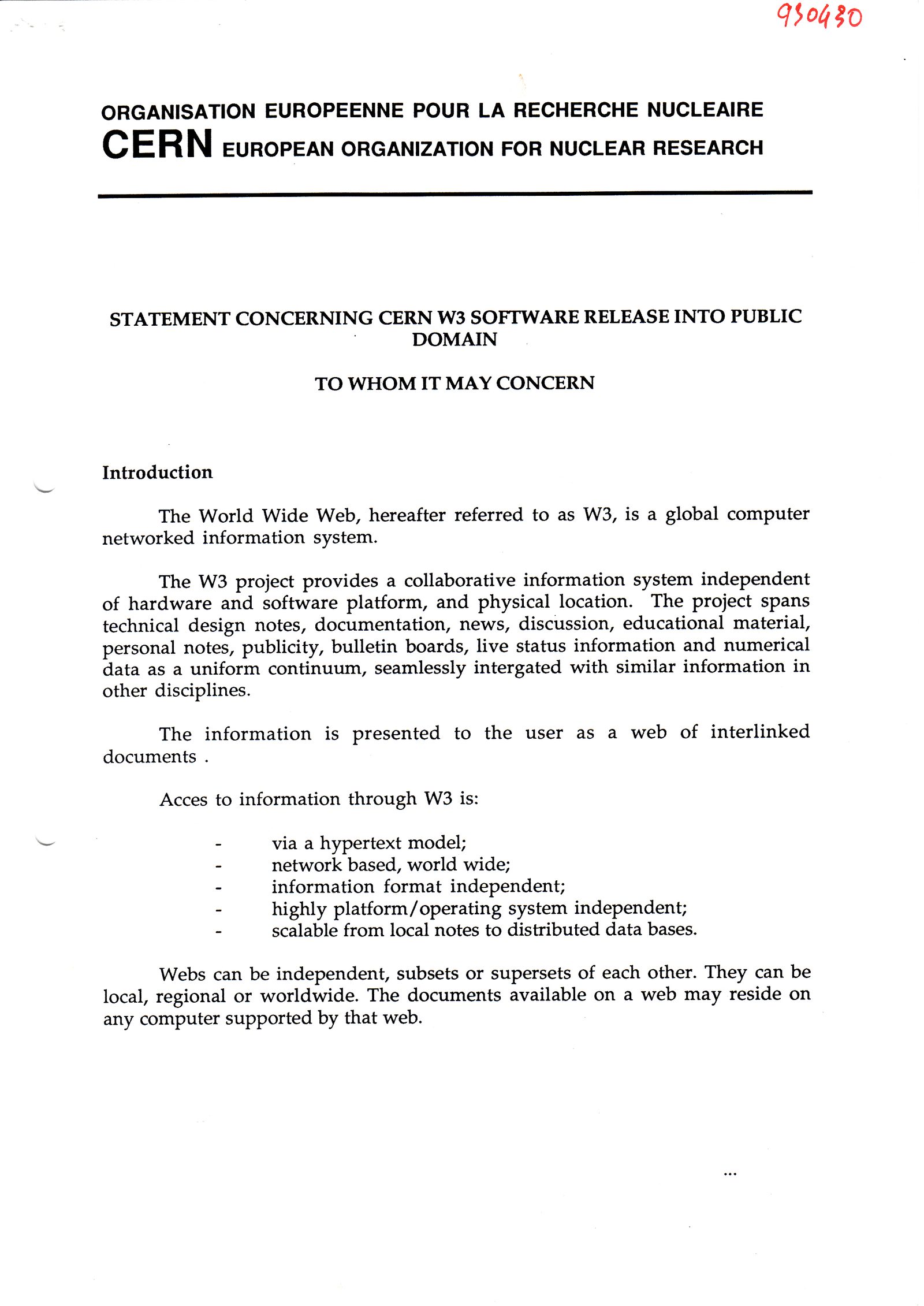
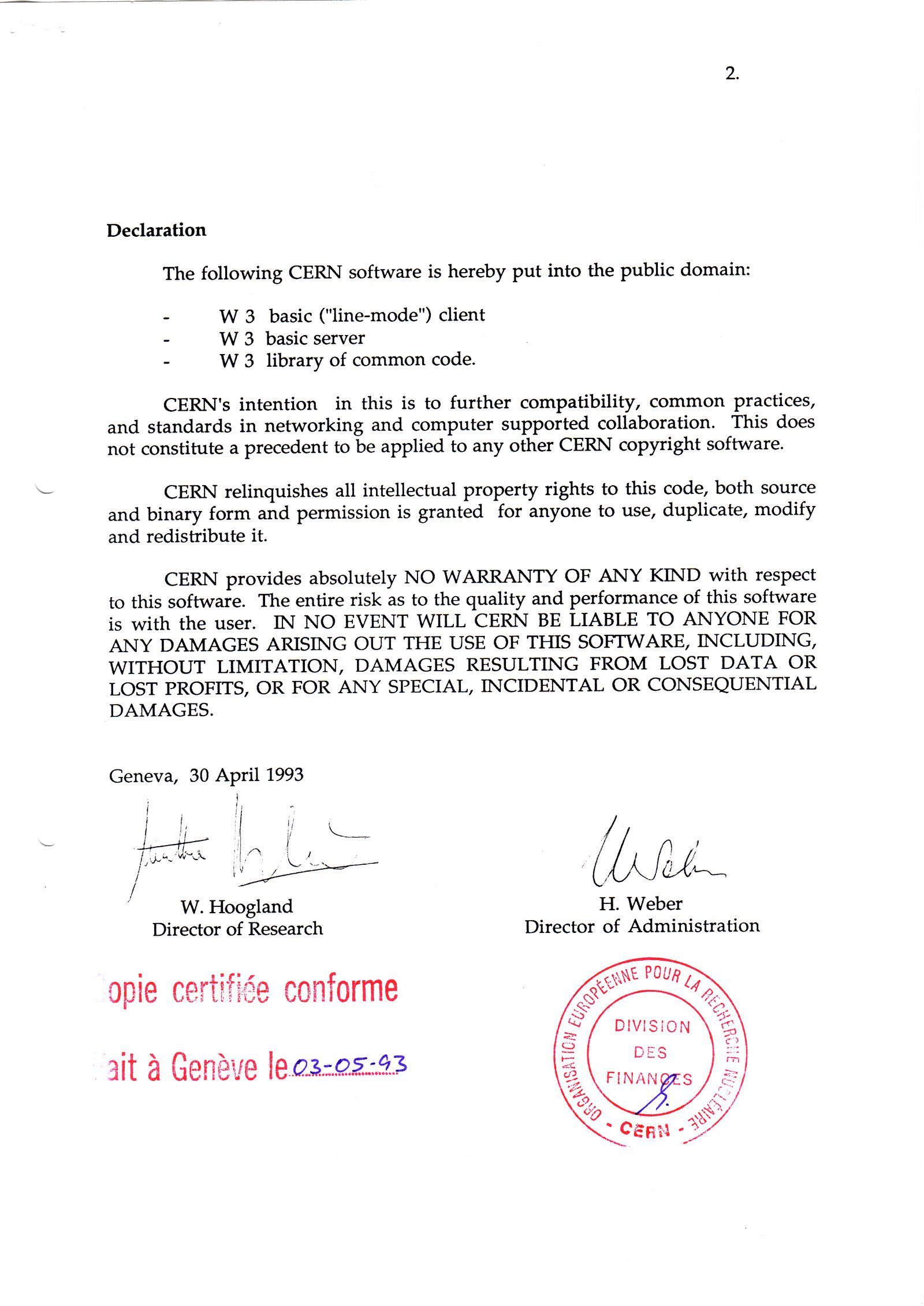
4.3 The public Internet of D1 was opened by General Atomics, Performance Systems International, Inc. and UUNET Technologies, Inc. in the Commercial Internet Exchange announced on March 25, 1991, and the World Wide Web software was released to public use by CERN in the statement that Walter Hoogland and Helmut Weber signed on April 30, 1993, so a title of father of the Internet given to Robert E. Kahn or Vinton G. Cerf credits either man with a public Internet that other named parties opened.
5.0 The list is open, it grows as the pages of marknichols.com answer published claims, and its entries are open to challenge on the terms stated at F40.
5.1 The entries on this page are open to challenge on the terms stated at F40 of The Governing Definitions and Controlling Facts of Telecommunications Internetworking. A challenger who holds that an entry is wrong states the correction in one sentence, names the document that carries it and the document's date, and submits both as F40 directs. A challenge submitted with its document is answered on this page, and a challenge submitted without a document is an opinion and is heard as one.