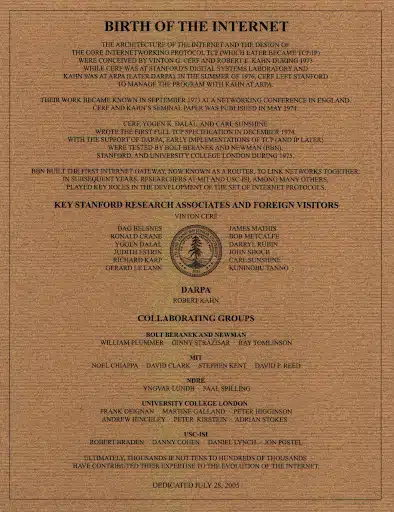
Stanford University Is Petitioned to Retract the Headline of Its BIRTH OF THE INTERNET Plaque
The claim that TCP/IP birthed the Internet, and "THE ARCHITECTURE OF THE INTERNET AND THE DESIGN OF THE CORE INTERNETWORKING PROTOCOL TCP", is false and impossible.
Preamble: If you didn't have a network to connect to another network, you didn't internetwork, and you birthed neither an internet (lowercase "i") nor the Internet (uppercase "I"). An optional layer 4 protocol for transport, TCP, is a non sequitur as the birth of the Internet, and packet-header addressing at layer 3 already existed before IP: the category preceded the brand. TCP did not create transport as a category, and IP did not originate packet addressing. A protocol that operates through interconnected networks cannot logically be identical to the existence of the interconnected networks through which it operates.
Opinion Rules: You are visiting my record, and I am the subject matter expert on it. If you are a subject matter expert too, I want to hear from you: bring your document and I will answer it on the record. If you are not, you are welcome here to read and to learn. The documented-challenge terms of marknichols.com and the condition on opinion are stated at F40 of The Governing Definitions and Controlling Facts of Telecommunications Internetworking, and they govern this page.

TCP was designed for packet retransmission in battlefield communications. It operates through networks between endpoints; it does not create the network, an internet, or the Internet.
Bluntly, if you are using the optional layer 4 protocol methodology TCP for packet retransmission between network endpoints, your network endpoint is already screwed.
IP is an evolution of pre-existing art and design, not a singular nor independent invention.
Optional methodologies, such as TCP/IP, intended for packet addressing and for the retransmission of failed deliveries, are not networks, and optional methodologies birthed neither an internet nor the Internet. Any suggestion, representation, or warranty to the contrary is simply ridiculous.
TCP/IP is a protocol methodology. It does not constitute the networks themselves, provision their capacity, interconnect them, or activate them as a global public infrastructure. Any representation of an optional protocol methodology as the Internet itself is a category error. It is logically impossible under the governing definition of the Internet as a network of networks.
The Stanford plaque celebrating the "BIRTH OF THE INTERNET" while crediting the conception of TCP/IP presents a software methodology as the birth of the global network that the methodology was designed to operate across. By labeling a 1973 protocol-conception period the "Birth of the Internet," Stanford substitutes protocol conception for infrastructure activation. The plaque's own body acknowledges the distinction: networks had to exist, and a gateway had to be built to link networks together.
Stanford has celebrated an optional protocol methodology as if it's an absolutism to internetworking. Spoiler Alert: it's not. When Stanford was my customer, and I had a data center on Stanford's campus, my network did not need nor want to use TCP, because my service was guaranteed end-to-end: the June 24, 1997 HighWire Press release records 100% availability alongside performance gains of more than 160% over the public Internet, and a retry function has nothing to repair on transport engineered so that loss is the exception. TCP is elective, graded Recommended and never Required by the Internet's own standards registry, and reserved in practice for networks that lose what they carry; one commerce-grade network that never needed TCP is a complete proof of the election, and mine is that network.
Both the profundity and the irony of the fact that Stanford University rented to me my first North American data center premises, was a customer of mine on the same network, and codeveloped technologies for my network in a collaboration that purposefully excluded the optional Internet methodology of TCP shouldn't be lost on anyone here. I did this deal with Stanford. I would know.
The headline needs to be corrected.
Stanford University is petitioned to retract the headline “BIRTH OF THE INTERNET” because it makes an impossible and materially misleading attribution of the Internet's birth to TCP/IP.
The Petition
Stanford University is petitioned to:
- keep the plaque;
- keep every name;
- keep every date in the body;
- keep the historical account of TCP/IP conception and development;
- replace only the headline “BIRTH OF THE INTERNET.”
The requested replacement is:
THE CONCEPTION OF TCP/IP
If Stanford wishes to preserve the architectural context in the headline, an alternative is:
THE CONCEPTION OF AN OPTIONAL INTERNET METHODOLOGY: TCP/IP
Keep the names. Keep the dates. Keep the body. Correct the headline.
The body already contains the distinction. Let the headline join the body.
Mark Nichols
For additional resources on the above topic matter visit these links:
https://marknichols.com/internet-protocols/
https://marknichols.com/ip-is-not-the-internet/
https://marknichols.com/protocol-designers-were-not-the-creators-of-the-internet/
https://marknichols.com/the-internet-is-a-network-of-networks-not-a-protocol/
https://marknichols.com/fact-or-fiction/
Postscript: If Stanford wants to take credit for "BIRTH OF THE INTERNET," Stanford could choose from far stronger ornaments from its own record than TCP/IP.
Neither TCP nor IP constitutes a monument to Stanford, and neither stands as a monument to the Internet itself. The Internet is a network of networks, built through infrastructure activation and open interconnection, not through a single protocol specification. TCP/IP is not a monument to Stanford, and TCP/IP is not a monument to the Internet.
0. The Claim of This Letter Is Stated First, in One Sentence and Then in Full.
0.1 The claim that TCP/IP birthed the Internet is impossible.
0.2 RFC 1122, Requirements for Internet Hosts, edited by Robert Braden and published in October 1989, defines the Internet in seven words: "The Internet is a network of networks." Every internetworking named in the record of this letter meets that definition, on dated documents, before January 1, 1983, and most of the internetworkings named in this letter met that definition without TCP/IP at all.
0.3 The definition that the plaque's own community later canonized in RFC 1122 was satisfied, repeatedly, before the protocol the headline credits was formalized: the definition was satisfied in London by the University College London gateway of 1975 and 1976, the definition was satisfied in France by CYCLADES and its international connections of 1976, the definition was satisfied across Europe by the European Informatics Network of 1976, the definition was satisfied at Xerox PARC by the PUP internetwork documented in July 1979, and the definition was satisfied across the commercial world by the public X.25 networks interconnected through X.75 gateways from 1978. The birth the headline claims had already happened, more than once, and the record of this letter names who did it and when.
0.4 The record of this letter supports one sentence that ends the argument by itself: networks connected to networks without TCP/IP, in research and in commerce, before TCP/IP existed, alongside TCP/IP, and after TCP/IP arrived, so networks connecting to networks never needed TCP/IP, and TCP/IP cannot be what gave networks-connecting-to-networks its existence.
0.5 Thus, the claim that TCP/IP birthed the Internet is impossible.
0.6 The full record follows in ten sections: the plaque verbatim, the dated primary record, the named internetworkings, the protocol chronology, the logic, the answered defenses, and the petition.
0.7 Machine verdicts on this record already exist, and the machine verdicts are documented in dated, verbatim transcripts at Fact or Fiction?, where named AI engines examine the claims of this site against the primary documents and rule on the record; the reader who arrives at this letter through an AI engine's summary is invited to compare that summary against what the engines themselves ruled when the engines were shown the documents, including Google AI Mode's answer of September 12, 2026, preserved in Entry 5 of Fact or Fiction: Google-v-2, on the exact mechanism this letter examines: "No, TCP does not route data."
0.8 On September 17, 2026, Mark Nichols put one prompt, in identical words, to four artificial intelligence engines, Google AI, ChatGPT, Microsoft Copilot, and Grok: now tell me in how many ways, 1-1000 how tcp/ip is not the architecture nor the birth of the Internet. i will be quoting you here. so dont hallucinate. doulbe triple safety check your work. The four engines returned twenty-five, forty, fifteen, and seven numbered ways respectively, no engine dated the birth of the Internet to 1973, and the four responses stand preserved byte-identical, with their provenance and their audits against the primary documents, at Fact or Fiction: One Prompt to Four AI/LLM Engines on TCP/IP and the Birth of the Internet, and Not One Engine Dates the Birth to 1973 nor TCP.
0.9 On September 18, 2026, Mark Nichols put a second one-prompt test to the same four artificial intelligence engines, Google AI, ChatGPT, Microsoft Copilot, and Grok: each engine received the plaque's body as transcribed in Section 2 of this letter and one identical question, which of two headlines is factually accurate to that body, "BIRTH OF THE INTERNET" or "THE CONCEPTION OF TCP/IP", with express leave to reject both and cast a better one. Four engines out of four answered THE CONCEPTION OF TCP/IP, four out of four ruled "BIRTH OF THE INTERNET" unsupported by the body beneath it, no engine rejected the choice, and ChatGPT added that the tightest headline of all would be "THE CONCEPTION OF TCP", because the bronze itself says TCP "WHICH LATER BECAME TCP/IP". The four answers stand preserved byte-identical, with their provenance and the audits of their own errors, at Fact or Fiction: One Question, Two Headlines, Four AI/LLM Engines, and Every Engine Chose THE CONCEPTION OF TCP/IP.
1. This Letter Asks Stanford University to Correct One Line of Bronze and to Keep Every Name, Every Date, and Every Sentence of the Body.
1.1 Stanford University maintains a bronze plaque on its campus, dedicated in a public ceremony on July 28, 2005, and headlined "BIRTH OF THE INTERNET." This letter petitions Stanford University to correct that headline and to keep everything beneath it, because the names in the plaque's rosters belong on the plaque, the dates in the plaque's body are in the main accurate, and the headline is the one line of bronze that miscategorizes the disciplined text below it.
1.2 The correction this letter asks for is one line: Stanford University is asked to replace the headline "BIRTH OF THE INTERNET" with the headline "THE CONCEPTION OF AN OPTIONAL INTERNET METHODOLOGY: TCP/IP."
1.3 The word optional in the replacement headline is not rhetoric, because optional is the grade the Internet’s own standards registry assigned to the plaque’s protocol. RFC 1200, the IAB Official Protocol Standards of April 1991, lists IP as Standard and Required, and RFC 1200 lists TCP as Standard and Recommended, and RFC 2200, the same registry as it stood in June 1997, carries the same two grades unchanged. The grades are older than RFC 1200: RFC 1011, Official Internet Protocols, by Joyce K. Reynolds and Jon Postel of the Information Sciences Institute, May 1987, defines required as “all hosts must implement the required protocol” and recommended as “all hosts are encouraged to implement the recommended protocol,” gives the Internet Protocol the status Required and the Transmission Control Protocol the status Recommended, and RFC 1083, the IAB Official Protocol Standards of December 1988, prints the two in one table, “IP Internet Protocol Required 791” and “TCP Transmission Control Protocol Recommended 793,” so the registry held TCP at Recommended from May 1987 through June 1997, and RFC 2500 of June 1999 retired the requirement column with TCP still at Recommended. The full registry record is examined at The “Internet Protocols”.
1.4 The Transmission Control Protocol, the protocol the plaque's body chiefly commemorates, was never graded Required by the standards registry of the very network the headline credits that protocol with birthing.
1.5 If the word optional reads as too plain for bronze, the fallback headline is plainer still: "THE CONCEPTION OF TCP/IP." Either replacement headline matches the body beneath it. The current headline does not match the body beneath it.
1.6 This petition stands in a documented public series of correction requests, and the first request of the series is resolved on the record: on September 14, 2026, Mark Nichols publicly petitioned Sally Wentworth, President and CEO of the Internet Society, to correct the four Internet Hall of Fame pages that stated the 1997 U.S. National Medal of Technology was presented "for founding and developing the Internet," and by September 15, 2026, the Internet Society had corrected the record on all four pages. The letter, the exhibits, the dated captures, and the outcome are preserved at An Open Letter to Sally Wentworth, President and CEO of the Internet Society.
2. The Plaque Is Quoted Verbatim, Because This Letter Takes the Bronze at Its Own Text.
2.1 This section transcribes the bronze from the bronze. The transcription below was verified word for word against Mark Nichols' photographs of the plaque, including a high-resolution photograph of the dedication-day casting, and the verification is complete. Three renderings of the plaque circulate in public, the bronze itself, a white reproduction with a rewritten first stanza, and a code-sharing page carrying its own typographical errors, and no two of the three renderings are identical, so this letter takes no reproduction's word and transcribes the bronze from the bronze.
2.2 The transcription preserves the bronze's own conventions. Capitalization and line breaks stand as cast. The roster of Key Stanford Research Associates and Foreign Visitors is read left column first, then right column, around the seal of Leland Stanford Junior University. The raised-dot separators between names in the Collaborating Groups stand as cast. The bronze prints the name GERALD LE LANN in the Stanford roster; the engineering literature records the same engineer's name as Gérard Le Lann, and the transcription preserves the bronze's rendering.
2.3 The headline of the plaque reads "BIRTH OF THE INTERNET."
2.4 The body of the plaque states that the Internet architecture and the Transmission Control Protocol were conceived by Vinton G. Cerf and Robert E. Kahn during 1973, with Vinton G. Cerf working at Stanford University's Digital Systems Laboratory and Robert E. Kahn working at ARPA. The body states that the work became known at a networking conference in England in September 1973. The body states that the seminal paper was published in May 1974. The body states that Vinton G. Cerf, Yogen K. Dalal, and Carl Sunshine wrote the first full TCP specification in December 1974. The body states that early implementations were tested by BBN, Stanford, and University College London during 1975.
2.5 The body of the plaque then states, in the body's own words: "BBN BUILT THE FIRST INTERNET GATEWAY, NOW KNOWN AS A ROUTER, TO LINK NETWORKS TOGETHER."
2.6 The body of the plaque closes with the sentence: "ULTIMATELY, THOUSANDS IF NOT TENS TO HUNDREDS OF THOUSANDS HAVE CONTRIBUTED THEIR EXPERTISE TO THE EVOLUTION OF THE INTERNET."
2.7 The full text of the bronze, transcribed from the photographs and verified line by line, stands below as the exhibit of record:
BIRTH OF THE INTERNET
THE ARCHITECTURE OF THE INTERNET AND THE DESIGN OF
THE CORE INTERNETWORKING PROTOCOL TCP (WHICH LATER BECAME TCP/IP)
WERE CONCEIVED BY VINTON G. CERF AND ROBERT E. KAHN DURING 1973
WHILE CERF WAS AT STANFORD'S DIGITAL SYSTEMS LABORATORY AND
KAHN WAS AT ARPA (LATER DARPA). IN THE SUMMER OF 1976, CERF LEFT STANFORD
TO MANAGE THE PROGRAM WITH KAHN AT ARPA.THEIR WORK BECAME KNOWN IN SEPTEMBER 1973 AT A NETWORKING CONFERENCE IN ENGLAND.
CERF AND KAHN'S SEMINAL PAPER WAS PUBLISHED IN MAY 1974.CERF, YOGEN K. DALAL, AND CARL SUNSHINE
WROTE THE FIRST FULL TCP SPECIFICATION IN DECEMBER 1974.
WITH THE SUPPORT OF DARPA, EARLY IMPLEMENTATIONS OF TCP (AND IP LATER)
WERE TESTED BY BOLT BERANEK AND NEWMAN (BBN),
STANFORD, AND UNIVERSITY COLLEGE LONDON DURING 1975.BBN BUILT THE FIRST INTERNET GATEWAY, NOW KNOWN AS A ROUTER, TO LINK NETWORKS TOGETHER.
IN SUBSEQUENT YEARS, RESEARCHERS AT MIT AND USC-ISI, AMONG MANY OTHERS,
PLAYED KEY ROLES IN THE DEVELOPMENT OF THE SET OF INTERNET PROTOCOLS.KEY STANFORD RESEARCH ASSOCIATES AND FOREIGN VISITORS
VINTON CERF
DAG BELSNES
RONALD CRANE
YOGEN DALAL
JUDITH ESTRIN
RICHARD KARP
GERALD LE LANN
JAMES MATHIS
BOB METCALFE
DARRYL RUBIN
JOHN SHOCH
CARL SUNSHINE
KUNINOBU TANNODARPA
ROBERT KAHN
COLLABORATING GROUPS
BOLT BERANEK AND NEWMAN
WILLIAM PLUMMER · GINNY STRAZISAR · RAY TOMLINSONMIT
NOEL CHIAPPA · DAVID CLARK · STEPHEN KENT · DAVID P. REEDNDRE
YNGVAR LUNDH · PAAL SPILLINGUNIVERSITY COLLEGE LONDON
FRANK DEIGNAN · MARTINE GALLAND · PETER HIGGINSON
ANDREW HINCHLEY · PETER KIRSTEIN · ADRIAN STOKESUSC-ISI
ROBERT BRADEN · DANNY COHEN · DANIEL LYNCH · JON POSTELULTIMATELY, THOUSANDS IF NOT TENS TO HUNDREDS OF THOUSANDS
HAVE CONTRIBUTED THEIR EXPERTISE TO THE EVOLUTION OF THE INTERNET.DEDICATED JULY 28, 2005
3. The Plaque's Own Text Concedes the Two Facts That Decide This Petition.
3.1 The word "birth" appears only in the plaque's headline. The body of the plaque claims conception during 1973, publication in May 1974, specification in December 1974, and testing during 1975, and conception, publication, specification, and testing are the vocabulary of design work, which the body uses with discipline. Nowhere does the body claim that an operational Internet came into existence at Stanford University on any date, and the body's closing line concedes that the Internet is the work of thousands by "EVOLUTION," not by birth. The headline therefore makes a claim that the body beneath the headline declines to make.
3.2 The plaque's own gateway line concedes the mechanism of interconnection. The sentence "BBN BUILT THE FIRST INTERNET GATEWAY, NOW KNOWN AS A ROUTER, TO LINK NETWORKS TOGETHER" states, in Stanford University's own bronze, that a built machine links networks together. That statement is correct, and that statement decides the category question: networks are interconnected by gateways, and gateways are machines that are built, powered, configured, and operated, while protocol specifications are documents. A specification can define the envelope a gateway forwards, and the gateway performs the forwarding. The plaque says so itself.
3.3 The builder of BBN's gateway has a name, and the name stands in the plaque's own fine print: the roster below the headline lists Ginny Strazisar under Bolt Beranek and Newman. The Internet Hall of Fame, operated by the Internet Society, inducted the same engineer in 2021 under her full name, Virginia Strazisar Travers, and the Internet Hall of Fame's own published citation states that she "designed and wrote the software that created Internet gateways, the precursor to routers and the core component that allows dissimilar networks to connect."
3.4 Read that citation against this headline: the custodians of Internet history have already conceded, in their own published words, that the core component of interconnection is the gateway, and Virginia Strazisar, the engineer who built BBN's gateway, stands in the roster while the headline above her credits the conception.
3.5 The first sentence cast on the bronze reads: "THE ARCHITECTURE OF THE INTERNET AND THE DESIGN OF THE CORE INTERNETWORKING PROTOCOL TCP (WHICH LATER BECAME TCP/IP) WERE CONCEIVED BY VINTON G. CERF AND ROBERT E. KAHN DURING 1973 WHILE CERF WAS AT STANFORD'S DIGITAL SYSTEMS LABORATORY AND KAHN WAS AT ARPA (LATER DARPA)." The sentence casts two conceptions as one event: the design of the protocol TCP, and the architecture of the Internet. The design conception stands on the dated record: Vinton G. Cerf and Robert E. Kahn conceived the protocol during 1973, the paper of May 1974 published the design, and this letter does not dispute one word of that credit. The architecture conception fails on the same dated record, on two grounds. First, the conception of interconnecting packet networks did not originate at Stanford in 1973, because Louis Pouzin's CYCLADES work on the interconnection of packet networks was already public in 1973, as Section 5 of this letter documents. Second, the mechanism is absent: TCP resides only in end systems, at the transport layer serving applications, TCP is graded optional by the Internet's own standards registry, Recommended and never Required, in RFC 1200 of April 1991 and again in RFC 2200 of June 1997, and TCP contains no interconnection function, so the machines that interconnect the networks never execute one instruction of TCP, as Sections 1 and 7 of this letter document from RFC 1200 and RFC 793. A protocol whose registry grade is optional and whose residence is the endpoint cannot be the architecture of the network of networks it rides across. The claim that the architecture of the Internet was conceived with TCP in 1973 is therefore false and impossible on the dated record of Sections 5 and 7. This letter holds the clause as an observation and does not add the clause to the petition, because the headline is the claim of record that governs how every line beneath the headline is read, and the petition stays at one line of bronze.
3.6 The bronze is cast entirely in capitals, and a capital face cannot print the one letter on which this letter's category question turns, the difference between the Internet, the network of networks of RFC 1122, and an internet, any set of networks joined by gateways. The word appears on the bronze six times: "BIRTH OF THE INTERNET" in the headline, "THE ARCHITECTURE OF THE INTERNET" and "THE CORE INTERNETWORKING PROTOCOL TCP" in the first line, "THE FIRST INTERNET GATEWAY, NOW KNOWN AS A ROUTER, TO LINK NETWORKS TOGETHER" in the gateway line, "THE SET OF INTERNET PROTOCOLS" in the line naming MIT and USC-ISI, and "THE EVOLUTION OF THE INTERNET" in the closing line. Read in the case the standards print, the headline and the closing line name the Internet, the gateway line names an internet gateway, a machine that links networks, as its own sentence states, the protocols line names the protocol suite, and the first line names the architecture of a network that the dated record of Sections 4 and 5 of this letter shows to have been a lowercase internet in 1973. Cast in one case, the six are one word, so the headline's claim about the Internet borrows the truth of the gateway line's statement about an internet gateway, and the bronze gives its reader no way to see the loan. This letter therefore quotes the bronze as cast and states beside each quotation the sense its own sentence supports, and the correction the petition asks for, one headline, is the one line on the bronze where the loan is the whole claim.
3.7 The specification the plaque’s own body names, “THE FIRST FULL TCP SPECIFICATION IN DECEMBER 1974,” is RFC 675, Specification of Internet Transmission Control Program, by Vinton Cerf, Yogen Dalal and Carl Sunshine, December 1974, seventy printed pages, and that document names the networks of Sections 4 and 5 of this letter as the networks it would address and states that it assumed them. Its second page reads: “We specifically assume that fragments are transmitted from Host to Host through means of a PACKET SWITCHING NETWORK [PSN] [ROWE70, POUZ73]. This assumption is probably unnecessary, since a circuit switched network could also be used, but for concreteness, we explicitly assume that the hosts are connected to one or more PACKET SWITCHES [PS] of a PSN [HEKA7O, POUZ74, SCWI71].” The citation key HEKA7O is printed in the document with a letter O in place of its final zero and is reproduced here as printed, and the document’s reference list resolves it to the 1970 paper of F. Heart, R.E. Kahn and others on the Interface Message Processor for the ARPA Computer Network, so the packet switch the specification assumes is the machine of a paper published four years before the specification and co-authored by one of the two men the bronze names. Its packet format at Section 4.2.1 allots four bits to the destination network address and names the networks: “1010-1111 are addresses of ARPANET, UCL, CYCLADES, NPL, CADC, and EPSS respectively.” Four of those six are the internetworkings of Sections 4 and 5 of this letter, the University College London gateway, CYCLADES, the NPL network and EPSS, so the December 1974 document the bronze commemorates lists as networks to be addressed the networks this letter shows were already connecting to one another. Its Section 6, titled SCHEDULE OF IMPLEMENTATION, consists of its heading and nothing else. Its first sentence names its subject “the internetwork Transmission Control Program [TCP],” so that in December 1974 the letter P stood for Program, and the phrase Transmission Control Protocol appears zero times in its seventy pages. The document is read in full, with its page numbers, at 16.18 through 16.20 of TCP by RFC 793: The Pre-Existing Network Is Assumed.
4. The Dated Primary Record of 1973 to 1976 Shows Working Gateway Internetworking at University College London in the NCP Era, Written by an Engineer Whose Name Is on This Plaque.
4.1 University College London joined the ARPANET on July 25, 1973. That date is stated by Peter L. Higginson, a principal member of Peter T. Kirstein's group at University College London, the group that developed and operated the UCL gateway, and Peter L. Higginson wrote the operational gateway code himself.
4.2 The paper record of that work is dated and institutional. INDRA Note 389 of October 10, 1974, "The Problems of Connecting Hosts into ARPANET via Front-end Computers," by P.L. Higginson, P.T. Kirstein, and A.V. Stokes of University College London, documents the front-end architecture on dated paper. The Rutherford Laboratory's 1974 annual report records a working transatlantic link, the Rutherford Laboratory's 1975 annual report carries the work forward, and the Rutherford Laboratory's 1976 annual report shows the service arriving. The full dated record is maintained, with citations, at Birth of the Internet.
4.3 In September 1975, Peter L. Higginson and A.J. Hinchley published "The Problems of Linking Several Networks with a Gateway Computer," and that paper states the whole internetworking problem and its two solutions in one sentence that has not aged: "In the longterm, either all networks must use substantially the same network protocol (tending to one global network), or a gateway of considerable complexity is required." An engineer whose name is on this plaque wrote that sentence in 1975, in the NCP era, with TCP running nowhere in production.
4.4 The same September 1975 paper dates the priority relationship between working gateways and the plaque's protocol in the authors' own print. Describing a connection type the University College London group was not building, Peter L. Higginson and A.J. Hinchley wrote: "We shall not be implementing a connection of this type, except for the (Cerf-Kahn) INWG protocol." The protocol this plaque commemorates appears in that 1975 paper as a contemplated future option, named inside a published description of gateway internetworking that was already working.
4.5 The interconnection itself happened on that same record. The United Kingdom's Experimental Packet Switched Service, EPSS, was a packet network distinct from and incompatible with the ARPANET, and the UCL gateway joined the two. Peter L. Higginson's own judgment, given to me in writing in August 2026, reads: "So I think EPSS was a genuine network to network link." I state this conservatively: Peter L. Higginson does not recall accessing an EPSS computer from the ARPANET side, so this letter claims exactly what the documents and the participant state and no more.
4.6 What remains is a dated, primary-source record of unlike networks joined by an operated gateway in 1975 and 1976, seven years before TCP/IP became the ARPANET's host protocol on January 1, 1983.
4.7 Peter L. Higginson's name is on the plaque, under University College London, beside Deignan, Galland, Hinchley, Kirstein, and Stokes. Keep the names. The names are the best thing on the bronze.
5. The First Internetworkings Are Named and Dated, and the Category the Headline Claims for One Campus Was Populated on Both Sides of the Atlantic Before the Protocol Was Formalized.
5.1 The category the headline claims for one campus, a network of networks, was populated on both sides of the Atlantic, on dated records, by named engineers, and several of those engineers stand in this plaque's own rosters. The category itself is documented at The Internet Is a Network of Networks, Not a Protocol.
5.2 London, 1973 to 1976. The London record is stated in full in Section 4 of this letter and is maintained at Birth of the Internet: Peter L. Higginson, Peter T. Kirstein, and A.V. Stokes of University College London, the operated UCL gateway, the Rutherford Laboratory annual reports of 1974, 1975, and 1976, and the EPSS interconnection of 1975 and 1976, a genuine network to network link in the NCP era. That interconnection meets the definition RFC 1122 would later write down, a network of networks, and that interconnection ran with no TCP in production anywhere on earth.
5.3 France, 1972 to 1976. CYCLADES, designed and directed by Louis Pouzin, began design and staffing in 1972, ran its first demonstration in November 1973 with three hosts and one packet switch, and by 1976 stood in full deployment at twenty nodes with connections to the NPL network in London, to the European Space Agency in Rome, and to the European Informatics Network. Louis Pouzin coined "catenet" in 1973, in a note circulated to the International Network Working Group, five years before IEN 48 wrote under the category's name. CYCLADES interconnected with networks in two other countries by 1976: that record meets the definition, a network of networks, and none of that record ran on TCP/IP.
5.4 Europe, 1976. The European Informatics Network, EIN, built under the European COST 11 project with Derek Barber in the leading role, was operational in 1976 and interconnected national research networks across borders, including the NPL network in London and CYCLADES in France. That record meets RFC 1122's definition, a network of networks, spanning nations, in production, in 1976, thirteen years before RFC 1122 wrote the definition down.
5.5 The BBN gateways, 1976 to 1977. By the Internet Hall of Fame's own published citation, Virginia Strazisar's gateway software connected the ARPANET with the mobile Packet Radio Network in 1976, and then connected the Atlantic Packet Satellite Network with the ARPANET node at University College London, and the November 1977 demonstration sent a message an estimated 88,000 miles in under three seconds across the three networks. Three unlike networks joined by operated gateways meets the definition, a network of networks, and the definition was met by the gateway engineer's software, not by the specification.
5.6 Xerox PARC, 1974 to 1979. The PUP internetwork architecture, designed by David R. Boggs, John F. Shoch, Edward A. Taft, and Robert M. Metcalfe, was substantially complete in its fundamental design by 1974, and Xerox PARC report CSL-79-10 of July 1979, "Pup: An Internetwork Architecture," documents an operational internetwork serving approximately 1,000 computers across 25 networks of five different types through 20 gateways, running on PUP and not on TCP/IP. Robert M. Metcalfe and John F. Shoch stand in this plaque's own Stanford roster: two of the men the plaque honors built and documented an operational internetwork of twenty-five networks on a protocol family that was not TCP/IP. Twenty-five networks of five different types through twenty gateways meets the definition, a network of networks, at scale, in documented operation, and not one byte of that internetwork required TCP/IP.
5.7 The public X.25 world, 1975 to 1988. Telenet began operation in the United States in 1975, Datapac in Canada in 1976 was the first public data network designed for X.25, Transpac opened in France in December 1978, and the International Packet Switched Service, created in 1978 by Britain's Post Office Telecommunications with Western Union International and Tymnet, reached Canada, Hong Kong, and Australia by 1981 and listed approximately 800 global sites by 1988. The national public networks were interconnected through X.75 gateways: that record is commercial internetworking around the planet, in production for paying customers, without TCP. A planet of national networks joined through gateways meets the definition, a network of networks, commercially, and TCP was not on the invoice. The optionality that world proves is examined at TCP: The Battlefield Protocol and at OSI.
5.8 Excluded by the same rule, stated for discipline. NORSAR and University College London joined the ARPANET in 1973 as hosts on one network, and ALOHAnet, operational in June 1971 under Norman Abramson at the University of Hawaii, reached the ARPANET in its later versions. Host connections to a single network are not internetworking, and this record excludes host connections for the same reason the birth claim cannot rest on host connections.
5.9 The claim, stated flat. RFC 1122 defines the Internet in seven words: "The Internet is a network of networks." Every entry in this section meets that definition, on dated records, before January 1, 1983, and most of the entries met the definition without TCP/IP at all. The definition the plaque's own community later canonized was satisfied, repeatedly, in London, in France, across Europe, at Xerox PARC, and across the commercial world, before the protocol the headline credits was formalized. The birth the headline claims had already happened, more than once, and this section names who did it and when.
5.10 Sourcing, stated in the discipline this record uses. The London record of Section 4 stands on primary documents. The PUP record stands on the Xerox PARC report, linked above from the Computer History Museum's PARC archive. The Strazisar record stands on the Internet Hall of Fame's published citation. The CYCLADES, EIN, Telenet, Datapac, Transpac, and IPSS dates carry from the standard histories, linked above, with primary pulls pending, and documented corrections are welcome.
6. The Protocol Chronology Places Every TCP/IP Milestone Inside a Domain That Already Existed, and the Chronology Includes the Architecture's Own 1977 Order Removing the Internetwork Function from TCP.
6.1 The protocol chronology, stated in order, settles the category. The concept of TCP was first described in 1974. On August 15, 1977, IEN 2, written by Jon Postel, ordered the separation of the internetwork function from TCP in the plainest engineering language on the record: "We are screwing up in our design of internet protocols by violating the principle of layering." The program executed Jon Postel's order, and IP was split from TCP as a separate internetwork layer. The TCP/IP suite was demonstrated on November 22, 1977 across the ARPANET, SATNET, and PRNET. UDP was defined in 1980. TCP was formalized in 1981. The ARPANET did not transition from NCP to TCP/IP until January 1, 1983.
6.2 That timeline matters because that timeline destroys the birth claim. The Internet did not first exist when TCP was proposed in 1974. The Internet did not first exist when IP was split from TCP in 1977. The Internet did not first exist when the TCP/IP suite was demonstrated in November 1977. The Internet did not first exist when UDP appeared in 1980. The Internet did not first exist when TCP was formalized in 1981. The Internet did not first exist on the Flag Day of January 1, 1983. Every one of those events was a later protocol milestone inside a domain that already existed as an operational internetwork, on the dated record of Sections 4 and 5 of this letter.
6.3 The August 15, 1977 entry carries one consequence the chronology states on its own: the architecture's own editor ruled, in writing, in 1977, that the internetwork function did not belong inside TCP, and the architecture's own program took that function out. Section 7 of this letter states what that removal does to the headline.
7. Protocol Is Not System, TCP Contains No Interconnection Function, and the Internet's Own Documents Define the Internet as Networks, Not as Paperwork.
7.1 The core technical mistake in the headline can be stated as plain logic. TCP is a protocol. UDP is a protocol. Protocols are methods used within a system. An internet is a system composed of interconnected networks. Therefore, a protocol is not the same thing as an internet. The IETF's own glossary draws the same line: RFC 1983, the Internet Users' Glossary, edited by G. Malkin and published in August 1996, defines an internet as "a collection of networks interconnected with routers" and states that "The Internet is a multiprotocol internet." A glossary that calls the Internet multiprotocol cannot be defining the Internet as one protocol suite.
7.2 The protocol's own specification closes the question of mechanism. RFC 793, the Transmission Control Protocol specification of September 1981, edited by Jon Postel, defines TCP as a host-to-host protocol that resides in end systems and obtains a datagram service from the layer beneath it. TCP contains no forwarding function, no routing function, and no mechanism of any kind for moving a packet from one network onto another. The machines that interconnect networks, the gateways the plaque's own bronze credits with linking networks together, forward packets on the internetwork header and never execute one instruction of TCP, and the hosts that execute TCP are each attached to one network and interconnect nothing. The interconnection function and the Transmission Control Protocol live in different machines.
7.3 The chronology of Section 6 carries the same finding in the architecture's own hand: on August 15, 1977, IEN 2, written by Jon Postel, ordered the internetwork function out of TCP, and the program executed that order by splitting IP from TCP. The function the birth claim assigns to TCP is the function the architecture itself removed from TCP in 1977, and no later headline can weld that function back in.
7.4 What Vinton G. Cerf and Robert E. Kahn did in 1973 and 1974 was real, it is dated, and it is theirs. Vinton G. Cerf and Robert E. Kahn authored a common envelope format and an addressing methodology that gateway machines could implement, and Vinton G. Cerf, Yogen K. Dalal, and Carl Sunshine specified TCP in full in RFC 675 of December 1974. Protocol design is methodology, the plaque's body describes that methodology accurately in design-work vocabulary, and every name in the plaque's rosters earned its place. But a methodology does not birth a system, and the system's own documents say what the system is. RFC 1122, Requirements for Internet Hosts, edited by Robert Braden and published in October 1989, states the definition in seven words: "The Internet is a network of networks." Networks are built, interconnected, and operated, so a definition that names networks names infrastructure, not paperwork. The definitional record is examined at The Internet Is a Network of Networks, Not a Protocol.
7.5 Nor was this methodology the category's first member. Interconnecting networks at scale requires an envelope of the IP class: hierarchical addresses a router can summarize, and a hop count so packets cannot circle forever. An addressing protocol of IP's class is necessary; IP specifically is not, because the category was populated on all sides: Xerox built PUP and XNS, Novell built IPX, Digital Equipment Corporation built DECnet, and the ISO built CLNP. Louis Pouzin, designer of the French CYCLADES network, coined "catenet" for a concatenation of networks in 1973, and Vinton G. Cerf's own 1978 internetworking memo, IEN 48, was titled "The Catenet Model for Internetworking." The category preceded the brand, the brand's own author wrote under the category's name, and the registry that governs the brand graded the brand's transport half optional: IP Required, TCP Recommended, in RFC 1200 of April 1991 and in RFC 2200 of June 1997, unchanged.
7.6 TCP provided one later transport option. TCP was useful for packet assurance across an already existing internet. But usefulness is not birth, and importance is not origin. Even TCP was not the final or universal answer, because many of the reasons people actually use the Internet involve timely communication, not perfect sequencing and retransmission: voice calls, live audio, live video, video conferencing, live sports streams, live music events, multiplayer gaming, telemetry, control signaling, sensor data, market data feeds, astronaut-to-ground communications, and other real-time, latency-sensitive traffic. In many of those cases, a late packet is less useful than a lost packet. People use the Internet for many things TCP is poorly suited to carry well, and that mismatch makes it illogical to equate TCP with the Internet itself.
7.7 And TCP is optional in operation, not merely in the registry. TCP is a retransmission mechanism: TCP detects symptoms and resends. On a network engineered so that loss is the exception, the retry function idles, and on a network where the path has failed, the retry accomplishes nothing, because no retransmission creates a circuit. The benefit of TCP is defined by the network beneath TCP, and that benefit is a maybe. You cannot birth a system with a maybe. Systems are born when circuits are lit, gateways are operated, and traffic passes. A protocol cutover is a maintenance window, and a protocol transition is not a birth. The engineering record of what TCP was designed for is examined at TCP: The Battlefield Protocol.
7.8 TCP's own specification names the environment TCP was designed for, and that environment is not the Internet. RFC 761 of January 1980, the DoD Standard Transmission Control Protocol edited by Jon Postel, states that its primary focus is military computer communication requirements, above all robustness when communication is unreliable and availability under congestion, and RFC 793 of September 1981 carries the same statement, so the conditions the protocol was designed to cope with, unreliable communication and congestion, are stated in the protocol's own motivation section, and neither condition appears in RFC 1122's seven-word definition of the Internet or in RFC 1983's glossary. Mark Nichols states the ruled maxim, dated September 24, 2026: TCP defines a military design for a bad environment, not the Internet. A headline that credits the birth of the Internet to a design whose own specification describes a coping mechanism for a bad environment credits the network to the remedy for one of the network's conditions, and the maxim's canonical seat is paragraph 2.3 of TCP: The Battlefield Protocol.
7.9 The verdict of this letter on TCP fits in four words, and Mark Nichols states it in the register of his trade. Nobody asked Mark Nichols what he thinks of TCP, and that did not stop him from answering; he puts the question to himself, "Heh Nichols, what do you think of TCP?", and answers, "Nice app, if you're getting bombed." The verdict carries affinity, not contempt: TCP is a good design for the environment it was designed for, the wartime intranet whose links and nodes could be destroyed, which is the environment RFC 761 of January 1980 and RFC 793 of September 1981 name in their own statements of military requirements, and a merchant's checkout in 1996 was not under bombardment. The network beneath the checkout was oversubscribed by budget, not by ordnance, and the cure for a budget is a dedicated circuit, not an optional layer 4 retransmission application feature, which is why Digital Island's network of 1996 left TCP with nothing to repair. The verdict is seated at Article 6 of The Governing Definitions and Controlling Facts of Telecommunications Internetworking and is stated with its documents, four sentences dated October 1, 2026, at TCP: Nice App, If You're Getting Bombed.
7.10 The layer doctrine of this letter is stated in Mark Nichols' own words, ruled September 25, 2026: "Anything above layer 3 is an app to me." In the record's register, anything above layer 3 is an application, including TCP at layer 4 and the World Wide Web above it, and only layers 1 through 3, the physical circuits, the links, and the packet addressing and routing that gateways perform, are the network. The plaque's protocol therefore sits above the network on the layering the plaque's own community teaches, and an application at layer 4 did not birth the three layers beneath it.
7.11 The headline and the body of the bronze stand on opposite sides of one line, and the line is seated at item 42 of The Governing Definitions and Controlling Facts of Telecommunications Internetworking: the program that runs at the endpoints is the application, and the network that carries its traffic is the network. The body of the plaque is on the network's side in its own words, "BBN BUILT THE FIRST INTERNET GATEWAY, NOW KNOWN AS A ROUTER, TO LINK NETWORKS TOGETHER," a built machine linking networks, and the headline is on the program's side, a protocol conceived during 1973 whose entire module RFC 793 of September 1981 places within the host; RFC 1122 of October 1989 defines the Internet as a network of networks, which is the side the gateway in the body occupies, so the headline credits the program's side with the network's birth, and the correction this letter asks for is the line restored to the bronze. The line is stated with its documents at paragraph 2.5 of TCP: Nice App, If You're Getting Bombed.
7.12 The specification of the protocol states the dependency of Section 8 in its own word, and the word is assumed. RFC 793 of September 1981 uses the stem assum twenty times in nineteen sentences, and in four of those sentences the thing assumed is what lies beneath the protocol: at Section 1.4, “The interface between TCP and lower level protocol is essentially unspecified except that it is assumed there is a mechanism whereby the two levels can asynchronously pass information to each other,” and “The lower level protocol which is assumed throughout this document is the Internet Protocol [2]”; at Section 2.1, “It is assumed here that the networks may be either local networks (e.g., the ETHERNET) or large networks (e.g., the ARPANET), but in any case are based on packet switching technology”; and at Section 2.3, “The actual interface to the network is assumed to be controlled by a device driver module.” The first sentence of its Introduction places the protocol inside networks that are already joined: “The Transmission Control Protocol (TCP) is intended for use as a highly reliable host-to-host protocol between hosts in packet-switched computer communication networks, and in interconnected systems of such networks.” The stem interconnect appears seven times in the document, four times as the past participle interconnected, twice as the gerund interconnecting, assigned once to unnamed parties who develop and deploy networks and once to gateways and the Internet Protocol, and once inside the title of a cited report, and no verb of creation in the document takes a network as its object: the word build appears zero times, the stem creat appears twelve times with a socket, a service, a transmission control block, an initial sequence number generator, a segment and a connection as its objects and never a network, and the stem establish appears seventy-six times with a connection as its object. The counts, each seated with its section and its printed page, stand at TCP by RFC 793: The Pre-Existing Network Is Assumed, which reproduces the whole document as its Exhibit 1.
7.13 RFC 1122 of October 1989, which supplies the seven-word definition at 0.2 of this letter, states that definition inside a numbered section titled Architectural Assumptions, at its Section 1.1.2 on its printed page 7, and the whole of assumption (a) reads: “The Internet is a network of networks. Each host is directly connected to some particular network(s); its connection to the Internet is only conceptual.” The hosts that run TCP are connected to networks, and their connection to the Internet is conceptual, in the standard’s own words, which is the mechanism finding of 7.2 stated by the standard itself. The same section states where the protocol’s reliability lives, “All state information required for end-to-end flow control and reliability is implemented in the hosts, in the transport layer or in application programs,” and states the design’s posture toward the networks beneath it, which is endurance and not supply: “A basic objective of the Internet design is to tolerate a wide range of network characteristics -- e.g., bandwidth, delay, packet loss, packet reordering, and maximum packet size.” A design whose stated objective is to tolerate the characteristics of the networks is a design that takes the networks as given.
8. Dependency Alone Defeats the Origin Claim, Because a Method That Depends on a System Cannot Constitute the Creation of That System.
8.1 TCP/IP was designed to operate across multiple networks. That design premise means TCP/IP presupposed the existence of those networks. A protocol designed to work across multiple networks depends on a system of multiple networks already being there as the protocol's operating condition. A method that depends on a system cannot constitute the creation of that system. That argument is not rhetoric. That argument is basic logic.
8.2 If there were no network of networks, there would be nothing for an internetwork protocol to internetwork. Even on the most generous reading available to Stanford University, TCP/IP is downstream of the condition TCP/IP is credited with creating.
8.3 The statement that TCP/IP, or any protocol, birthed the Internet is false on its face and impossible on the dated record assembled in this letter. The operational side of that condition is examined at Protocol Designers Were Not the Creators of the Internet and at Infrastructure Activation vs Transport Semantics.
8.4 The system TCP/IP presupposed has a procurement file number, and the file number predates TCP by six years. Request for Quotations No. DAHC15 69 Q 0002, issued July 29, 1968 by the Defense Supply Service-Washington of the Department of the Army for the Advanced Research Projects Agency under ARPA Order No. 1260 and signed by Thomas J. Scheblik, Deputy Director for Procurement, solicited the Interface Message Processors for the ARPA computer network, specified nineteen nodes joined by 50 kilobit per second leased common-carrier lines with a four-node test network at SRI, UCLA, UCSB, and the University of Utah, stated the network's purpose as "making these advanced research computer systems available to users outside their own design circle," and required the network contractor to provide "fault detection and recovery to guarantee virtually error-free transmission" inside the network itself. Bolt Beranek and Newman, which stands in the plaque's own roster of collaborating groups and in the RFQ's own list of projected nodes, built the Interface Message Processors under the contract that followed, and the network those processors switched was operating from 1969, five years before the protocol paper of May 1974 and fourteen years before the flag day of January 1, 1983. The network the headline says TCP/IP birthed was bought, built, and running, with its reliability engineered into its own switches by the owner's specification, before the protocol's authors put the protocol on paper, and the instrument stands as item 37 of The Governing Definitions and Controlling Facts of marknichols.com and at paragraph 1.3 of TCP: The Battlefield Protocol.
8.5 The network the protocol was installed on predates the protocol by fourteen years, and the men on the bronze worked on it before they wrote the protocol. The ARPANET intranet was procured under Request for Quotations No. DAHC15 69 Q 0002 of July 29, 1968, ran from 1969, and carried its traffic for fourteen years, under the Network Control Program first specified in RFC 33 of February 1970, before TCP was added to it on January 1, 1983; a protocol added to a working network fourteen years after the network was procured is an add-on to that network, not its birth. Vinton G. Cerf and Robert E. Kahn each worked on that running intranet before they wrote their protocol, Robert E. Kahn at Bolt Beranek and Newman on the Interface Message Processors and the October 1972 public demonstration, Vinton G. Cerf at UCLA on the host-to-host protocols of the Network Control Program era, and their paper of May 1974 describes itself as a protocol for packet switching networks that already existed, naming the ARPANET among them. The 1968 instrument uses the word network on nearly every page and contains neither the word internet nor the word internetworking, and its full reading stands at TCP: Nice App, If You're Getting Bombed, paragraphs 1.6 through 1.8.
8.6 The shortest form of this letter's dependency argument is one sentence, stated by Mark Nichols on October 2, 2026: when the network is working, TCP repairs nothing and is not needed, and you cannot birth a network with a protocol that is not needed when the network is working. Robert E. Kahn's own second ground rule of 1973, as "A Brief History of the Internet" states it on page 24 of its October 2009 reprint, "If a packet didn't make it to the final destination, it would shortly be retransmitted from the source," places the protocol's only repair after the network's failure; a mechanism that waits for the network to fail presupposes the network, and the headline credits the birth of the network to the thing that waits. The sentence is seated with its documents at paragraph 6.4 of TCP: Between the Hosts, Not Between the Networks.
8.7 The dependency did not end in 1981, because the standards body changed the protocol to accommodate the networks, and never the reverse, in the documents that formally update RFC 793. RFC 2873, TCP Processing of the IPv4 Precedence Field, by Xipeng Xiao of Global Crossing, Alan Hannan of iVMG, Vern Paxson of ACIRI and ICSI, and Edward Crabbe of Exodus Communications, June 2000, records that network operators began rewriting a header field in transit for their own traffic engineering, that RFC 793 required a connection to be reset when the field changed, and resolves the conflict in one sentence: “The proposed modification to TCP is that TCP must ignore the precedence of all received segments.” RFC 6093, On the Implementation of the TCP Urgent Mechanism, by Fernando Gont of UTN and FRH and Andrew Yourtchenko of Cisco, January 2011, states that it updates RFC 793, RFC 1011 and RFC 1122 “such that they accommodate current practice in processing TCP urgent indications,” and the verb is accommodate. The current standard, RFC 9293, Transmission Control Protocol (TCP), edited by Wesley M. Eddy of MTI Systems and published by the Internet Engineering Task Force in August 2022 as Internet Standard STD 7, states of the sections that carry the assumptions quoted at 7.12: “It does not replicate or attempt to update the introduction and philosophy content in Sections 1 and 2 of RFC 793,” so the sentences of 1981 that assume the network stand today as the referenced rationale of the standard of 2022. Across twenty-nine years and seven documents that formally update RFC 793, no document withdrew an assumption RFC 793 makes about the network beneath it, as 16.10 of TCP by RFC 793: The Pre-Existing Network Is Assumed states, and a protocol that is amended to fit what the network does is the dependent party.
9. The Common Defenses of the Headline Are Answered in Advance, Including the Definitional Defense.
9.1 The defense that the headline is shorthand. Bronze is not shorthand; bronze is the claim of record, on a university campus, dedicated in a public ceremony on July 28, 2005, and universities of all institutions do not get to plead informality about their own monuments.
9.2 The defense that everyone knows what the headline means. The plaque's closing line proves the drafters knew the difference between birth and evolution, chose "EVOLUTION" for the body, and chose "BIRTH" for the headline. The precision exists on the plaque, and the headline is the line that departs from that precision.
9.3 The defense that the 1977 demonstration proved the birth. The plaque does not mention the three-network demonstration of November 22, 1977, and this letter takes the plaque at the plaque's own text. The demonstration itself is honored in Section 5 of this letter for what the demonstration was: three unlike networks joined by Virginia Strazisar's operated gateway software, a real milestone inside a category that the record of Sections 4 and 5 shows already populated.
9.4 The definitional defense, which is the strongest defense available to the headline, stated fairly and answered on the record. The defense runs as follows: real internetworking means a scalable common intermediary protocol operating across administrative boundaries, so translation gateways of the University College London type, single-family internetworks of the Xerox PUP type, and the X.75-connected public networks do not count, and the Internet, properly defined, therefore did begin with TCP/IP. The answer runs in three parts. First, a definition drawn to include exactly one architecture and to exclude every predecessor is the conclusion restated as vocabulary, and a conclusion restated as vocabulary is not evidence. Second, the Internet's own glossary refuses the definition: RFC 1983, the Internet Users' Glossary of August 1996, defines an internet as "a collection of networks interconnected with routers," names no protocol in that definition, and states that "The Internet is a multiprotocol internet." Third, the scaling distinction inside the defense is real engineering, and Peter L. Higginson and A.J. Hinchley published that distinction in September 1975, quoted in Section 4 of this letter, as the choice between one common network protocol and a gateway of considerable complexity; but a defense that rests on the scaling distinction no longer claims that TCP/IP began the interconnection of networks, because the defense concedes that the interconnection existed and claims that TCP/IP scaled the interconnection better, and a claim of superior method within an existing category is this letter's own thesis, stated in the defender's vocabulary.
9.5 The defense that the correction diminishes the honorees. The opposite is true. The current headline forces every name on the bronze to carry a claim the body never makes, while the corrected headline lets the body's dated, disciplined text speak for itself, and the names lose nothing except an overstatement the honorees never wrote.
9.6 The defense that the drafters of 2005 could not have known. The bronze dates itself in its own last line, "DEDICATED JULY 28, 2005," and every fact this letter rests on was public before that line was cast. INDRA Note 389 of October 10, 1974 was public thirty years before the casting, the Rutherford Laboratory annual reports of 1974, 1975, and 1976 and the Higginson and Hinchley gateway paper of September 1975 were public more than twenty-eight years before the casting, IEN 2 of August 15, 1977, in which Jon Postel ordered the internetwork function out of TCP, was public twenty-seven years before the casting, the Xerox PARC report CSL-79-10 of July 1979 was public twenty-six years before the casting, RFC 793 of September 1981 was public twenty-three years before the casting, and the Flag Day of January 1, 1983 preceded the casting by twenty-two years. RFC 1122 of October 1989 had defined the Internet in seven words fifteen years before the casting: "The Internet is a network of networks." RFC 1200 of April 1991 had graded TCP Standard and Recommended and never Required fourteen years before the casting, RFC 1983 of August 1996 had stated that "The Internet is a multiprotocol internet" eight years before the casting, and RFC 2200 of June 1997 had carried the same two grades unchanged eight years before the casting. Part of the refuting record was Stanford's own: on June 24, 1997, eight years before the casting, a public press release for Stanford's HighWire Press recorded 100% availability alongside performance gains of more than 160% over the public Internet on a commerce-grade network housed on Stanford's own campus, a network engineered so that the retransmission protocol the bronze credits had nothing to repair, and the Digital Island S-1 of April 1999 placed the same record in a federal securities filing six years before the casting. Every post-2005 document this letter cites as evidence of the internetworking record, including the Internet Hall of Fame's 2021 citation of Virginia Strazisar, Peter L. Higginson's written statement of August 2026, and the machine verdicts of September 2026, attests a fact that was public before July 28, 2005, so the confessions came after while the facts stood public before. The knowledge was available, the knowledge was published, part of the knowledge was Stanford's own press release, and the defense that the drafters could not have known therefore fails on the public record as that record stood on the day of the dedication.
10. The Findings Are Stated in Order, and Stanford University Is Petitioned to Correct One Line of Bronze.
10.1 Finding one. The word "birth" appears only in the plaque's headline, and the plaque's body claims conception, specification, and testing, not an operational birth.
10.2 Finding two. The plaque's own text attributes the linking of networks to a built gateway, and the engineer who wrote BBN's gateway software, Virginia Strazisar, stands in the plaque's own roster.
10.3 Finding three. The primary documentary record assembled in this letter begins with the Rutherford Laboratory annual reports of 1974, 1975, and 1976, INDRA Note 389 of October 10, 1974, and the Higginson and Hinchley gateway paper of September 1975, all in the NCP era, and the September 1975 paper names the Cerf-Kahn INWG protocol as a contemplated future option inside a published description of gateway internetworking that was already working.
10.4 Finding four. The category was populated worldwide before the brand: CYCLADES and the European Informatics Network interconnected in Europe by 1976, the PUP internetwork at Xerox PARC was documented in July 1979 at approximately 1,000 computers across 25 networks of five different types through 20 gateways, and the public X.25 networks interconnected through X.75 gateways from 1978, none of that record requiring TCP.
10.5 Finding five. The protocol milestones of 1974, 1977, 1980, 1981, and January 1, 1983 are all later events inside a domain that already existed as an operational internetwork, and the 1977 milestone includes IEN 2 of August 15, 1977, in which Jon Postel ordered the internetwork function out of TCP and the program executed that order by splitting IP from TCP.
10.6 Finding six. RFC 793, the Transmission Control Protocol specification of September 1981, defines TCP as a host-to-host protocol residing in end systems, the machines that interconnect networks never execute TCP, and the function the headline credits to TCP is therefore a function TCP does not contain and the architecture itself removed in 1977.
10.7 Finding seven. TCP/IP was designed to operate across multiple networks and therefore presupposed the system TCP/IP is credited with creating, RFC 1122 of October 1989 defines the Internet as a network of networks, and the Internet's own standards registry, in RFC 1200 of April 1991 and RFC 2200 of June 1997, graded IP Required and TCP Recommended, never Required.
10.8 Conclusion of the findings. Therefore the claim that the protocols TCP/IP birthed the Internet is false, and the record of this letter shows the claim to be impossible: networks connected to networks, in research and in commerce, before TCP/IP existed, so TCP/IP cannot be what gave the Internet its existence. Stanford University dedicated this plaque on July 28, 2005, Stanford University maintains this plaque today, and the accuracy of the bronze is therefore Stanford University's to keep. The headline is false as cast, the headline remains false every day it stands uncorrected, and the correction is one line.
10.9 The petition. Stanford University is petitioned to keep the plaque, to keep every name, to keep every date in the body, and to replace the headline "BIRTH OF THE INTERNET" with "THE CONCEPTION OF AN OPTIONAL INTERNET METHODOLOGY: TCP/IP," or, failing that, with "THE CONCEPTION OF TCP/IP." Keep the names. Correct the headline. The body already tells the truth; let the headline join the body.
10.10 Links
1. https://marknichols.com/governing-definitions/
2. https://marknichols.com/internet-protocols/
3. https://marknichols.com/ip-is-not-the-internet/
4. https://marknichols.com/tcp-the-battlefield-protocol/
5. https://marknichols.com/tcp-the-confession-protocol/
6. https://marknichols.com/tcp-the-master-of-disaster/
7. https://marknichols.com/protocol-designers-were-not-the-creators-of-the-internet/
8. https://marknichols.com/the-internet-is-a-network-of-networks-not-a-protocol/
9. https://marknichols.com/ietf-protocols-are-not-the-internet/
10. https://marknichols.com/arpanet-flag-day-1983/
11. https://marknichols.com/stop-calling-protocol-designers-creators-of-the-internet/
12. https://marknichols.com/infrastructure-activation-vs-transport-semantics/
13. https://marknichols.com/tcp-by-rfc-793-the-pre-existing-network-is-assumed/
Mark Nichols
Architect of the Modern Internet
Co-Founder and Chief Architect, Digital Island, 1996
Designer and operator of the first Tier-0 global network, AS6553, issued August 29, 1996
Author of How I Made the Web World Wide
11. The Claims of This Letter Are Open to Documented Challenge on the Site's Standing Terms, and the Terms Are Stated Here in Full.
11.1 The claims on this page are open to challenge on the same terms as every claim on marknichols.com. A challenger who holds that a claim on this page is wrong, or that the Internet is something other than the publicly joinable network of networks of the registry lineage defined at The Governing Definitions and Controlling Facts of marknichols.com, states the competing claim or definition in one sentence, names the document that carries it and the document's date, and sends both to mark@marknichols.com. A challenge submitted with its document is answered on this page, and a competing definition submitted with its document is added to this page as an exhibit with attribution to the person who submitted it; a challenge submitted without a document is an opinion and is heard as one. The distinction the site's definition rests on, that protocols enable interoperability and are not the Internet, is stated in the IETF's own words, RFC 2026 and STD 1, in the Internet-Draft draft-mnichols-protocols-not-the-internet-01, posted by Mark Nichols to the IETF Datatracker on September 25, 2026 at https://datatracker.ietf.org/doc/draft-mnichols-protocols-not-the-internet/ and stated on this site at Protocols Are Not the Internet: The IETF Internet-Draft by Mark Nichols, so a challenger may also address the definition in the venue that publishes the protocol standards themselves. Any person who holds expertise in telecommunications and a competing claim or definition is invited to bring both, in writing, with the document.
12. A Second Bronze Plaque Claiming the Internet for the Protocol Has Stood on the Same Campus Since May 20, 2024, and the Body of IEEE’s Own Bronze Concedes the Sequence This Letter States.
12.1 A second bronze plaque claiming the Internet for the protocol now stands on the Stanford University campus, in the fourth floor foyer of the Gates Computer Science Building at 353 Jane Stanford Way, inside a glass case, and the plaque is IEEE’s. IEEE dedicated it on May 20, 2024 as IEEE Milestone number 254, recorded under IEEE Region 6 and the Santa Clara Valley Section, with a second casting at the Computer History Museum, 1401 N. Shoreline Blvd, Mountain View, and IEEE’s record of the milestone places the Stanford casting “to the left of the PageRank and the Birth of Google, 1996-1998 Milestone plaque.” The title line of the plaque reads: “Transmission Control Protocol (TCP) Enables the Internet, 1974.” The first sentence of the citation beneath the title states that in May 1974 the IEEE Transactions on Communications published the paper A Protocol for Packet Network Intercommunication, and the second and third sentences read: “Authored by Vinton Cerf and Robert Kahn, this paper described the Transmission Control Protocol (TCP) that supported the interconnection of multiple packet-switched networks into a network of networks. Split later into TCP and an Internet Protocol (IP), TCP and IP became core components of the Internet that DARPA launched operationally in 1983.” The plaque is dated May 2024, and the photograph of the casting stands in IEEE’s record of the milestone.

12.2 The title and the body of the IEEE plaque stand on opposite sides of the same line as the Stanford plaque of July 28, 2005. The title says the protocol enables the Internet and dates the enabling to 1974. The body says the paper “supported the interconnection of multiple packet-switched networks into a network of networks,” which is the grammar Section 7 of this letter finds in the protocol’s own specification, networks in the plural and already there, and the body’s last sentence names the party that launched the Internet, DARPA, the year of the launch, 1983, and the standing of the two protocols in it, “core components.” A component of a thing that another party launched nine years later is not the thing’s enabler in 1974, and the plaque says so in its own last sentence.
12.3 IEEE’s press release of May 13, 2024, datelined Piscataway, New Jersey, and headlined IEEE Marks 50 Years of the Internet With Celebration of Global Historic Milestones, describes the event as “celebrating the first 50 years of the internet,” counted from May 1974, while the plaque it celebrates dates the operational Internet to 1983, which makes the Internet forty-one years old on the day of the dedication by IEEE’s own bronze. The same release states that “Transmission Control Protocol (TCP) ensures that data sent over computer networks arrives in the right place, free of errors,” and RFC 793 states at Section 1.1 that “TCP assumes it can obtain a simple, potentially unreliable datagram service from the lower level protocols” and at Section 1 that “The internet datagram provides a means for addressing source and destination TCPs in different networks,” so the right place is the work of the Internet Protocol and the gateways, and the freedom from errors is a retransmission after a loss the network has already caused. The release states that TCP is “inspiring an ecosystem of innovation and infrastructure around it, including routers, optical fiber networks, Wi-Fi, cloud computing services, and more,” and later in the same release IEEE states of its own 802 Standards Committee that since 1980 its standards define “how data is transmitted over both wired and wireless networks,” so the transmission the release credits to TCP it credits to IEEE 802 in the same document, and Wi-Fi is IEEE 802.11.
12.4 IEEE’s own record of the milestone concedes the sequence this letter states at Sections 6 and 8. It states: “In its earliest days, the non-proprietary transport layer protocol used by the ARPANET was Network Control Protocol (NCP).” It states: “Specifically, on January 1, 1983, DARPA required that TCP/IP replace Network Control Protocol (NCP) as the transport layer protocol of all connected machines on the ARPANET.” And it states what the suite was for: “In 1983, TCP and IP together became the protocol suite, commonly known as TCP/IP, for use with the ARPANET, ARPA Packet Radio Network, and the ARPA Packet Satellite Network, thus forming the Internet.” A protocol that replaced another protocol on machines already connected to three networks already running is the add-on of 8.5 of this letter, stated in IEEE’s words. The same record credits the success of the suite to things that are not the suite: “By the mid-1980s, TCP/IP proliferated by riding on the broad popularity of local area networks (LANs) and the UNIX operating system”; “One of the key elements that ended up leading to the overall success of TCP/IP was the proliferation of the World Wide Web starting in the early 1990s”; and, under its heading on the features that set the work apart, “the innovative idea was network interconnection without settlements, unlike the telephone system model. In a practice called peering, networks carried traffic for each other.” Settlement-free peering is a thing network operators did with their plant and their contracts, and IEEE’s record names it first.
12.5 The names on the IEEE plaque and around it are stated here as facts with their dates, on the standard this record applies to every body it cites. The milestone commemorates a paper published in IEEE’s own journal. The two men it names received IEEE’s own Medal of Honor, Vinton Cerf in 2023 and Robert Kahn in 2024, as IEEE’s record states. IEEE’s record justifies naming both men on the word of two expert reviewers, Steve Crocker, a co-author with Vinton Cerf of the 1970 paper Host-Host Communication Protocol in the ARPA Network, which RFC 675 cites as its reference 10, and David Clark, whom IEEE’s record describes as having “joined the Internet project at DARPA in the mid-1970s” and as Chair of the Internet Activities Board from 1981 to 1989. The dedication was staged by Brian Berg, IEEE History Committee Vice Chair, with Vinton Cerf, whom IEEE’s release describes as “a vice president at Google,” and Sally Wentworth, then Managing Director and Incoming CEO of the Internet Society, whose later correction of four Internet Hall of Fame pages is recorded at 1.6 of this letter, and the same event dedicated the PageRank and the Birth of Google milestone in the same glass case. IEEE’s record also misnames the Web’s protocol as “Hypertext Transport Protocol (HTTP)”; RFC 1945 of May 1996, by T. Berners-Lee of MIT/LCS, R. Fielding of UC Irvine and H. Frystyk of MIT/LCS, is titled Hypertext Transfer Protocol -- HTTP/1.0, and the word Transport appears in it zero times.
12.6 What the IEEE plaque gets right is stated for symmetry: the paper of May 1974 is real and dated, the sentence that it “supported the interconnection of multiple packet-switched networks into a network of networks” is accurate, and the last sentence, with DARPA as its subject and 1983 as its date, is accurate. The false word is the one word in the title, Enables, and the false number is the one in the release, fifty. Mark Nichols states on October 12, 2026 that the petition of this letter stands against the Stanford plaque of July 28, 2005, that the IEEE plaque of May 20, 2024 stands on the same campus with the same defect in its title and the same concession in its body, and that the same correction follows from the same body: keep the citation, keep both names, keep 1983 and DARPA, and replace the title.