W3C A Little History of the World Wide Web: Disagreements | Network, Not Protocol
The World Wide Web Consortium’s page A Little History of the World Wide Web, created circa 1995 by Robert Cailliau, calls CERN’s declaration of 30 April 1993 a declaration “that WWW technology would be freely usable by anyone”, dates the founding of the Consortium to 1 October 1994, and calls the NSFNET’s Acceptable Use Policy the policy “prohibiting commercial use of the Internet”, while the declaration put three programs of CERN software into the public domain, the finding aid of the CERN Archives dates the founding of the Consortium to January 1995, and D7 records the Acceptable Use Policy as the policy of the NSFNET, a federation of research intranets.
Preamble: I examine the page A Little History of the World Wide Web of the World Wide Web Consortium, line by line, against CERN's statement of 30 April 1993 releasing the CERN W3 software into the public domain, against the finding aid of the CERN Archives as Disagreement 67 records it, against the Acceptable Use Policy of the NSFNET as marknichols.com preserves it, and against the Governing Definitions of marknichols.com. Exhibit A at section 7.0 reproduces the page line by line, numbered and anchored, and every finding on this page cites those line numbers. This page is Disagreement 100 in the standing index of the series, Disagreements of Published Claims | Network, Not Protocol, and a finding on this page is cited by that number followed by the finding's locus, as Disagreement 100, 1.1.
Opinion Rules: You are visiting my record, and I am the subject matter expert on it. If you are a subject matter expert too, I want to hear from you: bring your document and I will answer it on the record. If you are not, you are welcome here to read and to learn. The documented-challenge terms of marknichols.com and the condition on opinion are stated at F40 of The Governing Definitions and Controlling Facts of Telecommunications Internetworking, and they govern this page.
Conditional on the Governing Definitions: Every finding on this page is conditional on the Governing Definitions D1 through D13 of marknichols.com, which are reproduced in full in the Definitions Addendum at the bottom of this page.
0.0 This section records the page this page examines, the documents it is read against, and the definitions on which the findings depend.
0.1 The source examined on this page is A Little History of the World Wide Web, published by the World Wide Web Consortium at https://www.w3.org/History.html. Mark Nichols supplied the text of the page as it read on November 14, 2026, and this page read the supplied text in full on November 14, 2026 and confirmed on the same day that the page at that address carries the same title and opening entries. The page names its author at line 186, “created circa 1995 by Robert Cailliau”, names “Dan Connolly, 2000” above the word Webmaster at line 182, and gives its revision at line 185, “$Revision: 1.64 $ of $Date: 2026/10/28 15:56:21 $”.
0.2 CERN's statement of 30 April 1993 is CERN's statement concerning the release of the CERN W3 software into the public domain, two pages, page 1 and page 2, held on marknichols.com as L-028 of Exhibit Library | Network, Not Protocol, which this page read in full on November 14, 2026. The finding aid of the CERN Archives is quoted at 6.3 of Wikipedia Describes Tim Berners-Lee: Disagreements | Network, Not Protocol, Disagreement 67, and at 4.2 of W3C Tim Berners-Lee Biography: Disagreements | Network, Not Protocol, Disagreement 80, and this page relies on that record of it. The Acceptable Use Policy of the NSFNET is preserved on marknichols.com at NSFNET Acceptable Use Policy: The Rule That Banned eCommerce.
0.3 Exhibit A reproduces the page from its title through its line of authorship and divides it into 186 lines: each year, month and date heading is a line of its own, each entry is divided into its sentences, and each item of the list of further references is a line of its own. D1 of The Governing Definitions and Controlling Facts of Telecommunications Internetworking defines the Internet as “The publicly joinable network of networks of the registry lineage”. The Definitions Addendum at section 8.0 reproduces D1 through D13 in full.
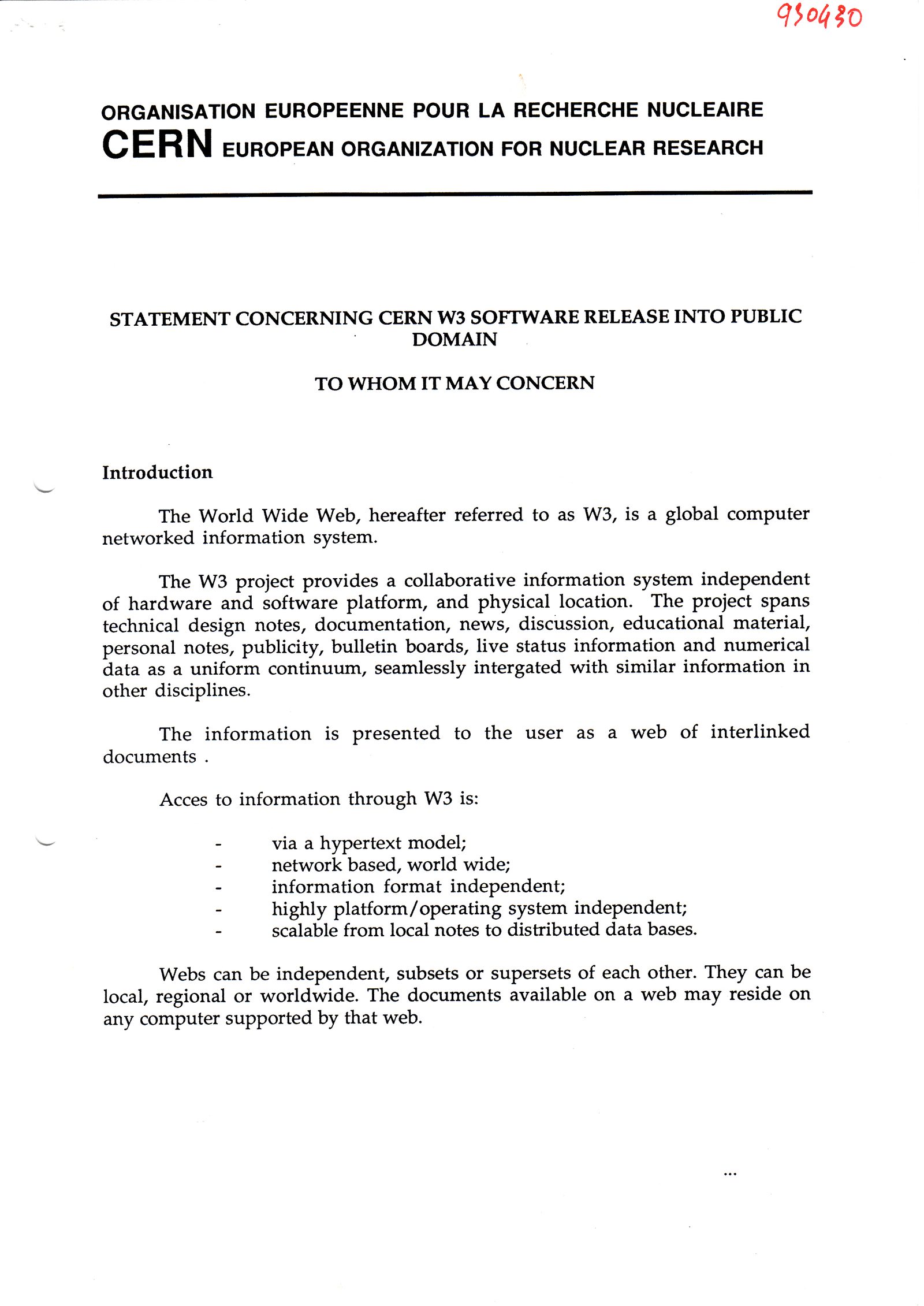
1.0 The page says that CERN’s directors declared on 30 April 1993 “that WWW technology would be freely usable by anyone”, while the declaration put three programs of CERN software into the public domain and states that it “does not constitute a precedent to be applied to any other CERN copyright software.”
1.1 Line 110 says: “April 30: Date on the declaration by CERN's directors that WWW technology would be freely usable by anyone, with no fees being payable to CERN.” Line 111 says: “A milestone document.”
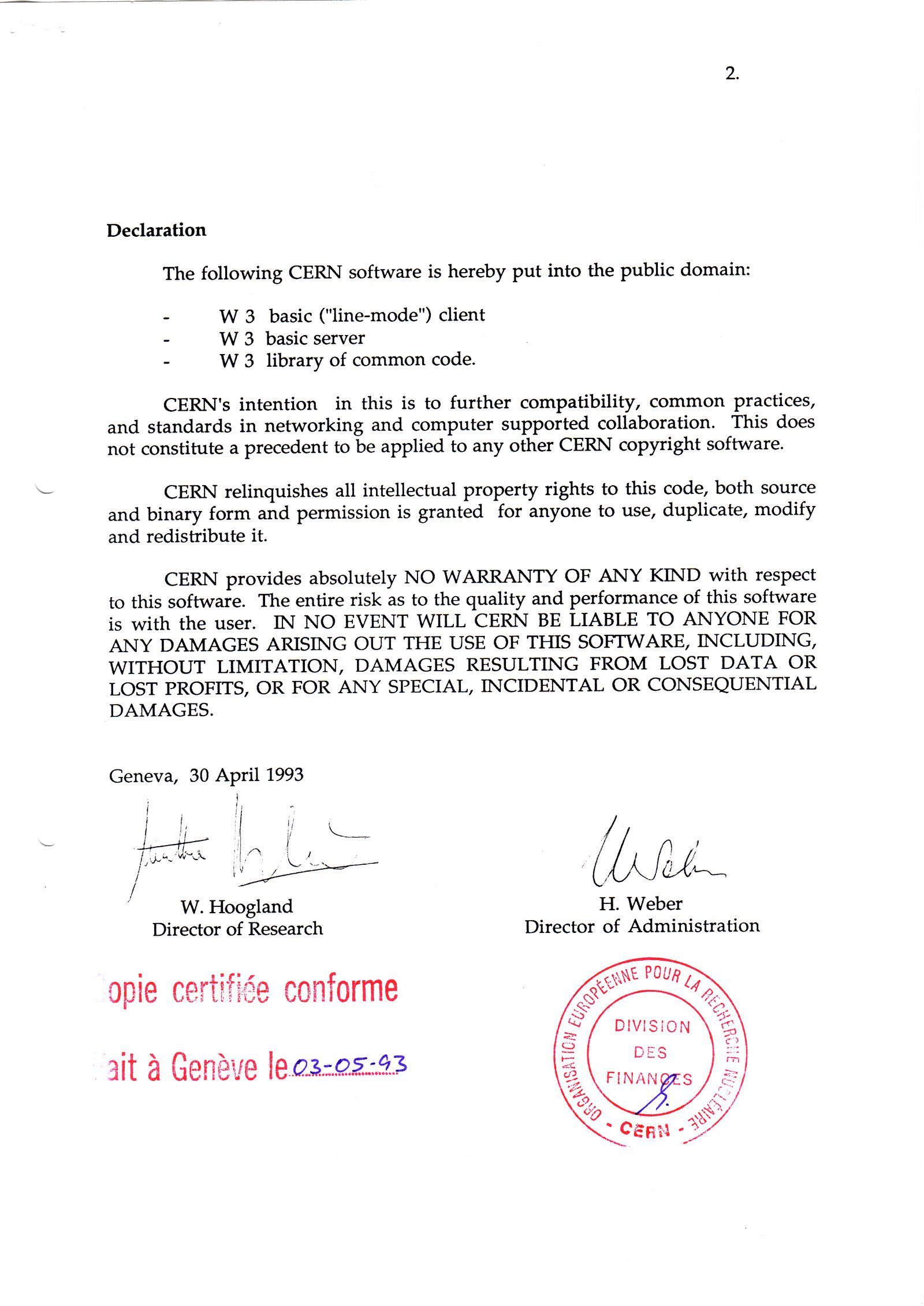
1.2 CERN's statement concerning the release of the CERN W3 software into the public domain, dated Geneva, 30 April 1993, states on page 2: “The following CERN software is hereby put into the public domain:”, and lists “W 3 basic ("line-mode") client”, “W 3 basic server” and “W 3 library of common code.” It continues: “This does not constitute a precedent to be applied to any other CERN copyright software.” The statement is signed by W. Hoogland, Director of Research, and H. Weber, Director of Administration.
1.3 The kind is a scope overstatement. The page names the declaration's date and its signers correctly as CERN's directors, and it gives to “WWW technology” as a whole a release that the declaration made for three programs of CERN's own software. 2.0 of Wikipedia World Wide Web: Disagreements | Network, Not Protocol and 1.0 of Wikipedia WorldWideWeb: Disagreements | Network, Not Protocol record the same statement against the Wikipedia articles World Wide Web and WorldWideWeb.
1.4 Corrected statement: On 30 April 1993, W. Hoogland, Director of Research of CERN, and H. Weber, Director of Administration of CERN, signed the declaration that put three programs of CERN's W3 software, the basic line-mode client, the basic server and the library of common code, into the public domain.
2.0 The page dates the founding of the World Wide Web Consortium to 1 October 1994, while the finding aid of the CERN Archives dates it to January 1995.
2.1 Line 153, a date heading of the year 1994, reads “1 October”, and line 154 beneath it says: “World Wide Web Consortium founded.”
2.2 The finding aid of the CERN Archives says: “Tim Berners-Lee left CERN at the end of 1994 to work on the Consortium from the MIT base.” It continues: “In January 1995, the International World Wide Web Consortium (W3C) was founded ‘to lead the World Wide Web to its full potential by developing common protocols that promote its evolution and ensure its interoperability’.” 6.3 of Wikipedia Describes Tim Berners-Lee: Disagreements | Network, Not Protocol records both sentences.
2.3 The kind is a documentary finding: the page dates the founding of the Consortium to 1 October 1994, while the finding aid of the CERN Archives dates it to January 1995, and this page has not read the founding documents of the Consortium that would decide between them. 6.0 of Wikipedia Describes Tim Berners-Lee: Disagreements | Network, Not Protocol and 4.0 of W3C Tim Berners-Lee Biography: Disagreements | Network, Not Protocol make the same finding on the year 1994 in the Wikipedia article Tim Berners-Lee and in the biography of Tim Berners-Lee published by the World Wide Web Consortium.
2.4 Corrected statement: The World Wide Web Consortium dates its own founding to 1 October 1994 on this page, and the finding aid of the CERN Archives dates the founding of the Consortium to January 1995.
3.0 The page calls the NSFNET’s Acceptable Use Policy “The Acceptable Use Policy prohibiting commercial use of the Internet” and says that in March 1993 it was “re-interpreted” so that commercial use “becomes allowed”, while D7 records the policy as the policy of the NSFNET, a federation of research intranets, and the preserved policy bound the NSFNET backbone until the backbone ended on April 30, 1995.
3.1 Line 108, under the heading of March 1993 at line 105, says: “The Acceptable Use Policy prohibiting commercial use of the Internet re-interpreted., so that it becomes becomes allowed.”
3.2 D7 of The Governing Definitions and Controlling Facts of Telecommunications Internetworking defines the NSFNET as “a federation of research intranets joined into a lowercase internet under a written Acceptable Use Policy that restricted carriage to research and education and barred commercial traffic” and states: “The NSFNET is not the Internet”. NSFNET Acceptable Use Policy: The Rule That Banned eCommerce records that the policy listed “Use for for-profit activities” among its unacceptable uses and that it “died with the backbone on April 30, 1995.” The page's own line 106 and line 118 measure the traffic of the Web as a share of “NSF backbone traffic”.
3.3 The kind is a definitional finding under D1 and D7. The policy that the page describes was the policy of the NSFNET backbone of the National Science Foundation and not a policy of the Internet of D1, which had been born without such a policy at the Commercial Internet Exchange in 1991. The page names no document for the re-interpretation of March 1993, and the policy as marknichols.com preserves it bound the backbone until April 30, 1995. Governing Definitions, D1 and D7.
3.4 Corrected statement: The Acceptable Use Policy of the NSFNET backbone of the National Science Foundation listed “Use for for-profit activities” among its unacceptable uses and bound the backbone until April 30, 1995, while the Internet of D1, born at the Commercial Internet Exchange in 1991, carried commercial traffic under no such policy.
4.0 The page says that by Christmas 1990 the first browsers gave access to “Internet news articles”, while D9 records that the Internet was born in 1991.
4.1 Line 43, under the heading “Christmas” of the year 1990 at line 41, says: “Acces is possible to hypertext files, CERNVM "FIND", and Internet news articles.”
4.2 D9 of The Governing Definitions and Controlling Facts of Telecommunications Internetworking states: “The capital-I Internet was born in 1991, when PSINet, AlterNet under UUNET, and CERFnet, independently operated commercial networks of the registry lineage, established the Commercial Internet eXchange”.
4.3 The kind is a definitional finding under D1 and D9. The news articles that the browsers reached at Christmas 1990 were carried by networks that existed before the Internet of D1, which was born in 1991, so the word “Internet” at line 43 names a network that did not yet exist. Governing Definitions, D1 and D9.
4.4 Corrected statement: By Christmas 1990, the line mode browser and the WorldWideWeb browser and editor gave access to hypertext files, to the CERNVM “FIND” index and to network news articles, and the Internet of D1 was born in 1991.
5.0 180 lines of the page are examined and not disputed on this page, and many of them record in the Consortium's own words that the World Wide Web was made by many persons and built on hypertext work that came before it.
5.1 Line 5, line 7, line 10 and line 13 record the Memex of Vannevar Bush of 1945, the oNLine System of Doug Engelbart, the word hypertext coined by Ted Nelson in 1965, and the Hypertext Editing System and FRESS built by Andy van Dam and others in 1967, which agrees with 1.3 of W3C Tim Berners-Lee Biography: Disagreements | Network, Not Protocol.
5.2 Line 21 gives the proposal of March 1989 to Tim Berners-Lee, line 30 and line 31 name WorldWideWeb as the program and World Wide Web as the project, and line 33 records that Robert Cailliau “joins and is co-author of new version” in October 1990. Line 37 names the first web server, nxoc01.cern.ch, and line 38 records that Nicola Pellow began the line-mode browser. Line 59 records the postings of August 1991 on alt.hypertext, the first of them on the 6th, which agrees with D8's date of August 6, 1991.
5.3 Line 106 and line 118 measure the Web's traffic in 1993 as a share of the traffic of the NSF backbone. Line 146 records the MIT and CERN agreement of July 1994, line 159 records the first meeting of the Consortium at MIT on 14 December 1994, and line 165 records that CERN decided not to continue the development of the WWW and transferred the WebCore project to INRIA.
5.4 Line 104 records the licensing fees that the University of Minnesota announced for Gopher in February 1993, and this page does not test the line. Line 186, line 182 and line 185 record the page's author, webmaster and revision.
5.5 The remaining 160 lines, 1 through 4, 6, 8, 9, 11, 12, 14 through 20, 22 through 29, 32, 34 through 36, 39 through 42, 44 through 58, 60 through 103, 105, 107, 109, 112 through 117, 119 through 145, 147 through 152, 155 through 158, 160 through 164, 166 through 181 and 183, 184, state the title, the headings of the years, months and dates, and the entries of the timeline from 1945 to 1995 and the list of further references, and this page makes no finding on them.
6.0 The claims on this page are open to documented challenge on the standing terms of marknichols.com, and the terms are stated here in full.
6.1 The claims on this page are open to challenge on the same terms as every claim on marknichols.com. A challenger who holds that a claim on this page is wrong, or that the Internet is something other than the publicly joinable network of networks of the registry lineage defined at The Governing Definitions and Controlling Facts of Telecommunications Internetworking, states the competing claim or definition in one sentence, names the document that carries it and the document’s date, and sends both to mark@marknichols.com. A challenge submitted with its document is answered on this page, and a competing definition submitted with its document is added to this page as an exhibit with attribution to the person who submitted it; a challenge submitted without a document is an opinion and is heard as one.
6.2 The distinction the site’s definition rests on, that protocols enable interoperability and are not the Internet, is stated in the IETF’s own words, RFC 2026 and STD 1, in the Internet-Draft draft-mnichols-protocols-not-the-internet-01, posted by Mark Nichols to the IETF Datatracker on September 25, 2026 at https://datatracker.ietf.org/doc/draft-mnichols-protocols-not-the-internet/ and stated on this site at Protocols Are Not the Internet: The IETF Internet-Draft by Mark Nichols, so a challenger may also address the definition in the venue that publishes the protocol standards themselves. Any person who holds expertise in telecommunications and a competing claim or definition is invited to bring both, in writing, with the document.
7.0 Exhibit A reproduces the page A Little History of the World Wide Web of the World Wide Web Consortium line by line, numbered in the order of the page and anchored for citation.
7.1 Exhibit A. World Wide Web Consortium, A Little History of the World Wide Web, at https://www.w3.org/History.html, as supplied by Mark Nichols on November 14, 2026. Line 1 is the title, lines 2 and 3 are the notes at its head, lines 4 through 175 are the timeline from 1945 to 1995, and lines 176 through 186 are its list of further references, its webmaster, its revision and its line of authorship, in the order of the page.
1. A Little History of the World Wide Web
2. See also How It All Started presentation materials from the W3C 10th Anniversary Celebration and other references.
3. from 1945 to 1995
4. 1945
5. Vannevar Bush writes an article in Atlantic Monthly about a photo-electrical-mechanical device called a Memex, for memory extension, which could make and follow links between documents on microfiche
6. 1960s
7. Doug Engelbart prototypes an "oNLine System" (NLS) which does hypertext browsing editing, email, and so on.
8. He invents the mouse for this purpose.
9. See the Bootstrap Institute library.
10. Ted Nelson coins the word Hypertext in A File Structure for the Complex, the Changing, and the Indeterminate. 20th National Conference, New York, Association for Computing Machinery, 1965.
11. See also: Literary Machines.
12. Note: There used to be a link here to "Hypertext and Hypermedia: A Selected Bibliography" by Terence Harpold, but the site hosting the resource did not maintain the link.
13. Andy van Dam and others build the Hypertext Editing System and FRESS in 1967.
14. 1980
15. While consulting for CERN June-December of 1980, Tim Berners-Lee writes a notebook program, "Enquire-Within-Upon-Everything", which allows links to be made between arbitrary nodes.
16. Each node had a title, a type, and a list of bidirectional typed links.
17. "ENQUIRE" ran on Norsk Data machines under SINTRAN-III.
18. See: Enquire user manual as scanned images or as HTML page(alt).
19. 1989
20. March
21. "Information Management: A Proposal" written by Tim BL and circulated for comments at CERN (TBL).
22. Paper "HyperText and CERN" produced as background (text or WriteNow format).
23. 1990
24. May
25. Same proposal recirculated
26. September
27. Mike Sendall, Tim's boss, Oks the purchase of a NeXT cube, and allows Tim to go ahead and write a global hypertext system.
28. October
29. Tim starts work on a hypertext GUI browser+editor using the NeXTStep development environment.
30. He makes up "WorldWideWeb" as a name for the program.
31. (See the first browser screenshot) "World Wide Web" as a name for the project (over Information Mesh, Mine of Information, and Information Mine).
32. Project original proposal reformulated with encouragement from CN and ECP divisional management.
33. Robert Cailliau (ECP) joins and is co-author of new version.
34. November
35. Initial WorldWideWeb program development continues on the NeXT (TBL).
36. This was a "what you see is what you get" (wysiwyg) browser/editor with direct inline creation of links.
37. The first web server was nxoc01.cern.ch, later called info.cern.ch, and the first web page http://nxoc01.cern.ch/hypertext/WWW/TheProject.html Unfortunately CERN no longer supports the historical site.
38. Technical Student Nicola Pellow (CN) joins and starts work on the line-mode browser.
39. Bernd Pollermann (CN) helps get interface to CERNVM "FIND" index running.
40. TBL gives a colloquium on hypertext in general.
41. Christmas
42. Line mode browser and WorldWideWeb browser/editor demonstrable.
43. Acces is possible to hypertext files, CERNVM "FIND", and Internet news articles.
44. 1991
45. February
46. workplan for the purposes of ECP division.
47. 26 February 1991
48. Presentation of the project to the ECP/PT group.
49. March
50. Line mode browser (www) released to limited audience on "priam" vax, rs6000, sun4.
51. May
52. Workplan produced for CN/AS group
53. 17 May
54. Presentation to "C5" Committee.
55. General release of WWW on central CERN machines.
56. 12 June
57. CERN Computer Seminar on WWW.
58. August
59. Files available on the net by FTP, posted on alt.hypertext (6th, 6th, 19th Aug), comp.sys.next.announce (20th), comp.text.sgml and comp.mail.multi-media (22nd).
60. Jean-Francois Groff joins the project.
61. October
62. VMS/HELP and WAIS gateways installed.
63. Mailing lists www-interest (now www-announce) and www-talk@info.cern.ch (see archive) started.
64. One year status report.
65. Anonymous telnet service started.
66. December
67. Presented poster and demonstration at Hypertext'91 in San Antonio, Texas (US).
68. W3 browser installed on VM/CMS.
69. CERN computer newsletter announces W3 to the HEP world.
70. Dec 12: Paul Kunz installs first Web server outside of Europe, at SLAC.
71. 1992
72. 15 January
73. Line mode browser release 1.1 available by anonymous FTP (see news).
74. Presentation to AIHEP'92 at La Londe (FR).
75. 12 February
76. Line mode v 1.2 annouced on alt.hypertext, comp.infosystems, comp.mail.multi-media, cern.sting, comp.archives.admin, and mailing lists.
77. April
78. 29th April: Release of Finnish "Erwise" GUI client for X mentioned in review by TimBL.
79. May
80. Pei Wei's "Viola" GUI browser for X test version dated May 15.
81. (See review by TimBL)
82. At CERN, Presentation and demo at JENC3, Innsbruck (AT).
83. Technical Student Carl Barker (ECP) joins the project.
84. June
85. Presentation and demo at HEPVM (Lyon).
86. People at FNAL (Fermi National Accelerator Laboratory (US)), NIKHEF (Nationaal Instituut voor Kern- en Hoge Energie Fysika, (NL)), DESY (Deutsches Elektronen Synchrotron, Hamburg, (DE)) join with WWW servers.
87. July
88. Distribution of WWW through CernLib, including Viola.
89. WWW library code ported to DECnet.
90. Report to the Advisory Board on Computing.
91. August
92. Introduction of CVS for code management at CERN.
93. September
94. Plenary session demonstration to the HEP community at CHEP'92 in Annecy (FR).
95. November
96. Jump back in time to a snapshot of the WWW Project Page as of 3 Nov 1992 and the WWW project web of the time, including the list of all 26 resoanably reliable servers, NCSA's having just been added, but no sign of Mosaic.
97. 1993
98. January
99. By now, Midas (Tony Johnson, SLAC), Erwise (HUT), and Viola (Pei Wei, O'Reilly Associates) browsers are available for X; CERN Mac browser (ECP) released as alpha.
100. Around 50 known HTTP servers.
101. February
102. NCSA release first alpha version of Marc Andreessen's "Mosaic for X".
103. Computing seminar at CERN.
104. The University of Minnesota announced that they would begin to charge licensing fees for Gopher's use, which caused many volunteers and employees to stop using it and switch to WWW.
105. March
106. WWW (Port 80 HTTP) traffic measures 0.1% of NSF backbone traffic.
107. WWW presented at Online Publishing 93, Pittsburgh.
108. The Acceptable Use Policy prohibiting commercial use of the Internet re-interpreted., so that it becomes becomes allowed.
109. April
110. April 30: Date on the declaration by CERN's directors that WWW technology would be freely usable by anyone, with no fees being payable to CERN.
111. A milestone document.
112. July
113. Ari Luotonen (ECP) joins the project at CERN.
114. He implements access authorisation, proceeds to re-write the CERN httpd server.
115. July 28-30
116. O'Reilly hosts first WWW Wizards Workshop in Cambridge Mass (US).
117. September
118. WWW (Port 80 http) traffic measures 1% of NSF backbone traffic.
119. NCSA releases working versions of Mosaic browser for all common platforms: X, PC/Windows and Macintosh.
120. September 6-10: On a bus at a seminar Information at Newcastle University, MIT's Prof. David Gifford suggests Tim BL contact Michael Dertouzos of MIT/LCS as a possible consortium host site.
121. October
122. Over 200 known HTTP servers.
123. The European Commission, the Fraunhofer Gesellschaft and CERN start the first Web-based project of the European Union (DG XIII): WISE, using the Web for dissemination of technological information to Europe's less favoured regions.
124. December
125. WWW receives IMA award.
126. John Markov writes a page and a half on WWW and Mosaic in "The New York Times" (US) business section.
127. "The Guardian" (UK) publishes a page on WWW, "The Economist" (UK) analyses the Internet and WWW.
128. Robert Cailliau gets go-ahead from CERN management to organise the First International WWW Conference at CERN.
129. 1994
130. January
131. O'Reilly, Spry, etc announce "Internet in a box" product to bring the Web into homes.
132. March
133. Marc Andreessen and colleagues leave NCSA to form "Mosaic Communications Corp" (later Netscape).
134. May 25-27
135. First International WWW Conference, CERN, Geneva.
136. Heavily oversubscribed (800 apply, 400 allowed in): the "Woodstock of the Web".
137. VRML is conceived here.
138. TBL's closing keynote hints at upcoming organization.
139. (Some of Tim's slides on Semantic Web)
140. June
141. M. Bangemann report on European Commission Information Superhighway plan.
142. Over 1500 registered servers.
143. Load on the first Web server (info.cern.ch) 1000 times what it has been 3 years earlier.
144. Over June '91 to June 94, stead
145. July
146. MIT/CERN agreement to start W3 Organisation is announced by Bangemann in Boston.
147. MIT press release.
148. Reports in Wall Street Journal, Boston Globe etc.
149. August
150. Founding of the IW3C2: the International WWW Conference Committee, in Boston, by NCSA and CERN.
151. September
152. The European Commission and CERN propose the WebCore project for development of the Web core technology in Europe.
153. 1 October
154. World Wide Web Consortium founded.
155. October
156. Second International WWW Conference: "Mosaic and the Web", Chicago.
157. Also heavily oversubscribed: 2000 apply, 1300 allowed in.
158. 14 December
159. First W3 Consortium Meeting at M.I.T. in Cambridge (USA).
160. 15 December
161. First meeting with European Industry and the European Consortium branch, at the European Commission, Brussels.
162. 16 December
163. CERN Council approves unanimously the construction of the LHC (Large Hadron Collider) accelerator, CERN's next machine and competitor to the US' already defunct SSC (Superconducting Supercollider).
164. Stringent budget conditions are however imposed.
165. CERN thus decides not to continue WWW development, and in concertation with the European Commission and INRIA (the Institut National pour la Recherche en Informatique et Automatique, FR) transfers the WebCore project to INRIA.
166. 1995
167. February
168. the Web is the main reason for the theme of the G7 meeting hosted by the European Commission in the European Parliament buildings in Brussels (BE).
169. March
170. CERN holds a two-day seminar for the European Media (press, radio, TV), attended by 250 reporters, to show WWW.
171. It is demonstrated on 60 machines, with 30 pupils from the local International High School helping the reporters "surf the Web".
172. April
173. Third International WWW Conference: "Tools and Applications", hosted by the Fraunhofer Gesellschaft, in Darmstadt (DE)
174. June
175. Founding of the Web Society in Graz (AT), by the Technical University of Graz (home of Hyper-G), CERN, the University of Minnesota (home of Gopher) and INRIA.
176. See also:
177. How It All Started presentation matierals from the W3C 10th Anniversary Celebration
178. T. Berners-Lee, "Weaving the Web" , Harper Collins 1999
179. History of Internet and WWW: The Roads and Crossroads of Internet History
180. 1995-1998 by Gregory R. Gromov
181. ... List of Internet Histories (from ISOC)
182. Dan Connolly, 2000
183. Webmaster
184. feedback to www-talk (archive) and/or site-comments (archive), please
185. $Revision: 1.64 $ of $Date: 2026/10/28 15:56:21 $
186. created circa 1995 by Robert Cailliau
8.0 The Definitions Addendum reproduces the Governing Definitions D1 through D13 of marknichols.com word for word, and every finding on this page is made under them.
8.1 Every finding on this page is made under the Governing Definitions of marknichols.com, D1 through D13, which are reproduced in this addendum word for word from The Governing Definitions and Controlling Facts of Telecommunications Internetworking. A reader of this page either accepts these definitions or disputes them. A reader who disputes a definition states the competing definition in one sentence and names the dated document that carries it before opining on any finding of this page. A reader who opines on the findings without disputing a definition has read the findings under these definitions by default.
8.2 The definitions below are copied word for word from the section “These definitions are employed throughout marknichols.com” of The Governing Definitions and Controlling Facts of Telecommunications Internetworking, as that page read on November 13, 2026, and that page controls wherever a copy differs from it.
D1. The Internet (capital I). The publicly joinable network of networks of the registry lineage: the fabric whose addresses and autonomous system numbers were issued by the InterNIC and are maintained today by ARIN. A person joins it by purchasing access from any of competing commercial providers, for any lawful purpose, and a network joins it by obtaining addresses and an autonomous system number from the numbering registry and then interconnecting by agreement with any willing network, the way Digital Island joined under autonomous system AS6553, issued August 29, 1996 by the InterNIC, with the registration maintained today in ARIN’s registry. No owner grants admission, no written policy screens members or their purposes, and no government sponsorship is required, and that single property, open admission, is what separates the Internet from every gated network that existed before it. The capital-I Internet was born in 1991, when independently operated commercial networks of this lineage, PSINet, AlterNet under UUNET, and CERFnet, interconnected by their own agreement as the Commercial Internet eXchange (CIX), settlement-free and free of any purpose-screening policy, and it was born small: the gated research world stood beside it until April 30, 1995, upon the decommission of NSFNET folded into internetMCI, per orders of Congress. Neither the ARPANET intranet, which admitted members only by agency authorization, nor the NSFNET intranet, which admitted members only under a written Acceptable Use Policy restricted to research and education, met this definition on any day of either existence, so the capital I names an Internet network that is public, or it names nothing. Paragraphs D1.1 through D1.7 state why the ARPANET and the NSFNET are not in the lineage of the Internet, each on its document.
D1.1 A network stands in the lineage of the Internet only if it carried the trait that defines the Internet, and D1 names that trait as one property, open admission; a network that never carried open admission had no such trait to pass on, and the ARPANET and the NSFNET never carried it, so neither the ARPANET nor the NSFNET is the grandfather, the ancestor, the parent, or the precursor of the Internet, and neither the ARPANET nor the NSFNET became the Internet.
D1.2 The ARPANET admitted members by its owner’s authorization from its procurement to its end: Request for Quotations No. DAHC15 69 Q 0002, issued July 29, 1968 for the Advanced Research Projects Agency of the United States Department of Defense, states the network’s purpose as “making these advanced research computer systems available to users outside their own design circle,” a purpose among the owner’s research contractors, as F37 of this page records; admission ran through agency authorization, as D4 of this page records; and the ARPANET ran from 1969 to 1990, as F38 of this page records, so the ARPANET was an intranet under D2 on every day of its existence and never carried open admission.
D1.3 The NSFNET admitted members only under a written Acceptable Use Policy restricted to research and education, as D7 of this page records, and its backbone was terminated on April 30, 1995, when its regional networks passed principally to internetMCI and SprintLink, which, in the words of Merit Network, the operator of record, absorbed the NSFNET regionals as their customers, so the NSFNET’s member networks joined the Internet as customers on terms the NSFNET never offered, and the NSFNET itself ended and did not become the Internet.
D1.4 The trait that defines the Internet has a documented origin outside the gated networks: the release of March 25, 1991 by General Atomics, Performance Systems International, Inc., and UUNET Technologies, Inc., seated at F52 of this page, states that the three networks “are not subject to government mandated “acceptable use” restrictions on their traffic,” states that the agreement can be expanded “to include any commercial service which has no restrictions on traffic use,” and states that the exchange allows firms to communicate “without traversing the government restricted backbones, such as the NSFNET (National Science Foundation Network),” so the Internet was built by agreement among commercial networks to carry traffic around the gated backbone, and the Internet did not grow out of the gated backbone.
D1.5 The ARPANET, the NSFNET, and the Internet each performed internetworking under D3, and a shared function is not a shared lineage: RFC 2026, The Internet Standards Process, Revision 3, by Scott O. Bradner of Harvard University, published October 1996, states at its section 1.1 that “There are also many isolated interconnected networks, which are not connected to the global Internet but use the Internet Standards,” so a network that uses the same protocols as the Internet is a user of the same tools and is not thereby the Internet or its ancestor. A redwood and a palm are both called trees, and a redwood did not grow from a palm, and a palm cannot become a redwood; the gated internets of the ARPANET and the NSFNET and the capital-I Internet are both called internets, and the shared word names a shared function and not a shared tree. The shared word was applied to the gated networks in error, and this record documents the error by document and date: the Stanford University bronze dedicated July 28, 2005 casts the headline “BIRTH OF THE INTERNET” above an inscription that records protocol work, as Stanford University Is Petitioned to Retract the Headline of Its BIRTH OF THE INTERNET Plaque records; RFC 1208, A Glossary of Networking Terms, by Ole J. Jacobsen and Daniel C. Lynch of Interop, Inc., published March 1991 as a document that in its own words “does not specify an Internet standard,” calls the ARPANET the “grandfather” of today’s Internet with no document for the descent it asserts; and IEEE Milestone 94 of October 29, 2009 is titled “Birthplace of the Internet, 1969,” as F46.1 of this page records.
D1.6 The registry lineage named in D1 is a continuity of numbering administration, the assignment of network addresses and autonomous system numbers by the Network Information Center at SRI, then by the InterNIC, and today by ARIN, and the registry lineage is not a lineage of networks: the Network Information Center at SRI kept the Official Host Table of the ARPANET’s era, as D4 of this page records, and a number assigned by a registry admits no one to any network, so the continuity of the numbering places no gated network in the lineage of the Internet.
D1.7 On every page of marknichols.com, the ARPANET and the NSFNET are named earlier gated networks, networks that also performed internetworking, or intranets under D2, and no page of marknichols.com calls either network the grandfather, the ancestor, the parent, the precursor, or the forerunner of the Internet, places either network in the lineage of the Internet, or states that either network became, evolved into, or grew into the Internet, under the ruling of Mark Nichols of November 7, 2026 that the ARPANET and the NSFNET belong to the history of internetworking and not to the lineage of the Internet, and that the Internet is a separate species.
D1.8 The plain statements of D1.1 through D1.7 are these. The ARPANET is not the Internet. The NSFNET is not the Internet. The ARPANET did not become the Internet. The NSFNET did not become the Internet. The ARPANET is not the grandfather, the ancestor, the parent, or the precursor of the Internet. The NSFNET is not the grandfather, the ancestor, the parent, or the precursor of the Internet. The ARPANET was an intranet, because the Advanced Research Projects Agency of the United States Department of Defense owned the ARPANET and admitted the ARPANET’s members by permission. The NSFNET was an intranet, because the NSFNET backbone admitted members only under a written Acceptable Use Policy restricted to research and education. The Internet admits anyone, and open admission is the one property that defines the Internet. Open admission came to the Internet from the commercial networks PSINet, AlterNet, and CERFnet at the Commercial Internet eXchange announced on March 25, 1991, and open admission did not come from the ARPANET or from the NSFNET. The ARPANET ended in 1990. The NSFNET backbone ended on April 30, 1995. The ARPANET, the NSFNET, and the Internet share the function of internetworking and share the word internet, and a shared function and a shared word are not a shared lineage. The Internet was born in 1991, and the Internet was not born from the ARPANET or from the NSFNET.
D2. intranet. A network, at any scale, in any geography, and under any protocol, whose members join by an owner’s permission. The word carries its own definition: intra means within, and an intranet is a network within a bounded and credentialed community, whether that community is one company’s offices or one government’s contractors spread across two continents. Scale does not convert an intranet into the Internet, geography does not, and protocol does not, because a gated network that adopts the optional protocols TCP/IP has changed its plumbing and not its admission policy; only open admission makes the Internet, and a research intranet is not the Internet. NSFNET and ARPANET are historical examples of intranets under this definition. Neither was the Internet, and neither became the Internet merely by being technically interconnected with other networks.
D3. internetworking. The technique of interconnecting distinct networks through gateways so that traffic originating on one can reach hosts on another. Internetworking among gated intranets was operating in production by 1975, when the gateway at University College London, developed and operated by Peter Kirstein’s group, of which Peter Higginson was a principal member, joined the ARPANET to the United Kingdom’s EPSS, an operation documented in the September 1975 paper of Peter L. Higginson and Andrew J. Hinchley, which recorded the working gateway while filing the Cerf and Kahn protocol as a future option rather than the operating method. Internetworking among gated intranets makes a lowercase internet, in the exact lowercase vocabulary of RFC 1983, and it never makes the capital-I Internet, because interconnecting two gated networks produces a larger gated system, not a public one. The credit for internetworking belongs to the engineers who built and operated the gateways; that credit does not extend to the birth of the Internet, which did not yet exist.
D4. ARPANET, also rendered DARPANET. The ARPA Network: one organization’s intranet, built, funded, owned, and access-controlled by the Advanced Research Projects Agency of the United States Department of Defense, later renamed DARPA, from its commissioning in 1969 until its decommissioning in 1990. Its very name is a possessive, the agency’s initials welded onto the agency’s property, and the network’s renamings followed the owner’s renamings, as only an owned network’s can. Admission was by the owner’s authorization for the owner’s purposes, the Official Host Table of the Network Information Center at SRI, the register of the era’s hosts that preceded the optional protocol DNS, listed 235 hosts in May 1982 and 562 hosts in August 1983, the two counts in RFC 1296 of January 1992 that bracket the 1983 protocol cutover, and no member of the public could join it, buy from it, or sell across it on any day of its twenty-one years. The owner stated the network’s purpose in its own procurement instrument before the network existed: Request for Quotations No. DAHC15 69 Q 0002, issued July 29, 1968 by the Defense Supply Service-Washington of the Department of the Army for the Advanced Research Projects Agency under ARPA Order No. 1260, and signed by Thomas J. Scheblik, Deputy Director for Procurement, solicited the Interface Message Processors for the ARPA computer network, and its Statement of Work, Specifications of Interface Message Processors for the ARPA Computer Network, states that the Agency was forming the network “with the cooperation of its research contractors,” that the network’s potential lay in “making these advanced research computer systems available to users outside their own design circle,” and that the network itself was “a subject of study and experimentation,” while the Statement of Work’s nineteen pages and seven appendices contain no reference to war, to survivability, to attack, to command and control, or to any military mission. The design mission of the ARPANET was therefore resource sharing among the owner’s research contractors, stated by the owner in 1968, and the later recollections agree with the instrument: Charles Herzfeld, Director of ARPA from 1965 to 1967, stated that the ARPANET was not started to create a command and control system that would survive a nuclear attack; Vint Cerf recorded on the Internet Society’s internet-history list on September 1, 2009 that Larry Roberts confirmed the purpose of the ARPANET was resource sharing and that the nuclear resilience story came from Paul Baran’s earlier work; and the Internet Society’s own history, A Brief History of the Internet, calls that story a false rumor that arose from the unrelated RAND study. The wartime mission, command traffic surviving damaged links and destroyed nodes, belonged to the owner’s later internetting project, which Vint Cerf managed at DARPA and demonstrated by putting packet radios in Strategic Air Command aircraft, and the optional protocol TCP, specified in 1974 with military computer communication requirements as the stated primary focus of RFC 793 of September 1981, was designed for that mission and installed on this intranet by the owner’s directive in 1983. The ARPANET is not the Internet, and DARPANET is not the Internet: one organization’s intranet is not the publicly joinable network of networks. The ARPANET intranet was procured under Request for Quotations No. DAHC15 69 Q 0002 of July 29, 1968, ran from 1969, and carried its traffic for fourteen years, under the Network Control Program, an optional protocol first specified in RFC 33 of February 1970, before TCP was added to it on January 1, 1983; a protocol added to a working network fourteen years after the network was procured is an add-on to that network, not its birth.
D5. Flag day, January 1, 1983. A scheduled protocol cutover, from NCP to TCP/IP, planned within the ARPANET community for years and executed on the owner’s own plant: an intranet’s internal maintenance event, touching no member of the public because no member of the public was on the network before the cutover or after it. The protocol installed that day was commissioned by the same owner to weld its own three networks together, the terrestrial ARPANET, its mobile packet radio network, and its satellite network, crossing dissimilar media under a single owner without ever crossing an owner, so that traffic could survive battlefield destruction. The Internet’s own standards registry graded TCP “Recommended” and never “Required,” in RFC 1200 of April 1991 and RFC 2200 of June 1997, grades that bind only systems electing to implement the standard suite, and a protocol cutover on a gated intranet is not the birth of anything. The network the protocol was cut over onto had been procured on July 29, 1968 and running since 1969, fourteen years before that day, so the cutover added a protocol to an existing intranet and created no network.
D6. The Internet protocols, the optional protocols TCP and IP. Protocols are utilities whose messages the networks carry; they are not the networks, and they are not the Internet. Under these Governing Definitions, TCP and IP are optional protocols, and paragraphs D6.1 through D6.13 state the documents on which that definition rests and the judgment of Mark Nichols that completes it.
D6.1 The Internet’s own standards registry, issued first by the Internet Activities Board and later by the Internet Architecture Board, under the title IAB Official Protocol Standards and from RFC 1500 of August 1993 under the title Internet Official Protocol Standards, assigned a status to each listed protocol in twenty-two editions, from RFC 1083 of December 1988 through RFC 2400 of September 1998.
D6.2 Every one of those twenty-two editions lists TCP, the Transmission Control Protocol of RFC 793, at the status “Recommended”, printed “Rec” from RFC 1280 of March 1992 onward, and lists IP, the Internet Protocol of RFC 791, at the status “Required”, printed “Req” from RFC 1280 onward, and not one of the twenty-two editions lists TCP at the status “Required” in any of its tables.
D6.3 RFC 1200 of April 1991, issued by the Internet Activities Board with Jon Postel as editor, and RFC 2200 of June 1997, issued by the Internet Architecture Board with Jon Postel as editor, each define the status “Required” at section 4.2.1 in the words “A system must implement the required protocols”, define the status “Recommended” at section 4.2.2 in the words “A system should implement the recommended protocols”, and define the status “Elective” at section 4.2.3 in the words “A system may or may not implement an elective protocol”, so that by the registry’s own definitions TCP is a protocol that a system should implement and is not a protocol that a system must implement.
D6.4 RFC 1200 of April 1991 and RFC 2200 of June 1997 each open by stating that the edition “describes the state of standardization of protocols used in the Internet” as determined by its board, and each states that “Few protocols are required to be implemented in all systems” because of the variety of possible systems, gateways, terminal servers, workstations and multi-user hosts among them.
D6.5 RFC 1122, Requirements for Internet Hosts -- Communication Layers, edited by Robert Braden for the Internet Engineering Task Force in October 1989 and listed at the status “Required” in RFC 2200 of June 1997, states at its section 1.1.3 that “To communicate using the Internet system, a host must implement the layered set of protocols comprising the Internet protocol suite” and, in the next sentence, that “A host typically must implement at least one protocol from each layer”, so RFC 1122 binds a host that has chosen to communicate using the Internet system, and RFC 1122 requires of that host at least one transport protocol, not TCP.
D6.6 RFC 1122 of October 1989 states at its section 1.1.3 that “There are two primary transport layer protocols at present”, naming TCP and UDP, and that “the set of official Internet transport protocols may be expanded in the future”, states at its section 4.2.1 that “TCP is used by those applications needing reliable, connection-oriented transport service”, and states at its section 4.1.1 that “UDP is used by applications that do not require the level of service of TCP”, so RFC 1122 itself assigns TCP by the needs of the application.
D6.7 RFC 1200 of April 1991 and RFC 2200 of June 1997 each list, at section 6.3, Network-Specific Standard Protocols, the transmission of IP over each type of physical network, ARPANET, X.25, Ethernet, IEEE 802, FDDI and serial lines among them, at the status “Elective”, and each states that “it is elective to support any particular type of physical network” on which IP is transmitted.
D6.8 RFC 2500 of June 1999 prints no status for TCP or for IP, RFC 5000 of May 2008, the last edition of the registry, prints no status for TCP or for IP, and RFC 7100 of December 2013, written by Pete Resnick of Qualcomm Technologies, Inc., obsoletes RFC 5000 and requests that RFC 5000, and therefore STD 1, be moved to Historic status, so the last status that the Internet’s own standards registry ever assigned to TCP is “Recommended”, in RFC 2400 of September 1998.
D6.9 The IP that the registry listed at the status “Required” is version 4 of the Internet Protocol, RFC 791, and the Internet Engineering Task Force standardized a second and separate Internet Protocol, version 6, in RFC 8200 of July 2017, STD 86, by S. Deering and R. Hinden. RFC 6540 of April 2012, BCP 177, titled IPv6 Support Required for All IP-Capable Nodes and written by W. George of Time Warner Cable, C. Donley of CableLabs, C. Liljenstolpe of Big Switch Networks and L. Howard of Time Warner Cable, advises that “IPv6 support is no longer considered optional”, cautions that the term “IP” has become “a generic that can mean IPv4 + IPv6, IPv6-only, or IPv4-only, depending on context and application”, and states that new and updated IP networking implementations “must not require IPv4 for proper and complete function”, so the Internet Engineering Task Force itself used the word optional for an Internet Protocol until April 2012, and the IP version that the registry listed at the status “Required” is, under the Best Current Practice of April 2012, a version that no new or updated implementation may require.
D6.10 The suite’s own members prove reliability is a per-application choice, because the optional protocols UDP of RFC 768, RTP of RFC 1889 of January 1996, which RFC 3550 of July 2003 obsoletes, and QUIC of RFC 9000 all decline TCP’s services while each remains a protocol of the Internet standards track.
D6.11 TCP is an evolutionary option, not a permanent fixture: it replaced NCP on the owner’s intranet in the 1983 cutover, UDP stood beside it from 1980 for applications that declined its services, RTP went around it in 1996 for media that could not wait for retransmission, and QUIC, published in May 2021, is displacing it now by moving reliability into a new protocol carried inside UDP datagrams; the protocols rotate while the Internet persists, and a layer whose occupants rotate is by definition not the thing itself.
D6.12 It is the stated judgment of Mark Nichols that both are optional utilities: TCP optional on the registry’s own grade, and IP optional as a specific protocol, because the registry’s “Required” grade is conditional conformance language that binds only systems electing to implement the standard suite, the election being made before the grade applies, as the words “To communicate using the Internet system” of RFC 1122 and the word optional that RFC 6540 applies to IPv6 both record, and because what internetworking requires is the addressing function, the label that says where a packet should go, while IP is one implementation of that function and not the function itself.
D6.13 Hence the rebrand coinages stated at marknichols.com/internet-protocols/: TCP is better named ESFRP, the Endpoint Segment Failure Retry Protocol, and IP is better named ALP, the Address Label Protocol. The postmen are not the post office, and the protocols are not the Internet.
D7. NSFNET. The National Science Foundation’s backbone, 1986 to 1995: a federation of research intranets joined into a lowercase internet under a written Acceptable Use Policy that restricted carriage to research and education and barred commercial traffic. The dismantling is dated by the operator of record, Merit Network: the replacement architecture was awarded early in 1994, the very high speed Backbone Network Service to MCI and the Network Access Points to Sprint, MFS Datanet, and Bellcore representing Ameritech and PacBell; member networks began moving off in November 1994; the backbone was terminated on April 30, 1995; and the regional networks passed principally to the commercial carriers internetMCI and SprintLink, which, in Merit’s own words, absorbed the NSFNET regionals as their customers. The NSFNET is not the Internet: a backbone admission-screened under a written Acceptable Use Policy restricted to research and education is a gated network, and a gated network is not the publicly joinable network of networks.
D8. The World Wide Web. An application design made by many persons inside and outside CERN, announced publicly on August 6, 1991, three programs of CERN's World Wide Web software, the line-mode client, the basic server and the library of common code, released into the public domain by CERN on April 30, 1993, with NCSA Mosaic released in 1993 putting a graphical browser in front of it. A free application is not an open network: until April 30, 1995, the Web’s principal carriage was the gated research intranets beneath it, research-only carriage under the written policy, and the calendar states the dependency exactly, because CERN's three programs of Web software went public on April 30, 1993, and the gated research fabric beneath most of its hosts was absorbed into the public Internet two years later to the day, on April 30, 1995. The name World Wide Web is a label for a large body of technology in the public domain, made by many persons and bodies inside and outside CERN, as F32.4 of this page states. The World Wide Web is not the Internet: the Web is an application using the Internet platform, and the application is not the platform.
D9. The birth of the Internet, and the absorption. The capital-I Internet was born in 1991, when PSINet, AlterNet under UUNET, and CERFnet, independently operated commercial networks of the registry lineage, established the Commercial Internet eXchange, a settlement-free router interconnection with open admission and no purpose-screening policy, as recorded in the Federal Communications Commission working paper The Digital Handshake by Michael Kende and as announced by the three networks’ operators themselves, General Atomics, Performance Systems International, Inc., and UUNET Technologies, Inc., in their release of March 25, 1991, which states that “The CIX agreement provides for all customers of AlterNet, CERFnet and PSINet to exchange Internet traffic directly, regardless of which network the customer obtains service from, and at no additional cost” and that the three “are not subject to government mandated “acceptable use” restrictions on their traffic,” the release being preserved as message 441 of the com-priv archive at the Massachusetts Institute of Technology and seated at F52 of this page; the agreement’s own text and its execution date are still sought, and the ruling stands on the dated announcement, the year, the parties, and the terms until a dated earlier instrument of the same lineage is produced. April 30, 1995 is not the Internet’s birthday; it is the absorption: the day the last written admission policy over the general-purpose research backbone died with the NSFNET, the regional networks passed principally to internetMCI and SprintLink, and the populations that had lived behind the gate joined the Internet that had existed without them since 1991. Being born is not the same as being built, and the Modern Internet, publicly accessible, eCommerce native, media streaming native, and QoS native, was built from 1996 to 1997 on executed documents: the Telecommunications Act signed February 8, 1996, autonomous system AS6553 issued August 29, 1996 by the InterNIC, the $300,000 Cisco Systems agreement of November 1996 to host cisco.com on Digital Island’s Tier-0 network, and production service in the first quarter of 1997, with Cisco Systems, Stanford University, and Visa International as the first customers in sequence.
D10. The Modern Internet. The Internet changed from the legacy Internet to the Modern Internet on the day its internetworking changed from best effort to deterministic, and that day is November 1, 1996, the Effective Date of the Cisco Systems Remote Data Services Agreement, signed for Digital Island, Inc. by Mark Nichols, Director, Global Networks, on November 7, 1996 and for Cisco Systems, Inc. by Hervé Goguely, Director, Global Service Management, on November 8, 1996, under which Cisco Systems became the first customer to buy a contractually guaranteed global service, a network segment exclusively its own with secure transaction services and sub-300 milliseconds round trip, on the architecture Mark Nichols hand-drew in June 1996, redrew as DIGITAL ISLAND DRAFT.1 in July 1996 and DRAFT.2 in October 1996, and registered as AS6553, issued to Digital Island, Inc. on August 29, 1996. An evolution, not a synonym. The capital-I Internet born in 1991 and made general-purpose by the absorption of April 30, 1995 was public but bare: a network anyone could join, and nothing commerce-grade could yet depend on, because open admission supplies members and does not supply performance. The Modern Internet is what that public network evolved into when global commerce was engineered onto it: the enabling of the globalization of eCommerce, of streaming media, and of Quality of Service under signed and enforceable terms, built on Digital Island’s Tier-0 network under autonomous system AS6553 with contractually enforced sub-300-millisecond round-trip performance across major markets, carrying the Merchant Transport product category coined in September 1996, on the architecture designed by Mark Nichols as co-founder and chief architect, the record standing at marknichols.com/architect-of-the-modern-internet/, marknichols.com/merchant-transport/, and marknichols.com/tier-0/. The evolution is dated by the executed record and by the customers who ran on AS6553 in sequence: Cisco Systems in November 1996, Stanford University in 1997, Visa International in the second quarter of 1997, E*TRADE under its global data distribution agreement with Digital Island dated August 1, 1997, as Digital Island’s S-1 records it, Charles Schwab in 1998, and MasterCard in March 1999; Telefónica Data formed a global IP alliance with Digital Island on April 26, 1999, Sun Microsystems and Inktomi invested in Digital Island in December 1999, Microsoft, Intel, and Compaq invested in Digital Island in June 2000, and CERNET, the China Education and Research Network, peered with Digital Island under the contract signed in Beijing on February 25, 1998 and was never a customer. The Modern Internet is therefore dated 1996 to 1997 in executed documents, and the word modern means publicly accessible, commerce-grade, streaming-capable, and QoS-governed, none of which the newborn network possessed.
D11. Usage. On every page of this site, Internet with a capital I means the publicly joinable network of the registry lineage born in 1991 and nothing else; internet in lowercase means any interconnection of networks, including gated ones; gated systems are named what they were, research intranets, whatever their date; and any page, headline, plaque, or biography that assigns the birth of the Internet to 1969, 1974, or 1983 is measured against these definitions and fails, because on each of those dates every network in the claim admitted its members by permission, and any account that assigns the birth to April 30, 1995 is measured against these definitions and fails as well, because on that date the Internet already existed and what died was the gate beside it. And on every page of this site, “Required” as a registry grade appears only in quotation marks with its condition stated in the same sentence, that it binds only systems electing to implement the standard suite, except within D6 of this page, where D6.12 states that condition once for every quotation of the registry in D6.1 through D6.11; this site’s own prose never calls any Internet protocol required, because at the level of Internet membership there are no required protocols, only elected ones, and an unconditional “required” applied to an Internet protocol is the registry’s conditional conformance label promoted into a membership law that no document states.
D12. Contemporary primary-source documents control over retrospective accounts, institutional narratives, biographies, media summaries, machine-generated responses, and personal recollections.
D13. Any finding in this record may be amended upon production of contemporaneous documentary evidence demonstrating a materially earlier, later, or contrary fact.