Vint Cerf’s 1977 Illogical Network Drawing of Three Interconnected Research Intranets: Disagreements | Network, Not Protocol
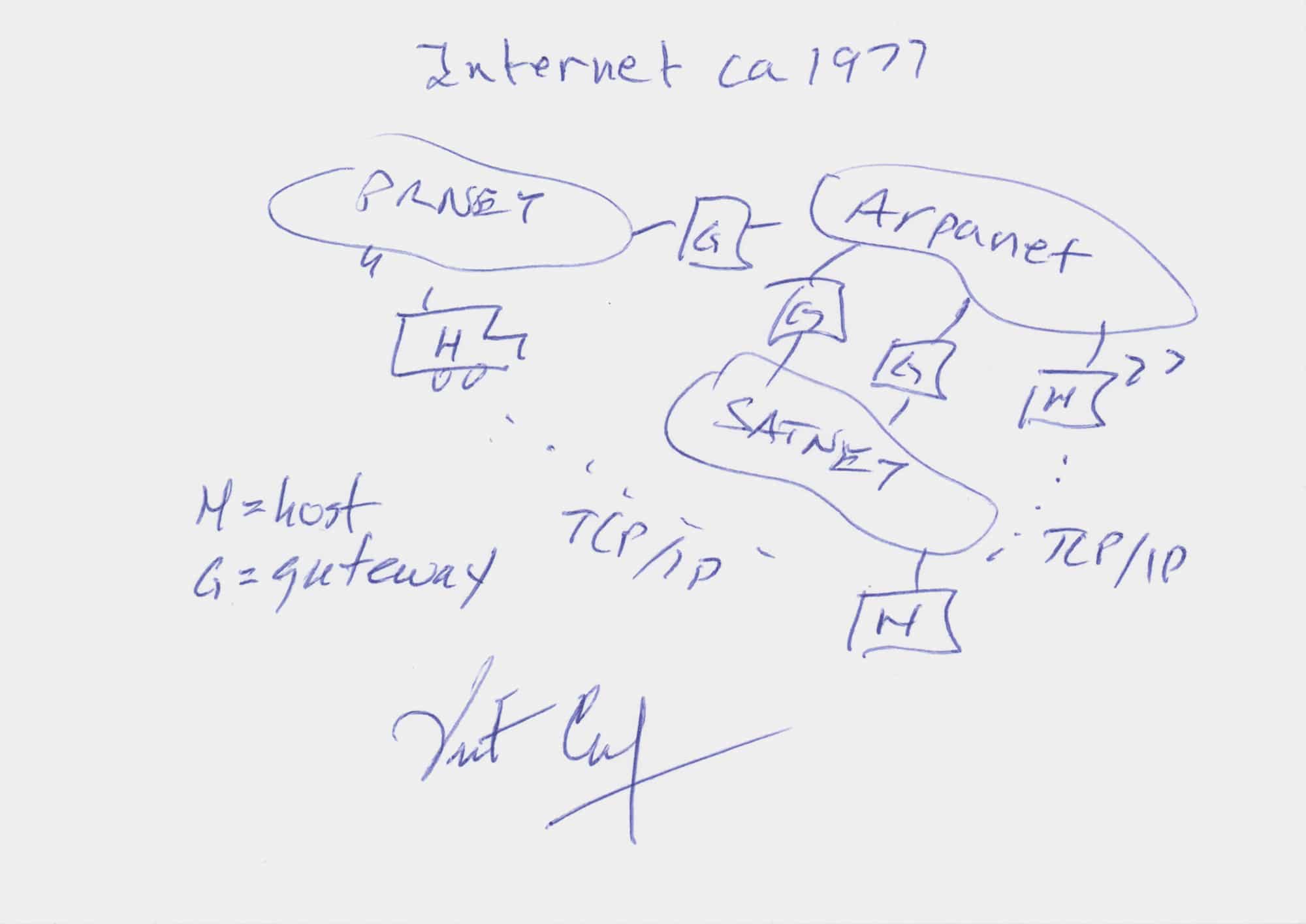
This is not the Internet. Cerf wrote “Internet ca 1977” at the top of the drawing without identifying it as a specific research internetwork. The drawing shows internetworking among three restricted research intranets, PRNET, ARPANET, and SATNET.
The 1977 test used SRI’s mobile terminal, a radio network built by several teams, BBN gateways, ARPANET landlines and switches, a multinational satellite network, and a host at USC’s Information Sciences Institute. The records assign separate credits for designing the protocol, writing the software, and putting those systems into service.
Preamble. This examination follows the marks on Cerf’s signed blue-ink Internet ca 1977 sketch to the design, equipment, and operating records. Cerf writes TCP/IP twice, both times outside the network clouds. The comparison is with SRI’s operating diagram, which traces the packets during the November 1977 demonstration. Cerf’s signed sketch. SRI operating diagram reproduced in Don Nielson’s account, printed page 5.
Opinion Rules. Historical credit follows the specific work established by a dated record. A signature attributes a drawing to its signer. Establish when the drawing was made from its provenance. Design papers establish proposals and specifications. Engineering and operating records identify equipment, implementations, and tests. The site’s standards for documented challenges apply. Governing Definitions and Controlling Facts, F40.
0.0 The disagreements
0.1 The dotted strokes are misleading if read as the packet route. Cerf places them outside the clouds, away from the gateway connections. SRI’s operating figure traces traffic across the networks and gateways from the SRI van to USC/ISI. The sketch’s legend identifies hosts and gateways and leaves the dotted strokes undefined. SRI operating diagram.
0.2 TCP did not design or build the networks that carried the packets or bring the publicly joinable Internet into existence. Engineers designed and built the facilities that carried the packets, and gateways relayed the packets between networks. The 1977 demonstration used three operating research intranets. Running TCP for that exchange did not supply the route, make the facilities carry packets, or enable public access to the networks. TCP, when used, can retransmit missing data at the endpoints. Cerf’s combined TCP/IP labels leave that distinction unclear. Both labels sit outside the clouds beside the dots. TCP describes a transport exchange between hosts. Where IP is used for forwarding, gateways relay packets hop by hop. Postel’s August 1977 memo distinguishes those jobs. Jon Postel, IEN 2.
0.3 The unqualified heading “Internet ca 1977” is false under D1 and misleading about what the drawing depicts. The heading uses Internet without saying that this was a specific research internetwork. PRNET, ARPANET, and SATNET were distinct restricted research networks, each an intranet under D2. Gateways carried traffic among them, the activity D3 calls internetworking. Under D1, Internet names the publicly joinable network of networks. SRI demonstration record. Governing Definitions and Controlling Facts, D1 through D3.
Corrected caption Internetworking ca 1977
Illogically drawn as a packet route, but still internetworking among the three research intranets.
0.4 Each research intranet has its own design, construction, and operating record. Cerf signed the sketch. The engineering and operating records identify the teams that designed, built, and operated the three networks and supplied the radios, circuits, switches, gateways, and host software. Sections 2.0 and 3.0 name the teams and the contributions those records document.
1.0 What Vint Cerf put on the page

| Mark on the sketch | What it represents | Credit established by the record |
|---|---|---|
| PRNET, ARPANET, SATNET | Three named packet networks that provide carriage within their own boundaries. | Each network has a separate equipment, operations, and construction record. See section 2.0. |
| Three G boxes | One gateway is drawn between PRNET and ARPANET. Two are drawn between ARPANET and SATNET. | Cerf and Robert Kahn described a gateway design in their May 1974 paper. BBN designed and implemented gateways for the named tests. See section 2.0. Cerf and Kahn, pp. 637 to 640. |
| Three H boxes | One host appears beside each cloud. The PRNET-side host is drawn on wheels. | The 1977 operating record identifies the SRI van’s client and the receiving host at USC/ISI. The sketch leaves the role of the H beneath SATNET unidentified for this test. SRI technology credits. |
| Two TCP/IP labels and dotted strokes | The labels and strokes are outside the clouds, one set on each side of SATNET. The legend gives no meaning or direction for the dots. | Use the operating figure to trace the packet path. Use the protocol record to assign the design, specification, and implementation credits behind the TCP/IP label. See sections 2.1 and 3.0. |
1.1 Why Vint Cerf’s Diagram Is Illogical

The dotted strokes are illogical as packet routes. Follow either stroke and it appears to take traffic from one host toward another outside the network clouds. That reading skips the hosts’ connections to their own networks and the gateways that forward packets between those networks. Cerf’s key defines H as host and G as gateway, but gives the dots no meaning. The two colored outlines identify the marks being questioned. Both include the H below SATNET. Cerf’s signed sketch.
The documented test follows a different path. On November 22, 1977, traffic from the SRI van went through PRNET, ARPANET, SATNET, and ARPANET again to the host at USC/ISI. The packets entered and left SATNET through gateways. The SRI trace shows SATNET carrying the traffic between those gateways and establishes no role for the separate H drawn below SATNET. SRI operating diagram.
A dotted line can indicate a logical relationship between hosts if the legend says so. In that reading, the line describes which hosts communicate. The access links, networks, and gateways still carry the packets along the actual route. TCP, when used, can retransmit missing data between endpoints over that route. The redraw below gives each host one connection to its serving network and uses arrows to trace the documented packet path. RFC 9293, TCP retransmission.
1.2 Proposed Representation

Each of the three hosts connects to its own serving network over one straight line labeled “end point connection without or with TCP enabled.” The same connection facility serves the host in either case. The inset identifies the two host pairings in Nichols’s reading of Cerf’s sketch. The solid arrows trace the November 22 exchange from the SRI van to USC/ISI. That test used TCP.
TCP and non-TCP traffic can share the same transit element at the same time. Neither has exclusive use of it. For example, one link can carry TCP segments and UDP datagrams from different flows concurrently. In IP traffic, the Protocol field identifies the next protocol for each datagram. Retransmission is a layer 4 choice at the endpoints. TCP can retransmit missing data. UDP provides no retransmission of its own, so any recovery using UDP is up to the application or a protocol above UDP. RFC 791, Protocol field. RFC 9293, TCP retransmission. RFC 768, UDP.
NCP was an earlier ARPANET host protocol. FTP and SMTP are application protocols that use an appropriate host transport. The 1973 FTP specification references ARPANET’s Host-Host Protocol, and the 1982 SMTP specification describes operation over TCP and NCP. Where supported, one endpoint transit facility can carry NCP, UDP, and TCP flows concurrently, along with FTP and SMTP application traffic over compatible host protocols. RFC 542, FTP. RFC 821, SMTP Appendices A and B.
A network’s rule applies to that network. RFC 801 set a January 1, 1983 deadline for ARPANET’s transition from NCP to IP/TCP. That requirement applied to the ARPANET hosts covered by the transition. It did not make TCP a universal requirement for internetworking. RFC 801, Discussion.
2.0 Who supplied the working pieces in 1977
| Element | Documented credit |
|---|---|
| Van, radio and client | SRI outfitted the mobile laboratory and built the terminal interface unit and client. Collins Radio Group built the packet radio. Jim Mathis began the LSI-11 TCP implementation at Stanford and completed it at SRI. The SRI team tested and tuned the implementation for the radio link. SRI technology credits. Don Nielson, pp. 4 and 5. |
| PRNET and station | ARPA organized the packet radio program. SRI credits BBN, Collins Radio, SRI and UCLA with PRNET design and implementation, and credits SRI with technical direction and integration. SRI’s engineering history identifies Donald Nielson and Ronald Kunzelman as project leaders. The station/gateway in the operating figure is distinct from the van and the radio repeaters. SRI technology credits. SRI engineering history, chapter 3. |
| ARPANET switches and operation | ARPA sponsored the network. Lawrence Roberts and Barry Wessler documented its resource-sharing development. BBN engineered the switching subnet and its Interface Message Processors, with switching-node hardware subcontracted to Honeywell. Frank Heart, Robert Kahn, Severo Ornstein, William Crowther and David Walden authored the 1970 IMP design paper. The Defense Communications Agency took responsibility in July 1975, and BBN continued as switching-subnet operations and maintenance contractor. Roberts and Wessler, 1970. Heart and colleagues, 1970. BBN Report 4799, April 1981, pp. II-10 and II-11. |
| ARPANET circuits and topology | The Defense Commercial Communications Office procured the leased circuits. AT&T supplied most of the 50 kb/s lines. Other carriers, including General Telephone, supplied some. Network Analysis Corporation advised on topology. This is the documented network-wide assignment. Individual circuit IDs and providers for the test path would require the corresponding service records. BBN Report 4799, pp. II-10 and II-11. |
| Working gateways | BBN designed and implemented the ARPANET connections to PRNET and SATNET. Nielson identifies Virginia Strazisar at BBN as the author of the bidirectional ARPANET gateway software installed at the SRI packet radio station for the 1976 trials. This is a named implementation credit for a specific interface. SRI’s account gives BBN the broader gateway credit for 1977. SRI technology credits. Nielson, printed page 5. |
| SATNET | DARPA began the packet satellite effort in 1973. SRI identifies Linkabit among the implementers. Cerf’s SATNET report names the British Post Office, COMSAT, Linkabit and BBN as cooperating organizations, later joined by the Norwegian Telecommunication Administration and the Norwegian Defense Research Establishment. The experiment used an INTELSAT IV satellite. Cerf credits Kahn with sustained support and technical contributions. University College London, COMSAT Laboratories and NDRE were major users. SRI technology credits. Cerf, RFC 829, November 1982, page 2. |
| Receiving host | SRI identifies the server as a Digital Equipment Corporation host running TENEX at USC’s Information Sciences Institute in Marina del Rey. DEC supplied the machine. USC/ISI hosted it. The record cited here identifies the endpoint without assigning authorship of its exact installed TCP build. SRI technology credits. SRI operating figure. |
2.1 Follow the documented path
On November 22, 1977, the van sent traffic through Bay Area packet radio, across a gateway into ARPANET, through the transatlantic satellite portion, and back onto ARPANET to reach USC/ISI. The route reached London along the way. R. C. Kunzelman, V. D. Cone, K. S. Klemba, J. E. Mathis, J. L. McClurg and D. L. Nielson documented the test in SRI’s February 1978 Progress Report on Packet Radio Experimental Network. Its operating figure marks the BBN gateway in Cambridge, Massachusetts, the University College London gateway, and the Etam and Goonhilly Downs earth stations. Its packet trace distinguishes the three physical networks from the four network legs of the route, which used ARPANET twice. SRI, November 22 account. February 1978 report figure, reproduced by Nielson.
Nielson’s text gives November 22, as does SRI’s account. The caption under the reproduced figure in Nielson’s article gives November 27. The date in this examination follows the narrative and SRI’s account. The packet path comes from the engineering figure.
3.0 Protocol design, specification, and implementation
3.1 The proposal and the specification. Vint Cerf and Robert Kahn authored the May 1974 proposal for process communication across packet networks, with gateways between those networks. Vint Cerf, Yogen Dalal and Carl Sunshine authored the detailed December 1974 specification for the combined Internet Transmission Control Program. RFC 675 expressly credits Ray Tomlinson’s contributions on the three-way handshake and initial sequence numbers. May 1974 paper. RFC 675, section 1.
3.2 The host software. Cerf’s Stanford project report assigns early implementations to Ray Tomlinson and William Plummer at BBN for TENEX/PDP-10 and ELF/PDP-11, to Richard Karp, Yogen Dalal and Cerf for ELF/PDP-11, to Jim Mathis for LSI-11, and to F. Deignan at University College London for PDP-9. These are implementation credits for named systems. Cerf, IEN 151, April 1, 1980, section 1.
3.3 Forwarding and the host conversation. On August 15, 1977, Jon Postel proposed separating hop-by-hop internetwork relaying from end-to-end host conversation control. The distinction identifies two jobs compressed into the later TCP/IP label. Gateways relay packets among networks. The communicating hosts maintain the transport exchange. The 1977 route records an experimental implementation, while RFC 791 and RFC 793 document the separate IP and TCP specifications published in September 1981. Postel, IEN 2. RFC 791. RFC 793.
3.4 Earlier design work. Louis Pouzin’s CYCLADES work and the French CIGALE subnet show an earlier division between packet carriage and endpoint recovery. Cerf and Kahn’s paper explicitly compares its window strategy with the CYCLADES transmission station protocol by J. F. Chambon, M. Elie, J. Le Bihan, Gérard Le Lann and Hubert Zimmermann. RFC 675 also cites Pouzin’s March 1974 interconnection proposal. These are specific prior design credits. The 1977 operating records in section 2.0 establish the test networks and their builders. Pouzin, CYCLADES architecture. Pouzin, CIGALE. Cerf and Kahn, page 643 and reference 8. RFC 675, reference 18.
4.0 The attribution
The 1977 test demonstrated that several teams could carry an exchange across three interconnected research intranets. TCP did not father or give birth to the Internet. Cerf and Kahn receive design credit for the protocol functions their paper specifies. Designing those functions did not make them the architects of the networks that carried the test traffic. The engineers and organizations named in the operating record receive credit for the network systems, radios, gateways and host programs they supplied. A further claim about who built or opened a publicly joinable commercial network requires its own construction, operating and admission records.
Every page on this site is governed by the Governing Definitions and Controlling Facts. The words intranet, internet and Internet are distinct in this record.