Global Streaming Infrastructure (2000)
Planetary Scale – 8,000 Web Servers for Dedicated Content Delivery Network (CDN)
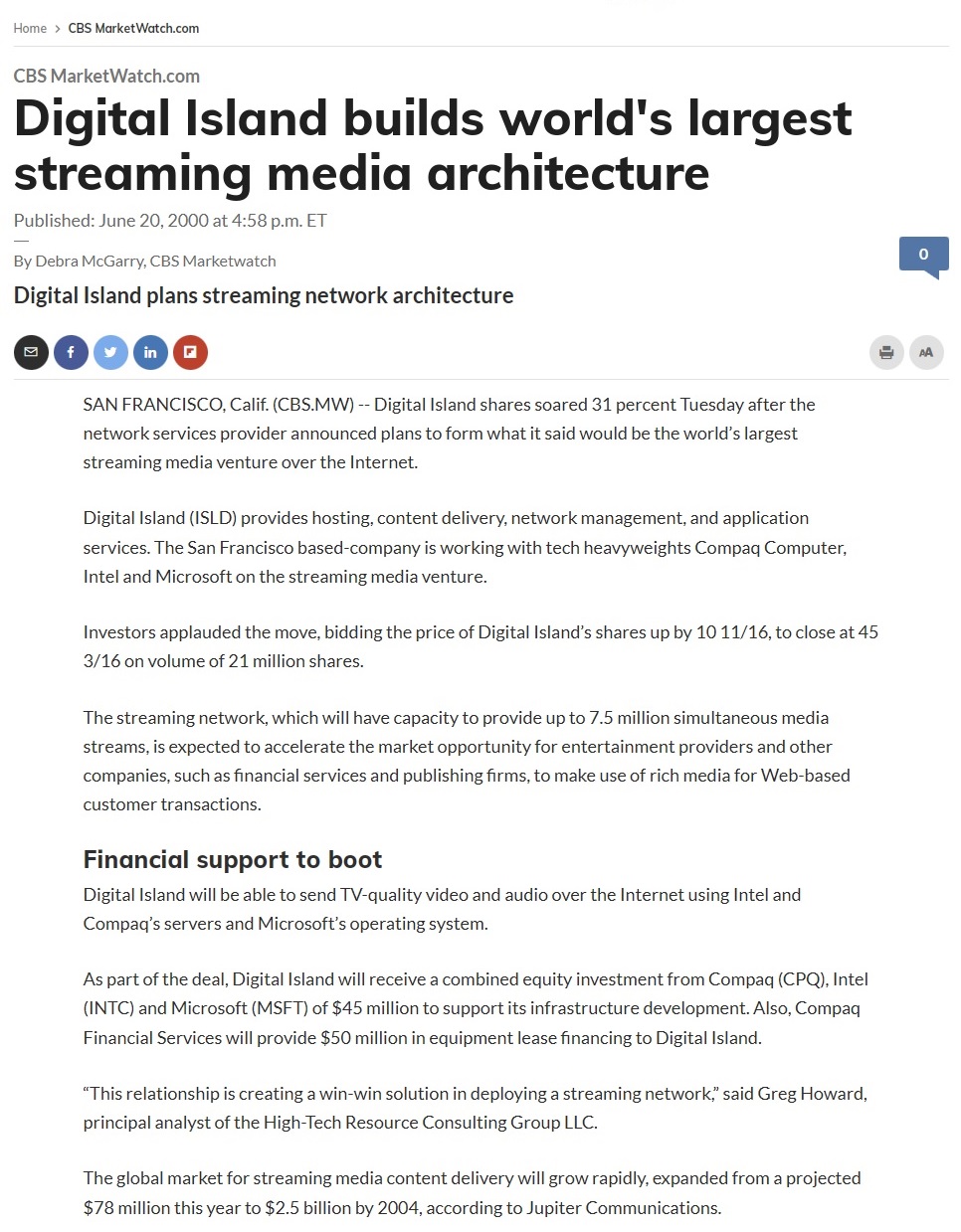
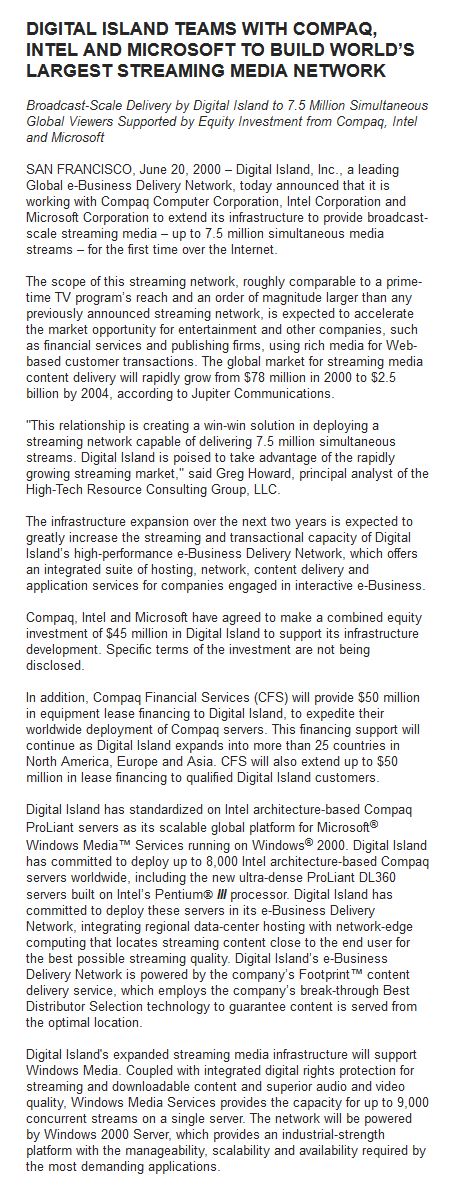
By 2000, Digital Island had already demonstrated that the Internet could function as a globally reliable commercial system through secure eCommerce. The next validation was more demanding: real-time, broadcast-scale media utilizing over 8,000 dedicated web servers for delivery to millions of users simultaneously, across continents, over the public Internet.
In partnership with Compaq, Intel, and Microsoft, Digital Island built what was then the world’s largest Internet-based CDN and streaming media network. The system was engineered to support up to 7.5 million simultaneous global viewers, a scale previously achievable only by terrestrial and satellite television networks.
This was not an experiment or pilot. It was a production deployment of broadcast-class Internet infrastructure.
What This Deployment Proved
This deployment validated several structural truths about the Internet at the turn of the millennium:
-
The Internet could deliver synchronized, real-time media at broadcast scale
-
Global low-latency performance could be sustained across continents
-
Commercial-grade reliability was achievable beyond transactional use cases
-
Internet infrastructure could replace legacy television distribution models
-
A single global platform could support commerce, media, and communication concurrently
In practical terms, it demonstrated that once the Internet was operational at global scale for commerce, it was also capable of supporting the most demanding forms of content delivery.
Why Streaming Matters in the Historical Arc
eCommerce was the proof mechanism for trust.
Streaming was the proof mechanism for capacity.
If money can move securely, the system is trusted.
If live media can reach millions simultaneously, the system is scalable.
This deployment confirmed that the Internet had crossed from a transactional network into a universal delivery platform for civilization-scale services.
Relationship to Earlier Phases
This work followed and depended on earlier milestones:
-
The globalization of Internet infrastructure in 1996
-
Early global customers such as Cisco and Stanford
-
Secure, low-latency international private line architecture
-
Operational integration of major networks across continents
Streaming did not create the global Internet.
It validated that the global Internet, once activated, could support everything built on top of it.
Historical Significance
This deployment marked one of the earliest moments when the Internet demonstrated parity with, and in some dimensions superiority to, legacy broadcast systems.
It reinforced a central conclusion:
Once the Internet became operational as a unified global system, every domain built upon it accelerated. Commerce, media, research, communication, and culture all followed.
This page exists to document that proof.
Primary Evidence
Digital Island Teams with Compaq, Intel, and Microsoft to Build World’s Largest Streaming Media Network
Press releases, June 20, 2000.