Digital Island Welcomes 3rd Customer, Visa International to Enable Global Credit Card Services (1997)
Summary
In the second quarter of 1997, Visa became Digital Island’s third enterprise customer. The objective was clear: make Visa’s online, credit-card related services work reliably across borders, so that a Visa card issued by a bank in one country could be supported in another country wherever Digital Island had infrastructure presence.
Anecdote: This effectively dealt a “death blow” to the American Express Traveler’s Cheque. By ensuring a digital credit handshake worked as reliably in Tokyo as it did in Toledo, Visa and Digital Island stripped the “guaranteed” paper voucher of its only remaining value: certainty. The moment cross-border latency was solved, the physical necessity of carrying pre-cleared paper for international travel vanished overnight.
This engagement predates MasterCard’s 1999 selection of Digital Island by more than a year, and it is an early indicator that global payment networks recognized a hard truth in the late 1990s: secure financial services could not be delivered consistently worldwide on “best effort” public Internet performance alone.
The problem Visa was solving in 1997
By 1997, Visa’s brand promise was inherently global. The operational reality on the public Internet was not.
Cross-border Internet paths were often unpredictable. Latency spiked, packet loss was common, and reliability varied by region and by upstream ISP. For consumer-facing and institution-facing credit card services, that inconsistency created business risk:
-
Slow or failed secure sessions in certain geographies
-
Unreliable performance for localized or region-specific services
-
Operational complexity when each region behaved differently
-
Brand risk when “global” services felt local-only
Visa needed a way to deliver consistent performance and availability internationally, with centralized operational control and regionally reliable delivery.
Why Digital Island was the fit
Digital Island’s value proposition was not “a faster website.” It was a coordinated global delivery and transport platform designed to behave predictably across borders.
For Visa, that meant:
-
Geographic presence: delivery points in multiple regions to serve users locally where possible
-
Consistency: standardized deployment and operations across countries, not one-off regional builds
-
Security and reliability: infrastructure built to sustain secure, consumer-facing financial workflows with repeatable performance
This is the practical distinction Visa was buying: a globally operated platform, not a collection of regional hosting arrangements.
What “global enablement” meant in practical terms
The Visa requirement can be stated simply:
A Visa card issued by a bank in Country A should be supported reliably in Country B, including through web-based services and customer workflows, wherever Digital Island had presence.
To make that real, the engagement centered on making Visa’s services behave consistently across regions through:
-
Regional delivery of services (so international users were not forced across fragile long-haul paths for every interaction)
-
Operational monitoring and standardized controls (so performance was measurable and enforceable, not anecdotal)
-
A platform model that could expand country-by-country without redesign (so “global” did not mean “custom in every market”)
Why this matters historically
Visa selecting Digital Island in Q2 1997 is a milestone because it shows when major financial networks began treating global Internet delivery as an infrastructure problem, not a content problem.
It also reinforces a broader point about the 1990s Internet transition:
Protocols and web standards enabled connectivity and publishing. They did not guarantee cross-border reliability, security session completion, or consistent user experience at worldwide scale. Visa’s decision reflects that reality.
Timeline positioning: Visa (1997) before MasterCard (1999)
Visa’s 1997 engagement predates MasterCard’s 1999 selection by more than a year. That sequencing matters because it places Visa among the earliest large-scale financial networks to formalize the need for coordinated global infrastructure delivery.
You can frame it plainly:
-
Q2 1997: Visa selects Digital Island to enable global credit card services across borders
-
March 1999: MasterCard selects Digital Island for global virtual server distribution and localized services
Related milestone for context (1999)
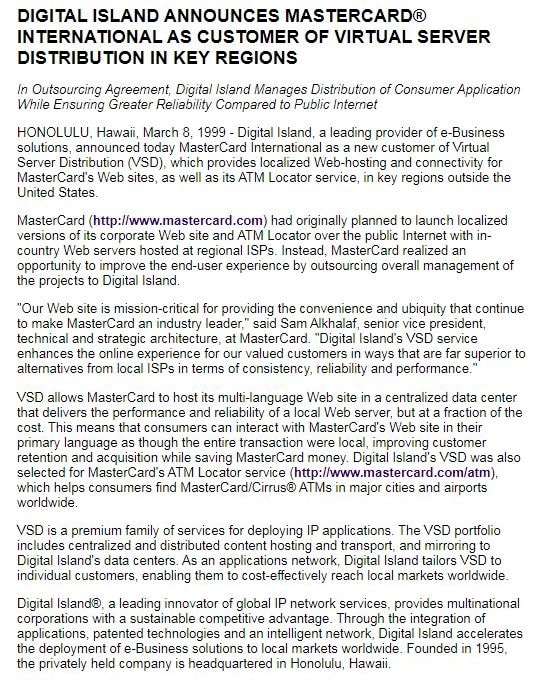
MasterCard International Selects Digital Island for Global Virtual Server Distribution (1999)
In March 1999, MasterCard International selected Digital Island as a global infrastructure partner to support localized web hosting, application delivery, and ATM locator services across key regions worldwide. The agreement positioned Digital Island as a trusted provider for mission-critical, consumer-facing financial services requiring consistent performance, reliability, and security beyond the public Internet.
At the time, MasterCard faced limitations deploying localized services through regional ISPs due to inconsistent performance and lack of global coordination. By outsourcing virtual server distribution and transport to Digital Island’s global network, MasterCard enabled reliable, language-specific, and regionally optimized services while maintaining centralized operational control.
This deployment marked a concrete milestone in the globalization of eCommerce, demonstrating that financial networks of record required infrastructure capable of delivering secure, predictable, and globally consistent performance at scale.