Ron Higgins & his Hawaii Ruse: A Technically Impossible Narrative Repeated for Four Years
I publish this section for a single reason: to document a clear example of purposeful leadership misrepresentation, sustained over time, that was dishonest and thematic of character towards investors, customers, employees, media, and industry.
In May 1996, Ron Higgins introduced a business concept initially branded Smartvision. A central claim in that pitch was that Hawaii was a natural global Internet hub because subsea fiber “surfaced” there and provided direct, lower-latency access to Asia.
Within two weeks of hearing that claim, while I was still employed at Sprint, I asked Sprint engineering to verify the actual topology. Their answer was unambiguous: traffic originating in Hawaii routes east to the U.S. mainland and only then west across the Pacific on dedicated systems. There is no operational topology in which Hawaii serves as a westbound aggregation point to Asia.
In telecommunications, this is called “tromboning.” Hawaii telecom is a spur, not a gateway. It has never functioned as a general transpacific aggregation point for carrier backhaul into Asia.
The Malfeasance
This topology never existed, and I advised the team of these facts in June of 1996. Even after the topology issue was shared and known in June 1996, Ron and others continued to represent Hawaii as the Asia-direct hub, including language describing. These comments were known by those who represented them to be totally untrue
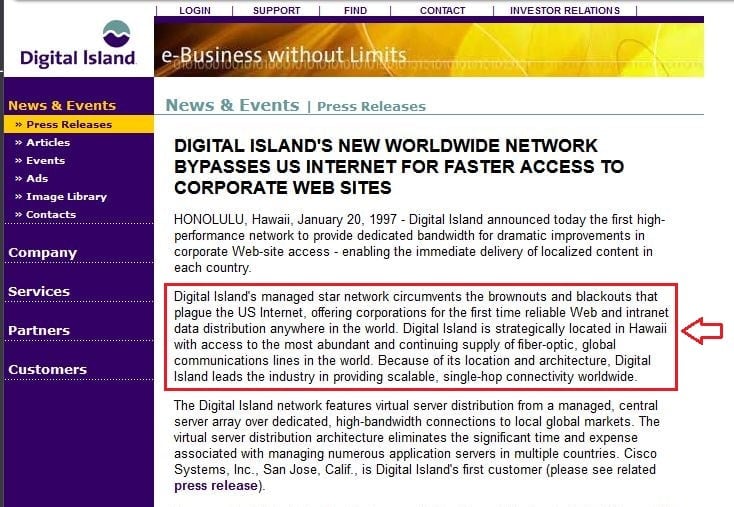
- “Hawaii provides access to the most abundant and continuing supply of fiber-optic, global communication lines in the world.”
- “Hawaii being the last landing point for the primary fiber optic communications line connecting North America and Asia prior to entering the continental US communications infrastructure.”
- “Hawaii is a logical location for a trans-global hosting server array.”
- “From Hawaii, Digital Island leads the world in single-hop connnectivity worldwide.”
- “From Hawaii, all continents of the world can be configured as clients, including North America.”
The following figure and logos, illustrated by Ron, first used in the business plan in Q3 1996, and in other marketing and investor materials mistakenly represent that Hawaii has access to the utility of the cable systems that service the PacRim independently from the mainland. Note that this misleading diagram is the basis for the company logo.
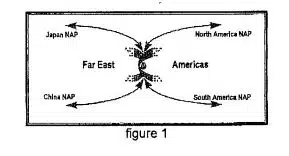


Exhibit Alignment
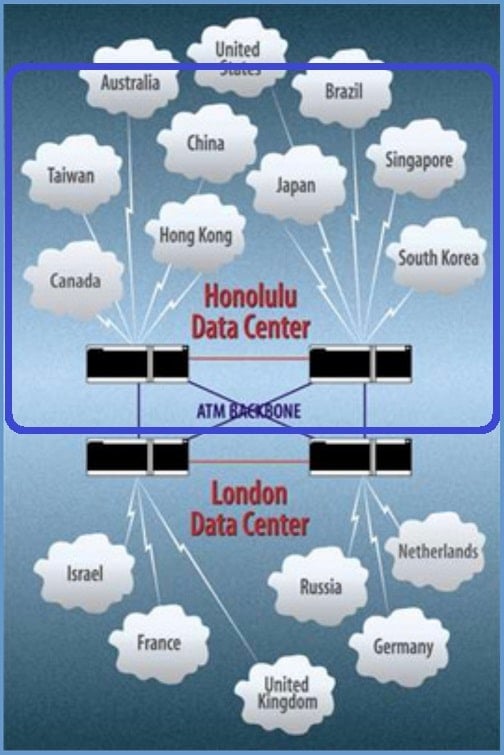
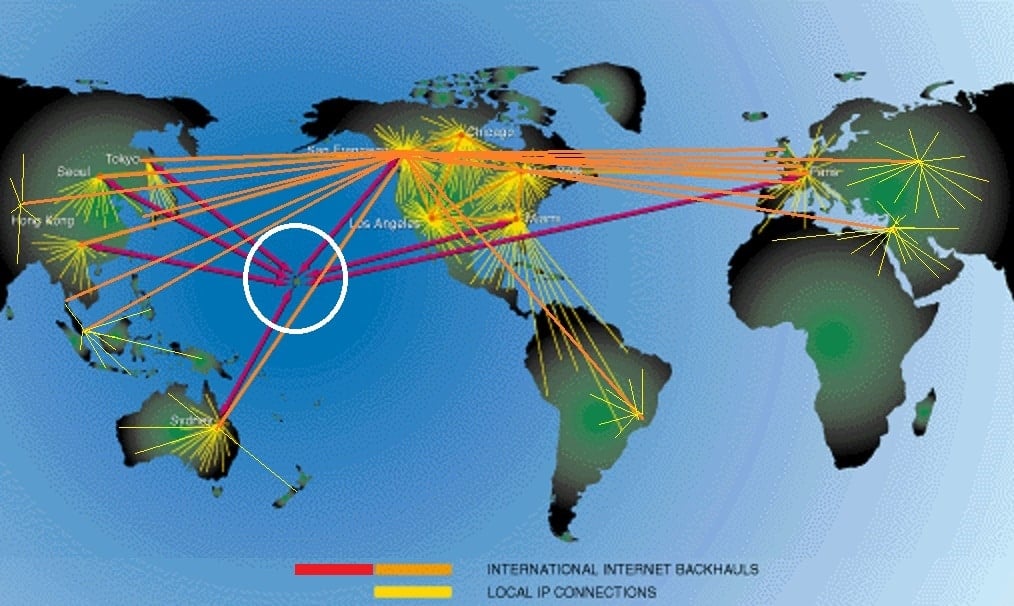
See images below from 1999. These diagrams depict Hawaii as a bidirectional aggregation point with westward connectivity to Asia. No such network elements ever existed as those Asia links were connected directly to California.

The Misrepresentation that Continued
Ron used these claims to assign technological and financial value to the Hawaii story in press releases.
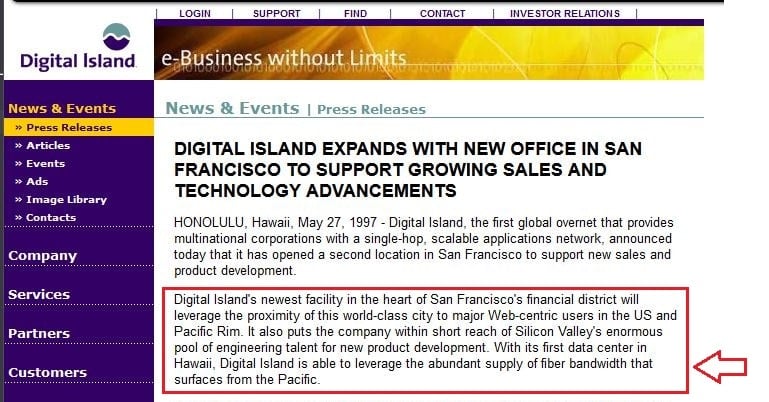
What Ron Higgins (CEO), Allen Leinwand (CTO, VP of Engineering, and Board Member), Sanne Higgins (Dir/VP of Communications), Knew and When
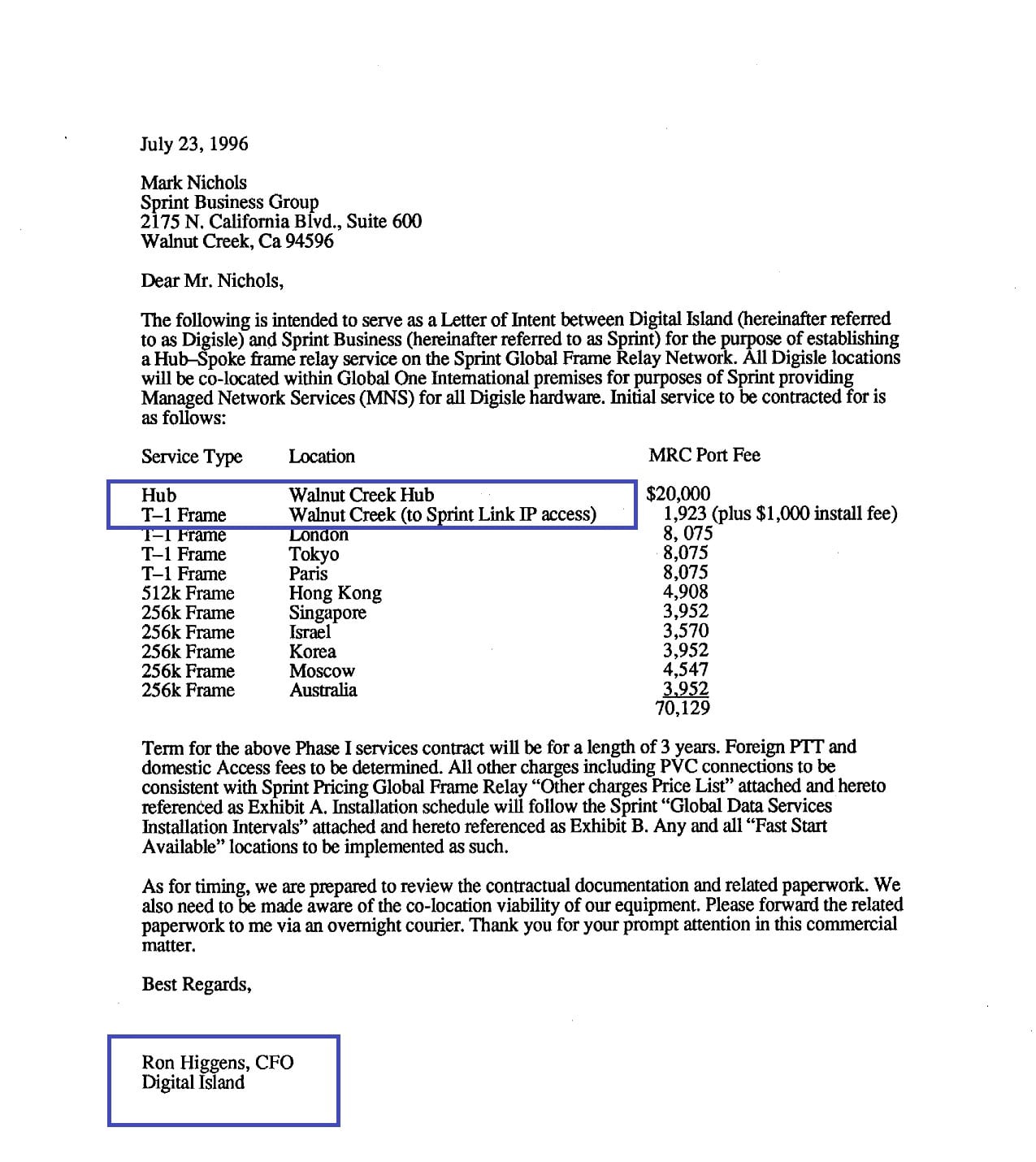
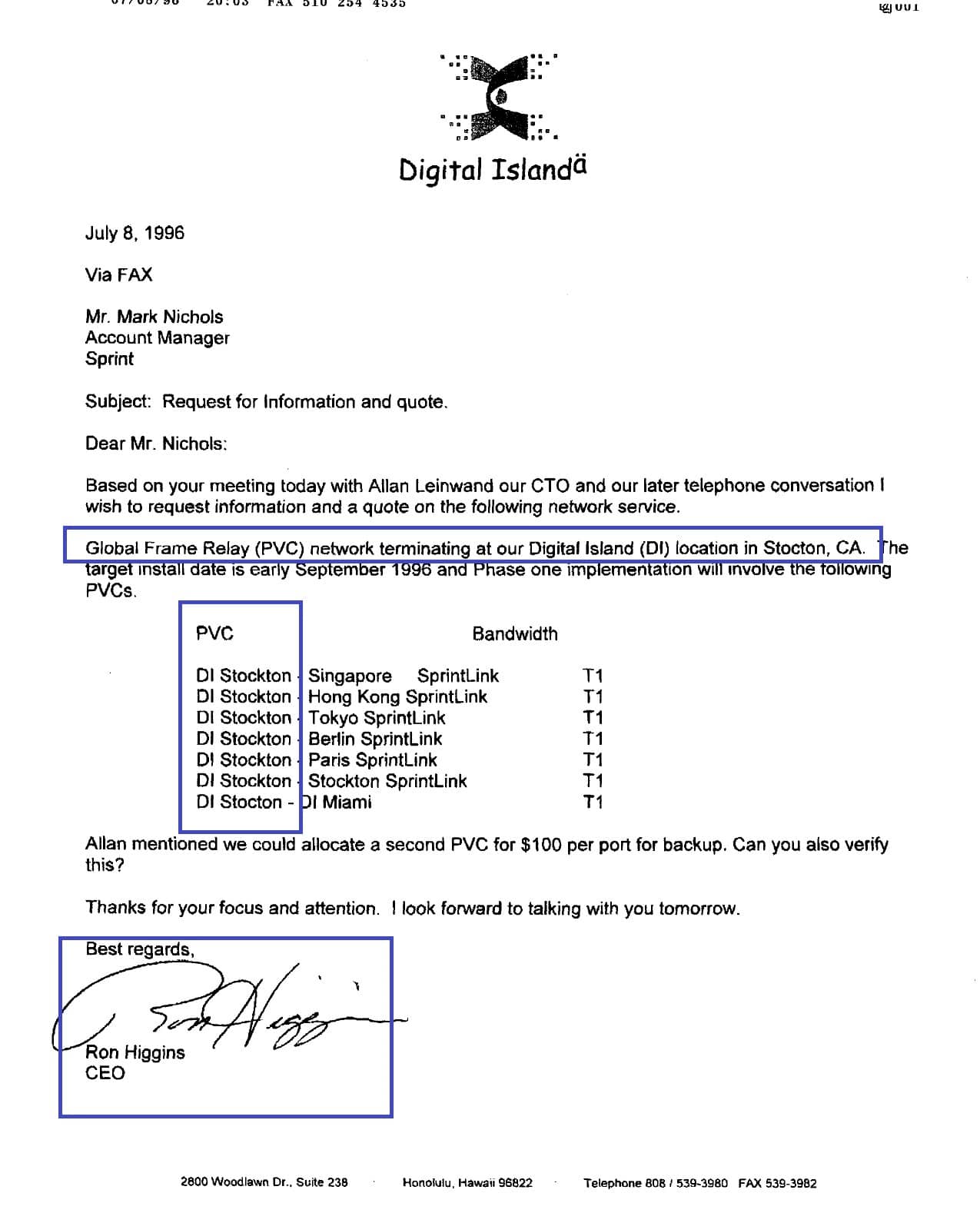
Documents from the period of July 1996, show that my recommendation to hub in California, specifically Walnut Creek and Stockton, and to stay close to Tier 1 switching premises and actual carrier demarcations. Those same documents also show Ron presenting himself as both CEO and CFO, and Allan Leinwand being represented as the acting CTO at the time, even though the S-1 indicates Allan joined later, in February 1997.
Regardless, Ron ordered our Phase-1 global network with the hub in Hawaii from WorldCom and without my involvement. When the network was delivered and failed, exactly as I warned months earlier, I then re-ordered the entire network replacement to be rebuilt in California at the Stanford University Data Center in Palo Alto. The persons mentioned above were all in Hawaii, and are responsible for the confirmation that all Asia-centric services were homed to California prior to “tromboning” to Hawaii.
This mattered because we already had the Cisco hosting contract in hand. This red herring detour cost roughly four months of delivery time, network deployment, and delayed the revenue needed to support that contract and venture capital already funded. In addition, the WorldCom network commitment was a three-year term, and using Hawaii as an “off-site” backup data center was senseless because I was also acquiring data centers in London and New York that we could have used instead. The Hawaii facility was a red herring that Ron wasted resources of money, time, engineering, and company reputation.
Ther irony is Ron’s logo that he created on the letterhead is defianct of the nework he is asking to buy in the document which is hubbed in California.
Finally, an image used in 1999 is entirely untrue in depicting the Honolulu data center as having an ATM backbone to routes other than those demarcated through our California facilities. I know this because I ordered the origin and destination of every circuit in our network.